Trbusiness. The travel retail Trbusiness. The magazine for global retail and duty free professionals.
Value still matters but wider factors sway shoppers
By Tina Milton |
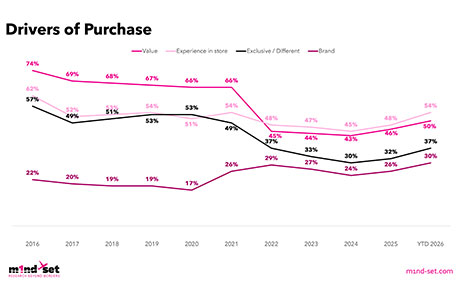
Ten years ago value was by far the main reason people bought in duty free. Today it still matters, but it is no longer as important, according to m1nd-set research. (See below for a close up of this chart).
The relative importance of what travelling shoppers consider to be “pure value” has declined markedly over the past decade, according to research by m1nd-set.
In 2016, 74% of global travel retail shoppers identified value as a purchase driver; this fell to 50% in H1 2026, shows data revealed in the second instalment of the travel retail research agency’s 10-year analysis of global duty-free shopper behaviour*.
“Ten years ago value was by far the main reason people bought in duty-free. Today it still matters, but it is no longer as important,” said Dr Peter Mohn, CEO & Owner at m1nd-set.
“Shoppers are influenced by a much wider set of factors, such as the quality of the store environment, the strength of the brands on offer, the ability to check prices, and the advice of sales staff.
“Stakeholders must no longer treat value as the only lever.”
As well as tracking the shifting weight of value, this wave of the research – which focuses on what happens once passengers reach the shop floor – also zooms in on the in-store experience, brand, exclusives, promotions, price comparison, digital marketing and the influence of sales staff.
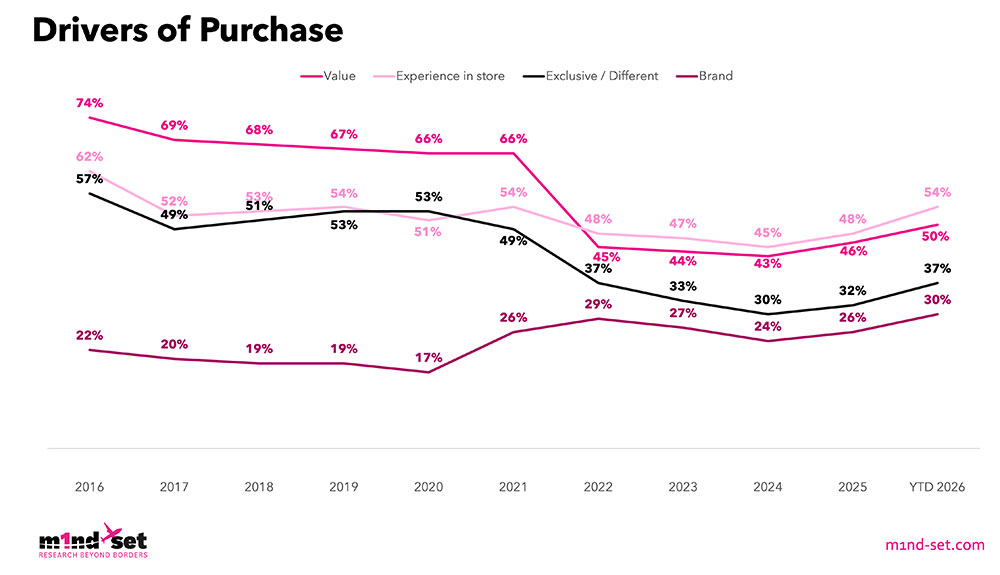
The insights show that in-store experience, a purchase driver for 62% of global shoppers in 2016, experienced a decline around the global pandemic period, before recovering to 54% in 2026. The availability of premium brands as a purchase driver rose from 22% to 30% over the same period.
Promotional purchasing has also eased, according to the data. Initially recorded at 54% in 2016, promotional purchasing increased to 68% in 2022 during the post-pandemic recovery.
However, the share of shoppers buying on promotion has since declined to 47% in the first half of 2026.
Price comparison, on the other hand, has increased over the last 10 years, climbing from 60% in 2016 to 65% in 2026 after sharp swings during and after the pandemic years.
Awareness of digital and in-terminal marketing touchpoints followed a turbulent path, according to m1nd-set, falling to 14% in 2020 before rising sharply and then settling at 31% in the first half of 2026.
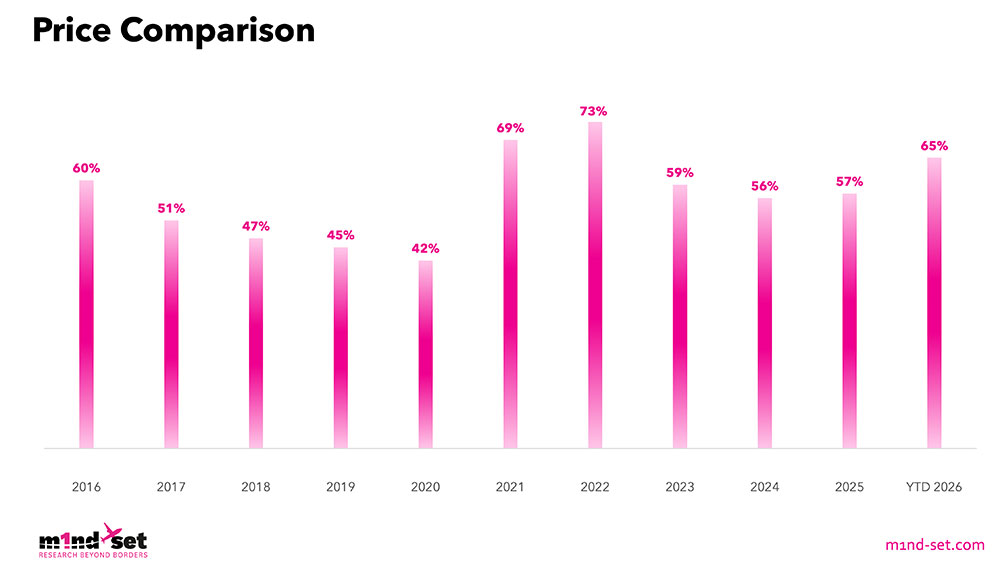
Price comparison has increased over the last ten years, climbing from 60% in 2016 to 65% in 2026 after sharp swings during and after the pandemic years.
Staff interaction rates remain close to their 2016 level of 57%, stabilising at 56% in H1 2026.
The influence of those engagements, however, has strengthened. Three-quarters of shoppers who interacted with sales staff in 2026 said the staff had positively impacted their final purchase decision, up from 63% a decade earlier.
“The gaps that characterised shopper behaviour in 2016 have closed considerably,” said Mohn. “Whichever world region a traveller is from, their expectations on the shop floor are now much more consistent.
“This means that marketing, merchandising and staff training can no longer assume large regional differences in the weight given to value, experience or brand. The same core elements matter across the board, even if local nuances remain.”
Regional differences in both interaction and influence have likewise narrowed, leaving only modest variations between markets.
Staff interaction rates were consistently higher among travellers from Asia Pacific and the Middle East & Africa in the years leading up to the pandemic.
Shoppers from the Americas generally interacted less often, apart from a brief peak during the 2021–2022 Covid recovery period.
European travellers tended to engage the least frequently.By the first half of 2026 these regional differences had narrowed considerably, with interaction rates converging in the low-mid-fifties across all regions.
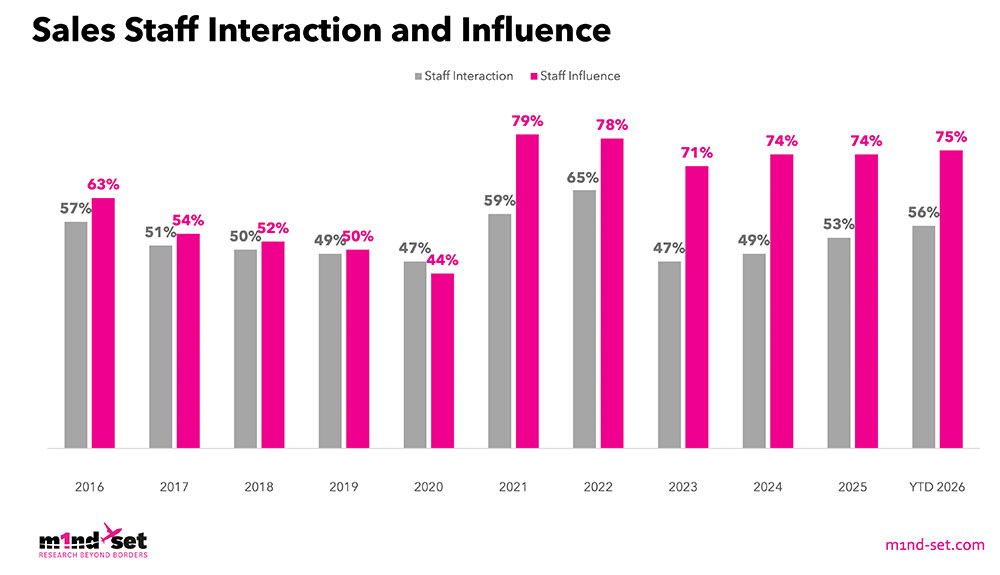
Staff interaction rates remain close to their 2016 level of 57%, stabilising at 56% in H1 2026.
Staff influence over the past decade, has been quite consistent across all world regions apart from minor variations. Regional differences have since narrowed, however,and the impact of staff interactions has now converged to around 75% across all regions.
“A helpful, well-informed assistant still makes a measurable difference,” explained Mohn. “Even as price comparison becomes commonplace and digital messaging reaches more travellers, engagement with sales staff is more effective than it was a decade ago. Investing in staff knowledge and relevance is not a soft option; the insights show that sales teams directly impact conversion.”
According to m1nd-set, the insights imply that global shoppers are influenced by several factors rather than one or two dominant ones, and that their behaviour is more uniform across regions than at any point in the past 10 years.
“The challenge for the industry,” said Mohn, “is to ensure that shoppers understand the value of the duty-free offer, they discover an in-store experience that is truly engaging, and they find brands they recognise and trust.
“It’s equally important that digital touch points are visible to travellers before and during their journey, and that staff are able to guide shoppers in their purchase decision. Stakeholders also need to reassess how they segment their consumer groups.
“Shopper behaviour previously differed quite broadly across world regions but is now much more aligned in several key areas.
“Marketing, store layout and training programmes need to reflect this reality while allowing for differences between individual shoppers and markets,” he concluded.
*Based on a decade of shopper insights from m1nd-set’s Business Intelligence Service (BIS) between 2016 and the first half of 2026.
READ NEXT: m1nd-set to deliver data-rich keynote at TR Wellbeing Week – register today!
READ NEXT: m1nd-set reveals decade-long shift in duty free shopping behaviour
READ NEXT: m1nd-set research highlights generational differences in travel retail
Suntory Whisky Toki debuts first global TRX collection with Streets of Toki
Suntory Whisky Toki has unveiled its first global travel-retail exclusive collection, Streets...

IAM and Scentopia expand fragrance activations in Africa
Image Credit: IAM Inter-African Marketing (IAM) and its luxury beauty retail arm Scentopia are...

Vandermarliere Cigar Family nurtures networking at Riviera Sunset party
Image Credit: Vandermarliere Cigar Family Vandermarliere Cigar Family held its annual Riviera...
-
 Data and Analysis,
Suntory Whisky Toki debuts first global TRX collection with Streets of Toki
-
Data and Analysis,
IAM and Scentopia expand fragrance activations in Africa
-
Data and Analysis,
Vandermarliere Cigar Family nurtures networking at Riviera Sunset party

In the Magazine
TRBusiness Magazine is free to access. Read the latest issue now.