 Trbusiness. The travel retail Trbusiness. The magazine for global retail and duty free professionals.
TFWA: AI and frictionless travel reshape the battle for passenger attention
By Naomi Chadderton |
#attachment_caption
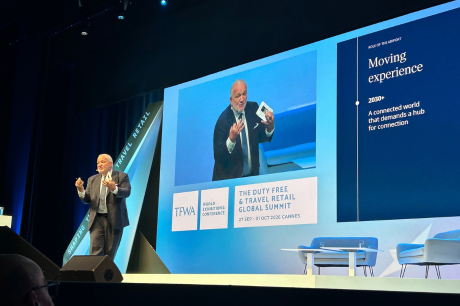
Airports must remove friction from the passenger journey and rethink how they compete for travellers’ attention as artificial intelligence, biometrics and changing consumer behaviour transform the travel experience, according to Oliver Wyman Managing Partner and Head of Industries Gilles Roucolle.
Speaking at the TFWA World Conference in Cannes this morning (28 September), Roucolle opened his presentation with a question for the travel retail industry: “Who do you think is owning [travellers’] attention? Is it the airline, the airport authority, their iPhone or their AI assistant?”
“The answer to this question is changing rapidly,” he added, pointing to the unique position airports occupy at the intersection of mobility, infrastructure, technology, commerce and human experience.
Roucolle described airports as the “global connectors of the new age” and “true facilitators of the global economy”, but noted that the industry itself remains relatively young. Commercial aviation was still in its infancy a century ago, with airports largely focused on aircraft, take-off, landing and refuelling.
The establishment of IATA in 1945 and the development of scheduled airline services helped accelerate the sector’s evolution, while the first airport duty free shop followed in Ireland in 1947. Deregulation later made air travel accessible to a much wider audience, bringing millions more passengers into airports and helping duty free become a standard part of the terminal experience.
Looking ahead, however, Roucolle said the next generation of travel will not be defined simply by “faster planes and larger airports”.
“It’s really about creating a mobility ecosystem that is seamless and connects people, places, brands and products,” he said.
Airports remain under financial pressure
Despite passenger traffic recovering following the pandemic, Roucolle warned that airport finances remain fragile. While the difficulties experienced by airlines during Covid-19 have been widely documented, he argued that less attention has been paid to the challenges facing airports, which were forced to dramatically reduce their workforces during the crisis. Many employees subsequently left the sector, making it difficult for airport operators to rebuild staffing levels as passengers returned.
Non-aeronautical revenues also remain 15% below 2019 levels, according to figures presented by Roucolle, creating both a challenge and an opportunity for the travel retail industry.
“There is a huge opportunity to grow,” he said, adding that airport authorities could therefore be expected to remain receptive to investment in commerce within their facilities.
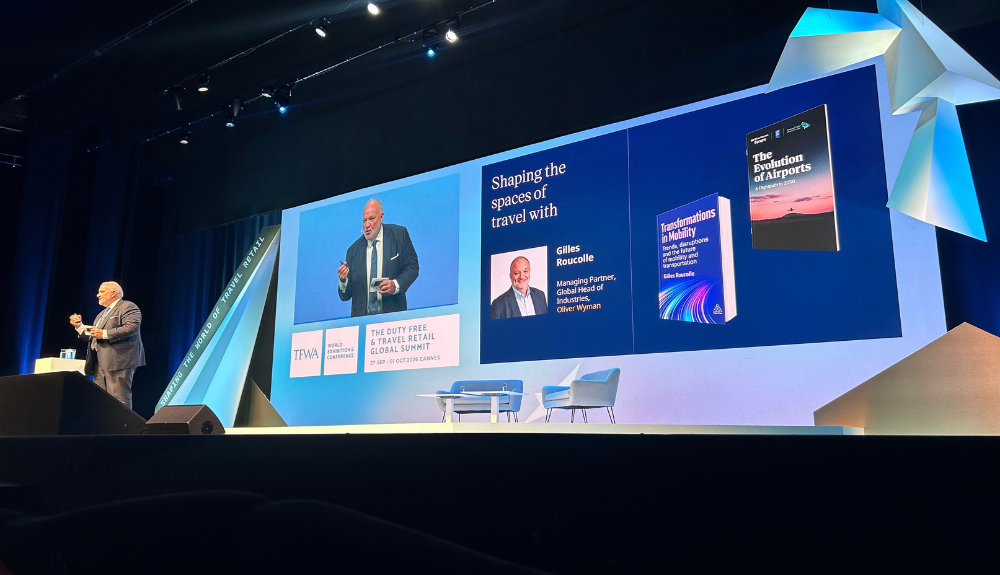
Roucoulle is also author of Transformations in Mobility and The Evolution of Airports.
Roucolle was nevertheless optimistic about aviation’s ability to withstand current geopolitical and economic uncertainty. Drawing on previous shocks including the Gulf War, 9/11, the 2008 financial crisis and Covid-19, he said history demonstrates that travel demand ultimately returns following periods of disruption.
He also addressed predictions that the growth of ultra-long-range narrow-body aircraft could undermine the traditional hub model by enabling airlines to connect secondary cities directly. Services using this aircraft class have increased by 75% since 2019, he said, but Oliver Wyman has so far seen no material impact on hubs.
“Hubs are here to stay,” he said, pointing to significant airport investment currently underway around the world.
AI moves to the front of the shopping journey
Changing consumer behaviour presents another major challenge for airports and travel retailers. Citing Oliver Wyman research based on 300,000 consumer interviews, Roucolle said 62% of consumers now say they will use AI for product recommendations. Younger generations are even more inclined to begin their purchasing journey with the technology.
“So what happens with AI, and how do we rebuild the duty free shopping experience with AI at the front?” he asked.
Three developments will be particularly important in reshaping airports, according to Roucolle: greater intermodal connectivity, technological innovation and e-commerce.
On technology, he highlighted the potential for facial recognition and digital identity to dramatically reduce the time passengers spend navigating airport processes. Oliver Wyman’s experience suggests the technology can cut waiting times at security checkpoints by 60% and boarding times by 30%, freeing up considerably more time for travellers to spend within terminals.
Airports are also increasingly investing in digital marketplaces and more personalised relationships with passengers. Roucolle cited Toronto Pearson and New York JFK among those developing digital marketplaces, while Heathrow has deployed thousands of beacons to promote products and services according to travellers’ locations.
He illustrated how these developments could come together through a hypothetical traveller a decade from now. Rather than arriving early because of uncertainty around queues and processes, the passenger could use an AI assistant to research products available at the airport before travelling, make purchases online, send checked luggage ahead and check in from home. Facial recognition and digital identity could then allow the traveller to move through smart gates with minimal interruption, collect pre-ordered duty free purchases at an arranged point and receive a notification from their airline when it is time to head to the gate.
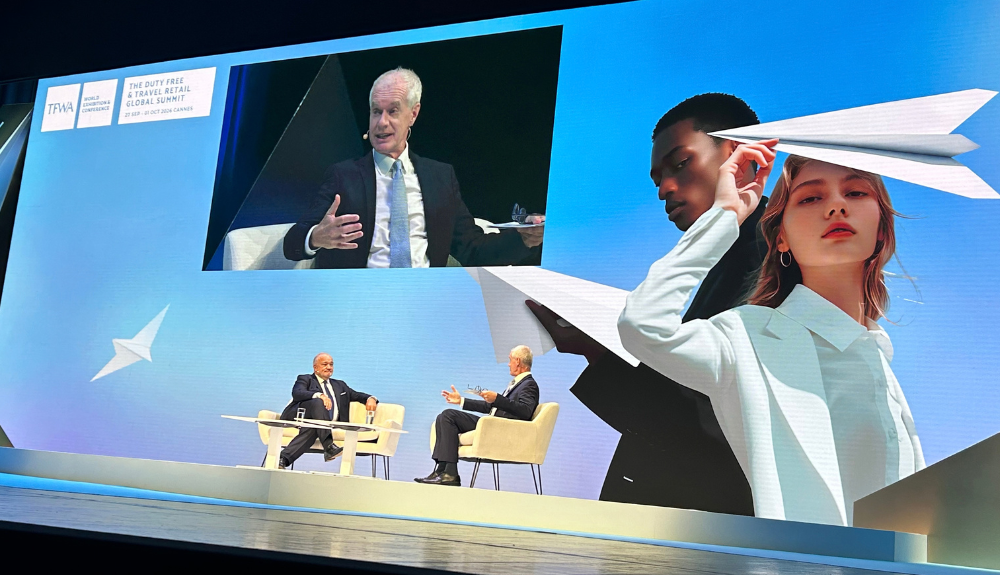
Roucoulle answered questions from both conference moderator Stephen Sackur and the audience.
‘More attention and less stress’
In a discussion following the presentation, conference moderator Stephen Sackur questioned whether removing friction could have an unintended consequence for travel retail by encouraging passengers to arrive later and reducing valuable dwell time. Roucolle rejected the suggestion, arguing that a more efficient journey could instead improve the quality of the time passengers spend in the terminal.
“By removing friction, you not only give time, but you give more attention and less stress to the people,” he said, adding that this could give travellers greater freedom to choose to dwell at the airport. Capturing attention before passengers reach the terminal will, however, become increasingly important as product discovery moves online and towards AI.
Asked by Sackur to assess airports’ current performance, Roucolle acknowledged that “the average is not great”, although he said best practice is evolving quickly. He highlighted Dubai and Singapore as examples of airports leading the way, while Heathrow is “catching up” in some terminals. For major hubs, investing in this transformation is becoming a necessity rather than an option, he argued.
“I think the big hubs have to, because it’s a great opportunity, and I think it’s a financial obligation,” Roucolle said. Legacy infrastructure remains a significant barrier, but new terminal developments provide airports with an opportunity to build innovation into their plans from the outset rather than attempting to retrofit existing facilities.
Despite the considerable geopolitical, economic and technological challenges facing aviation, Roucolle ended on an optimistic note.
“I feel challenged in the short term, confident in the long term,” he concluded. “This industry always survives the biggest headwinds.” Ultimately, he said, the fundamental driver behind aviation remains unchanged: “Human beings need to travel and need to move.”
READ MORE: TFWA: Turning travel growth into sustainable growth for travel retail
READ MORE: Furla maps out travel retail expansion at TFWA Cannes
READ MORE: Registration open for APTRA India Conference with royal City Palace event

Elizabeth Hurley on the power of ELC's Breast Cancer Campaign
Image Credit: The Estée Lauder Companies To mark Breast Cancer Awareness Month in October,...
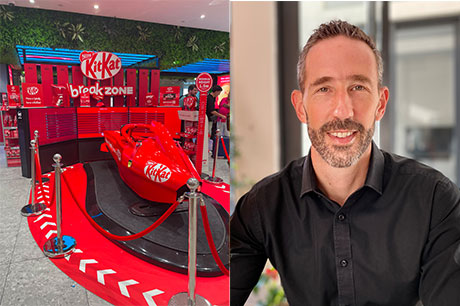
NITR's KitKat and Formula 1 experience races to Madrid with Avolta
Image Credit: Nestlé ITR Nestlé International Travel Retail (NITR) and Avolta have...

Furla maps out travel retail expansion at TFWA Cannes
Image Credit: Furla Furla will return to TFWA World Exhibition & Conference for a second...
-

-
-
International,
Furla maps out travel retail expansion at TFWA Cannes

In the Magazine
TRBusiness Magazine is free to access. Read the latest issue now.