Archives

President Xi stands behind ‘Korean embargo’ at G20

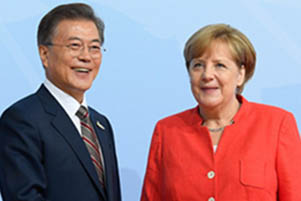
Angela Merkel and South Korean Preident Moon jae at last week's G20 meeting in Hamburg

Chancellor of Germany Angela Merkel welcomes South Korean President Moon Jae-in at last week’s G20 meeting in Hamburg.

South Korean President Moon Jae-in would appear to have much more work to do to convince Chinese President Xi Jinping that he should relax – or even halt – the country’s stringent economic retaliatory measures imposed on South Korea – based on their meeting at last week’s G20 Summit.


Both presidents met on the summit sidelines last week in discussions that were reported to have been both cordial and positive in terms of keeping the door open for more talks. However, significant concessions are still needed from both leaders if the Chinese administration is to consider relaxing, or even dropping existing economic sanctions against South Korea.


This follows the well documented and severely damaging toll on South Korea’s economy, including the total ban on organised Chinese tour groups visiting South Korea, which has battered the country’s economy and severely damaged its duty free and domestic retail industries.


CRISIS IS GROWING MORE SERIOUS…

Multiple other South Korean companies have also suffered losses totalling billions of dollars, both in and outside China – including South Korea’s retail and car industries.
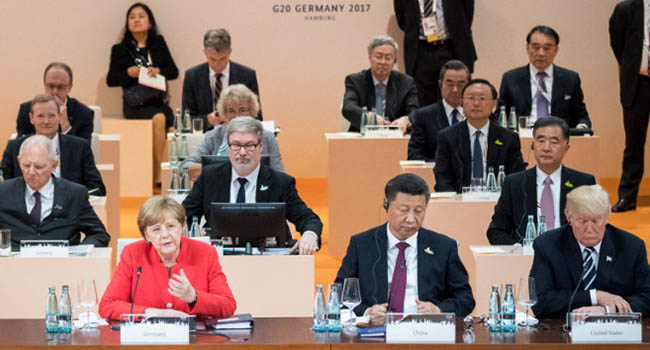
 

Last weeks G20 summit July 2017

Chancellor of Germany Angela Merkel, Chinese President Xi Jinping and US President Trump at last week’s G20 Summit in Hamburg where South Korean President Moon Jae-in (not pictured here) held an informal sidelines meeting with President Xi Jinping to discuss the major issues between the two nations.

Highlighting the severity of the crisis to South Korea and its duty free industry just a few weeks ago, Lotte Duty Free CEO Jang Seon-wook pulled no punches when he referred to the impact of the market downturn on the retailer. He said: “The decline in sales is a shock that has been unprecedented since the founding of Lotte Duty Free in 2003, except for the SARS crisis.”


As is well documented, the Chinese authorities remain literally unmoved by Moon’s underlying appeal to President Xi to intervene in this impasse, following China’s stated objection to Seoul’s US-supplied THAAD missile defence system, which it claims has the added capability of spying on its own military defences within the Chinese mainland.


The fall out from this long-running dispute continues to be very damaging to the South Korean economy, which has relied upon a huge injection of revenue in recent years from high-spending Chinese tourist visitors.


SOUTH KOREA’S FOREIGN EXCHANGE REVENUES ARE DOWN

The detrimental impact on the duty free business alone has hurt all of the larger duty free companies, including Lotte Duty Free, Shilla Duty Free and several medium-to-small retailers, not to mention the country’s airports and airlines.


President Moon’s negotiating position has also clearly been made all the more difficult by North Korea’s recent escalating missile testing. This has also clearly raised tensions with South Korea’s neighbour to such a degree that any attempt by Moon to dismantle the so-called THAAD deterrent would doubtless be regarded at home as very unpopular, while also regarded by many as a real sign of weakness.


At the same time, there are also great expectations that the relatively new president can deliver a lot more on both the domestic and international stages than his predecessor (Park Geun-hye) ever did during her term of office.

 

US removes laptop ban on more Midddle East airlines

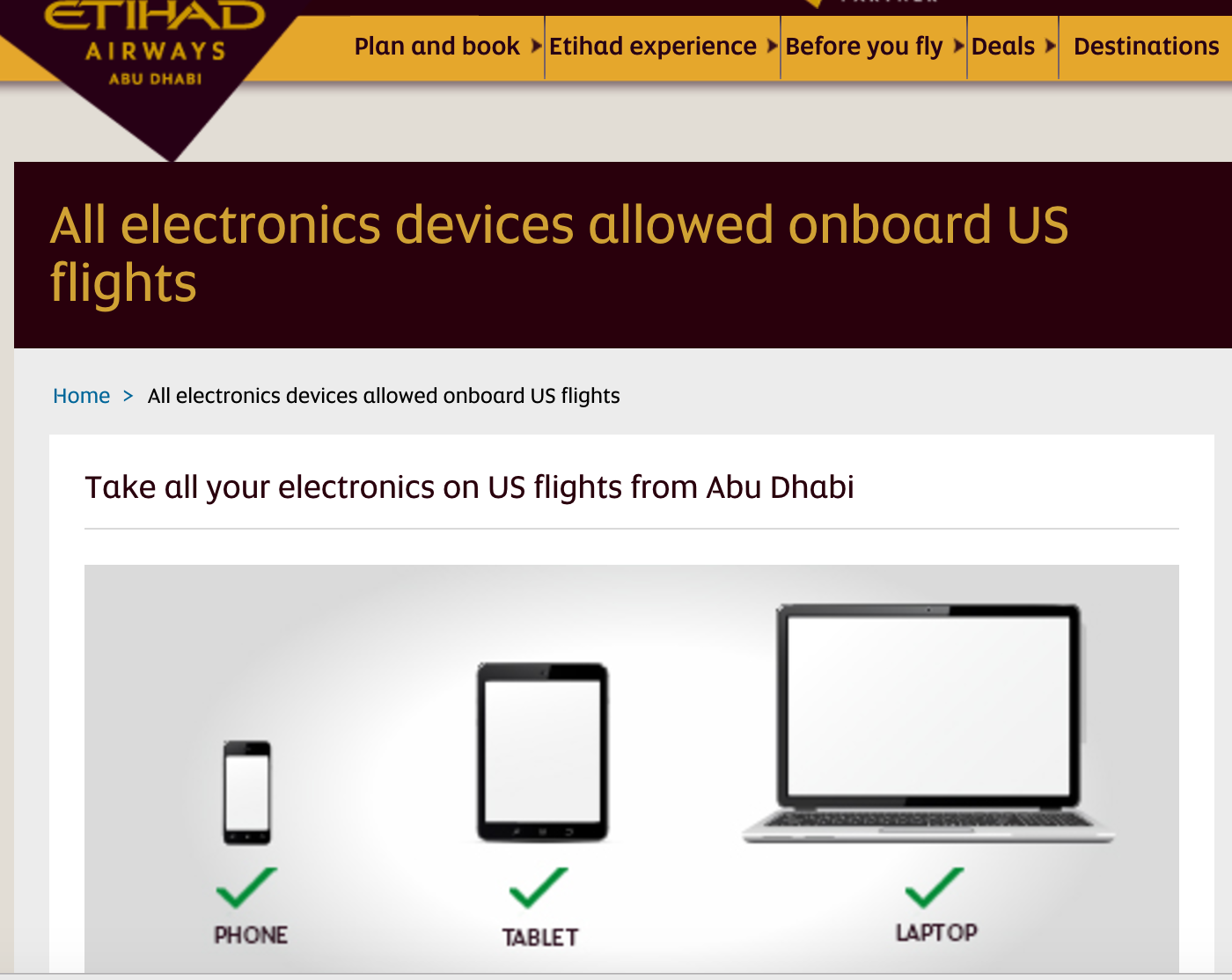
LaptopbanKuwait Airways and Royal Jordanian have joined Etihad, Turkish Airlines, Emirates and Qatar Airways as the latest two carriers to have in-cabin laptop privileges restored on US-bound flights, according to the US Department of Homeland Security.
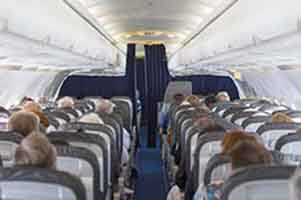
 

The Transportation Security Administration (TSA), which is an agency of the US Department of Homeland Security recently formally verified that Royal Jordanian Airlines operating out of Queen Alia International Airport and Kuwait Airways based at Kuwait International Airport ‘have implemented the required initial enhanced security measures’.


As such, they now join Etihad, Turkish Airlines, Emirates and Qatar Airways, who all had their in-cabin laptop privileges restored last week on all of their US-bound flights.


As reported, Homeland Security imposed the ban on the carriage of laptops in the cabins of several Middle East airlines after fears were raised that the battery compartments could be used by terrorists to conceal explosives.


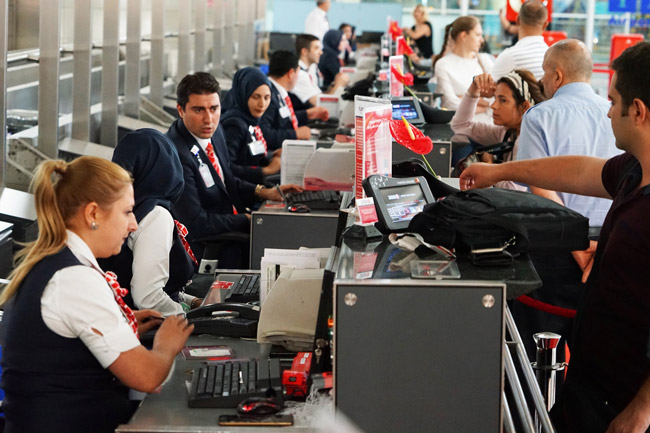
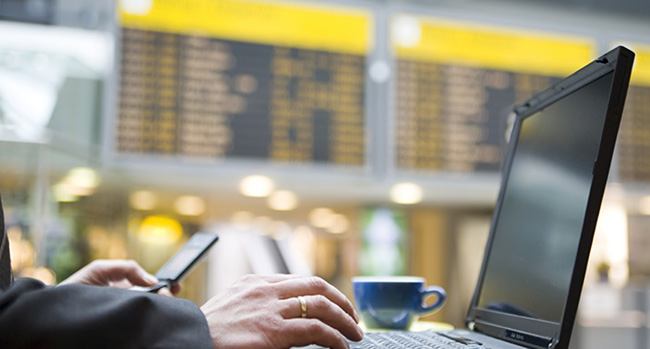
Laptop at airport (Photo credit TSA)

IATA has been severely critical of the US laptop ban on Middle East airlines. (Photo credit: TSA).

INTENSE CRITICISM…

However, last March’s ban on in-cabin carriage of laptops on direct flights from eight Middle East countries to the US also came under intense criticism from other security experts.


These included the International Air Transport Association (IATA) and various respected pilot unions who pointed out that consigning multiple laptops in concentrated into areas of shared storage within aircraft holds was potentially a much more dangerous fire hazard.


The US Department of Homeland Security had earlier insisted that Middle East airport security staff must conduct more rigorous screening of both passengers and electronic devices on US-bound flights.


This ban still applies to airlines based in Egypt, Morocco and Saudi Arabia, although authorities in all of these countries say they are now hopeful that all these restrictions will be lifted by the end of this month.

IATA says pax demand slows in May but still remains ‘solid’

IATA airline passengersGlobal air passenger demand in May increased by +7.7% compared to May 2016, although this was lower than the 10.9% growth seen in April, according to the International Air Transport Association (IATA).
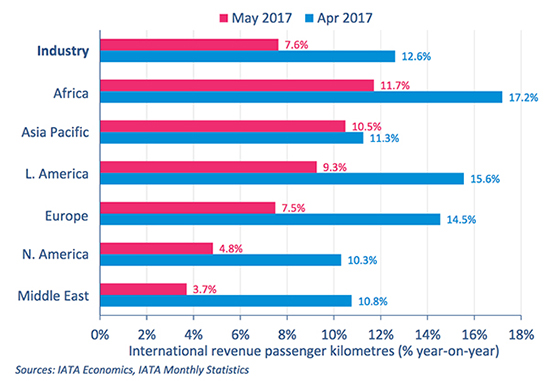
 

However, with international traffic up 7.6%, IATA is still pointing to a solid and positive trend which it says remains ‘well ahead’ of the five and ten-year average growth rates, according to its measure in revenue passenger kilometres, or RPKs.


The global airlines’ body noted that capacity still climbed 6.1%, while average load factors increase by 1.2 percentage points to 80.1%, setting a new all-time record high for the month.


In fact, all regions – excluding the Middle East and North America – reported record-high May load factors at the same time that air fares at the start of the second quarter fell by around 6% compared to the same period a year ago.


International pax growth IATA May 2017OVERALL DEMAND REMAINS ‘SOLID’

Meanwhile, IATA remains positive that passenger demand is solid and will remain so during the peak travel months of both July and August.


Alexandre de Juniac, Director General and CEO said: “Passenger demand is solid. And we don’t foresee any weakening over the busy summer months in the Northern Hemisphere.


“But the rising price of fuel and other input costs is likely to see airlines’ ability to stimulate markets with lower fares taper over the coming months.


“In parallel, rising trade protectionism and barriers to travel are worrying trends that, if unchecked, could impact demand.


“As a business, airlines depend on borders that are open to trade and people.”


INTERNATIONAL TRAFFIC UP 7.6%

IATA reports that international traffic demand rose 7.6%, with airlines in all regions recording growth, led by African carriers for a second consecutive month. Total capacity climbed 5.7%, with the load factor rising 1.4 percentage points to 78.5%.


At the same time, European carriers’ May demand increased by 7.5% over May 2016, down from the 14.5% year-over-year growth recorded in April.


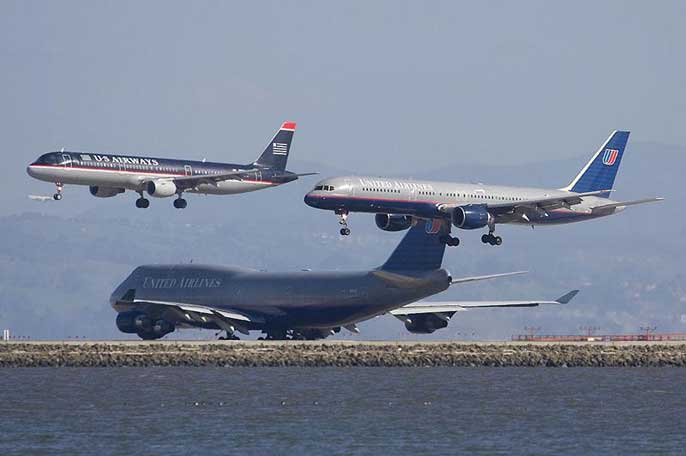
san-fran-airport-planes

Capacity rose 5.2% while the load factor was up 1.8 percentage points to 82.8% – the highest amongst all regions.


By contrast, Asia-Pacific airlines saw their traffic rise 10.5% in May compared to the month last year. Capacity increased 7.2% while the load factor jumped 2.3 percentage points to 77.6%.


Traffic on the Asia-Europe route has recovered strongly since last year’s terrorism-related disruption, surging at an annualised rate of more than 26% since November. Meanwhile, traffic on inter-Asia routes remains robust.


At the same time, Middle East carriers recorded a 3.7% rise in demand in May compared to a year ago, close to an eight-year low.


Capacity increased by 5.7%, while the load factor dropped 1.3 percentage points to 69.8%.


LAPTOP BAN HITS GROWTH

IATA said: “Although year-to-year comparisons are distorted by the strong performance for the same period a year ago, the slow-down also reflects the ban on the carriage of large portable electronics devices (PEDs) in the cabin from 10 airports in the region to the US, as well as a wider impact on inbound travel to the US from President Trump’s proposed travel bans.”


Meanwhile, North American airline traffic rose 4.8% in May, down from 10.3% annual growth in April, ‘but still a strong result for the region’ compared to the five-year average growth rate.


Laptop at airport (Photo credit TSA)IATA said: “While growth has slowed of late, the comparatively healthy regional economic backdrop, coupled with the strength of the US dollar, should support outbound passenger demand, although the latter impacts inbound demand.


“Anecdotal evidence also suggests that tourists may be deterred by the additional security measures put in place by the US Government. Capacity rose 4.2% and load factor climbed 0.5 percentage points to 80.5%.”


There was also continuing good news from Latin America, where the region’s airlines recorded a 9.3% increase in traffic in May compared to the same month last year.


BRAZIL IS UNDERPINNING LATIN GROWTH

IATA commented: “Notwithstanding ongoing challenges, an improvement in the Brazilian economy is helping to support growth, particularly on intra-South American routes. Airlines are coping well with some political and economic volatility in the region. Capacity climbed 6.8% and load factor climbed 1.9 percentage points to 81.8%.”


At the same time, African airline traffic rose by an even higher percentage to 11.7% in May – more than twice as fast as the 5.1% rise in capacity.


As a result, IATA noted that the load factor jumped 4.0 percentage points to 67.5%, with this demand ‘supported by recovery on the key Europe market’. IATA added: “Conditions in the region’s two largest economies are diverging, with business confidence in Nigeria rising sharply over the past six months, while South Africa’s economy fell into recession in the first quarter”.


Lastly, IATA pointed to domestic market demand for air travel up 7.9% in May, which was slightly below the 8.1% level of growth recorded in April.


“It adds that the results also varied widely, with China, India, Japan and Russia showing double-digit percentage growth, while others remained in single-digit growth.”


Emirates, Turkish Airlines granted US laptop ban lift

Emirateslaptop

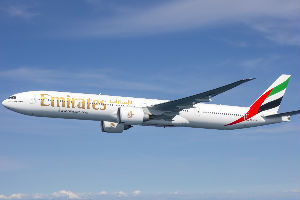
The US government has now lifted the laptop ban on flights to the US onboard Emirates, Turkish Airlines and Etihad Airways. Source: Emirates.

Passengers travelling on US-bound flights on Emirates and Turkish Airlines can now use laptops in the cabins after the US lifted a ban on the carriers.

In March, the US Department of Homeland Security (DHS) imposed an electronics ban preventing passengers carrying laptops and other large electronic devices in their hand luggage on flights between the US and eight Muslim-majority countries (Egypt, Jordan, Kuwait, Morocco, Qatar, Turkey, Saudi Arabia and the United Arab Emirates’ Dubai and Abu Dhabi) in a response to perceived security threats.

Emirates, which operates 11 direct flights from Dubai International to the US, made the announcement via its Twitter feed this morning (5 July).

Laptopban

Emirates has met ‘heightened security measures and protocols’, says the US DHS.

‘HEIGHTENED SECURITY MEASURES’

A statement issued on its website confirmed the lifting of the ban on the flights, ‘effective immediately’.

It added: “Emirates has been working hard in coordination with various aviation stakeholders and the local authorities to implement heightened security measures and protocols that meet the requirements of the US Department of Homeland Security’s new security guidelines for all US bound flights.

“We would like to express our gratitude to the US and local authorities for their support and thank our customers for their understanding and patience during the last few months when the ban was in place.”

Turkishairlines1

Turkish Airlines collected 81,736 electronic devices during the 102 days the ban was in place. Source: Turkish Airlines.

A spokesperson from Emirates declined to comment when asked by TRBusiness for clarity on what these ‘heightened security measures and protocols’ meant in practice.

Turkish Airlines responded with a formal announcement on its website and a Twitter message stating: “ to our US-bound flight. Please fasten your seatbelts and enjoy your own electronic devices”.

Chairman of the Board and the Executive Committee of Turkish Airlines M. İlker Aycı said: “During 102 days, 81,736 electronic devices were carefully collected from our passengers at gates by our staff and carried in overprotected baggage on 1,087 flights to the US.

“75% of devices were laptops and tablets and 25% of devices consisted of  cameras, GPS devices, and kindles.

“I would like to express my  gratitude to all my colleagues who carried out this operation with a sense of mission sensibility.”

Etihad

Etihad Airways confirmed the lifting of the electronics ban in a notice on its website.

ETIHAD BAN REVOKED

The latest development follows the lifting of Etihad Airlines’ ban on passengers travelling with phones, tablets and laptops on flights from Abu Dhabi to the US, as widely reported by international news outlets this week and subsequently confirmed on the airline’s website.

US Department for Homeland Security Spokesperson David Lapan said in a Twitter post Monday that “Etihad Airways & Abu Dhabi International Airport have implemented the required initial enhanced security measures.

“Kudos to for swift security changes. Passengers will now be able to bring PEDs (Personal Electronic Devices) into the cabin of their US-bound flights.”

Late last month, the DHS announced plans to implement ‘enhanced’ security measures at last point of departure across approximately 280 airports in 105 countries.

These include more rigorous passenger screening methods, including heightened screening of personal electronics devices and increased security protocols around aircraft and in passenger areas.

No specific mention of an extension of the electronics ban was mentioned, however the DHS made clear that the measures “were not limited to” the above.

As reported in March, the UK imposed a separate ban on the ‘inbound’ carriage of laptops, iPads and ‘some’ mobile phones in hand luggage only on flights between six countries to the UK (Egypt, Jordan, Lebanon, Saudi Arabia, Tunisia and Turkey).

ETRC reports DF post Brexit campaign remains on track

The Top 10 countries for pax TOPThe European Travel Retail Confederation (ETRC) presented a determined and united front at an informative press conference update on the industry campaign to restore duty free allowances yesterday.

 

Following her re-election as ETRC President for a further year at the earlier annual general meeting of around 30 members, Sarah Branquinho made it clear that ‘Brexit’ has obviously opened up a ‘huge opportunity’ to restore duty free allowances for UK citizens – once the UK is no longer technically a member [expected departure date: March 2019-Ed].


DETERMINED TO SECURE THE RETURN OF UK DUTY FREE

As such, ETRC says its one clear objective is to remain ‘determined to secure the immediate return of tax and duty free sales’ for passengers travelling between the UK and European Union – as soon as the aforementioned UK leaving date arrives.


ETRC TABLE 1

Click to enlarge table.

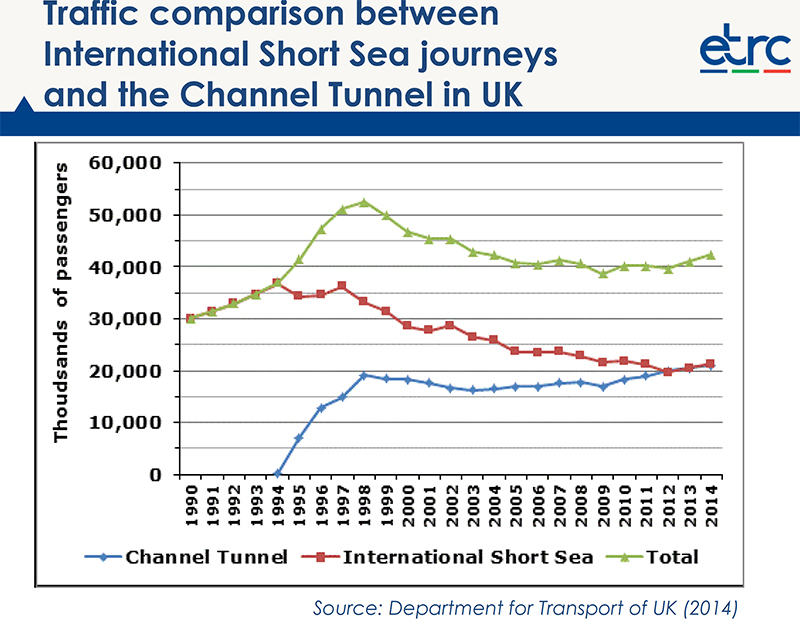
As Branquinho and her ETRC directors emphasised yesterday, current 2016 levels of passenger traffic between the EU and the UK across multiple transport sectors also bode extremely well for the future.


These include 153m air travellers, 20m maritime passengers, 21m Eurotunnel customers and 1.9m international cruise passengers. The top 10 countries’ for UK air traffic in terms of the percentage of travellers also makes interesting reading.


According to the UK Civil Aviation Authority, this list includes Ireland with 46.1%, Cyprus (45%); Slovakia (41%); Malta (30.8%); Spain (30%); Poland (28.5%); Portugal (25%); Lithuania (25%); and Greece (22.1%).


KEITH SPINKS OUTLINED CAMPAIGN POSITION…

While the ETRC went on to provide an interesting and informative ’off-the-record briefing’, it should be said here that Branquinho specifically asked all journalists present to take a measured and cautious approach to day-to-day reporting on the duty free issue as a whole – including reports on the contents of this meeting.


Nevertheless, ETRC Secretary General Keith Spinks was able to outline where the campaign is today, along with some of the challenges moving forward, although much of this briefing remains confidential for the time being.


The Top 10 countries for passenger flows (Source- CAA) copy

Click to enlarge table showing concentration of passenger flows (Source: CAA).

More generally he also added that ETRC had held a number of meetings in Brussels and in EU member states, and UKTRF had already done quite a lot of the hard work before the last UK general election, by talking to several Members of Parliament in several constituencies.


As such, he says the feedback has been ‘fantastic’ and most accept that a return to duty free on the day the UK leaves the EU ‘is a totally good thing’.


MORE COMPANIES NEED TO SUPPORT THIS VITAL CAMPAIGN

He also made reference to several other ongoing formal and informal meetings held with appropriate departments such as HM Customs and others, although he preferred not to divulge much more openly, sharing this with the journalists present as background only – at least for now.


Conclusion/opinion: Based on both the information we can and cannot report, the campaign for a return to duty free allowances for UK nationals certainly appears to be in good shape.


However, two years is a long time in politics and it remains to be seen where the UK will be in 2019 and how general negotiations will have progressed – or otherwise.


What is clear is that funding remains crucial for both the ETRC and the Duty Free World Council (DFWC). This is highlighted by the sad fact that there are still many companies who stand to benefit hugely from the anticipated return of duty free allowances – yet they have failed to contribute a single euro to the campaign.


ETRC unanimously re-elects Sarah Branquinho President

Sarah BranquinhoThe European Travel Retail Confederation (ETRC) today confirmed the unanimous re-election of Sarah Branquinho as President for another year at the representative trade body’s Annual General Meeting in London.


Commenting on her appointment, Branquinho said she was ‘honoured’ to be re-elected for another 12-month term: “Brexit presents a huge opportunity for the industry and with Brexit negotiations now in full swing, will occupy centre stage.


MULTIPLE MAJOR ISSUES

“There are, however, many other important issues on the industry agenda, including product labelling, transport security, restrictions on sales of tobacco and alcohol and I look forward to continuing to strengthen the voice of duty free and travel retail in Europe.”


ETRC added that the appointment follows 12 months of comprehensive lobbying by ETRC – both in Europe and the UK – where it is calling for an immediate return to duty and tax free sales once the UK leaves the European Union.

Clockwise- Sarah Branquinho, John Hume, Keith Spinks and Frank O'O'Connell

A full ETRC AGM took place at Heathrow Airport’s Sofitel Hotel today, attended by several officers and members, including (clockwise): Sarah Branquinho, President ETRC; John Hume, Director Hume Brophy; Keith Spinks, Secretary General ETRC; Frank O’Connell, President Duty Free World Council (DFWC); and Erik-Juul Mortensen, President of TFWA (out of shot).


The association says that from an EU and UK perspective the immediate return of duty free and tax free sales post-Brexit presents huge potential benefits for transport and tourism industries.


VITAL REVENUE INJECTIONS

This development would also significantly improve connectivity by bolstering the revenues of airports, airlines, ports and ferry operators at a time when ETRC notes the uncertainty about future rules on the free movement of people and goods.


Branquinho added: “We have received positive feedback across Europe for an immediate return to several members, including duty free sales once the UK leaves the EU, but this is far from being a done deal.


“A lot of work needs to be done at a technical and political level to make this a reality and we urgently need the full support of the entire industry.


“With over 150 million air passengers and over 40 million passengers by sea and Eurotunnel, an immediate return to duty and tax free sales will be transformational for the industry in Europe. Rest assured that ETRC is doing all it can to ensure a positive outcome.”


A report on the ETRC meeting will be published in TRBusiness shortly.


Ryanair’s O’Leary calls upon retailers to ‘screw the airports’

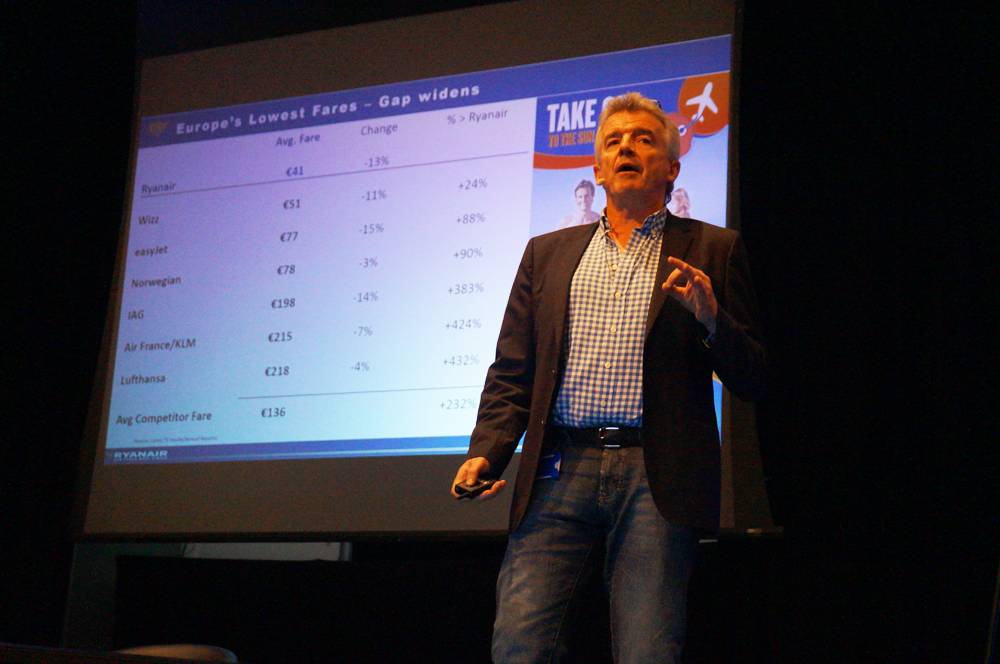
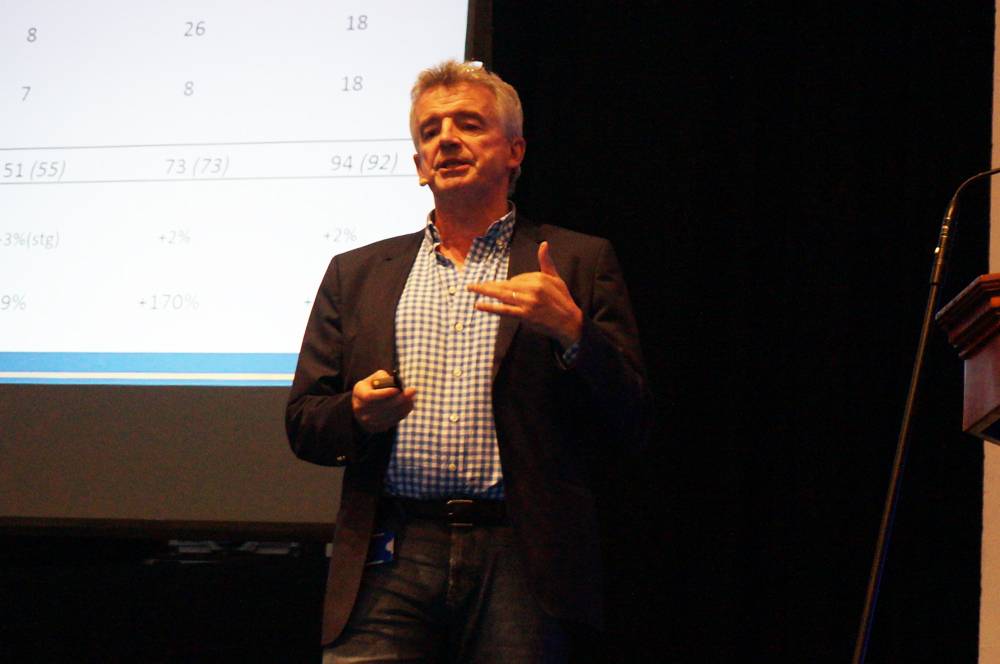
Michael-O'Leary-Ryanair-FTE-leadIn a typically candid and colourful presentation delivered at the Future Travel Experience conference (FTE) in Dublin, Ryanair CEO Michael O’Leary yesterday called on duty free & travel retailers to work with Ryanair to ‘screw the airports’, whilst restating his ambition for Ryanair to become the ‘Amazon of travel’.

 

On the topic of duty free and travel retail he shared his opinion that ‘retailers are getting screwed by the airports’ and said that for this reason transactions needed to be moved away from the airport.


He said airlines and retailers needed to work together to take the transaction out of the airport and make airport shops more like showrooms.


“It’s payback time,” he said. “Let’s all work together to screw the airports. Let’s work with the retailers to screw the airports.”


RYANAIR REVISES ITS ANCILLARY FORECAST

Interestingly, as has already been reported by TRBusiness, Ryanair’s ancillary revenue forecast has been revised up from 27% to 30% by March FY2020, which underlines Ryanair’s more concentrated focus on this area of its business.


Ryanair-slide-Europe's-lowest-fares

O’Leary believes that air fares will eventually be driven down to zero…at least on the the majority of flights.


Interestingly, his colleague in the audience yesterday revealed that 45% of the airline’s customers already buy ancillary products, although O’Leary was convinced this percentage was ‘much higher’ – at more like 60%.


Ryanair was also asked about ‘disruptors’ in the travel industry and the threat of these companies to the airline in particular, to which he replied. “Flights are not up for disruption. Everyone still has to fly.”


Despite the agility of the airline and the speed at which it can make decisions, O’Leary has been reticent to offer connectivity onboard up to this point. He said that this was down to the fact that he would be losing €80-100m a year due to a 4% drag factor – a result of fitting a very heavy aerial to the aircraft. “Our fuel bill was already €2bn last year.”


Michael-O'Leary-Ryanair-FTE-large

“It’s payback time,” says O’Leary. “Let’s all work together to screw the airports. Let’s work with the retailers to screw the airports.”


Since launching its package holiday service and the ‘MyRyanair’ personalised digital platform over a year ago, O’Leary has made it clear that revenue growth will not be driven by airline tickets.


RYANAIR TO TAKE ON BOOKING.COM IN EUROPE

Instead, the airline is openly and very publicly focusing on ancillary revenue generation. It also plans to ‘take on’ hotel/booking aggregator and price comparison sites, such as Expedia and booking.com which he deems ‘useless’.


“Booking.com are useless,” he said. “They don’t own a brick. We are going after them in Europe. I own the customer in Europe because we have the lowest fares.”


He reinforced his opinion about his reluctance to work with Google. “Google are not getting a cent of us.”


Ryanair have always been clear about their business model and have driven democratisation of travel harder and faster than any other airline. O’Leary believes that costs will continue to be driven down to basically zero. “The majority of seats will be free, obviously not on bank holidays and things like that.


MORE THAN JUST CREDIT CARD INFORMATION…

O’Leary readily admitted that Ryanair’s method of collecting customer data used to consist of just capturing their credit card information. He said they have since learned that they need to know more about their passengers.


However, he remained resolute in his opinion that the airline really owns the passenger, ‘not Google, Expedia or Booking.com’, who he believes are ‘scamming the customer one way or another.’


Michael-O'Leary-Ryanair-FTE-large-2

O’Leary readily admitted that Ryanair’s method of collecting customer data used to consist of just capturing their credit card information.


“We’ll be using real-time customer info to prompt packages, hotels, flights that customers want to book/order before they initiate the process themselves,” he added.


He also said that customers are given an incentive (a huge discount) to book directly on Ryanair’s website. Indeed, many other airlines have followed suit.


European duty free ‘poised for big gains post Brexit’

Midset story smallSwiss research company m1nd-set is predicting that the duty free business will register strong sales gains ‘across Europe’ once the United Kingdom completes its Brexit departure from the European Union (EU) – whether it is a soft or hard exit.


m1nd-set reasons that the ultimate result will still be highly positive for the UK when comparing the short and long-term impacts, since traffic between the UK and EU countries in a hard Brexit is forecast to be up to 6% lower than in the event of a ‘soft Brexit’, while by 2035 the total UK air travel market will still be over 45% higher than it was in 2015 – and over 55% in the event of a soft Brexit.


Company owner and CEO Peter Mohn says these are m1nd-set’s findings using data obtained through the research agency’s Business 1ntelligence Service, covering both shopper behaviour and what he describes as ‘the industry’s most accurate air traffic forecasting tool’ provided through IATA and ARC’s ‘Direct Data Service’ (DDS) database.


REAL-LIFE MEASUREMENT PARAMETERS

Mohn says the methodology is based on quality real-life measurement parameters, focusing on the net duty free market gain due to Brexit by measuring passenger movements for every single flight to and from around 1,500 airports.


He added: “The analysis further identifies the increased percentage of passengers who would benefit from duty free purchases. This ‘net gain’ for the UK is clearly the greatest with over 54% more passengers qualifying for duty free purchases on UK – EU routes. (See attached chart).”


m1nd-set says that Ireland also stands to see strong gains with eligible duty free purchasers coming in at just below the 40% net gain mark. He added: “Interestingly five out of the top 10 countries that will see the most positive impact are from Central and Eastern Europe: Slovakia, Poland, Lithuania, Bulgaria and Slovenia.


“Malta, Cyprus and Spain – which all have high passenger movements with the UK – are also among the top ten countries that will see the biggest potential gains.”


Mindset Brexit

Click on table to enlarge.


NET GAIN ON AN INDIVIDUAL AIRPORT BASIS

Mohn reasons that this analysis is ‘particularly beneficial to retailers’ as it demonstrates the net gain on an individual airport basis. He also emphasizes that where some UK airports have most, if not all flight movements with EU countries, the impact on the number of eligible passengers is even more significant.


As such, m1nd-set is predicting that airports such as Bournemouth, Doncaster, the East Midlands and Leeds, London Stansted and London Southend will see gains of around 90%, while Scotland’s Glasgow Prestwick Airport will see 100% of its passengers eligible for duty free purchases in a post-Brexit scenario.


m1nd-set also expects net gains of above 60% per airport for larger UK facilities, such as Gatwick, Manchester, Liverpool, Luton and Birmingham. At the same time he argues that opportunities for increasing customer penetration levels within the duty free shops will also increase in these airports.


Peter Mohn new

Peter Mohn, m1nd-set.

With such ‘an extremely rare occurrence for retailers to see overnight growth of their potentialcustomer base’, Mohn says all stakeholders really do need to think about how this opportunity may best be exploited to the industry’s advantage.


WILL THE OPPORTUNITY TO RESTORE REAL VALUE BE TAKEN UP?

He said: “This type of analysis is imperative to both suppliers and retailers as their pricing strategy at some airports in particular will need to be adjusted. The restitution of duty free sales on these UK-Europe routes may well present an unprecedented opportunity to all retailers to reposition the duty free shops as a place for great value shopping”.


Having said this, Pablo Saez-Gil, the Senior Consultant at m1nd-set who is responsible for the Business 1ntelligence Service believes that it will not be easy to negotiate or reinstate genuine duty free status for travel retail sales between the UK and the EU.


He explained: “The potential benefits from lifting the duty-free exemptions on routes between UK and the EU-27 are unevenly distributed across European airports – even within each country.


DIFFERENT INCENTIVES AND DIFFERENT POSITIONS?

“Retailers, airports, cruise and ferry companies, airlines and regulators will have each very different incentives and the lack of a shared position on the matter may undermine the negotiations.”


TRBusiness also notes that there are clearly concerns elsewhere that some suppliers and retailers have now adapted to their own added margin duty paid premium offerings over standard brand savings – particularly where travel retail channel-only premium brands have been specifically ‘created’ to deliver higher margins for both suppliers and retailers.


For more information on m1nd-set’s Business 1ntelligence Service reports, please contact m1nd-set by email or telephone: T: +41 21 925 5025 | i[email protected]


Baptiste Duguit set to join Lagardère TR from Dutyfly

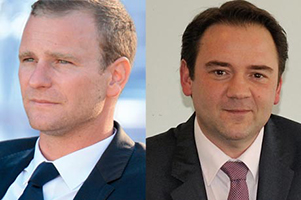
Baptiste Duguit and Philippe Le Goff.

Baptiste Duguit and Philippe Le Goff.

Baptiste Duguit is leaving Dutyfly Solutions at the end of this month to take up a new position within Lagardère Travel Retail.


Commenting on his move, thanking him for his contribution and wishing him ‘every success’ in his new role, Dutyfly Solutions’ CEO Philippe Le Goff said: “After six years at Dutyfly Solutions as Marketing Manager and then Marketing and Sales Director, Baptiste was offered a very good opportunity at Lagardère Travel Retail.


“I will take over the duties of his position until the appointment of his successor.”


Le Goff added that the company remains at the disposal of all of its clients and colleagues where ongoing projects are concerned.


Baptiste Duguit.

Baptiste Duguit.

A VERY WELL RESPECTED MANAGER

Within Lagardère Travel Retail and Dutyfly Solutions, Duguit previously managed the product offer strategy for all the company’s airline customers and was Senior Project Manager within the Aelia purchasing team.


More recently his responsibilities included the product offer, marketing strategy, account management, business development and new projects.


Before joining Dutyfly Solutions he worked in Sports Marketing for Havas Entertainment (Advertising) as well as the French brand Le Coq Sportif (sports lifestyle goods), developing experience in consumer marketing, communication tools, purchasing and sales promotion.


Duguit holds an MBA from the ESSEC Business School and played rugby at semi-professional level.


(Gategroup/HNA announced it was acquiring majority control of Servair from Air France for an enterprise value of €237.5m ($248.6m) on a 50% basis last December, including the 50% holding held by Servair in Dutyfly Solutions. The other 50% in Dutyfly is owned by Lagardère Travel Retail–Ed).


$110bn-worth of new orders for Boeing and Airbus in Paris

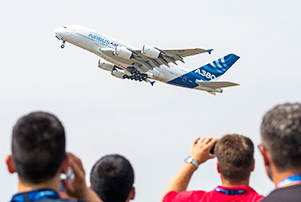
A380 flying display day A380 flying display at Paris Air Show © Airbus (Photo credit F. LANECOLT-master films TOPBoth Boeing and Airbus reported positive global demand for new international commercial aircraft at the recent Paris Air Show at Le Bourget (22 June).
 

The Seattle-based company reported commercial orders and commitments during the week for a total of 571 commercial aircraft valued at $74.8bn, while Airbus reported $40bn-worth of commercial aircraft orders.


Both companies also included some aircraft in their numbers where some provisional orders had been placed prior to this week’s air show event.


41,000 NEW AIRCRAFT PROJECTED OVER NEXT 20 YEARS

Boeing also unveiled its latest ‘2017 Current Market Outlook’ which suggests that demand will grow over the next 20 years for more than 41,000 new aircraft valued at $6.1 trillion. This excludes the additional Aerospace Services Market projected demand for commercial and government services over the next decade – said to be worth an additional $2.6 trillion.


A380 flying display day A380 flying display at Paris Air Show © Airbus (Photo credit F. LANECOLT-master films BIG

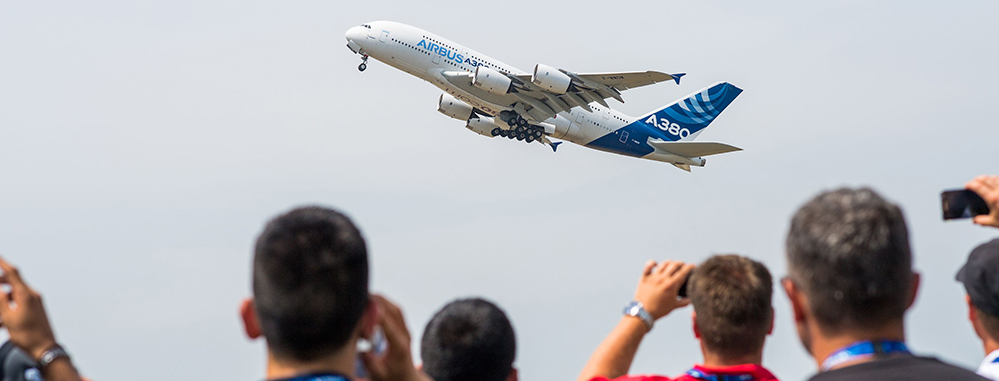
An A380 flying display at this week’s Paris Air Show (© Airbus – photo-credit F. LANECOLT-master films).


This year, Boeing also took the opportunity to launch its new 737 MAX 10, receiving more than 361 orders and commitments from 16 customers worldwide – although some of these aircraft had been provisionally ordered previously. The company says this aircraft is regarded by many as the industry’s most efficient and profitable single-aisle aircraft.


Meanwhile, Airbus also announced $39.7bn-worth of new business during the same show, with the Toulouse-based company pointing to commitments for a total of 326 aircraft, including firm orders for 144, worth $18.5bn and MoUs for 182 aircraft worth $21.2bn.


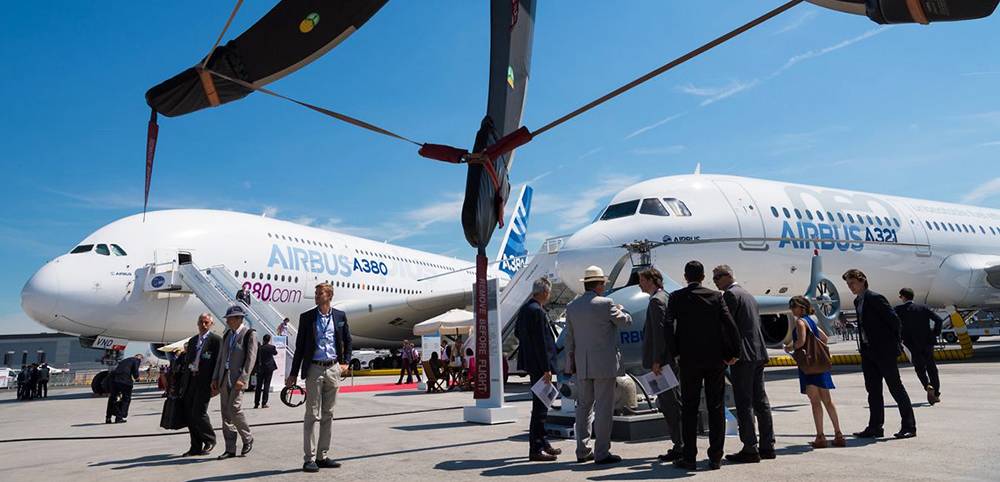
AIRBUS 2017 Paris Air Show (Photo credit F LANCELOT master films

The nicely-grounded AIRBUS family at the recent Paris Air Show (© Airbus – photo-credit F. LANECOLT-master films).


The company reports that its A320 Family aircraft sales and commitments were specially robust, with business accounting for a total of 306 aircraft worth $33.8bn.


This total comprises 132 firm orders worth $14.7bn and MoUs for 174 aircraft worth $19.1bn. Meanwhile, in the wide body segment, Airbus won business for 20 aircraft worth $5.9bn, comprising 12 firm orders worth $3.6bn and MoUs for eight aircraft worth $2.3bn.