Trbusiness. The travel retail Trbusiness. The magazine for global retail and duty free professionals.
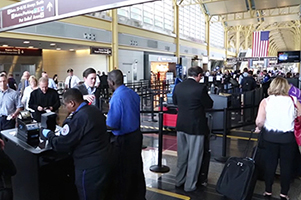 Aviation security experts are warning that serious airport delays could result from any escalation in the current limited ban on laptops being carried in hand luggage on EU/UK flights bound for the US.
Reports from London to Washington over the weekend are suggesting that a major initiative is strongly under consideration, although no decisions had been formally communicated at press time. This follows heightened fears that terrorists in the UK in particular are suspected of plotting to blow up aircraft with explosives hidden in laptops, which can be detonated remotely.
The threat is said to be identical to the existing electronics ban on carry-on laptops – and some phones – which was introduced last March for passengers travelling to 10 cities in the Middle East [As reported by TRBusiness at the time-Ed].
A NEW LAYER OF SECURITY CHECKS?
If the carry-on ban is extended, then it is expected to result in the introduction of a new layer of security checks at Heathrow and other EU airports with direct flights to the US, as well as other direct point-to-point flights from European airports to US destinations. [In 2016, a total of 30m passengers flew to the United States from Europe, according to the US Transportation Department-Ed].

Alexandre de Juniac, IATA’s Director General and CEO has called for more dialogue and coordination between governments and industry to keep flying secure – in relation to the so-called ‘laptop ban’.
According to reports, passengers could be routinely subjected to further body searches at boarding gates, so causing huge delays. This could also result in the urgent need for additional fully trained airport security staff.
Any laptops or other electronic devices of concern would be taken from their owners to be packed into specially-screened bags and placed in the aircraft hold, with these containers said to be especially designed to block out any remote signal triggers that might be sent to a laptop containing explosives.
US Homeland Security Secretary John Kelly is known to have shared several security briefings with foreign governments on this sensitive issue, following the aforementioned US’ lead on banning cabin laptops, iPads and some mobile phones in hand luggage on flights between the US and eight countries two months ago.
Those countries and routes where the US ban is already in place include Egypt, Jordan, Kuwait, Morocco, Qatar, Turkey, Saudi Arabia and the United Arab Emirates (Dubai and Abu Dhabi). At the same time, the countries where the UK ban also applies include Egypt, Jordan, Lebanon, Saudi Arabia, Tunisia and Turkey.
IS THERE ‘A LACK OF COORDINATION?’
As of today, the specific airports relating to the US ban include the following: Abu Dhabi International Airport (United Arab Emirates); Cairo International Airport (Egypt); Dubai International Airport (United Arab Emirates); Hamad International Airport (Qatar); Istanbul Ataturk Airport (Turkey); King Abdulaziz International Airport (Saudi Arabia); King Khalid International Airport (Saudi Arabia); Kuwait International Airport (Kuwait); Mohammed V International Airport (Morocco); and Queen Alia International Airport (Jordan).

Security staff and screeners are under ever-increasing pressure to keep passengers safe, as the terrorist threat remains as real as ever, following the liquids restrictions brought in back in 2006 and now the partial laptop ban.
Meanwhile, Alexandre de Juniac, IATA’s Director General and CEO has called for more dialogue and coordination between governments and industry in relation to the ‘laptop ban’ in an effort to keep flying secure. Addressing the ARC Travel Executive Council on May 5, he said the lack of coordination on the issue raises too many questions.
He said: “Why on some flights and not others? How did the UK and US end up with different lists? What are the implications for safety of having so many lithium batteries [stored] in the hold? And surely, with all that has and continues to be spent on screening, we must be able to find a technology-based solution?
IATA SAYS CURRENT BANS ARE ‘NOT SUSTAINABLE IN THE LONG RUN…’
“We are now in a more open dialogue with governments on this important issue. And the responses of Canada, the EU and Australia to the same intelligence demonstrate that a ban on large electronic devices in the cabin is not the only way forward. Indeed, we believe that it is not sustainable in the long run.
“So, even as rumours persist that the ban will be extended, we are calling on governments to work with the industry to find alternatives – to keep flying secure without such great inconvenience to our passengers.”