Archives

Travel to Europe returns to growth despite terror attacks

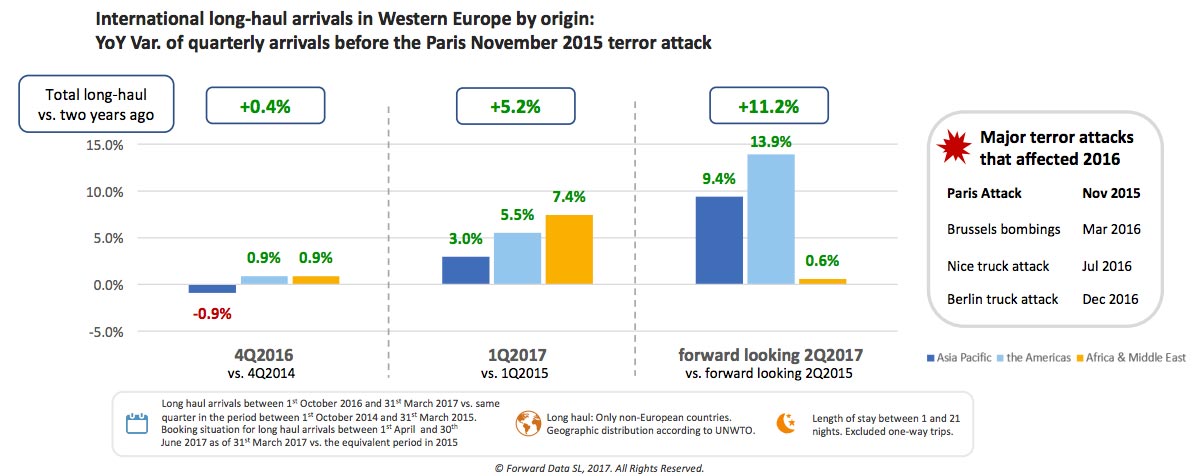
ForwardKeys-April-2017-leadAccording to travel analysts from ForwardKeys air traffic to Europe is recovering from last year’s terrorist attacks with arrivals growth said to be ‘back on track’.


ForwardKeys’ latest global air travel overview concludes that passengers from Europe, the Americas and the Far East are making more bookings and taking more flights, despite recent terrorist attacks and geopolitical upheaval in many countries.


ForwardKeys predicts future patterns by analysing 16m booking transactions a day.


The findings will be presented at the World Travel and Tourism Council’s Global Summit, taking place in Bangkok, 26-27 April.


BOOST TO ASEAN NATIONS AS CHINESE AVOID SOUTH KOREA

The report also suggests that Canada is the ‘new star destination in North America’ and that Chinese travellers that have turned their backs on South Korea are exploring ASEAN countries instead.


Interestingly, the BRIC countries are seeing a return to growth with Brazil and Russia leading the way with benefits seen to Thailand’s tourism industry.

Click to enlarge graphs.

ForwardKeys-April-2017-Europe

Olivier Jager, CEO of ForwardKeys, said: “This overview reveals the resilience of the travel industry globally. People are finding alternative new destinations and they are returning to others previously blighted by dreadful events.


“However, in a world of shifting travel patterns, businesses that depend on travellers need to be able to readjust ever more quickly.”


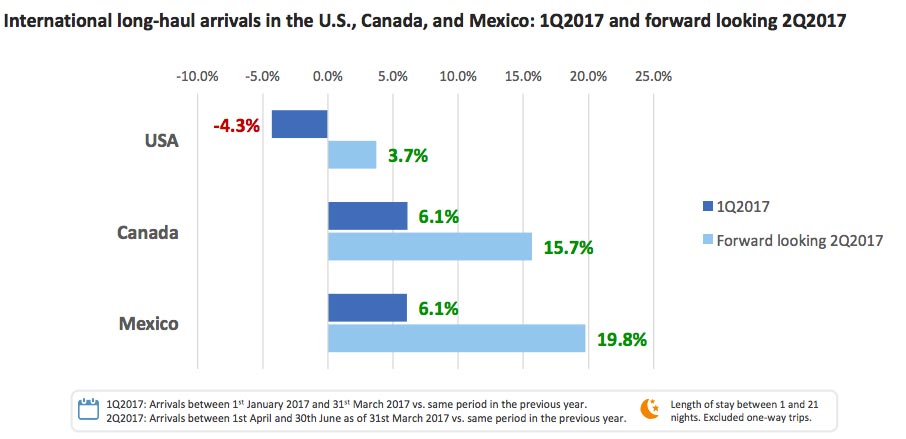
ForwardKeys-April-2017-US

The ForwardKeys data shows that in the Americas, Canada and Mexico are setting the pace for long-haul arrivals. The Netherlands, China, the UK, and Germany are fueling the additional forward bookings to both countries.


The US suffered a decrease in visitors in the first quarter of this year – uncertainty due to Donald Trump’s travel ban and the stronger value of the dollar may have discouraged Middle Eastern (down 9.5%) and European travellers (down 6.5%). Forward bookings to the US have picked up mainly due to the Easter shift.

LCC boom requires airports to ‘think clever’, says CiR

LCCAirport duty free and travel retailers should pay closer attention to the evolution of the low-cost carrier (LCC) market in order to optimise retail sales, according to Counter Intelligence Retail (CiR).

In a broad analysis of the evolving dynamics of the LCC market and its likely impact on travel retailing patterns, CiR acknowledges that the market’s position as a leading driver of airport traffic requires careful monitoring.

Drawing on its State of the Nation 2017 report, CiR warns that passenger growth – which leaped to approximately 7.6bn PAX last year according to the latest preliminary results from ACI World – is no longer a guarantee of corresponding increases in retail sales.

“Without that guarantee, DF &TR operators will have to plan and research better – by country, nationality and location – just to get the same results,” commented Garry Stasiulevicuis, President, CiR.

The combination of low oil prices and recovery from the global financial crisis has fuelled the ‘boomtime’ for LCCs, with the CAGR for LCCs in the past decade springing +7.1% against growth in the total global airline market of +3.5%, CiR drawing on data from aviation economics analyst RDC points out.

CiR LCC's share of the global market has steadily increased.

LCC’s capacity share of the airline market continues to rise. Source: CiR.

KEEPING THE RETAIL TILLS ‘RINGING’

According to CiR’s Business Lounge Global Traveller Report – Low Cost Carriers Review, LCCs have outperformed their airline counterparts in every region, with Central and South America and the Caribbean witnessing the strongest gains.

Across the Americas, LCCs serve more than 300m international passengers per year – a 14% share of the market, says CiR. In 2016, the segment grew its share by +13.5%, compared with +6.8% in the regular carriers group.

In Europe, the dominance of LCCs is striking, with airlines such as easyJet and Ryanair both ranking within the top five for passengers carried, with the latter exceeding 100m PAX per year.

According to the latest information from ACI Europe, approximately 47% of Europe’s airports are loss making, which underlines the increasingly important role that LCCs play in contributing vital revenues at many regional airports.

This role, CiR says, has helped to keep the “retail tills ringing”, as the model has evolved from the simple ‘no frills’ associations of the past.

“The fact is that without LCCs, these airports would struggle even more, financially,” explains Stasiulevicuis.

“It is already the case that regional airports can hardly make ends meet as their infrastructure costs are often fixed – they have to maintain a runway to high safety standards, for example, even if they only have a few flights daily.”

Top-garry-cir-2014

Garry Stasiulevicuis, President, CiR.

‘20% OF AIRPORTS MAKE MONEY’

The result, CiR says, is that approximately 20% of the globe’s airports actually generate healthy returns, and most of this is consigned to the big hubs.

“It is worth noting that the world’s top 10 airports account for 20% of all passengers – while the top 20 airports account for 31% of all global traffic,” says Stasiulevicuis, referring to CiR’s State of the Nation 2017 report.

“This concentration is set to grow and the issue for smaller regional ‘alternative’ airports is that LCCs have started to gravitate to larger airports serving the same catchment area, as this is more convenient for customers.”

The move of LCCs towards larger airports marks an interesting turnaround from the days of old, notes CiR.

Similarly, LCCs have come to the rescue in cases where national carriers have pulled out or ceased operations altogether, an example being the collapse of Hungarian flag carrier Malev in 2012, with Ryanair and WizzAir filling the void at a time of notable investment from Gebr. Heinemann in its retail stores.

“As well as the trend to larger hubs – which they used to avoid because of their higher costs – the rise in long-haul LCCs also looks like it might persist after many false starts over the years,” says Stasiulevicuis.

“Norwegian Air’s popular transatlantic service from the UK has won over thousands of customers and spurred IAG into launching its own competing airline.”
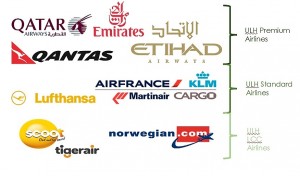
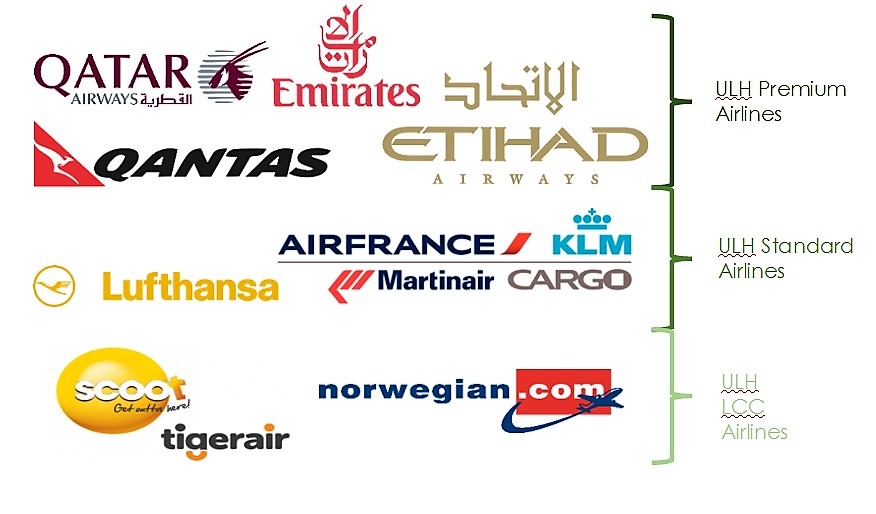
CiR The lines are blurring between ultra long-haul LCCs and regular airllnes.

The lines are blurring between ultra long-haul LCCs and regular airlines. Source: CiR.

STIFFER COMPETITION IN LONG HAUL

While several cost and operational factors have in general kept LCCs out of the long-haul market, the signs are that this could now be changing if more airlines follow the Norwegian model, notes CiR.

It says the carrier launched its first low-cost, long-haul flights to the US in 2014, and now serves eight US destinations.

“It seems that passengers can’t get enough of Norwegian’s Europe to US services – an indicator that they as consumers are becoming more cost savvy and aware, something that is fast filtering into travel shopping habits,” continues Stasiulevicuis.

“LCCs are now competing on a more equal footing with legacy carriers in the eyes of travellers. With British Airways deciding to charge for food and drink on short-haul routes – and considering doing the same thing on long haul – passengers are seeing less of a difference and increasingly choosing on pricing.”

CiR concludes by identifying the convergence of full-service operators that offer lower prices, with LCCc that divide into ‘value’ and ‘ultra low-cost’ segments, means a blurring of the offer and commoditisation.

Stasiulevicuis concludes: “This value-based offering is great for the new middle classes in developing markets like China and India wanting to go abroad, but will they also want the traditional high-end, high-price products that the FD&TR business has served up for so long?”


 

Heinemann says more airlines opt to run own programmes

Peter Irion Gebr Heinemann

Peter Irion, Executive Director Distribution, Gebr. Heinemann.

Gebr. Heinemann’s Executive Director Distribution Peter Irion believes that the airline duty free and travel retail business is consolidating and he is predicting fewer concessionaires, as more airlines choose to run their onboard sales programmes themselves.


Answering a question from TRBusiness at the retailer’s business press conference at its Hamburg headquarters earlier this month, Irion said this scenario is hardly surprising, since the airlines own the customer, so why shouldn’t they develop the business themselves?


At the same time, he believes that Heinemann also knows the customer, so the better job it can do in future can only increase its growing number of airline cooperation agreements.


Airline business

Irion believes that more airlines are looking to run their own programmes, opening up opportunities for Gebr. Heinemann’s supply services.

Having said that, he also acknowledged that the ground-based airport shopping environment will always have an advantage, although he also pointed to some real advantages on the airline side as well.


‘POSITIVE FEELING’ ABOUT AIRLINE BUSINESS

He said this is particularly the case when where airlines physically manage both the sales and product promotion functions themselves both on a pre-order basis and inflight.


As a result, he said Gebr. Heinemann has ‘quite a positive feeling’ about its growing airline business, with the added advantage that airlines always have the information on who the customer is first, which he says is often a big advantage when it comes to targeting the final assortment offer.


Heinemann board

This month’s press conference in Hamburg, with Peter Irion flanked left by Raoul Spanger and Claus Heinemann and right by Kay Spanger and Gunnar Heinemann.

Irion said the company is also looking to improve its business in this sector, where Heinemann’s combined airline and catering division accounted for 2.0% of the retailer’s business last year – equivalent to €76m ($82.5m) from the €3.8bn ($4.1bn) sales turnover generated by all of Heinemann’s divisions during the year.


[Gebr. Heinemann’s Sales Director Inflight & Catering John Baumgartner also pointed to the competition pressure from the internet in an extensive interview with Charlotte Turner in the TRBusiness print edition last February. A full and expanded report on Heinemann’s results presentation can be found in the May print edition when it is published shortly, as well as in the TRBusiness web report by clicking here: http://www.trbusiness.com/regional-news/international/heinemann-hits-4bn-in-group-turnover-in-2016/118358].


UK consumers spend the most online per household

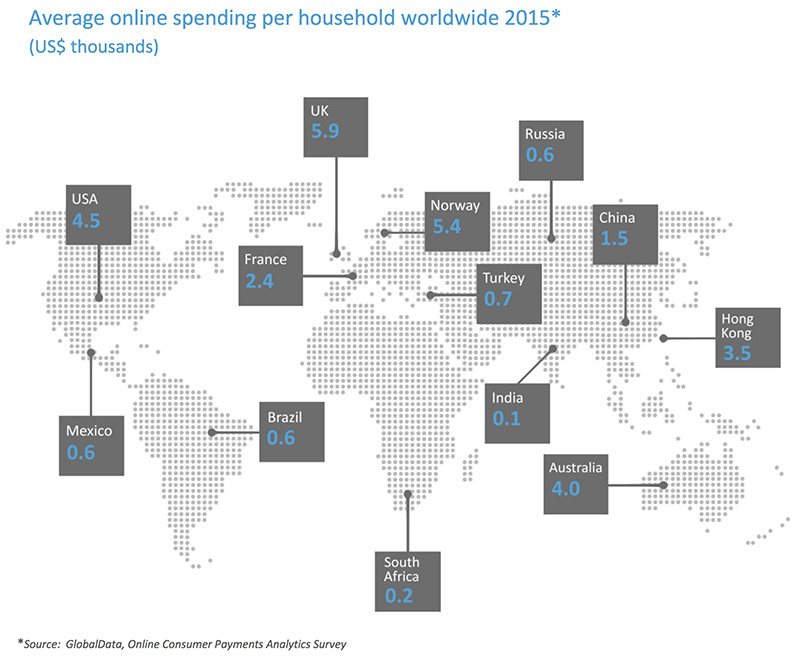
Online card spendingUK consumers spent more online per household than any other country at US$5,900, followed by Norway ($5,400), the USA ($4,500) and Australia ($4,000) – according to the latest findings of a new collated survey based on 2015 figures, according to the UK Cards Association (UKCA).


The trade body, which represents financial institutions which act as both card issuers and acquirers says there were 14.8bn card transactions in 2016, equivalent to 40.5m transactions a day, or 469 a second.


It adds that three-quarters of this retail spending (76.4%) was made using payment cards, with total card spending in 2016 reaching £298bn ($382bn), compared with £290bn ($372bn) in 2015..


UK Cards Association tabke 2016

Click on all tables to enlarge.

DEEP UK SPENDING ANALYSIS

By contrast, the UKCA says that internet spending has jumped by more than a quarter in the last two years with card spending on the internet totalling £154bn ($197bn) in the UK in 2016.


This was equivalent to an average of £422m ($541m) a day – up 28% since 2014, when online spending amounted to £120bn ($154bn).


The UKCA adds that its analysis shows that one in four card purchases online is on entertainment, with consumers buying cinema and concert tickets, takeaway orders and digital content.


UK ONLINE SPEND AT $5,900 LEADS THE WORLD


As aforementioned, its figures also show that UK spends more online per household than any other country, at US$5,900 in 2015 – higher than Norway (US$5,400), the USA (US$4,500) and Australia (US$4,000).


Online vs Face to face transactions 2014-2016Breaking down internet spending patterns on debit and credit cards in the UK the report found that a quarter (26%) of all card spending was online last year, up from 22% in 2014.


In addition, a total of 1.8bn purchases were made online in 2016 – equal to an average of 150m a month and an increase of 38% on the 1.3bn in 2014,


The UKCA says that entertainment sales comprised the highest proportion of all online purchases (26%); although these only account for 7% cent of the total value, reflecting the relatively low cost of digital entertainment such as apps and music downloads.


UK ONLINE SPENDING BROKEN DOWN BY SECTOR

In addition, some 41% of in-store card purchases were made on food and drink, with this sector accounting for only 7% of online transactions, while over a quarter (27%) of all online spending by value was on financial services – the highest share of any sector.


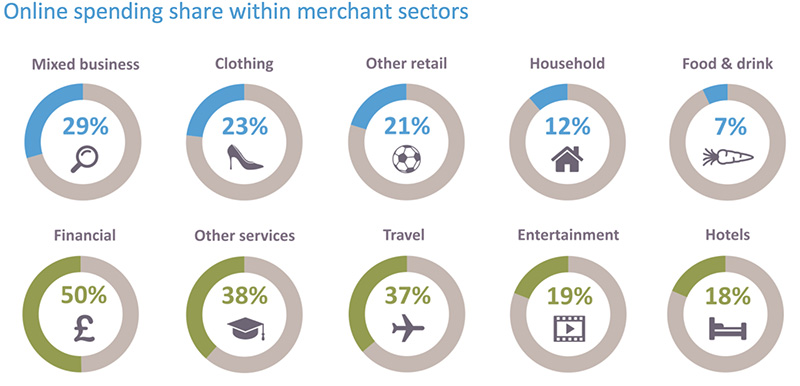
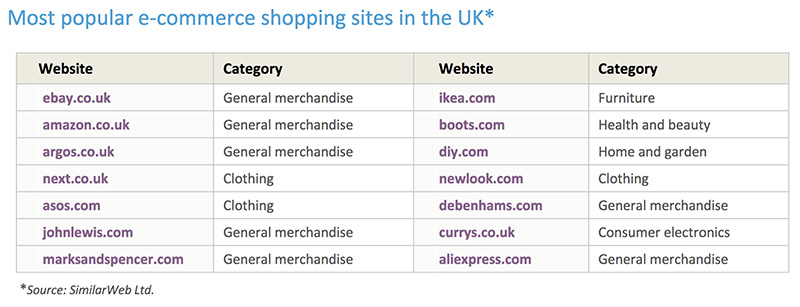
Most popular e-commerce sites in the UKBreaking spending patterns down further, the report also reveals the dominance of online spending in certain sectors, including travel where nearly four in every ten pounds (37%) was spent on travel online last year, with 54% of all spending on airline tickets made through the internet.


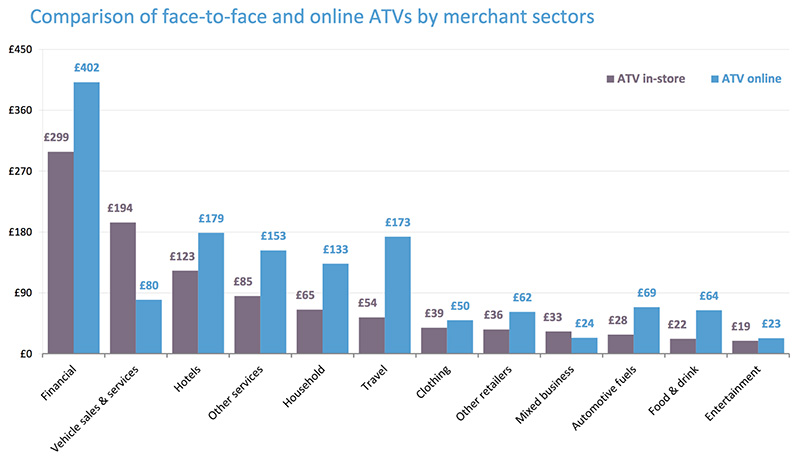
Interestingly, the UKCA adds that over the last two years the average card purchase online has dropped by £9 ($11), suggesting that internet shopping is no longer the domain of big ticket items.


However, the average e-commerce purchase at £85 ($109) is still more than double that of in-store sales at £38 ($49).


Average online sending per household worldwide 2015


The full report can be found at the following link: http://www.theukcardsassociation.org.uk/wm_documents/Online%20Card%20Spending%20-%202014-2016.pdf

Terrorism returns to Paris in Champs-Elysees attack

President Hollande okA terrorist gunman killed a policeman and injured two others and a passing female tourist on the Paris Champs-Elysees last night, before security forces shot and killed him as he tried to run away at around 21:00 local French time.


All access to the iconic French landmark was then effectively blocked and ’locked down’ by security forces as tourists were ordered to return to their hotels, as shops and restaurants were closed, following scenes of panic after the gunshots were heard.


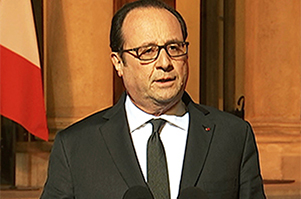
President Francois Hollande (top, right) has since stated that he believes there is no doubt that this was a terrorist attack, while a group alleging to represent Islamic State (IS) has since claimed responsibility, just three weeks ahead of the French General Election.


COLD AND CALCULATED MURDER

Describing the incident, witnesses said how a car parked next to a police transport vehicle before a man got out and began firing an automatic weapon, killing one policeman and injuring another – plus a passing female tourist. The attacker was subsequently shot dead as he tried to run away.


Police and investigators now suspect the identity of the attacker is a 39-year old male with a criminal record who lives in an eastern Parisian suburb. However, there were contradictory reports at press time – including speculation that he may or may not – have been working with an accomplice.


PARIS Arc de Triomphe

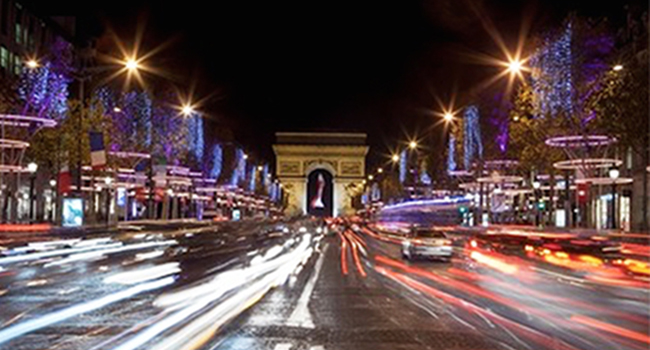
The Champs-Elysees has ‘returned to normal’ this morning, as the capital city of Paris comes to terms with yet another terrorist incident and its tourism industry inevitably fears yet more damaging fall-out.

This latest incident in France this year alone follows the two well-documented attacks on soldiers at the Louvre last February and also in Paris Orly Airport last month.


MULTIPLE INCIDENTS

In February, a soldier shot and injured a man who attacked a security patrol at Paris’ Louvre Museum, while security officers shot and killed another who tried to wrestle a gun from a female member of a security patrol at Paris Orly in March [https://www.trbusiness.com/regional-news/europe/security-shoot-man-dead-at-paris-orly-sud-airport/117187].


The last two years have been very difficult for France since January 2015, with more than 240 innocent people killed over the two-year period, in no less than 22 confirmed terrorist incidents.


However, the French government is determined that Paris will not be closed down by these continued terrorist incidents, with the Champs-Elysees boulevard now reported to have been reopened – albeit under tight security controls.


The government will also be hoping that this latest event will not damage the country’s tourism industry as badly as the coordinated terrorist attacks on Paris did in November 2015 – and the subsequent Nice attack in July 2016.


DFWC says UK election call will have only ‘limited impact’

UK PM Theresa MayUK Prime Minister Theresa May’s 180-degree U-turn decision to hold a ‘surprise’ June 8 general election should not be viewed with incredulous surprise, although speculation that this might somehow make any Brexit process ‘less hard’ might be wishful thinking on the part of some.


At the same time, European Travel Retail Confederation (ETRC) President Sarah Branquinho says, ‘our view at this stage is that this election will not have any impact on the overall Brexit process, other than to delay negotiations slightly whilst a new government is formed’.


She adds that it is also inevitable that the European lobbying body – which is obviously working hard towards the restoration of full UK duty free allowances – will experience some delays to its political engagement activities, due to the government’s new diary change.


ETRC DUTY FREE LOBBYING WORK CONTINUES

In a holding statement, Branquino said: “Article 50 has been triggered and therefore our job is to continue to show both the UK and EU governments the benefits of a return to duty free sales for UK air and sea passengers.


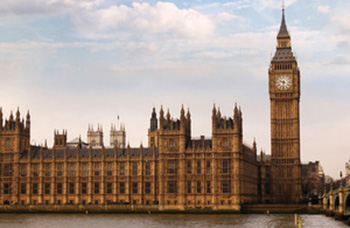
Houses of Parliament“Our lobbying work continues in the UK, in Brussels and in capital cities across the EU, and we need the entire industry and all stakeholders to work with us to achieve our goal.”


While ETRC can only wait for this process to run its course, this election may not be such a singularly Brexit-led focus event as Prime Minister May would like, although in truth there are few who expect it will backfire.


The prospect that the government might not improve its current 17-strong parliamentary majority will nevertheless be there until all the votes have been finally counted, although this is clearly a gamble that Prime Minister May seems comfortable with.


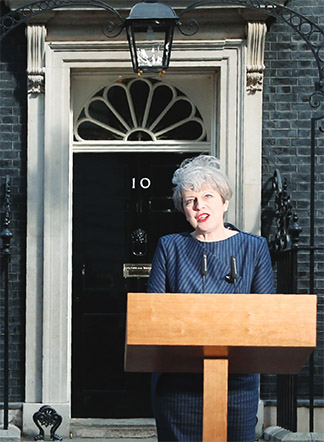
Rheresa May announces snap election April 2017

UK Prime Minister Theresa May announces the snap election date as June 8, 2017.

As such, the potential opportunity to deal the UK Labour Party opposition another mortal blow is clearly irresistible.


Having said that, Labour and other opposition groups – including the Liberal Democrats – have welcomed the snap election call.


CLEAR ELECTORIAL MANDATE

At the same time, the Hume Brophy Public Affairs company rightly says that the prime minister’s agenda is clearly looking to the electorate to provide her with more powerful and mandated majority voting powers to remove any doubts over her legitimacy to lead the UK out of Europe.


As Hume Brophy says: “At the moment, May is limited to the election promises of a manifesto which belonged to someone else. This election presents an opportunity for her to set her own agenda for government and amass enough support to push through the Great Repeal Bill – the first stage in ending the application of EU law in Britain.”


The public affairs company adds: “This will include renewal of opportunities to use the Salisbury Convention to compel the Lords to vote in favour of policies included in an election-winning manifesto.


“The prime minister is acutely aware that divisions in her party over Europe have claimed the political careers of three predecessor Conservative prime ministers. We might therefore expect Brexit to be an existential threat to her, but so far this has not dented her popularity.”


[Another reason for calling the snap election was that May and her advisors were also aware that following the triggering of Article 50, the government’s deadline for all negotiations to be complete would have been 2019, with the previously scheduled general election set for just one year later –Ed].

ISPY to introduce the ‘Award for Excellence’ this year

ISPY-2016-leadTravel Retail Training Ltd (TRT) has created the ISPY Award for Excellence, as part of its new-format International Sales Professionals of the Year (ISPY) Academy and annual event.


As previously announced, ISPY has been extended to include all duty free and travel retail sales channels, in addition to inflight. The concept is underpinned by a unique Academy, created with the aim of ‘becoming the key industry learning and certification resource for all sales professionals, customer-facing staff and their learning and development managers’.


The Academy Learning Management System (LMS), which goes live on 1 September 2017, will feature a series of e-learning assessments mapped against the ISPY Academy best practice standards.


“These will enable TRT to identify (and subsequently address) the skills and knowledge gaps within each participating organisation; benchmark knowledge and skills levels within each organisation, each travel-retail channel and across the industry; identify the most knowledgeable and skillful sales professionals,” says TRT.


Christine-Martin-MD-TRT-UK

TRT Managing Director Christine Martin.

Organisations with the most knowledgeable and skillful sales professionals will be rewarded with the ISPY Academy Award for Excellence, which will be presented at the Gala Dinner & Graduation Ceremony. This takes place on 20 December and concludes the ISPY 2017 three-day annual event.


‘LEADING THE WAY IN EDUCATION’

“ISPY is known for leading the way in using education and motivation to increase productivity and profitability,” noted TRT Managing Director Christine Martin.


“Together our new Academy, e-learning, certification and awards offer a unique learning and motivation resource and continued professional development service that will enhance, enrich and add value to every participating organisation.”


For more information about TRT and the ISPY Academy and annual event, contact Christine Martin on email: [email protected]; tel: +44 7811 372891.

Traffic +11.4% for MAN, but flat for Stansted

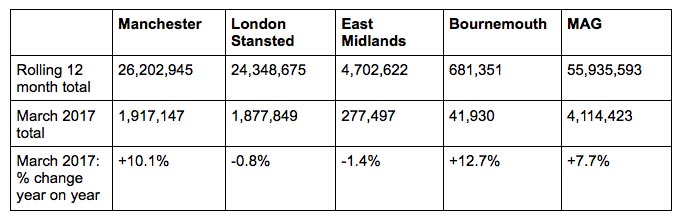
Manchester-Airport-leadMAG’s Manchester Airport has added 2.7m passengers to its annual total in the last year, representing growth of 11.4%, in a sign that airlines and passengers alike are increasingly looking to fly from the UK’s third airport as Heathrow and Gatwick fill up, it says.


Manchester Airport continued its spell of double-digit growth in March, with 1.9m passengers flying through the airport’s three terminals last month; +10.1% more than in March last year.


The airport’s recent growth has been enough to place it as the second fastest growing large airport in Europe in the most recent analysis from Airport Councils Europe. Among airports serving more than 25m passengers per year, only Moscow Sheremetyevo is growing faster.


In the past year, Manchester has flown more than 1.1m additional passengers to Spain alone, and four of the five destinations with the most passenger growth are Spanish.


GROWTH ON ROUTES TO FRANCE

After Spain, the next biggest short haul growth has been to France (+261k), Germany (+228k) and Italy (+198k), while the most significant long haul growth has been to the USA (+125k), Pakistan (+112k) and China (+77k).


MAG-airports-traffic-March-2017


Long haul growth has been driven by new routes, including the new direct service to Beijing with Hainan Airlines, and a new route to Houston with Singapore Airlines. Meanwhile, increased capacity to Islamabad has contributed to a surge in traffic to Pakistan.


Fellow MAG airport, London Stansted saw March’s passenger figures broadly flat (-0.8%) year on year. The inaugural flights from Jet2.com, which has chosen Stansted as its first base in the South East, will offer more capacity on more routes from next month.


Additionally, Stansted has recently celebrated winning planning permission for its new arrivals building, which will allow it to build the facilities it will need to make full use of existing single runway over the next 10-15 years.


East Midlands Airport handled 277,497 passengers in March (-1.4%) and Bournemouth Airport grew 12.7% to serve 41,930 passengers.

US and foreign airlines carry record 928.9m pax in 2016

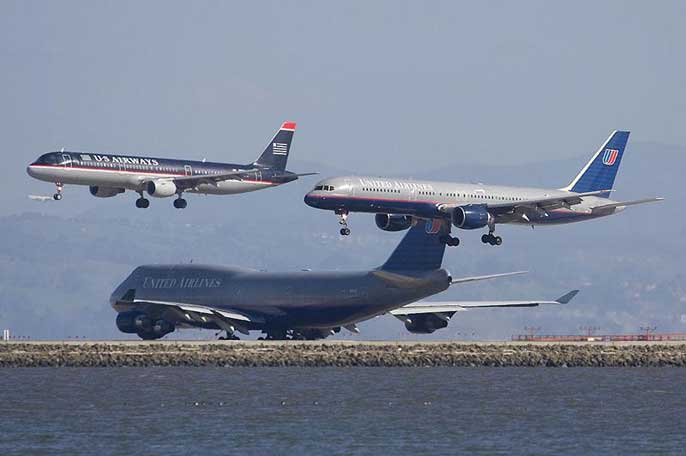
Lots of planesAccording to the US Department of Transportation’s Bureau of Transportation Statistics (BTS) US and foreign airlines serving airports in the United States handled an all-time high of 928.9m system wide (domestic and international) scheduled service passengers in 2016 – a rise of 3.5% more than the previous record high of 897.9m reached in 2015.


The BTS says that the system wide increase was the result of a 3.3% rise from 2015 in the number of passengers on domestic flights (719m in 2016) and 4% growth from 2015 in passengers on US and foreign airlines’ flights to and from the US (209.9m in 2016).


The BTS said: “US airlines carried 3.3% more passengers on domestic flights and 1.7% more passengers on international flights in 2016 than in 2015 for a system wide increase of 3.1%.


“Foreign airlines carried 6.3% more passengers to and from the United States than in 2015. The 209.9m passengers on international flights to and from the United States was a record high, exceeding the previous high set in 2015.”


san-fran-airport-planesAMERICAN CARRIED MOST INTERNATIONAL FLIGHTS

The BTS adds that Southwest Airlines carried more total system passengers in 2016 than any other US airline, while American Airlines carried more passengers on international flights to and from the US in 2016 than any other US or foreign carrier. British Airways carried the most passengers on flights to and from the US of any foreign airline.


Meanwhile, in its analysis of the airports with the most passengers, BTS said: “More total system passengers boarded planes in 2016 at Atlanta Hartsfield-Jackson International than at any other US airport. More passengers boarded international flights at New York John F. Kennedy than at any other US airport.”


Looking at the overall demand, the BTS added: “From 2015 to 2016, system wide demand, measured in Revenue Passenger-Miles, (RPMs), grew by 4.7%, while capacity, measured in Available Seat-Miles (ASMs), grew by 5%. As a result, the load factor – the measure of the use of the capacity – fell by 0.2%.


“Demand on international flights, measured in RPMs, rose 4.7% in 2016, less than the 4.8% rise in capacity measured in ASMs. The result was a decline in the international load factor to 80.5 from 80.6 in 2015.”


Tablet loans help Emirates respond to electronics ban

Emirates

The new tablet loan service applies to first and business class passengers only.

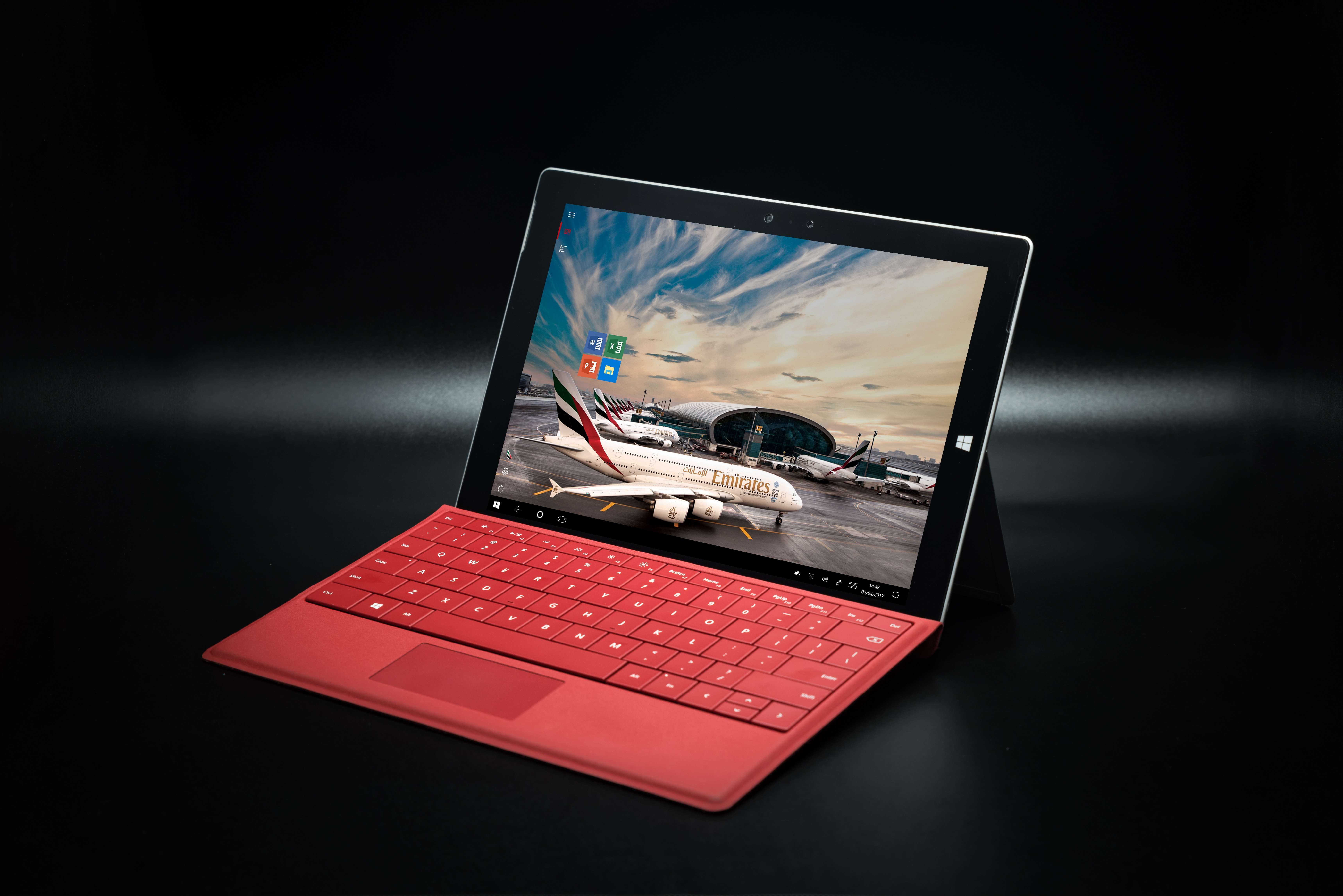
Emirates has launched a tablet loan service for its US-bound first and business class passengers in a bid to mitigate obstacles caused by the US Transportation Security Administration’s (TSA) onboard electronics ban.

Premium class travellers travelling on non-stop Emirates’ flights from Dubai to its 12 US airport destinations are now able to borrow tablets onboard as part of a complimentary service.

This alleviates the need to check in items such as laptops, tablets and devices larger than smartphones. The Microsoft Surface tablets will come equipped with Microsoft Office 2016.

Emirates previously introduced a laptop and tablet handling service for US-bound customers, available to all cabin classes since 25th March – the date the *TSA ban took effect.

PASSENGERS HAVE OPTIONS…

Nearly 8,000 passengers travelling on the airline’s 112 weekly non-stop services from Dubai to the US have taken advantage of the function to date.

They are permitted to use their personal devices until just before embarkation at the boarding gate, after which items are tagged, packed and stored in the aircraft hold before being returned to passengers at their destinations.

A statement from Emirates read: “These two new services by Emirates gives customers travelling to the US several options, such as packing their electronic devices into their check-in baggage at their point of departure; the opportunity to use their laptops and tablet on their first leg of their journeys and during transit in Dubai, up to the moment they board their US-bound flight; and for premium customers the choice to continue working on loaned devices on board.

“Customers can stay connected in the air with mobile phone connectivity, in-seat telephones with SMS and email and live TV on most flights. Currently, over 85% of Emirates’ fleet of passenger aircraft is equipped with Wi-Fi on board.”

Surface_1SERVICE ROLL OUT?

Emirates were yet to respond to TRBusiness‘ request for comment at the time of writing on whether there were plans to roll out the service from other departure destinations in the Middle East and North Africa subject to the ban. This includes any extension of the tablet loan service to economy class cabins.

Last month, Dubai Duty Free COO Ramesh Cidambi suggested the ban on certain electronics products in cabin luggage could cost the duty free retailer as much as $2m in lost revenue over the year, with US-bound passenger sales accounting for approximately 2% of its $1.85bn total revenue in 2016.

The electronics ban, which prevents devices carried in hand luggage on flights between the US and eight countries – many of which are Muslim-majority (Egypt, Jordan, Kuwait, Morocco, Qatar, Turkey, Saudi Arabia and the United Arab Emirates’ Dubai and Abu Dhabi) – was officially implemented on 25th March by the US Department of Homeland Security, but anticipated by TRBusiness days earlier.

This followed an information notice on Twitter from Royal Jordanian Airlines informing passengers departing to and arriving from the US that any electronic or electrical device carried onboard was prohibited.

As reported, the UK followed suit by banning inbound laptops, iPads and ‘some’ mobile phones in passenger hand luggage on flights between six countries to Britain (Egypt, Jordan, Lebanon, Saudi Arabia, Tunisia and Turkey).

Authorities stated at the time that items can still travel with passengers, provided they are housed in airlines’ baggage holds.

IATA Director General and CEO Alexandre de Juniac issued a statement following the ban, which read: “The current measures are not an acceptable long-term solution to whatever threat they are trying to mitigate. Even in the short term it is difficult to understand their effectiveness. And the commercial distortions they create are severe. We call on governments to work with the industry to find a way to keep flying secure without separating passengers from their personal electronics.”

*The TSA directive does not apply to Emirates’ US-bound flights via Milan and Athens, nor does it impact flights departing from the US or Emirates’ flights to other destinations.