Archives

IATA points to encouraging February passenger growth

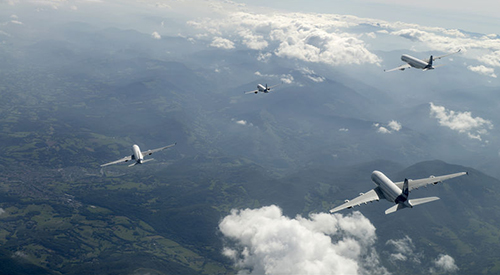
airbus multuiple planes copyGlobal passenger traffic expressed in total revenue kilometres (RPKs) for February rose by +4.8% compared to February last year, according to the International Air Transport Association (IATA).


However, IATA says ‘the real growth’ was higher at around +8.6% as year-on-year comparisons were distorted in February 2016 as it was a leap month.


IATA said: “Adjusting for the one fewer day this year, the underlying growth rate was estimated at +8.6%, just under January’s increase of 8.9%. Monthly capacity (available seat kilometres or ASKs) increased by 2.7%, and load factor rose 1.6 percentage points to 79.5%, which was the highest ever recorded for February.”


Adding his comments, IATA Director General and CEO Alexandre de Juniac said: “The strong demand momentum from January has continued, supported by lower fares and a healthier economic backdrop.


“Although we remain concerned over the impact of any travel restrictions or closing of borders, we have not seen the attempted US ban on travel from six countries translate into an identifiable traffic trend. Overall travel demand continues to grow at a robust rate,” he said.
 

International passenger growth by airline region of registration

Click on table to enlarge.

PRICE OF AIR TRAVEL HAS FALLEN

At the same time, IATA estimates that even allowing for inflation, the price of air travel has fallen by more than 10% in real terms over the past year, accounting for more than half the growth in RPKs in early 2017.


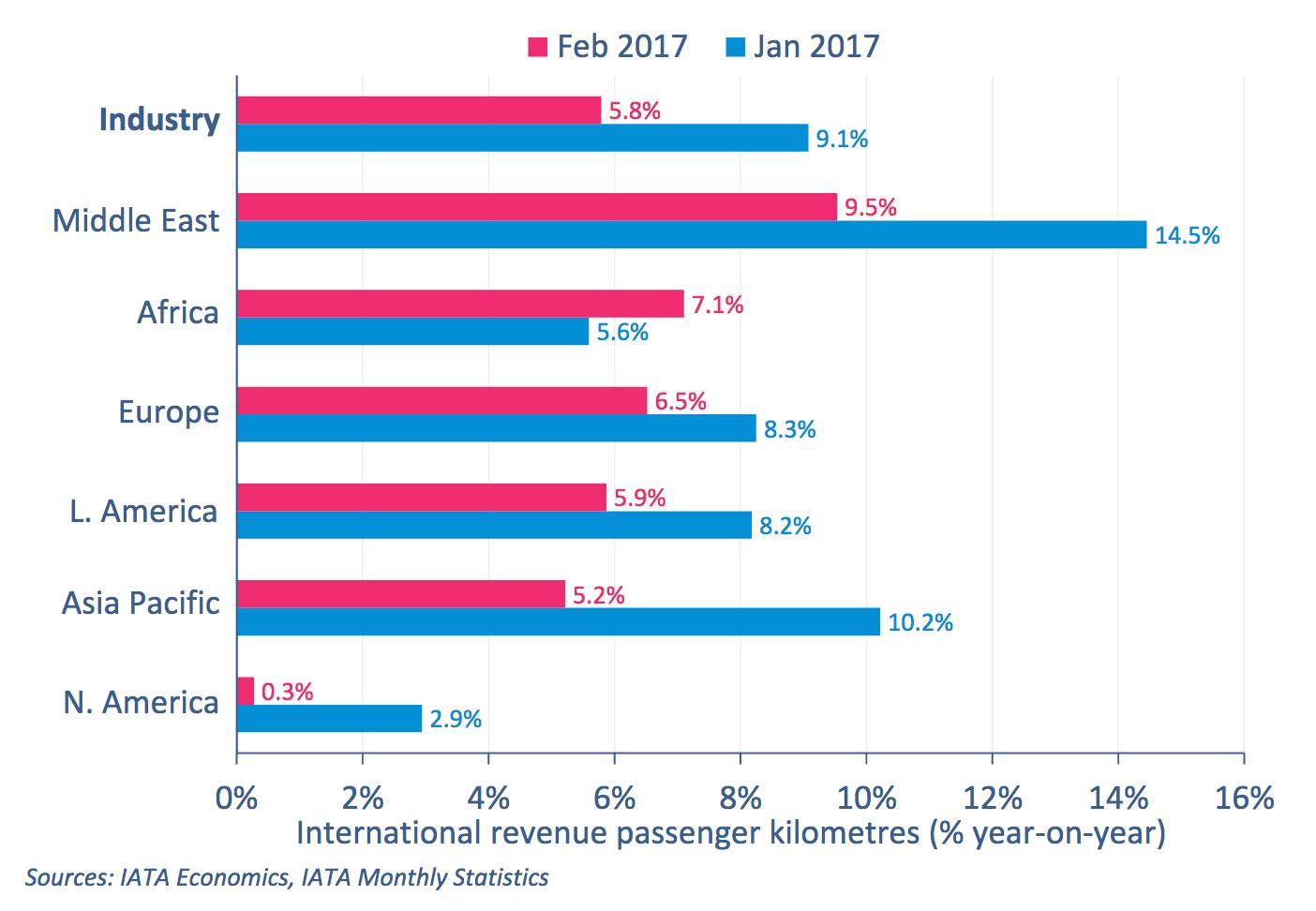
Breaking it down, February international passenger demand rose by 5.8% compared to February 2016, which was down compared to the 9.1% yearly increase recorded in January. Adjusting for the leap year, however, growth actually accelerated slightly compared to January, while total capacity rose 3.4% and the average load factor rose by 1.8 percentage points to 78.4%.


Turning to its monthly regional review, IATA added: “European carriers saw February demand increase by 6.5% compared to a year ago. Traffic has resumed its growth after the terrorist disruptions in 2016, supported in part by momentum in the regional economy. Capacity climbed 3.4% and load factor surged 2.4 percentage points to 81.1%.


“Asia-Pacific airlines’ February traffic rose 5.2% compared to the year-ago period, maintaining the strong momentum of the past few months. Intra-Asia traffic remains robust and conditions on the Asia-Europe route have continued to recover from last year’s terrorism-related slowdown. Capacity increased 2.9% and load factor climbed 1.7 percentage points to 79.8%.


“Middle East carriers had the strongest growth, with a 9.5% demand increase in February compared to a year ago. Capacity rose 7% and load factor climbed for a fourth consecutive month to 74.3%, up 1.8 percentage points over last year.
 

Domestic passenger growthbNORTH AMERICAN TRAFFIC TRAILING BEHIND

North American airlines’ traffic climbed 0.3%, which was the slowest among the regions. However, adjusting for the leap year, growth was estimated at 3.4%. Traffic to/ from Asia continues to move upward but transatlantic demand has trended sideways since mid-2016. Capacity inched up 0.1% and load factor edged up 0.1 percentage points to 75.9%.


“Latin American airlines saw February traffic rise 5.9% compared to February 2016. Capacity increased by 2.8%, boosting load factor 2.3 percentage points to 81.4%, highest among the regions. Robust international demand within South America is offsetting weaker traffic to North America, which has trended downward since mid-2015 and fell by 3.4% in January, the most recent month for which route-specific results are available.


“African airlines continued their recovery, with February traffic up 7.1% compared to a year ago. This mainly reflects the upturn on the key route to/from Europe, offsetting struggles in the region’s biggest economies of Nigeria and South Africa. Capacity rose 2.3%, and load factor jumped 2.9 percentage points to 66.0%.”


DOMESTIC DEMAND STEADY AT +3.3%

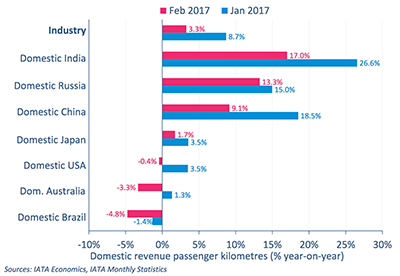
By contrast, domestic passenger travel within individual countries saw demand rise by 3.3% in February compared with the same month last year. This was a reduction from 8.7% in January with the leap year effect once more exaggerating the slowdown.


IATA says that results varied widely as Australia, Brazil and the US all registered non-adjusted declines. Domestic capacity climbed 1.6%, and the load factor increased by 1.3 percentage points to 81.4%.


In his monthly comment appraisal Alexandre de Juniac said: “The year has opened with some shocks – the attempted ban on travel to the US by citizens of six countries and the restrictions on the carry-on of large electronic items from certain airports in the Middle East and North Africa on direct flights to the US and the UK.

 

IATA de juniac

IATA Director General and CEO Alexandre de Juniac.

RESTRICTIONS ON ELECTRONICS: ‘A MISSED OPPORTUNITY’

“The potential implications of the Brexit talks on the air transport industry are significant and the political rhetoric of protectionism and closing of borders is adding to the ambiguity.


“It’s intolerable that governments continue to add to the uncertainties facing the air transport industry by failing to engage airline operational know-how on issues that can damage public confidence.


“The introduction of restrictions on the carry-on of large electronic devices was a missed opportunity and the result was a measure that cannot stand-up to the scrutiny of public confidence in the long term.


“Although Australia’s measures were also implemented without consulting the industry, they at least demonstrate the potential to mitigate the threat with less disruptive means. We all want to keep flying secure. And we can do that most effectively by working together.” said de Juniac.


He also called upon countries to support the International Civil Aviation Organization (ICAO) as it develops a Global Aviation Security Plan. Additionally, next month, ICAO member states will consider amendments to Annex 17 of the Chicago Convention that would require information sharing. “The security experience of recent years should compel states to support this,” said de Juniac.

DFWC’s economic reports ‘well-received’ by regulators

DFWCMeeting during last week’s IAADFS show in Orlando, the DFWC reported significant progress on the preparation of an Economic Impact Study on the importance of the Duty Free & Travel Retail Industry in the Americas.


Encouragingly, the DFWC says its Europe data-based economic report on the contribution of DF&TR to employment, airport and maritime financing, and indeed the overall economy, has been well received by regulators and governments.


“The value of such studies has been clearly demonstrated in Europe,” confirms the DFWC.


The Economic Impact Study on the Americas region will encompass North and Latin America and will cover the core channels comprising airports, border shops and cruise ships.


Field-work will be completed in Q2 and Q3 and the final report is expected to be published before the end of this year.

IAADFS-2017-exhibition-aisle

The DFWC was able to cover a great deal of material at its meeting held during the IAADFS Duty Free Show of the Americas last week.


DFWC ACADEMY UPDATE

Once completed and published, the study will be made available for consultation in the DFWC library, where the European Economic Impact Study can also be accessed, www.dfworldcouncil.com/data-resources


The council also reported progress on the work of the DFWC Academy where an industry wide consultation on draft Professional Standards for frontline retail staff is drawing to a close.


The council expressed its appreciation to all of those who have participated in the survey and provided valuable comment. Details of the consultation process can be reviewed at http://dfworldcouncil.com/dfwc-academy-consultation/.


“Discussions on the provision of a Professional Development Programme for management levels within the industry continue with a number of academic institutes,” adds the DFWC.


The council agreed that the academy would proceed with the development of some initial online learning modules.


In addition, the agreed DFWC Code of Conduct for the Sale of Alcohol Products in Duty Free & Travel Retail has been distributed across all regions and a register of the companies who have signed the code is being drawn up.


The Council has also agreed to adopt the APTRA created training programme for the Responsible Retailing of Alcohol products called RRTP and, where necessary, to adapt the programme to the specific needs and requirements of their respective regions. The Council expressed its appreciation to APTRA for making this material available.


Alpha LSG gains new five-year Jet2.com contract extension

Jet2.comAlpha LSG has won a new five-year extension to 2021 for its contract to provide catering, procurement, warehousing and packing of Jet2.com’s retail products for the airline’s entire UK network – with additional new routes now added out of Birmingham and London-Stansted from the end of last month.


As part of this contract, Alpha is also responsible for bar sets and service products packaged into kits for passengers. Hot meals are supplied to the airline’s customers including entrees from Alpha LSG’s frozen food production facility, along with full logistical support for loading and unloading aircraft, equipment cleaning and storage.


EXCELLENT RELATIONSHIP…

According to a statement from Alpha, this latest extension is part of the ‘excellent long-standing relationship’ between the two parties, since the award-winning airline began operating in the UK in 2003 from its main UK hub at Leeds-Bradford Airport.


Jet2 makes a stand

Jet2 is much admired and is one of the leading airlines to take a zero-tolerance stance on unruly passengers in the past.

The airline – which is said to be UK’s fourth largest scheduled operator – has since expanded services to the regional airports of Belfast, Edinburgh, East Midlands, Glasgow, Manchester and Newcastle in addition to the aforementioned Birmingham and London-Stansted.


Commenting, Alex Forbes, CEO of Alpha LSG said: “We have been the caterer of choice for Jet2.com since the airline’s inception 14 years ago, working closely with their team to support the airline’s rapid growth through our renowned expertise and our ability to meet all of their requirements at all of their bases across the UK.much


Alex Forbes, CEO, Alpha LSG

Alex Forbes, Alpha LSG CEO.

ALPHA HAS CONTRIBUTED TO AIRLINE SUCCESS

“This enhanced contract with Jet2.com reflects the superb relationship that has developed over the years and recognises the efforts of the entire team at Alpha LSG to provide the very best catering and logistical services to the airline. Indeed in 2016 we achieved a remarkable on-time performance score of 99.83% across Jet2’s bases, underpinning our reputation for reliability and consistency.”


Steve Heapy, CEO of Jet2.com and Jet2holidays added: “At Jet2.com everything is about delivering the very best for our customers, which is why we are a multiple award-winning airline that is growing all the time.


“Our relationship with Alpha LSG has made a significant contribution towards that success and this extension means we can continue providing an excellent on-board service for our customers.”


Jet2.com is expected to have a fleet of 75 aircraft by Summer 2017 and operate over 250 scheduled routes to around 65 destinations from nine UK bases.

PATA 5-year forecast expects 630m will visit Asia in 2017

Asia Pacific forecast PATAThe Pacific Asia Travel Association (PATA) expects the region to attract more than 630m international visitors in 2017, according to its most recent five-year 2017-2021 forecast for the Asia Pacific visitor economy.


This is part of the latest forecast data, which is now available at PATAmPOWER ‘exclusively for PATA Corporate members’.


PATA estimates that ‘collective’ foreign arrivals into 39 Asia Pacific destinations will grow by 5.9% this year compared with 2016, representing an additional 35m foreign arrivals to the region this year.


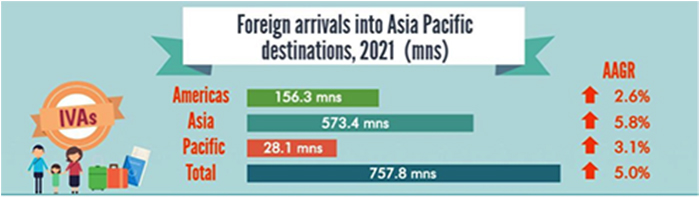
In a statement, PATA said: “Between 2017-2021, foreign arrivals into Asia Pacific are expected to grow at an average rate of five per cent per annum, reaching a combined foreign inbound count of close to 758m.


Foreign arrivals into Asia Pacific destinations 2021

ASIA PULLING WELL AHEAD…

“By 2021 the Americas (as defined by PATA) will be receiving 156m foreign arrivals annually, while Asia can expect to receive over 573m. The Pacific is forecast to receive over 28m foreign arrivals annually. China, Hong Kong SAR, the USA, Korea (ROK) and Canada will all remain in the top five traffic-generating markets for the Asia Pacific region.”


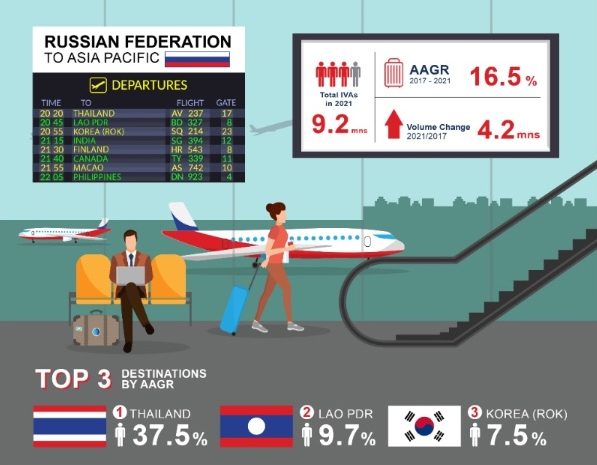
In addition, PATA predicts that the Russian Federation will generate four million foreign visitor arrivals to the Asia Pacific by 2021 and take the third-place ranking in absolute volume terms over 2017, following China and Hong Kong SAR.


Other destinations including Thailand (+37.5%), Lao PDR (+9.7%) and Korea (ROK) (+7.5%) will register the highest average annual growth from the Russian Federation over the next five years, while a few destinations such as Hong Kong SAR (-5.0%), Cambodia (-3.6%) and the Northern Marianas (-2.3%) are expected to face a slowdown in numbers from this source market.


Russian Federation 4m VISITOR ARRIVALS BY 2021

GLOBAL UNCERTAINTY FACTORS

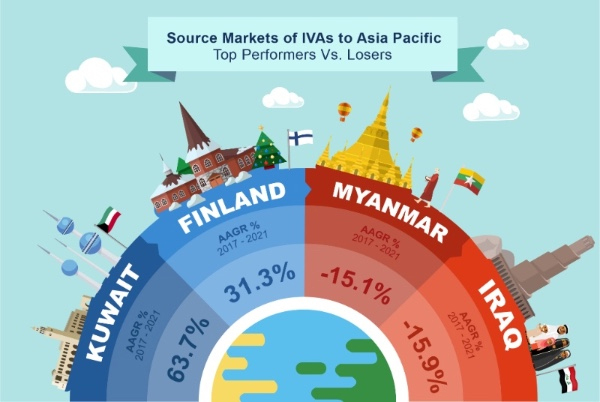
Interestingly, Kuwait will top the source market chart in percentage growth terms with an average growth rate of 63% annually between 2017 and 2021, followed by Finland (31%).


Meanwhile, Iraq and Myanmar are predicted to rank far behind with these source markets each contracting by around -15% annually over the same forecasting period.


“Although visitor arrivals growth remains impressively strong for destinations in the Asia Pacific region over the next five years, ongoing global economic uncertainty, coupled with rising political populism in the USA and Europe will present a continued challenge to and impact upon disposable income of travel consumers, travel demand and movement between countries,” said PATA CEO Dr Mario Hardy.


“These forecasts provide a valuable quantification of the expected future trends of travel demand for the Asia Pacific region and thus allow for risk assessments to be made well ahead of the curve.”


Source markets of IVAs to Asia Pacific winners and losers


Any readers interested in obtaining this study and/or becoming a member of PATA can contact the organisation at the following email address: [email protected]

Qatar/Etihad beat laptop ban as RJ says shop till you drop

Laptop Qatar Airways2 Qatar Airways and Etihad Airways have both risen to the recently-introduced ‘laptop/tablet challenge’ by offering to loan passengers laptops as they board so they can continue working, while Royal Jordanian Airlines has made a wish list of 12 other things to do, including onboard ‘shop til you drop’ duty free shopping.

Besides offering re-loan laptops on appropriate flights, Qatar Airways also points out that its permanent Wi-Fi connectivity also allows all of its passengers to use permitted phone devices throughout its flights. A specially introduced new offer means this now costs just $5 per passenger for the duration of the flight

Commenting, Qatar Airways Group CEO His Excellency Mr. Akbar Al Baker said: “As an award-winning and global airline we truly appreciate the importance of being able to work on board our aircraft and that is why I have insisted on offering only the best possible solution for our customers.

Laptop Qatar Airways

‘SHOP TIL YOU DROP’ SAYS RJA

“By providing this laptop loan service we can ensure that our passengers on flights to the US can continue to work whilst on-board. This unique ability to offer ‘business as usual’, above and beyond the competition, is yet another example of Qatar Airways justification for being the ‘World’s Best Business Class’.”

Qatar Airways says the complimentary laptops will be available to Business Class passengers travelling on all US-bound flights from Monday (3 April) and can be collected after boarding. Customers are being advised to download their work on to a USB memory stick before boarding.

Meanwhle, Qatar Airways is also offering a special service at the gate for all passengers, whereby any electronic items prohibited by the new ban will be collected and securely packaged. These will then be tagged, loaded as check-in baggage and returned safely to the customer on arrival to the US.

In the meantime, Royal Jordanian management hasn’t lost its sense of humour. It is currently offering two return tickets from Amman to the US for the best Electricsban poem from any paseenger with a cut off date of 10 April, while it has also published a tweet suggesting 12 things to do on a 12-hour ‘laptopless flight’… from the ordinary to ‘well beyond…’.

The 12 suggestions include the following:

1.  Read a book.
2.  Enjoy a light snack.
3.  Say hello to the person next to you.
4.  Meditate.
5.  Spend an hour deciding what to watch.
6.  Appreciate the miracle of flight.
7.  Engage in primitive dialogue from the pre-internet era.
8.  Reclaim territory on the armrest.
9.  Pretend the tray table is a keyboard.
10. Shop till you drop from the onboard duty free.
11. Analyse the meaning of life.
12. Think of reasons why you don’t have a laptop or tablet with you.

Airbus says LATAM will need 2,570 more aircraft by 2035

Airbus traffic forecastThe latest Airbus Global Market Forecast predicts that Latin America will need a total of 2,570 new passenger and freight aircraft – including 2,030 single-aisle and 540 wide-bodied planes worth $350bn – to service forecast demand through to 2035,


This is one of the key findings in the latest upbeat Airbus Global Market Forecast presented by Rafael Alonso, President of Airbus Latin America and Caribbean, at the International Brazil Air Show.


At the same time, he predicts that Latin America’s passenger and freighter fleet will surpass 3,000 in the next 20 years – more than double the fleet in-service today.


VERY GOOD NEWS FOR AIRPORTS AND RETAILERS…

The best news with it is the additional prediction that Latin America’s passenger traffic is now forecast to grow on par with the world average by 4.5% annually until 2035, which will be a welcome trend if it finally emerges.


This growth rate takes into account the 3.8% traffic rise between Latin America and other continents, plus the predicted 4.9% increase in Latin America’s domestic and intra-regional traffic over the next 20 years.


The Airbus forecast also says that Latin America’s middle classes will play an important role in prompting growth, reaching half a billion people by 2035 – more than double the number in 2006.


Airbus is predicting a major growth era for Latin AmericaLONG-TERM GROWTH FOR LATAM

Rafael Alonso said: “There’s no doubt that solid long-term growth is in store for Latin America and we see single-aisle aircraft leading the demand. We believe the A320neo Family, already flying with Latin America’s top carriers, remains perfectly suited to deliver on future growth and efficiency demands in the region, given its superior performance and comfort.”


Alonso added: “In the next 20 years Latin America will also be impacted by the rise of low-cost carriers in key markets such as Colombia, Chile, and Peru. This business model will impact market dynamics in the years to come, especially in domestic and intra-regional travel.


“Looking ahead, we also see a good opportunity for the region’s carriers to be more bullish on developing intra-regional routes, a space in which Latin America is less developed than other regions.”


AVIATION CONTRIBUTES +$32BN TO BRAZIL’S GDP

Meanwhile, Airbus says that in Brazil, where the aviation industry contributes over US$32bn to the country’s GDP, fleets serving the country will require over 1,400 aircraft by 2035 to meet market demand.


The report says that this will be driven by an increase in Brazilians’ propensity to travel, predicted to double the amount of trips per capita and the acceleration of traffic growth which is forecasted to increase by 4.8% annually in the next 20 years – above the region’s and world’s rates.


Ryanair warns UK could have no flights to Europe post-2019

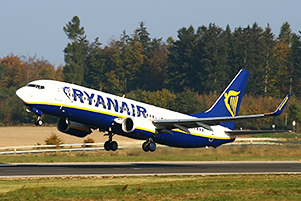
Ryanair BrexitRyanair, the world’s leading international scheduled carrier and equally Europe’s number one has warned that the UK could have no flights to/from Europe from March 2019 – when the UK leaves the European Union.


The low-cost scheduled carrier – which expects to carry 44m passengers to/from British airports this year – says that when the UK leaves Europe’s ‘Open Skies’ membership, the government will either have to negotiate a bilateral agreement with the EU to allow flights to/from Europe to continue, or revert to historical WTO rules which do not cover aviation.


The Irish carrier argues that in turn, the latter prospect could raise ‘the distinct possibility of no flights between Europe and the UK for a period from March 2019’ – in the absence of any bilateral deal.


RYANAIR CONCERN OVER ‘POST-OPEN SKIES REGIME’

Ryanair spokesman Kenny Jacobs said: “Some nine months on from the Brexit referendum, we are no closer to knowing what effect it will have on aviation. It’s become worrying that the UK Government seems to have no plan B to maintain Britain’s liberalised air links with Europe, in the absence of remaining in the ‘Open Skies’ regime’.


THE AIRLINE TOLD TRBUSINESS EXCLUSIVELY TODAY THAT ITS GROWTH RATE FOR FLIGHTS BETWEEN EUROPE AND THE UK STOOD AT 15% LAST YEAR, BUT IT EXPECTS ITS UK GROWTH RATE TO MORE THAN HALF TO JUST 6% THIS YEAR, WHICH IS BAD NEWS FOR AIRPORTS AND RETAILERS.


As a result, Ryanair is now calling upon the UK government to push aviation to the top of its priority negotiations with the EU to provide a coherent post-Brexit plan.


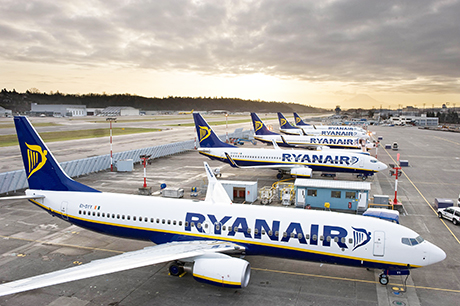
001 aa ryanair-aircraft-12

It is little realised that Ryanair has consistently carried more international passengers than any other airline for several years, according to IATA’s World Airline Transport Statistics. For example, last year IATA calculated that Ryanair carried over 101.4m international passengers in 2015 (the last year under review) with almost 40m more than second-placed Easyjet (62.6m); 50m more than third-placed Emirates; 54.5m more than Lufthansa (46.9m) in fourth place; and 64.5m more than fifth-placed British Airways (36.9m).

Ryanair, which employs over 3,000 UK staff and will carry over 44m customers to/from British airports this year has already ‘pivoted growth away from the UK’ to other EU airports.


The airline told TRBusiness exclusively today that its growth rate for flights between Europe and the UK stood at 15% last year, but it expects its UK growth rate to more than half to just 6% this year which is bad news for airports and retailers.


NO MORE AIRCRAFT FOR THE UK?

It has also taken the decision to base no additional aircraft at its 19 UK airports in 2017, while cutting its growth rate from 15% to an expected 6% this year.


The airline has also warned the UK government that as the clock is ticking fast, it needs to immediately outline a strategy to maintain low fare air travel between the UK and the EU from March 2019.


Ryanair’s Jacobs added: “With Britain planning to leave the EU and its Open Skies agreement, there is a distinct possibility that there may be no flights between the UK and Europe for a period of time after March 2019.


19 UK AIRPORTS RELY ON RYANAIR PASSENGERS TO SHOP

“The best we can hope for is a new bilateral agreement between the UK and EU. However, we worry that Britain may not be able to negotiate such a bilateral in time for the release by airlines of summer 2019 schedules in mid-2018.


“Ryanair, like all airlines, plans its flights 12 months in advance, so there are just 12 months to go until we finalise our summer 2019 schedule, which could see deep cuts to our flights both to, from and within the UK from March 2019 onwards.


“The UK Government must respond to the airlines and our customers, and put aviation at the top of its agenda when it negotiates its Brexit deal with Brussels. Britain’s airlines, airports and holidaymakers need a real and early solution for aviation, or risk Britain being cut off from Europe in March 2019.”


UNWTO: nearly 500m tourists (+4%) visited Europe in 2016

UNWTO logoThe World Tourism Organization (UNWTO) says its preliminary results show that nearly 500m international tourist arrivals – equivalent to 40% of the world’s total – visited the European Union last year.


The WTO reports that the 28 countries of the EU experienced a +4% increase in international tourist arrivals, effectively exceeding the world’s average growth rate as the received an additional 21m additional visitors to take the exact number past the 499m-mark.


According to the WTO, 2016 represented the ‘seventh consecutive year’ of sustained growth for the EU-28, following the 2009 global economic and financial crisis, with a total of 107m more tourists visiting the EU last year than when compared with the pre-crisis level of 2008.


taleb rifai unwto

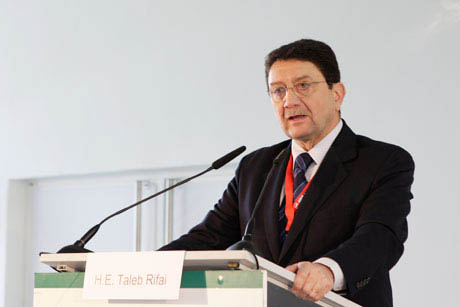
UNWTO Secretary-General, Taleb Rifai.

TOURISM: ‘ONE OF THE KEY PILLARS OF EU STRATEGY’

These findings have been released by the WTO as part of its preliminary results within the first release of the ‘European Union Short-Term Tourism Trends’.


This is a regular monitor of EU tourism by the World Tourism Organization (UNWTO) within the framework of cooperation with the Directorate-General for Internal Market, Industry, Entrepreneurship and SMEs (DG GROWTH) of the European Commission (EC).


UNWTO Secretary-General, Taleb Rifai commented: “Tourism is today one of the key pillars of the EU strategy for jobs and inclusive growth. UNWTO is very pleased to be working alongside the European Commission in monitoring international tourism trends, advance product development and sustainable tourism in Europe.”


IATA judges laptop cabin ban unacceptable and ineffective

Laptop IATA controversyThe International Air Transport Association (IATA) considers the recent laptop cabin ban by certain governments and airlines to be ’unacceptable’ and ‘ineffective’, according to the world airline body’s Director General and CEO, Alexandre de Juniac.


So much so that he is now calling upon governments ‘to urgently find alternatives to recently announced measures by the United States and the United Kingdom’ to restrict carry-on large electronic items on flights departing the Middle East and North Africa.


US AND UK LAPTOP CABIN BANS ‘INEFFECTIVE’

He argues that the US and UK laptop bans in cabin baggage on certain flights will not be effective as a security measure: “The current measures are not an acceptable long-term solution to whatever threat they are trying to mitigate,” said de Juniac.

 

“Even in the short term it is difficult to understand their effectiveness. And the commercial distortions they create are severe. We call on governments to work with the industry to find a way to keep flying secure without separating passengers from their personal electronics.”


De Juniac’s appeal was delivered in a recent speech to the Montreal Council on Foreign Relations where he emphasised the need to maintain public confidence in the security of the global aviation industry, which he pointed out delivers some 100,000 flights a day both safely and securely.


Typical current screening technology involving carry on bags through airport security.

INCONSISTENCIES MUST GO, SAYS DE JUNIAC

He said: “With the measures now in place, our passengers and member airlines are asking valid questions. Why don’t the US and the UK have a common list of airports?


How can laptops be secure in the cabin on some flights and not others, including flights departing from the same airport?


“And surely there must be a way to screen electronic equipment effectively? The current situation is not acceptable and will not maintain the all-important confidence of the industry or of travellers. We must find a better way. And governments must act quickly,” said de Juniac.


Meanwhile, IATA says that it has ‘long called for better information sharing and coordination on security measures amongst both governments and industry.


‘INTELLIGENCE IS KING’

“While governments have the primary responsibility for security, we share the priority of keeping passengers, crew and aircraft secure. To do that effectively intelligence is king. And it needs to be shared amongst governments and with the industry. It’s the only way to stop terrorists before they get near an airport, let alone aircraft,” said de Juniac.

IATA Director General and CEO, Alexandre de Juniac.

IATA Director General and CEO, Alexandre de Juniac.


“Airlines don’t want access to state secrets. But if airlines understand the outcome governments want, they can help with the operational experience to deliver that result effectively and efficiently,” he said.


With international cooperation in mind, IATA says that challenges to aviation security were highlighted in Resolution 2309 of the UN Security Council, which tasked the International Civil Aviation Organization (ICAO) with developing a Global Aviation Security Plan (GASeP).


“The need for such a plan has been made very clear by wide gaps in the measures taken by governments in recent days. States need to lend their full support to ICAO in developing GASeP quickly. And even before that can be achieved, there is an early opportunity to make a real improvement to international cooperation on security.


“In May ICAO member states will consider amendments to Annex 17 of the Chicago convention that would require information sharing. The security experience of recent years should compel States to support this,” he said.

Asia Pacific passenger traffic +2.2% to 24.2m in February

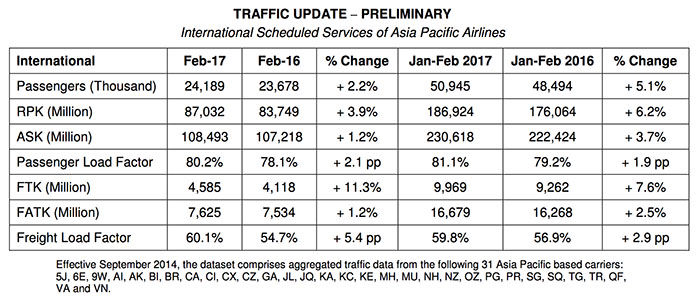
airbus multuiple planes copyThere was continued growth in international air passenger demand in February with the Association of Asia Pacific Airlines (AAPA) reporting an aggregate total 24.2m international passengers using the region’s carriers – a rise of 2.2%.


AAPA says preliminary figures ‘showed continued growth in international air passenger demand, whilst the pace of expansion in air cargo markets quickened, with solid increases in demand.’


ENCOURAGING START TO 2017

The association said: “In revenue passenger kilometre (RPK) terms, demand grew by 3.9%, reflecting relative strength on long-haul markets. Combined with a modest 1.2% expansion in available seat capacity, the average international passenger load factor strengthened by 2.1 percentage points to 80.2% for the month.


Airline Traffic update table“Measured in freight tonne kilometres (FTK), international air cargo demand of the region’s carriers registered a double-digit growth of 11.3% compared to the same month last year, underpinned by strong growth in new export orders and an acceleration in international trade activity.


“Growth in demand outpaced the 1.2% expansion in offered freight capacity by a comfortable margin, resulting in a 5.4 percentage point increase in the average international freight load factor to reach 60.1% for the month.”


Having said this, Andrew Herdman, AAPA Director General did point to a ‘distortion in growth comparisons’ due to the earlier timing of this year’s Lunar New Year festive period, but nevertheless, combined figures for the first two months still demonstrated an encouraging 5.1% rise in passenger numbers carried by the region’s carriers to a combined total of 51m.


BUSINESS CONFIDENCE REMAINS HIGH

Andrew Herdman

Andrew Herdman, AAPA Director General.

Herdman said: “During the same period, air cargo demand registered a healthy 7.6% increase, with a boost in demand for air cargo shipments of intermediate and finished goods.”


Concluding very positively, he said: “High levels of business and consumer confidence across most major markets underpins continued optimism for further growth in both air passenger and cargo demand.


“However, intense market competition, rising fuel and other costs will continue to put pressure on yields. As such, the region’s carriers remain vigilant in seeking further opportunities to enhance growth and increase operational efficiency.”


AAPA says that the region’s airlines carry around 1,214m passengers and 20m tonnes of cargo a year, representing one-third of global passenger traffic and two-fifths of global air cargo traffic respectively.