Archives

Cuba opening signals new dawn for Americas travel

Top White House Cuba Press conference

President Obama and President Raul Castro of Cuba at a joint press conference in Havana this week.

Last February’s US-Cuban agreement to permit 20 daily flights to Havana and 90 daily flights to nine other Cuban cities should open the door to a much larger and virtually tapped tourism market for the Americas – according to a study by the respected Fitch Ratings agency in New York.


In a briefing note on the expected development of travel between the two countries, the agency says it expects Cuban tourism will help drive regional airport traffic growth, with many airports in the region potentially set to benefit.


Thanks to the much-improved relations between the Washington and Havana administrations, Fitch says several feeder airports in the US will be important.


US AND CARIBBEAN AIRPORTS WILL BENEFIT

These include Miami and New York (where most foreign resident Cuban-Americans live) and it says Havana Airport’s potential could well unfold in the same way as has happened with other major airports in the Caribbean, including those in Puerto Rico and Dominican Republic.


Fitch said: “The normalization of relations between the US and Cuba will result in a higher number of travellers for Havana’s airport and will raise leisure-oriented enplanements at several US airports, including Miami and New York.”

 

President Obama waves to the crowd in Havana

President Barack Obama and his wife Michelle acknowledge the crowds in Havana on the latest state visit this week. [Photo credit all Obama pictures: The White House].

However, there are many analysts and politicians alike who rightly point out that this is just the beginning of a much better relationship between the two countries.


At the same time, the Cuban Government is also acutely aware that it needs to make major improvements to its tourism infrastructure if it is to adequately handle future demand.


Much work is already underway under the instructions of the Cuban government, which is also acutely aware that this new dawn is also a great opportunity for the country to start rebuilding its tourism industry with its nearest neighbour.

 

Obama visit to Cuba

Obama’s visit to Havana this month has put the seal of approval on opening up travel between the United States and Cuba.


The fact that President Obama arrived for a state visit to Cuba earlier this week is also very significant, building on the earlier work to open up travel between both countries. That this is a big event can be seen from the fact that this is the first time a sitting US president has visited Cuba in more than 80 years.


CURRENCY ISSUES HAVE BEEN DEALT WITH

As reported, the rules allowing a limited quota of Americans to travel to Cuba and spend US dollars have already been eased and US airlines have also been jostling to submit their proposed new routes to Cuba this month.


Obviously, Fitch Ratings is not alone in its belief that these flight numbers will grow over time, although it acknowledges it will be from a small base to begin with.


The ratings agency currently estimates Havana Airport’s departing passenger numbers at ‘around a few million per year’ although it admits to an of ‘uncertainty’ on the numbers, due to the current lack of data transparency at present.

 

Locals line the streets to welcome US President Obama to Havana

Locals line the streets to welcome US President Obama and his family to Havana this week. [Photo credit: The White House].

Nevertheless, it adds: “It [Havana Airport] could grow to be similar to that of two airports in the region. In our view, Puerto Rico’s Luis Munoz Marin International (SJU) and the Dominican Republic’s Punta Cana International Airport share some factors with Havana’s Jose Marti International Airport – aiding this comparison.


“Puerto Rico’s top destinations include New York, Orlando and Miami. We believe Havana will grow to share some of these destinations. According to the Federal Aviation Administration, SJU’s enplanements in 2014 were just over 4.1m. This may be indicative of Havana’s potential.


HAVANA AIRPORT SET TO GROW FAST…

“However, Cuba’s population is approximately three times as large as Puerto Rico’s. In the long run, this could lead Havana to larger enplanement rates. Furthermore, strong cultural ties may keep demand strong for years to come, even after the initial period of flight services.”

 

Havana beckons

Havana and all of its history and culture beckons – along with Cuba’s famous beach resorts.


Fitch adds that the Dominican Republic has a similar population to Cuba and Punta Cana’s top destinations may also be similar to Havana’s current list of major airports in Canada and the EU.


For example, Punta Cana’s top two destinations are Toronto and Paris. According to the Banco Central de La Republica Dominicana, Punta Cana saw approximately 783,000 enplanements in 1993, rising to 5.2m enplanements in 2013.
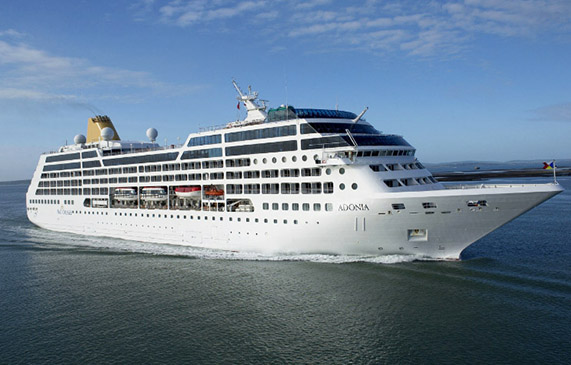
 

Carnival Corporation’s Fathom cruise brand has been granted approval by the Cuban Government to operate cruise services from the US to Cuba from May 1, 2016. The 704-passenger MV Adonia will make the first sailing to Cuba in more than 50 years, initially calling at Havana, Cienfuegos and Santiago de Cuba – the three ports of call for which Carnival Corporation has been awarded berthing rights. [Photo credit: Carnival Cruise Line].

Of course, it should also be noted that tourism isn’t all about airports in Cuba, with President Obama pointing out in Cuba this week that Washington has removed the last major hurdle to resuming cruise and ferry line services between the two nations.


Clarins’ Piquereau heads off to AmorePacific

Amore Pac N PiquereauLong-time Clarins senior executive, Nicolas Piquereau, has joined South Korea’s fast-expanding beauty house AmorePacific as Senior Vice President for Global Travel Retail.

In the new job, which he started in January, Piquereau is tasked with defining, developing and implementing short and long-term strategic directions and plans for AmorePacific’s duty free and travel retail business. Implementation of an integrated sales process store openings, product operations, and in-store promotions are also in his remit.

Prior to joining the Korean company, Piquereau was Commercial Director for France at Clarins Group for 18 months. However,  he has been tapped for his extensive experience in the DF&TR channel.

He was General Manager Travel Retail Worldwide at Clarins Group for almost three years from October 2011 to June 2014 and before that he had Regional Director DF&TR roles for the house in both Asia Pacific and Europe lasting a decade.

In the 1990s he also held the post of Regional Sales Manager Asia-Pacific at Beaute Prestige International (a Shiseido company) for more than four years.

International visitors to US spent $18.3bn in Jan

President Obama and President Xi Jinping.The US Department of Commerce’s International Trade Administration reports that international visitors spent an estimated $18.3bn on travel and tourism-related activities within the country in January 2016.


Both educational and health-related tourism, plus short-term worker expenditures apparently accounted for $4bn, a rise of more than 10% when compared with January 2015.


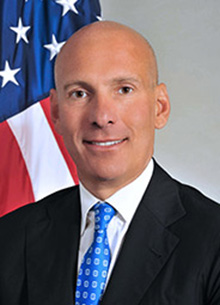
United States’ Under Secretary of Commerce for International Trade Stefan M. Selig said: “Today’s data show that the United States remains a desirable destination for international travellers.


Stefan Selig

Stefan Selig.

TOURISM GENERATES $1.6 TRILLION

“The travel and tourism industry remains important to the nation’s economy and to American workers, annually generating nearly $1.6 trillion of economic output that supports nearly 8.1m US jobs.


“The Commerce Department continues to introduce new initiatives like the recently launched 2016 US-China Tourism Year to support President Obama’s National Travel and Tourism Strategy goal of welcoming 100m international visitors by 2021.”


Selig added that one of the outcomes coming directly from President Xi’s September 2015 visit to the United States is that the 2016 US-China Tourism Year aims to increase travel and tourism between both countries.


The US and China are hoping to each enhance the traveller experience, increase the cultural understanding and expand travellers’ appreciation of natural landscapes in each other’s countries.


President and President

Chinese President Xi Jinping on his visit to meet with President Barack Obama at the White House last year. [Photo credit: The White House].

Meanwhile, purchases of travel and tourism-related goods and services by international visitors travelling in the US in January reached $11.1bn this year, while travel receipts accounted for 60% of total US travel and tourism exports during the same month.


FAST GROWING INDUSTRY

Passenger receipts on fares from US carriers from international visitors also reached $3.3bn for the month, accounting for 18% of total US travel and tourism exports during January. In addition, medical/education/short-term worker receipts accounted for 22% of total US travel and tourism exports during January 2016.


This report follows the ITA’s revelation earlier this month that at +9%, San Francisco International Airport (SFO) enjoyed the highest rate of international passenger traffic growth of any airport in the US last year.


AS reported, that was ahead of other major ‘international gateway airports’ such as New York-JFK, Los Angeles and Miami.


See more at: http://www.trbusiness.com/regional-news/the-americas/sfo-had-fastest-us-rate-of-international-growth/102436#


Norwegian promises 150 aircraft if Gatwick wins

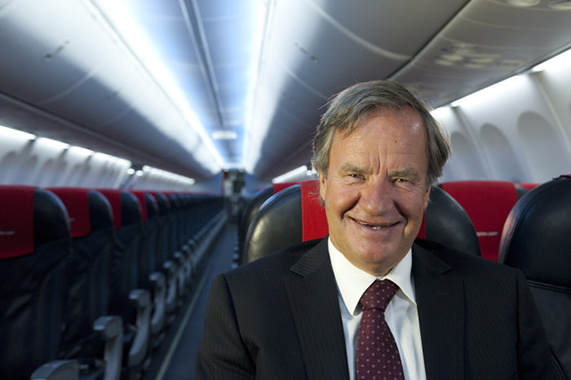
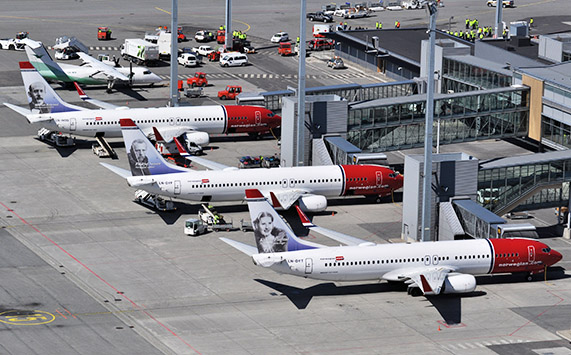
Bjorn Kjos, CEO, NorwegianLow-cost short and long-haul carrier Norwegian is promising to base 50 new long-haul 787 Dreamliners and 100 new short-haul aircraft at London Gatwick Airport if it is chosen as the airport for expansion within the next decade by the UK Government.


Norwegian already has more than 260 new aircraft on order, including 30 Dreamliners and in a speech to the UK Aviation Club yesterday, Bjorn Kjos, the CEO of Norwegian said clearly: “I strongly back Gatwick as the right choice for the new runway.”


Norwegian is already one of Gatwick’s fastest-growing airlines, carrying nearly 4m passengers from the airport a year. In 2014 it also launched the UK’s first low cost, long haul US service direct from Gatwick to New York, Fort Lauderdale and Los Angeles and it is adding Boston and Oakland (San Francisco) this year.


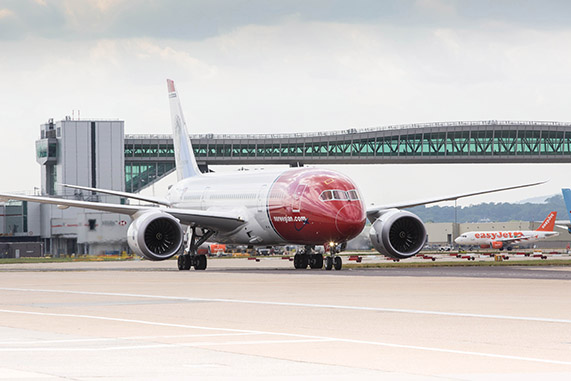
Norwegian 787 Dreamliner big

One of Norwegian’s nine 787 Dreamliners.

‘POSITIVE INTERVENTION…’

Stewart Wingate, Gatwick CEO said: “This is by far the most significant and positive intervention by an airline in the expansion debate to date. Norwegian’s ambitious plans will continue the low-cost long haul revolution for UK passengers delivering significantly cheaper long haul fares and more choice for generations to come.


“Norwegian recognises that Gatwick expansion can actually happen and would deliver a step change in capacity at a price everyone can afford. The UK must realise the potential of expansion and unlock the full benefits of competition by choosing a second runway at Gatwick.”


So what did Bjorn Kjos actually, say? Here are his final comments on the Gatwick issue from yesterday’s speech which TRBusiness has extracted from his speech without editing:


Bjorn Kjos, the CEO of Norwegian


Bjorn Kjos, the CEO of Norwegian:


“As a final topic, it would be impossible for me to speak to an aviation audience in London and not mention the runway debate between Gatwick and Heathrow. As I mentioned earlier, we have grown to become the third-largest airline at Gatwick, so I’m sure it won’t surprise you to hear that I strongly back Gatwick as the right choice for the new runway.


GATWICK RUNWAY A DECADE AWAY?

“This isn’t just for selfish commercial reasons – in my view Gatwick is the only choice that will actually deliver what the whole industry needs. Clearly Heathrow is a world-class airport, but when we look at how the industry is changing and what it needs in the future – lower landing charges and more capacity for low-cost growth, greater competition, more point-to-point travel – it is clear that Gatwick is the best choice.


“Delivery is also crucial and history has shown us that Heathrow has struggled for many years to deliver a third runway – by comparison Gatwick can build a new runway inside a decade. Gatwick would be the right choice and the bold choice for the whole of the industry – so let me be equally bold in explaining the opportunities Norwegian sees if Gatwick expands.


Norwegian at London Gatwick


“A Gatwick second runway would allow us to be even more ambitious in our plans for long-haul growth in the UK. That is why I am happy to commit that Norwegian will locate more than 50 new Dreamliner aircraft at Gatwick once a second runway is built.


A POTENTIALLY DRAMATIC INCREASE…

“To put that into context, we only have nine Dreamliners in our entire global operation today, so locating more than 50 at Gatwick would be a dramatic increase – it would help us create a truly global low-cost network serving a range of established and emerging markets.


“And it is equally important to increase our short-haul network to help feed continued long-haul growth, so let me make a second commitment: If Gatwick expands, for each of the 50 new Dreamliners we would also locate two new short-haul aircraft – so that is another 100 new short-haul aircraft at Gatwick in total.


Norwegion has already built a good reputation


“Again, to put this in context, that would mean doubling our entire global fleet of short-haul aircraft, solely at Gatwick.


“These may sound like big numbers, but they reflect the huge opportunities we are presented with – Gatwick is being ambitious in its plans for a second runway, so it is only right that airlines should show equal ambition.


“It also makes commercial sense – Gatwick’s costs are at the right price for us to continue offering lower fares, and their location gives us access to a catchment area of 18m people. Simply put – Gatwick is in the right place and at the right price.”


Heathrow loses market share to London rivals

London Stansted is growing well after years of stagnation.

London Stansted is growing well after years of stagnation.

London Heathrow Airport (LHR) is losing passenger share to its three key rival London air gateways according to provisional 2015 data from the UK’s Civil Aviation Authority. It has now slipped below the 30% mark.

Last year, LHR’s share of passengers at UK airports went from 30.8% in 2014 to 29.8%. While London Gatwick [the UK’s second busiest airport] was static with a 16% share, London’s low-cost carrier airports of Stansted (STN) and Luton (LTN) saw their shares rise significantly to 8.9% and 4.9% respectively (see table below and click to enlarge).

The increasing popularity of these latter airports –and their low-cost airlines – means that LGW, STN and LTN now have a combined share of the UK market exactly equal to that of LHR. STN and LTN are the fourth and fifth biggest airports in the UK with traffic of 22.5m and 12.3m passengers respectively last year.

UK top 20 airports 2015 (source: CAA)

UK top 20 airports 2015 and their market shares (source: CAA)

All three have also been developing their duty free and travel retail offers substantially. In July, the latest of these retail improvements will be Lagardère Travel Retail’s inauguration of its new DF&TR stores at LTN.

This year, based on growth projections, these three London gateways combined are expected to process more passengers than LHR. The CAA figures show that the passenger growth rate in 2015 was +2.10% for LHR which is constrained by its runway capacity. Against this, LGW had growth of +5.7%, Stansted +12.9%, and LTN surged by +17%.

London’s fifth biggest airport, City, is much smaller and processed 4.3m passengers, growing by +18.4% in 2015.

Restructuring Royal Jordanian picks DFASS

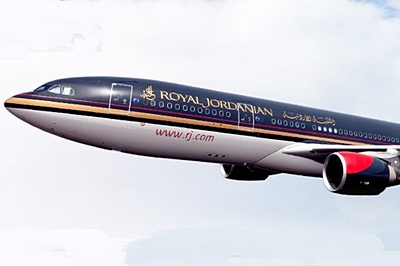
Royal JordanianUS-based inflight duty free and travel retailer, DFASS Group, has tied up with Royal Jordanian Airlines (RJ) to launch an on-board programme.

Jordan’s flag carrier – a member of the Oneworld alliance– has been undergoing a far-reaching restructuring following a net loss of JOD39.6m/$56m in 2014 which the company turned to a profit of JOD16m/$22.6m in 2015.

However the airline – based at Amman’s Queen Alia International Airport – is still reviewing its route network and reducing operating costs. RJ has shut down a number of stations [Delhi, Mumbai, Colombo, Lagos, Accra, Milan, Alexandria and Al-Ain] due to their weak economic feasibility and, consequently, reduced the number of its aircraft.

The carrier has also had to halt flights to eight destinations for security reasons: Damascus, Aleppo, Mosul, Tripoli, Benghazi, Misrata, Sanaa and Aden, but it has launched new destinations such as Tabuk, Najaf, Ankara, Jakarta and Guangzhou, the latter launching next week. Royal Jordanian currently flies to 56 destinations.

DFASS ceo Benny Klepach

Klepach is pleased to relaunch RJ’s inflight programme.

‘RIGOROUS RFP’

According to DFASS, the company was selected by RJ “following a rigorous RFP process whereby numerous factors were evaluated including information technology, creative sales/marketing plans, and access to prestige products, as well as a global operational infrastructure”.

Benny Klepach, CEO of DFASS Group, comments: “Royal Jordanian Airlines is an important partner and we are pleased to relaunch its inflight duty free sales.” Saul Hyatt, President and COO of DFASS Americas – EMEA, adds: “DFASS has developed strategic sales and marketing plans that have identified areas of tremendous opportunity for our customers.”

Asia arrivals to hit 550m in 2016; +600m in 2018

Report PATA QTM-2015-01The Pacific Asia Travel Association (PATA) is forecasting that the 38 main Asian destinations it monitors will continue to grow, passing 550m foreign arrivals in 2016 and more than 600m in 2018.


PATA said: “Each year between 2016 and 2020 is predicted to set new records for foreign arrivals which will reach a near-term collective record high of close to 650m by 2020.”


The association says this is ‘one of the key findings’ within its ‘Asia Pacific Visitor Forecasts 2016-2020’ report, which is not due for full release until the first half of 2016. [PATA adds that its members can now view and access some of these copyright forecasts at the following link: http://mpower.pata.org/forecasts/forecast-visitor-arrivals/-Ed].


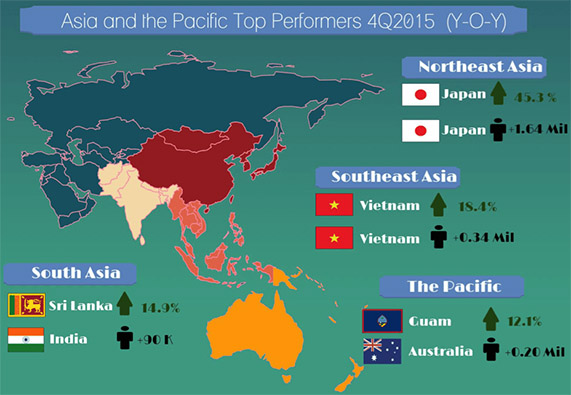
Meanwhile, PATA has also released its international visitor arrivals findings for 31 Asia Pacific destinations covering the fourth quarter of 2015, which show a year-on-year growth rate of 4.5% compared with the same period in 2014.


Tab 1 QTM2015-infographic copy

Infographic Source: Pacific Asia Travel Association (PATA).


Initial results were mixed, according to PATA, with South Asia recording one of the highlight results, returning a 5.3% year-on-year increase in international visitor arrivals (IVAs), thanks to a 14.9% rise in visitors to Sri Lanka.


PATA added: “Northeast Asia reported a minimal growth of 2.5%, weighing down by arrivals to Hong Kong SAR that reported a decrease of 8% during the quarter.


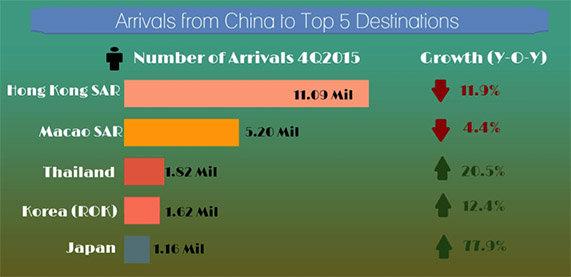
“Hong Kong SAR saw a significant drop of arrivals from its main source market China (-11.9%) during the quarter. On the other hand, Japan continued to see significant arrivals surge from China (+77.9%).


“In Southeast Asia, Vietnam and Myanmar led the region growth during the quarter, reporting year-on-year growth of 18.4% and 16.9% respectively.


Chinese QTM2015-infographic copy

Infographic Source: Pacific Asia Travel Association (PATA).


“During 4Q2015, Vietnam outperformed other regional peers in terms of both volume and percentage increases. The destination saw a significant rise of arrivals from its largest key source market, Northeast Asia, of 24.8%.”


Meanwhile, PATA added that in the Pacific, Oceania reported a solid growth of 10% during the period, benefiting from strong traffic from Northeast Asia.


The PATA Quarterly Tourism Monitor 2015 is available to PATA members at a cost of $500; Chapter members at $750 and non-members at $1,000. For more details, please contact: [email protected]

Gategroup points to strong ‘transformation’

Top Xavier Rossinyol CEO, gategroupGategroup Holding AG reported ‘a solid performance’ in 2015 in what was a year of ‘transformation’ according to CEO, Xavier Rossinyol, who says the company  is ‘on track’ to deliver on its five-year Gateway 2020 strategy.

In its results statement today, the company said: “In the first year of the five-year strategy, gategroup made considerable headway and is delivering to plan. The team simplified the business and engaged in turnaround measures to drive growth.

During 2015 the company renewed strategically important catering contracts worth CHF540m a year with Delta Air Lines, Air Canada and SAS, followed in early 2016 with United Airlines and American Airlines.


INFLIGHT SERVICE TO ADD CIRCA $250M
It also ’added CHF250m-worth of sales turnover which should materialise this year with the acquisition of Swedish travel retail specialist operation Inflight Service Group (IFS).

This is also expected to increase EBITDA by CHF13.4m a year and be cash accretive to earnings per share in year one. The company adds: “The acquisition further expands gategroup’s leadership position in retail on board in terms of size, number of customers, business intelligence (with data comprising purchasing preferences of more than 175m passengers worldwide), and onboard technology).

gategroup announced its acquisition of Inflight Service Group in December 2015

Gategroup announced its acquisition of Inflight Service Group in December 2015 and this is expected to boost profits. This will obviously be welcome as it made a CHF63.4m loss in 2015 compared with a CHF38.9m profit in 2014. This has led to speculation that this is why some minority shareholders have called for changes in the board room. gategroup blamed foreign exchange losses of CHF23.8m, plus restructuring charges and adjustments for the loss.

“The deal was complemented with new business agreed with TUI Group for retail on board services.” [As reported exclusively by TRBusiness comprehensively-Ed].

By the end of 2015, the company claims to have achieved almost half of its overhead reduction target of about 300 managerial positions by the end of 2016 and this is expected to deliver savings of about CHF20m a year.

REGIONAL STRUCTURE

Last June the company realigned its business into a regional structure focused on operating excellence and standardization, reporting performance by four regional segments: EMEA (Europe, Middle East, Africa and the Commonwealth of Independent States), North America, Latin America and Asia Pacific.

EMEA reported total revenue of CHF1,447.2m, or CHF1,529.3m at constant currency, stable with total revenue of CHF1,530.7m in 2014 and the North America region reported strong revenue growth, with total revenue for 2015 of CHF1,045.4m, or CHF1,016.2m at constant currency.

By contrast, the Latin America region increased total revenue to CHF219.1m for 2015, a 3.2% increase over total revenue of CHF212.3m for 2014, while the Asia Pacific segment had total revenue of CHF296.6m for 2015, down from CHF322.8m for the prior year.

TUI Group airlines

The TUI Group retail airline contract is very important to gategroup following the consolidation of the company’s many airline arms.

gategroup said this reflected the deconsolidation of Shanghai operations in 2014, plus foreign exchange impacts.

Commenting on the results, Xavier Rossinyol, CEO said: “2015 was a year of powerful transformation at gategroup. With the continued trust of our shareholders, customers and business partners, we set our new strategy in motion and undeniably progressed during the first year of our five-year journey.

“Each step was underpinned by a committed approach by our Board of Directors, our management and the entire gategroup team working together.

“Through these joint efforts, gategroup enhanced every area of the business. In just one year, we achieved organic revenue growth of 4.8%, ensured greater concentration on profit, with adjusted EBITDA reaching CHF180.8m and set additional focus on cash flow generation.

“The last quarter of the year showed continued acceleration, with 5.2% revenue growth and a 17.3% increase in EBITDA at constant currency, over prior year.


Inflight-Service-Warehouse-Logistics-Centre-in-Tibro-Sweden

The Inflight Service warehouse and logistics centre in Tibro Sweden.

‘SIMPLIFIED’ ORGANISATION
“We simplified the organization. We energized our commercial strategy with more than CHF540m of annual revenue renewed, including extensions with some of the top 10 customers for the Group, based on strengthened commercial capabilities.

“We launched the most innovative and complete offering in retail on board furthered by the IFS acquisition. We also expanded in emerging markets by establishing a presence in Kazakhstan.”

As exclusively reported last year, gategroup’s ‘Gateway 2020 Strategy’ unveiled to investors last September foresees its retail onboard share changing radically by 2020 from around 18% today to 50% – a huge move towards strengthening the retail side of the business to balance with its food business.

[Editor’s note: No currency conversions have been included at the time of writing, considering the current exchange rate sees the dollar and Swiss franc trading at virtual parity].
 

IATA: 2016 passenger demand ’strong’

Planes IATAThe International Air Transport Association (IATA) has underlined continuing strong demand for international travel in January, pointing to a 7.1% rise in revenue passenger kilometres (RPKs) compared with the same month last year.

This growth rate is ahead of the 2015 full year growth rate of 6.5%, with January capacity up 5.6% and load factors increasing by 1.1 percentage points to 78.8% – the highest load factor ever recorded for the first month of the year.

Tony Tyler, IATA’s Director General and CEO said: “January maintained the strong traffic growth trend seen in 2015, showing the resilience of demand for connectivity, despite recent turmoil in equity markets.

“The record load factor is a result of strong demand for our product and airlines making the most productive use of their assets. Underlying conditions point to another strong year for passenger traffic, with the latest decline in oil prices likely providing additional stimulus for air travel growth.”

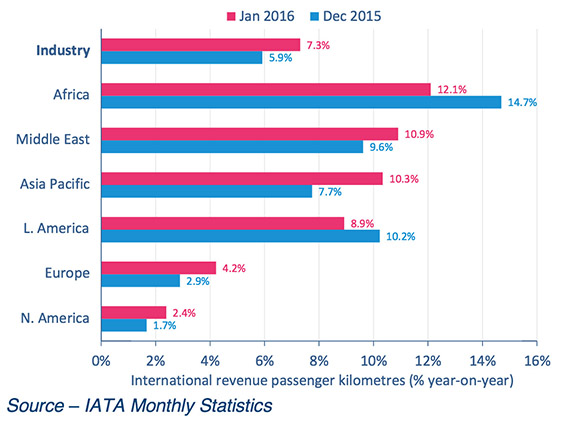
IATA added that international traffic in January rose by 7.3% compared to the year-ago period, while capacity rose 5.9% and the load factor rose one percentage point to 78.8%. All regions recorded year-over-year increases in demand.


Int pax table 2016 IATA

International passenger traffic growth by region of registration Jan 2016.

Looking at the regions, IATA noted the following:

• Asia Pacific carriers recorded an increase of 10.3% compared to January 2015. Capacity rose 7.6%, pushing up load factor 2.0 percentage points to 79.2%. A 7.3% increase in the number of direct airport connections within the Asia region over the past 12 months or so has helped to stimulate demand.

• European carriers’ international traffic climbed 4.2% in January compared to the year-ago period. Capacity rose 2.6% and load factor rose 1.2 percentage points to 78.8%. Airline strikes and the shutdown of Russia’s Transaero caused the region’s traffic to fall in the last quarter of 2015. Volumes have picked up somewhat in recent months.

• North American airlines saw demand rise 2.4% in January over a year ago. Capacity rose 1.3%, pushing up load factor 0.8 percentage points to 80.3%. North American international traffic growth was weakest among the regions, as carriers have focused on the stronger and larger domestic market.

Int pax traffic minus domestic growth

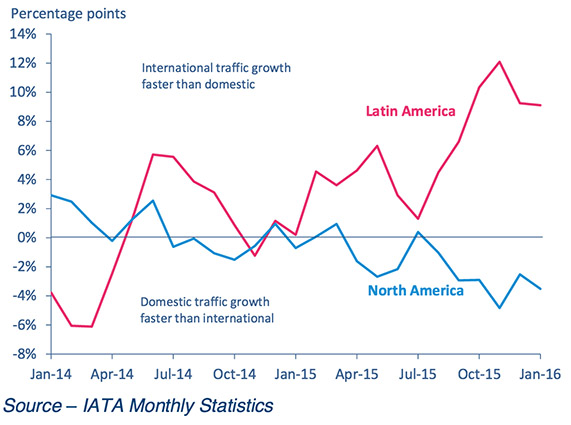
International passenger traffic, minus domestic growth.


• Middle East carriers had the strongest year-over-year demand growth in January at 10.9%, helped by ongoing network and fleet expansion. Capacity rose 12.9% and load factor dipped 1.4 percentage points to 77.8%.
• Latin American airlines’ traffic climbed 8.9% in January. Capacity rose 7.8% and load factor increased 0.8 percentage points to 82.5%, highest among the regions. Domestic traffic remains under pressure from economic difficulties in the region’s biggest economies, notably Brazil, but the strong growth in international demand shows little sign of slowing.
• African airlines saw January traffic jump 12.1% compared to January 2015. IATA said this continues the strong upward trend in travel since mid-2015 that coincides with a jump in exports from the region over the same period. With capacity up 8.2%, load factor rose 2.5 percentage points to 71.3%.

Turning to domestic passenger markets, IATA said air travel rose by 6.8% in this sector in January year-on-year, while capacity rose 5.1% and the load factor rose by 1.3% to 78.9%.


Domestic Passenger growth by country

Domestic passenger growth by country.


IATA added: “India’s domestic air travel soared 22.9% in January compared to a year ago. Growth is being propelled by the comparatively strong domestic economy and increases in air services. The Indian market overtook both Australia and Japan during 2015 and is currently level with Russia at around 1.2% of global RPKs.
“Russian domestic traffic slipped 2.0% in January. Despite the decline, the Russian domestic load factor reached an all-time January high, as capacity fell at a faster rate, suggesting that local carriers have absorbed traffic affected by the shutdown of Transaero.”

Dufry to propose 2 new board members in April

Dufry logoThe world’s leading DF&TR operator Dufry has announced its intention to propose Ms Heekyung (Jo) Min and Ms Claire Chiang as new board members for election at this 28 April’s AGM.

This follows the decisions by two existing current Board members – James Cohen and Lucas Melo not to stand for re-election (for personal reasons) when their terms expire on 28 April.

Juan Carlos Torres Carretero, Dufry Chairman commented: “We would like to thank Mr Cohen and Mr Melo for their commitment and dedication to the Dufry Group. Both have served Dufry with distinction and strongly contributed to the successful development of the company.

“Further, we are pleased to propose Ms Min and Ms Chiang for our Board of Directors. They have a significant management and leadership experience and will complement our Board in an ideal way, particularly in Asia where Dufry seeks to pursue new initiatives and take advantage of synergies stemming from its recent acquisitions.”

Dufry Retail concepts


PROPOSED MEMBER BACKGROUNDS
Ms Heekyung (Jo) Min gained an undergraduate degree from Seoul National University and her Masters in Business Administration from Columbia Graduate School of Business. Dufry says she has ‘many years of diverse management and leadership experience’, and currently serves as Executive Vice-President at CJ Corporation, a publicly-listed multi-industry Korean conglomerate, with travel retail operations. Ms Min is also serving on the Boards of a number of Asian companies and associations.

Ms Chiang was awarded her undergraduate degree from the University of Singapore, as well as a Masters in Philosophy from the University of Hong Kong. She has many years of international retail experience, being the founder and Managing Director of Banyan Tree Gallery, the travel retail arm of the publicly-listed Banyan Tree Group.

Ms Chiang also has broad Board level experience in a number of Asian companies and associations and was a Member of Parliament for the Government of Singapore from 1997 to 2001.