Archives

ETRC pleads with airports to protect commercial revenue

Sarah-Branquinho-Meadfa-leadIn a very important session updating the DF&TR industry on the most pertinent issues and threats to the business, ETRC President, Sarah Branquinho also pleaded with airports to better protect their commercial revenues and answered questions about the consequences of Brexit in the UK.


Branquinho, who is also the External Affairs Director & Head of Communication Europe & Africa for Dufry, covered four topics in her presentation this morning: Information to consumers and labelling; restrictions on carry-on baggage; tobacco and standardised packaging as well as cooperation with ACI regional teams.


See the TRBusiness Twitter feed and the following links for more on the 2016 Meadfa Conference.

Meadfa: Middle East DF&TR sales fell -2.6% in H1 2016

ARI: ‘We need to redefine the duty free promise’

Lagardère expects $320m a year in MidEast by 2018


Regarding the first topic on her agenda, she highlighted that there is now a greater demand for increased product information for consumers to make informed choices, but there is little category-specific legislation – at EU and national level – which recognises the uniqueness of DF&TR.


“We were mandated by the industry at the ETRC forum in January to find a solution whereby people can access information through their devices rather than putting it on the packaging,” Branquinho reminded the audience.


SCANNING BARCODES FOR INFORMATION

She revealed that the ETRC has progressed with this mandate and now needs to convince regulators that any new technology which is introduced can meet the same policy objectives. The ETRC ‘technology taskforce’ is currently reviewing whether the industry can implement the scanning of barcodes or QR codes on smartphones or tablets to avoid unreasonable and costly packaging requirements.
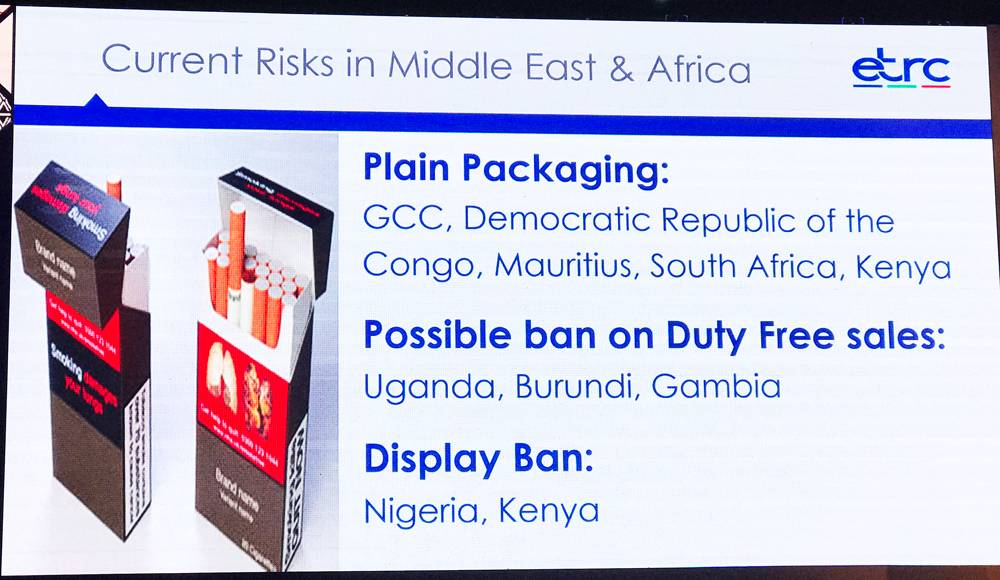
 

ETRC-plain-packaging-slide-meadfa-2016

Branquino reminded the audience that within the four markets where tobacco plain packaging has been introduced [Australia, France, UK and Ireland] disappointingly, there has been no exemption for duty free.

Branquinho said that the industry can expect a clear recommendation in early 2017 about ‘how we go forward’ with this.


Moving on to the issue of restrictions on carry-on baggage Branquinho vehemently pleaded with airports to address the problem in their agreements with air carriers.


“Things are getting confused between airlines driving ancillary revenue and common sense. And of course there’s a lot of confusion for travellers because, depending on each airline you fly with or even on which route, the instructions dictating what to do with carry-on baggage can be very different. We’re looking to create legislation in the European Union, which will allow passengers to bring their shopping onboard.”


LEGISLATION DECISION HALTED

In fact the ETRC have had a significant breakthrough by way of a favourable court judgement, which will prevent airlines from charging passengers to bring airport shopping on board.


“There are a couple of ways to solve this [problem]. Obviously one is legislation, but it’s taking time. Due to an unrelated political issue, the whole legislation process has stopped for the moment within the European Parliament.


“The simplest solution of course is what some airports have already done in the agreements that they are making with the air carriers. They’re saying that the air carrier does not have the right to restrict the commercial activity of the airport. If all airports put that into their agreements with air carriers then we wouldn’t be facing this problem constantly.”


Both Branquinho and her colleague at the ETRC made the important point that the industry dodged a bullet recently, when they were able to prevent the French Government from implementing a ban on tobacco duty free sales.
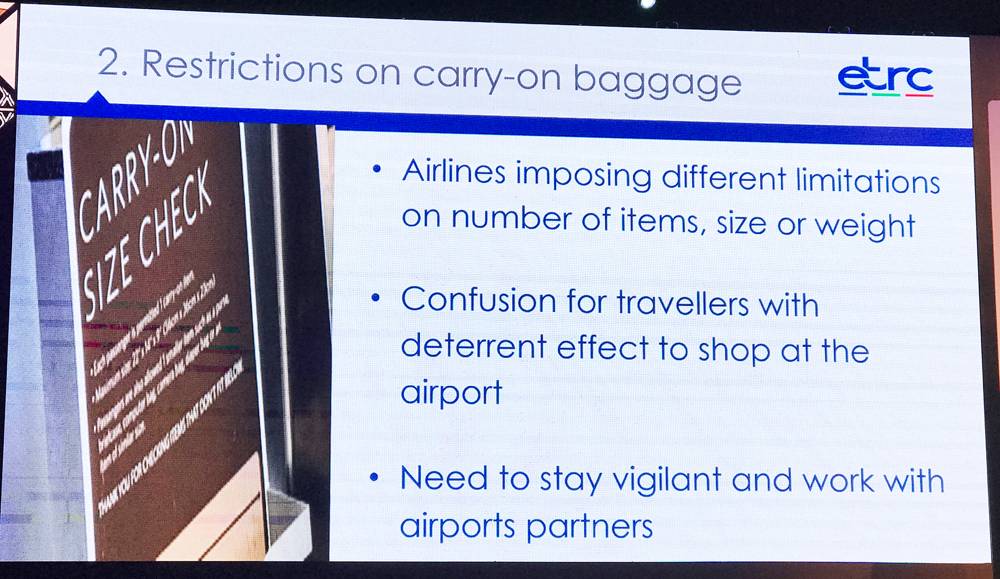
 

ETRC-luggage-slide-meadfa-2016

Sarah Branquinho pleaded with airports to better protect their commercial revenues.


The major campaign included support from Lagardère Travel Retail and Paris Aéroport who visited the French President’s office, after which the proposal was taken off the table.


WE NEED DUTY FREE EXEMPTIONS

Referring to another topic outlined at the start of her presentation, Branquino reminded the audience that within the four markets where tobacco plain packaging has been introduced [Australia, France, UK and Ireland] disappointingly, there has been no exemption for duty free.
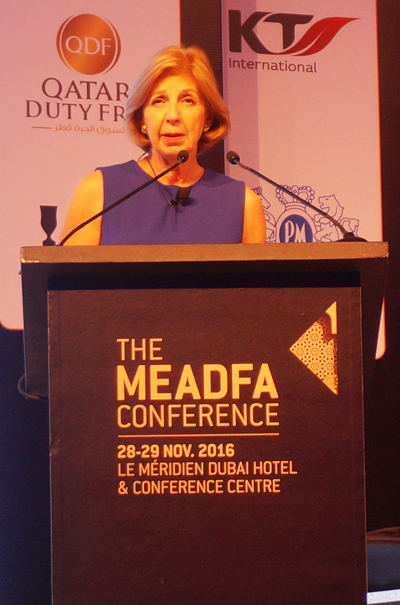
 

Sarah-Branquinho-ETRC-Meadfa-2016

Branquinho answered questions about the consequences of Brexit in the UK.

She also revealed that the following countries are ‘working on’ introducing plain packaging: New Zealand, Singapore, Hungary, Belgium, Norway, Romania, Canada, Turkey, Slovenia, Finland, Uruguay, Chile, Thailand and South Africa.


In a panel discussion [with Meadfa President Sean Staunton, moderated by The Moodie Davitt Report’s, Dermot Davitt], which immediately followed her presentation, Branquinho was asked if there will be a return to full duty free sales for the UK following Brexit.


“We have the greenlight from regulators in the UK to talk about Brexit. They have taken the stance that they won’t talk to individual companies, but instead through the UKTRF (UK Travel Retail Forum).


A RETURN TO FULL DUTY FREE SALES IN THE UK?

“The situation is that in two years after triggering Article 50, the UK will automatically become a third country and not a member of European Union. Therefore all travellers to the UK [theoretically] will be able to buy duty free as if they were travelling elsewhere in the world.”
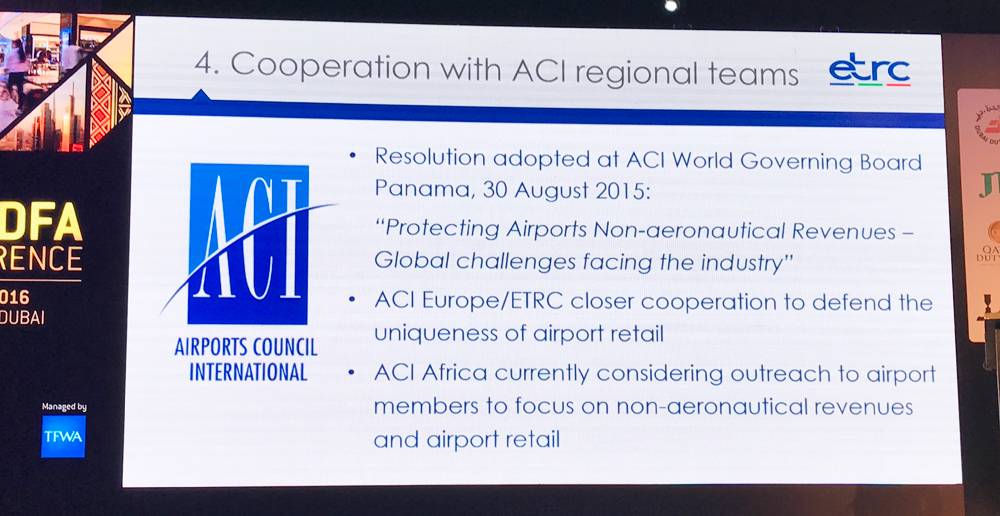
 

ETRC-ACI-slide-meadfa-2016

The ETRC believes it is imperative to work more closely with ACI regional teams.


However, Branquinho pointed out that the excise and VAT wording needs work: “We’re looking for a return to 1993 [pre-abolition] – nothing more, but a lot of legislation has to be approved first by the UK Government in the next two years.”


Branquinho emphasised that the ETRC needs to work quietly and efficiently on regulation in the background and to get their ‘ducks in a row’ before communicating through the media.


“The consumer media can be savage [in attacking duty free], so we want to get our ducks in a row first.”


See more coverage on the Meadfa conference at the following links:

Meadfa: Middle East DF&TR sales fell -2.6% in H1 2016

ARI: ‘We need to redefine the duty free promise’

Lagardère expects $320m a year in MidEast by 2018
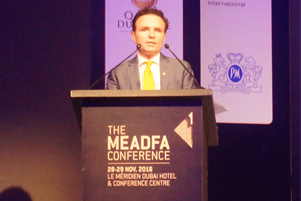
 

Meadfa: Middle East DF&TR sales fell -2.6% in H1 2016

Sean-Staunton-Meadfa-2016-leadDuring a welcome address at this year’s Meadfa (Middle East & Africa Duty Free Association) conference in Dubai, the association’s President, Sean Staunton revealed that DF&TR sales in the Middle East declined by -2.6% YTD up to June this year, whilst sales in Africa declined by -3.7%.


Set against a back drop of plunging oil prices, currency fluctuations, decline in Russians travelling and acts of terrorism as well as restrictions on hand baggage, Staunton pointed out that the results certainly could have been worse.


“On a positive we’re seeing a real growth in airports and travel in our region,” he said during the opening session of this year’s Meadfa conference, which is being held in Dubai at Le Méridien Dubai Hotel & Conference Centre today and tomorrow.


Prior to this, conference moderator from the TFWA, John Rimmer [The Moodie Davitt Report’s Dermot Davitt is his partner in crime for the two-day conference] revealed that close to 500 members of the industry are in attendance this year.


This is quite a step up from the 342 recorded in Jordan last year, but not as high as the number registered in 2014 [570 at the Jumeirah Creekside hotel in Dubai].


Meadfa-2016-conference-hall

Sean Staunton addresses close to 500 delegates.

HUGE INFRASTRUCTURE INVESTMENT IN AFRICA

Both moderators agreed that this was still a very positive result considering the various challenges facing the region, mentioned above.


“Africa has seen a surge in development of its airports with $8.5bn being injected over the coming eight years,” continued Staunton. “The new Addis Ababa Airport with an investment of $4bn; an $800m investment in Bugesera International Airport in Rwanda; a $550m investment in Entebbe International Airport in Uganda are just some examples of airport investment taking place.”


Meadfa-2016-conference-cocktail

Yesterday evening’s cocktail event, sponsored by Dufry and Pernod Ricard was very well attended and continued long into the night.


He also pointed out that aviation in the Middle East continues to show real growth, in tandem with a rise in low cost carriers as their networks and flight duration expand.


“We’ve seen the maturity of Chinese shoppers over the last two years,” added Staunton. “Our Chinese customer is now more sophisticated in their tastes. While they are still brand conscious they are now greatly influenced by price and the actual experience itself.”


Meadfa-2016-Sean-Staunton

Staunton was keen to get across just how imperative it is for the industry in the region to work together.

REGIONAL PRICING IS A PERMANENT AND DAMAGING ISSUE

Staunton was keen to get across just how imperative it is for the industry in the region to work together, and identified the issue of regional pricing, which he said has been ‘detrimental to our business in this region’.


“Over the last year I’ve heard the terms such as ‘temporary pricing’ and ‘tactical promotions’, which are all temporary measures introduced by some brands.


“Trying to explain to a passenger that a recommended retail price of a duty free item in this region is higher than the recommended retail price of a duty free shop in Europe is a no-win conversation. I don’t think we’re experiencing a downturn purely due to pricing, but I do feel that it’s a significant contributor and a totally unnecessary problem.


“Regional pricing is not a temporary issue, but a permanent and damaging one for both operators and suppliers. I feel this issue needs a permanent solution of removing regional pricing.”

Emerson’s Schwark awarded for 32 years of service

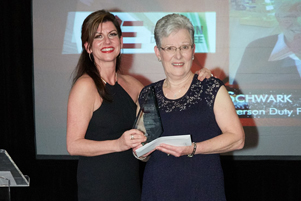
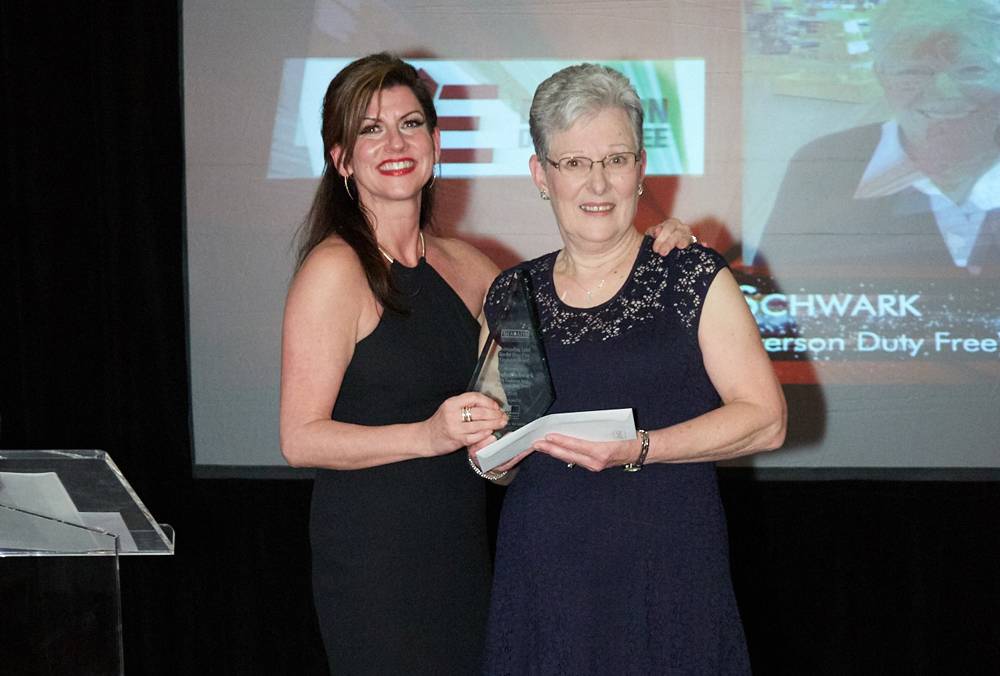
Emerson's-Swark-and-FDFA-Karson-leadEmerson Duty Free’s longest-serving employee, Carolyn Schwark has won the 2016 Outstanding Land Border Duty Free Employee Award for her 32 years of service to the family-run business (DFS Ventures Inc).


Emerson Duty Free is located an hour outside of Winnipeg on Highway 29 on the border with Minnesota and North Dakota. In operation for 34 years, the shop offers travellers passing between the US and Canada a range of products across categories, from spirits, tobacco and perfumes to souvenirs, confectionery and much more.


The award – handed out by Canada’s duty free association, the Frontier Duty Free Association (FDFA) – recognizes one land border duty free employee each year across the whole of Canada who has ‘gone above and beyond in their commitment to their store and the industry at large’.


Emerson-duty-free-logo

Emerson Duty Free is located an hour outside of Winnipeg on Highway 29 on the border with Minnesota and North Dakota.

Schwark, accompanied by her husband and by Emerson Duty Free owner/operators Michael and Simon Resch, accepted the award at the FDFA’s Annual Gold Standard Award Ceremony and Gala Dinner, which this year took place at the Hyatt Regency in Toronto, Ontario on Wednesday, 16 November.


‘TRULY ASTOUNDING’

“Not only is Carolyn the longest-serving employee at Emerson Duty Free, she may very well be the longest-serving employee at any land border duty free store in Canada,” said Simon Resch.


“Her accomplishments are truly astounding and I thank her for the dedication she has shown over the last three decades. It should be noted that the staff at Emerson Duty Free spearheaded Carolyn’s nomination, which to me is a clear indication that the good work she has done, the guidance she provides and the example she sets has had an indelible effect on our entire operation.”


Carolyn-Schwark-and-Laurie-Karson

FDFA’s Laurie Karson (left) hands the award to Emerson Duty Free’s longest-serving employee, Carolyn Schwark (right).


Nominees for the award – voted for by international duty free media and the Retail Council of Canada, with the latter also being the sponsor of this particular award – are judged on a number of criteria, including communication skills, leadership qualities, teamwork, selling skills, loyalty and dependability, and of course customer service.


“The Frontier Duty Free Association congratulates Carolyn on her award win and thanks Emerson Duty Free for nurturing the skills that have allowed her to rise to these heights,” noted Laurie Karson, Executive Director of the FDFA.


“Canada’s land border duty free industry is a tight-knit group of store operators and suppliers that contributes strongly to the economies of towns and cities across the country. Loyalty and a sense of purpose run deep in our industry, and Carloyn’s story is a great example of how impactful one person’s work can be, both for store guests and colleagues alike.”

Global lux sales fall as Chinese share slips to 30%

Chinese tourists (Global Blue)

Chinese shoppers have curbed their spending.

The global personal luxury market is expected to contract this year at the same time as the share of sales from Chinese shoppers slips below 30%. The contraction is the first since the global financial crisis.

According to the 15th edition of the Bain Luxury Study in association with Fondazione Altagamma, the personal luxury goods market will shrink slightly this year from €251bn/$266bn to €249bn/$264bn in what consulting group Bain refers to as a ‘new normal’ following the 2010 to 2015 period of very high growth, which Bain describes as a ‘Chinese Bulimia’ phase.

D’Arpizio: 'Relentless price increases over the last decade, aimed at creating a more exclusive position in the market and maximising touristic flows are now starting to backfire on luxury brands'

D’Arpizio: ‘Brands can no longer rely on low-hanging fruit’.

“The luxury market has reached a maturation point. Brands can no longer rely on low-hanging fruit.  Instead, they really need to implement differentiating strategies to succeed going forward,” says Claudia D’Arpizio, a Bain partner in Milan and lead author of the study.  “We are already starting to see clear polarisation when it comes to performance with winners and losers emerging across product categories and segments.”

‘FIRST TIME IN HISTORY…’

Another worry for the duty free and travel retail channel is that “for the first time in history” according to Bain, Chinese consumers have decreased their contribution to the total luxury market from 31% in 2015 to 30% in 2016.

2016 sees the first downward trend since the global financial crisis.

2016 sees the first downward trend since the global financial crisis.

Better news is that this share contraction is mostly happening at the domestic/internal level, driving down volumes and average ticket sales at home compared to Chinese consumers’ purchases overseas – although DF&TR operators have noted lower per head spends by travelling PRC nationals in 2016.

Bain also has a positive outlook for DF&TR operators. “Over the longer-term, Chinese luxury spending and the country’s contribution to total personal luxury goods consumption are expected to trend upward, due in large part to a growing middle class with more disposable income to spend on luxury purchases,” the company says.

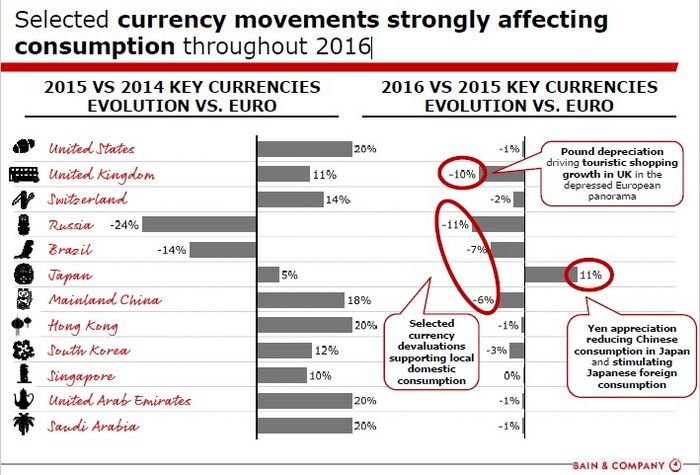
In 2016, selected currency movements affected luxury consumption to a high degree. Brexit, the US presidential election, and European terrorism all impacted consumer confidence, tourist flows and spending.

While luxury spending among tourists contracted across Europe, the depreciation of the UK pound drove shopping growth in the UK – a bright spot in an otherwise depressed pan-European market, especially as Germany and France were negatively hit by terrorism.  Spain and northern Europe fared better, due to a perceived lower threat risk, says Bain.

Currency flux is having a big impact on travel shopping,

Currency flux is having a big impact on travel shopping,

The Americas turned in an uneven performance, down -2% at constant exchange rates. In the US a strong dollar hampered tourism spending while in Latin America, luxury shoppers were focused on local spending

In Asia, Hong Kong and Macau continued their big decline, down -15% at constant rates while Chinese flows returned to South Korea (following MERS concerns last year), up +13%. Chinese spending is also boosting Thailand and Malaysia’s performance while Southeast Asia has generally been positive at +3% and Singapore is said to be attracting spending from China’s tier 2 and 3 cities.

Looking ahead, D’Arpizio anticipates the personal luxury market will reach €280-285bn by 2020 (CAGR of +3-4% from 2017), but she cautions that it will not be an easy road. “Luxury brands need to adjust their expectations and their strategies as we enter an era in which growth is no longer a given,” she says.  “We’re now on a level playing field. Brands that adapt their business and take an omni-channel, customer-centric approach will rise to the top.  Those that lag behind are sure to lose market share.”

Selfie generation to keep make-up ahead in beauty TR

Fabiano says that acceleration in make-up will come from new consumers.

Fabiano says that acceleration in make-up will come from new consumers.

L’Oréal Travel Retail says that make-up will continue to be the fastest growing segment in the beauty category in duty free and travel retail in next half decade due to demand from a selfie-obsessed Millennial generation, and from emerging markets.

Speaking at the TFWA Cannes show last month, Stefania Fabiano, LTR Consumer Product Division General Manager, said the make-up category was a bright star in the beauty firmament. “Make-up will remain the fastest growing category in travel retail in the coming five years and acceleration in this category will come from new consumers,” she noted.

With the ‘selfie generation’ of Millennials now a big part of the DF&TR passenger profile, the idea of looking good in front of the camera at all times also gives make-up a huge leg up. Fabiano says that this generation also loves to experiment and try new products, which makes make-up their ideal category. “They are also ultra-connected and they love tutorials so they are becoming more expert as make-up users,” she added.

The plus side for beauty players with make-up portfolios is that penetration of this segment in Asia, and China especially, is still underdeveloped compared to other regions – but it is growing fast.

PRICE ACCESSIBILITY

“Face products are still leading the market but the huge phenomenon across Asia is lipsticks,” said Fabiano who pointed out that, for the emerging middle classes, lipsticks also represent an accessible sub-segment of make-up.

L’Oréal's make-up portfolio spans a wide variety of price points.

L’Oréal’s make-up portfolio spans a wide variety of price points.

L’Oréal has a portfolio that spans all price points: from couture brands such as YSL and Giorgio Armani; luxury brands like Shu Uemura, Lancôme or Helena Rubinstein; to professional brands such as Urban Decay or the new Nyx line; and more competitively-priced lines L’Oréal Paris and Maybelline, and Essie in nailcare.

From a retailer perspective, L’Oréal believes that colour is key. “Colour drives shop penetration, creates impact and is playful. It is also often an impulse buy,” Fabiano said. She argued that colour products should therefore be at the centre of any retail design to act as a penetration driver – with fewer brands but a kaleidoscope of shades.

L’Oréal: ‘Digital is the only future for travel retail’

Laroia: 'We believe that digital will be a game-changer but this can only become a reality if we as an industry manage to unite'.

Laroia: ‘We believe that digital will be a game-changer but this can only become a reality if we as an industry manage to unite’.

L’Oréal Travel Retail has underlined its commitment to a digital future in the duty free channel – but says that to achieve all the benefits that digital can bring will require much stronger collaboration between retailers, landlords and suppliers.

The biggest beauty player in DF&TR was clear in its strategy when it outlined plans at the TFWA Cannes show last month. Speaking to media, Thomas Laroia LTR’s Digital Manager said boldly: “Digital is the only future for travel retail.”

Laroia added: “Guess what? The customers in travel retail have all gone 100% digital. We all search for information online, we book our travel tickets and hotels on websites and on top of that, the very first thing we do when we travel is to look for wifi. Shopping is the only behaviour that has not gone digital for travellers.”

He said that this was not because travellers don’t want to… but because “the airports, suppliers and travel retailers have not been able to provide a retail model that has been good enough to be adopted”.

AIMING FOR 100% DIGITALLY-INFLUENCED TRANSACTIONS

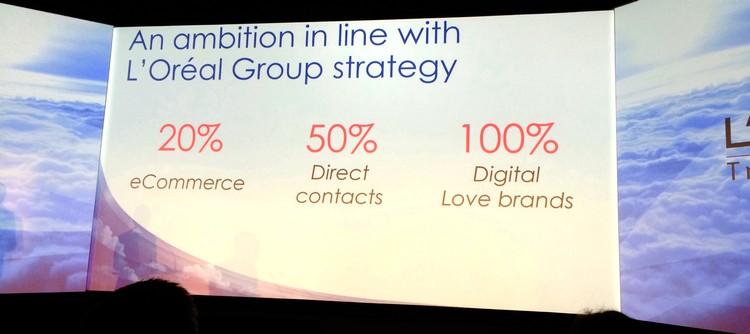
“At L’Oréal we are committed to change this in order to be closer to our customers which is in line with our overall group digital strategy,” he added. That is a based on a 20-50-100 concept where 20% of sales are done via e-commerce, 50% of transactions are enabled through direct contact, while 100% of transactions are digitally influenced. The plan is to achieve this within the next five years.

The beauty house aims to  achieve these shares within five years.

The beauty house aims to achieve these shares within five years.

L’Oréal brands globally already have substantial digital/online presences but it now plans to put that to work in DF&TR with the clear objective of serving both retail partners and travellers.

RL Polo Red2On the retailer side, a so-called PIMDAM (Product Information Management and Digital Assets Management) service currently provides retailers information on 2,400 products from seven brands in nine languages. Next year, an automated product information management system will be deployed which will cover the company’s entire product catalogue. “It will be hugely time-saving and, more importantly, it can be customised to each of our retailers,” says Laroia.

STORE PENETRATION

Digital is also helping to drive footfall in DF&TR stores – and a good example is the Polo Red campaign in the Americas. This was a clever and award-winning use of digital via social media and ibeacons to drive in-store product sampling at Miami and Rio and São Paulo airports via increased penetration at the main DF&TR stores at these US and Brazilian gateways.

“We believe that digital will be a game-changer but this can only become a reality if we as an industry manage to unite,” says Laroia. “That means stronger collaboration between retailers, landlords and the best suppliers they can find on the market. Nothing will be possible if we don’t work together and we are ready to do so.”


FDFA awards top border and airport players in Canada

The 2016 winners.

The 2016 winners.

Canada’s Frontier Duty Free Association has revealed its 2016 Gold Standards winners at its annual convention in Toronto with Abbotsford Duty Free, Importations Guay, and Aer Rianta International taking the top retailer awards.

FDFA Executive Director, Laurie Karson, who led the awards evening presentation at the Hyatt Regency Hotel, said: “The FDFA Gold Standards Winners represent the best of Canadian duty free.”

In total there were 15 awards for duty free and travel retail companies, individual employees, distributors/suppliers and brand owners. For the full list of winners see the table below.

FDFA winners 2016

China approves 16 duty free arrivals shops

Chengdu-Shuangliu-International-Airport-leadChina’s Ministry of Finance has approved applications to open 16 duty free arrival shops in 10 international airports and at six land border crossing points, introducing limited competition to the nation’s growing duty free market for the first time.
 

Four state-backed enterprises with existing duty free retail operations have qualified to bid for the 16 arrival shop licenses that are due to be awarded during the next six months.


The four companies are: China Duty Free Group (CDFG), China National Service Corporation For Chinese Personnel Working Abroad (CNSC), Shenzhen Duty Free and Zhuhai Duty Free.


“There is departure, arrival and downtown duty free shopping in China, now arrival shopping will be open to limited competition,” commented a source at one of the operating companies selected to bid for the licenses.


CDFG AND CNSC HEAD TO HEAD…

“The four companies are qualified to bid for all the duty free arrival shops. Probably Shenzhen Duty Free and Zhuhai Duty Free are not interested in operating nationally, but will bid for local arrival border shops, so the airport competition will be between CDFG and CNSC as they are the only two national operating companies.”

hainan - china duty frees sanya store

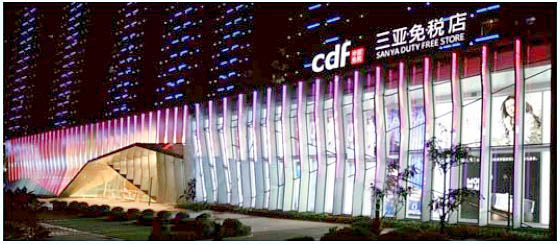
“Airport competition will be between CDFG and CNSC,” says the source.

The 10 airports approved to open duty free arrival shops include some of China’s top ten airports.


The list does not include Beijing Capital International Airport, Shanghai Pudong International Airport and Shanghai Hongqiao International Airport, however, as these already offer duty free arrival shopping services under a special government dispensation issued in 2008 to assist in the preparation of tourist facilities for the Beijing 2012 Olympic Games.


New airports selected to open duty free arrival shops are believed to include: Chengdu Shuangliu International Airport, Chongqing Jiangbei International Airport, Dalian Zhoushiuzi International Airport, Guangzhou Baiyun International Airport and Tianjin Binhai International Airport.


Ministry of Finance regulations permit the arrival shops to sell perfume and cosmetics, liquor and tobacco, confectionery, fashion items, accessories and watches.


MOSTLY L&T AND P&C

“Airport authorities rely on duty free operators to arrange the merchandise categories,” the source remarked. “The airports will want to sell mostly liquor and tobacco, and perfume and cosmetics. Airports care more about the sales volumes as that’s where their revenue comes from.”


Chengdu-Shuangliu-International-Airport-hero

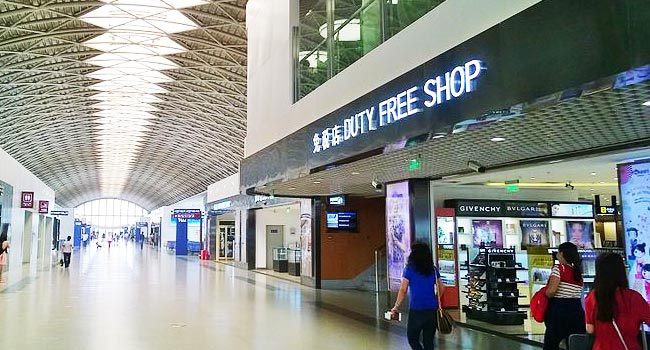
Chengdu Shuangliu International Airport.


The largest arrival shop application approved is understood to be Chongqing Airport’s plan to open a 500sq m arrival store while the smallest arrival outlet approved is Tianjin Airport’s 50sq m arrival shop.


Most airports have applied to open one arrival shop, though several with sufficient arrival halls have received permission to open two arrival stores.


Under Ministry of Finance regulations each of the 16 duty free arrival shop operator licenses awarded will be for 10 years. All the licenses are required to be tendered and awarded within six months of the date of the arrival shop application being approved.


TENDERS UNDER PREPARATION

While results of all the tenders will be registered with the Finance Ministry, China’s General Administration of Customs will be the controlling authority regarding arrival shop retail operations.

CNSC Beijing Flagship store

CNSC’s Beijing downtown shop.

Selected airport owners and land border crossing authorities are just starting to prepare their arrival shop tender specifications.


The various licenses are expected to be awarded in March and April 2017 as all 16 applications were approved at the beginning of November.


Constructing the arrival shops is expected to take about six months after each license is awarded. Consequently most of the new arrival shops are likely to begin trading around September and October 2017.


SHENZHEN AND ZHUHAI FOR LAND BORDER SHOPS?

Meanwhile, competition is likely to be fierce between CDFG and local operators Shenzhen Duty Free and Zhuhai Duty Free to win the land border arrival shop licenses as all the locations are busy crossing points.


Five of the six land border arrival shop licenses are for crossings on Guangdong Province’s southern border – four of these are for crossing points on the Shenzhen-Hong Kong border and one on the Zhuhai-Macau border where Shenzhen Duty Free and Zhuhai Duty Free operate departure duty free shops.


The other land border arrival shop license is for Heihe in northern China on the border with Russia where CDFG operates a large departure duty free shop.


The opening of border arrival shops in southern Guangdong also could have important implications for retailers in Hong Kong and Macau who will soon be competing with China’s new arrival border shops for mainland tourists’ custom.

Generation Research appoints Prof. Seret as MD

Prof-Alex-Seret-Generation-leadSwedish research and analyst firm, Generation Research has appointed Professor Alex Seret as its Managing & Technical Director, beginning 21 November, following a period of intensive collaboration with the company.


As previously reported, Generation Research has been working with Seret to analyse and improve the current structure and methodologies supporting Generation’s massive database and product offerings.


The project that started in June 2016 is about to be finalized; by the beginning of 2017. Based on the results obtained during this first project, Generation Research is now hiring Professor Seret as a Managing and Technical Director, starting 21 November 2016 when he will arrive in Örnsköldsvik, Sweden.


Seret has a Ph.D. in Decision Science from KU Leuven University and is a member of leading international research networks in both technical and applied aspects of data analytics.


SERET TO REDUCE ACTIVITIES AT CHILE UNIVERSITY

“Combining this expertise with his Masters in Information Management, Professor Seret has already applied his skills to companies coming from industries such as retail, finance, telecommunication and healthcare by helping them to manage and monetize their data sources,” says Generation.


Seret decided to accept this role by reducing his activities as Professor and researcher at the University of Los Andes in Santiago, Chile, while keeping his network and collaboration with different leading international research centres.


fredrikbluebig 2
Generation Research CEO Fredrik Lindh comments. “Professor Alex Seret is unique in the way that he is extremely experienced and well connected in the academic world.


“He is technically skilled and at the same time extraordinarily business-oriented. Seret is a recognised expert in analysing and monetising data in ultra-complex environments and he brings a wealth of experience in business analytics, data science and quantitative marketing to our already unique offer.


‘NEW MOMENTUM FOR GENERATION RESEARCH’

“Today there are multiple sources and massive amounts of data available for all stakeholders in the travel retail industry. Now, with the expertise of Alex, we will benefit a lot internally and at the same time better able to assist our clients to organise and analyse these sources of data, to make decisions more data driven and actionable.”


Professor Alex Seret Comments. “I want to bring a new momentum to Generation and to the travel retail industry. This industry has a unique potential and is at a key moment of its technological evolution.


“The specificities of current practices and challenges make it difficult for outliers to enter, understand and impact this industry. For this reason, I believe that the solution should come from inside and Generation Research’s unique position, staff and products are the perfect foundations for a new momentum. I wish to make Generation Research an example to follow in the industry while serving as an innovation centre allowing the different actors to connect with global best practices in data science.”

DFWC Monitor shows duty free price sensitivity is rising

Price is becoming more of an issue (click to enlarge).

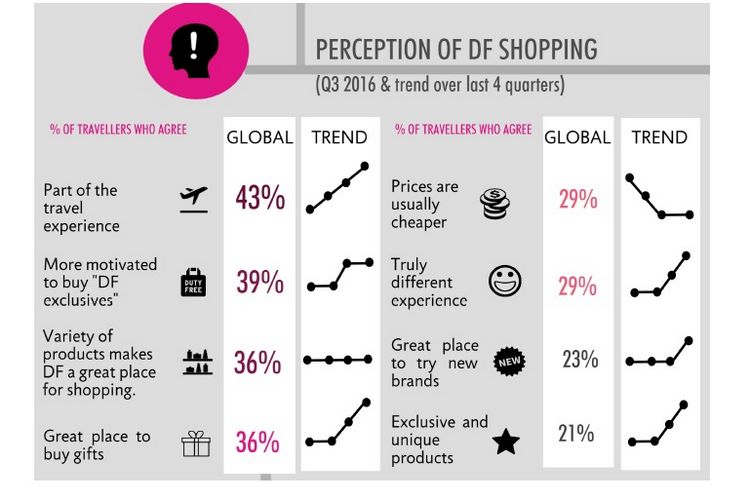
Price is becoming more of an issue (see top right of chart and click to enlarge).

Data from the latest quarterly Global Shopping Monitor for Q3 2016 from the Duty Free World Council, in partnership with research consultancy m1nd-set, shows that perception of price is the only parameter to show a negative trend.

The percentage of travellers who agree that prices are usually cheaper in duty free and travel retail has levelled off to 29% in Q3, after falls in the previous two quarters. The percentage of shoppers who find that duty free prices are cheaper than elsewhere has fallen by -2% since the first monitor in Q4 2015.

Others aspects such as offering a truly different experience, exclusive and unique products, a great place to buy gifts have all gained in the eyes of the consumer (see chart right) with none of the other seven parameters going backwards.

Perceived value for money remains the most important contributing factor to shopper satisfaction levels, followed by uniqueness of products and services based on the fourth edition of the DFWC Shopping Monitor, providing a full year analysis of the key indicators. The data is based on a sample of 4,000 travellers.

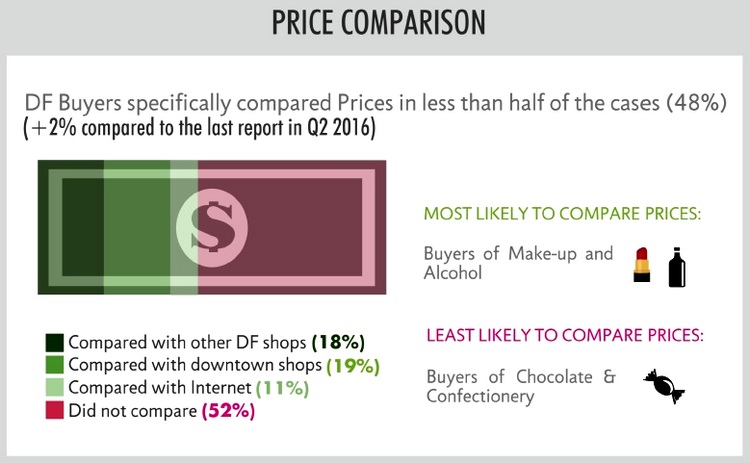
While less than half of DF&TR shoppers price compare (48%), this is up +2% on Q2 2016. They are most likely to compare prices on make-up and alcohol and least likely to do so on confectionery. Although – with the furore today that Mondelez has spaced out the triangles in Toblerone to minimise ingredient costs but sell the product at the same size in the UK domestic market – this category may also come under sharper scrutiny by shoppers in future.

When comparing price, travellers tend to look at downtown shops (19%), other DF&TR shops (18%) and the Internet (11%).

DFWC Q3 monitor

SATISFACTION UP

The DFWC global satisfaction index has seen a two-point gain overall, while Asia Pacific has performed particularly well with a +4% increase compared to the first edition in Q4 2015 and up +2% on the previous quarter this year.

Use of electronic devices to gather information on shopping also shows a strong upward trend, increasing by +2% compared to the previous quarter and+ 4% since Q4 2015. Similarly, the percentage of shoppers claiming to never use their electronic devices for shopping information has fallen sharply over the past four quarters from 53% to 42%. The Monitor reveals that Chinese travellers are particularly avid information seekers on their mobile devices.