Archives

US senators lobby Canada to raise duty free quota

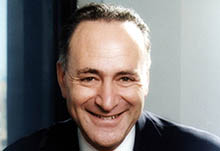
US retailers are losing sales because Canadian duty free policies governing short trips across the border ‘discourage’ visitors from shopping in the US, according to US New York senators Charles Schumer and Kirsten Gillibrand who have written to Canada’s government and its Ambassador this week.


Both senators have launched a joint campaign to try and persuade the Canadian government to equalise duties on a par with the more favourable levels applied in the US. The senators say that this would go some way towards helping retailers in the US and particularly in Buffalo, Watertown and Plattsburgh.


US Customs currently permits US residents the right to a duty free value allowance of $200 to spend in Canada for those travellers staying less than 48 hours and up to $800 for those staying longer. But both senators argue that Canada’s duty free policies ‘are far less favourable’.


Schumer and Gillibrand argue that an increased duty free allowance for Canadians shopping in the US would bolster economic growth and help local retailers on both sides of the border.


Senator Charles Schumer said: “Right now, Canadian families wishing to spend the day shopping in upstate New York must carefully watch the clock to calculate how high their duty rates will be and that shouldn’t be the case between neighbours. America’s duty free policies are much more favourable than Canada’s and Canada, our great friend and ally, should level the playing field.

 

New York US Senator Kirsten Gillibrand is strongly supporting the request for duty free allowances to be ‘equalised’ between the US and Canada.


CALL TO BRING DUTIES INTO LINE

“That is why we are calling on the Canadian government to bring their duties on par with ours so we can allow both of our economies to grow and prosper.”


Senator Kirsten Gillibrand added: “Businesses in Buffalo, Niagara Falls, Plattsburgh and Watertown are missing out because Canada places a higher burden on its residents who shop in New York than the US does on the New Yorkers who shop in Canada.


“Canada’s current policies put New York companies at a disadvantage to their competitors over the border and discourage Canadians from shopping in the United States. I urge Canada to increase their duty free threshold to create a level playing field that will benefit both American and Canadian companies.”
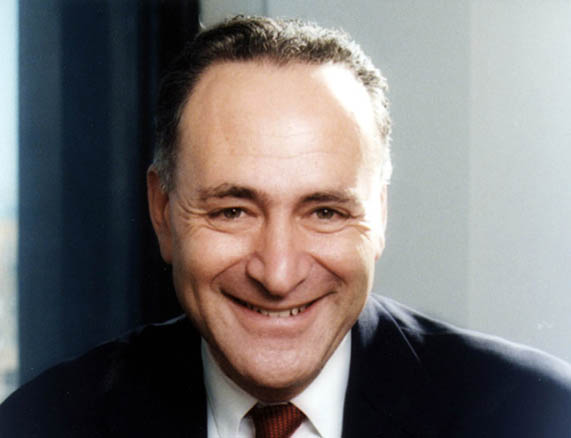
 

US Senator Charles Schumer is pushing for the change.


LARGE DISPARITY IN ALLOWANCES

Both senators argue that a Canadian family purchasing US$100-worth of clothing on a day drip in Buffalo will be subject to C$22 ($17.61) in duty when that family travels across the bridge into Ontario, Canada. By contrast, an American family from Buffalo, purchasing the same merchandise on a day trip to Niagara Falls, Canada is not subject to any duty on that same merchandise when they return to the US.


Both senators now contend that instead of policing low-value shipments and merchandise from short trips across the border, a raised duty free exemption would allow the Canada Border Services Agency to concentrate more dedicated resources to policing higher risk shipments and higher ticket items – rather than those every day items purchased by ordinary citizens from retailers in the US.


In addition to their support, both Schumer and Gillibrand’s letter to the Canadian government and its Ambassador Gary Doer is also being supported by US Senators Cantwell, Risch, Crapo, Tester, Daines, Peters, Baldwin, Ayotte, Shaheen and King.


TRBusiness has obtained a copy of the Senators’ letter to Canadian Ambassador Gary Doer – a copy of which is published below:

 

Several US Senators have formally added their names to Schumer and Gillibrand’s campaign to create a level playing field for duty free border allowances between the US and Canada.


LETTER TO THE CANADIAN GOVERNMENT:

DEAR AMBASSADOR DOER,


The United States places tremendous value on our trade relationship with Canada. With $632 billion in total goods trade (both import and export) in 2013, Canada is the largest goods trading partner for the United States.


At $300 billion in total goods exported to Canada, your country is also our largest goods export market. In support of increased goods trade between our two countries and as members of the United States Senate representing states that border Canada, we are writing to express our concern regarding Canada’s de minimis threshold on low-value imports to Canada.


De minimis thresholds vary greatly from country to country; however, Canada has one of the lowest thresholds at $20 per shipment or a personal exemption of $200 for Canadians returning from international travel.


The United States has a de minimis threshold of $200 for imported goods delivered via a shipper, while Americans returning from international travel have a personal exemption of $800 before meeting the de minimis threshold. Proposed legislation in the U.S. Senate would raise the de minimis level for imported goods delivered via a shipper in the U.S. to $800.


An increase in Canada’s de minimis level would have a significant and positive impact on U.S.-Canada trade, and help to bolster increased economic growth for both countries. An increase would particularly benefit small-and medium-sized businesses operating in e-commerce. Further, in addition to generating net economic benefits, an increase in Canada’s de minimis threshold would create customs efficiencies, allowing the Canada Border Services Agency to dedicate more resources toward higher risk shipments.


Canada’s low de minimis threshold represents an unnecessary trade barrier between our two countries, particularly for low-value, low-risk shipments. We respectfully urge the Canadian government to increase its de minimis threshold, ideally putting it on par with that of the United States, in order to further expand our historic and mutually beneficial trade relationship.


SIGNED BY SENATORS: Schumer; Gillibrand; Cantwell; Risch; Crapo; Tester; Daines; Peters; Baldwin; Ayotte; Shaheen; and King.



How can DF&TR handle the Russian decline?

As the decline in Russian international travel and tourism continued in 2014 – and is predicted to worsen in 2015 – the options for duty free and travel retailers to protect sales are dwindling. However, some opportunities still remain.
TRBusiness has documented the collapse of Russian travellers in great detail over the past year, as well as the impact on key operators such as Tallink in the Baltic, and most recently ATÜ in Turkey.

New data from air passenger forecasting and research group Air4casts show that the downward trend – while serious – is uneven, giving DF&TR operators the chance to retain sales in some locations to counterbalance losses at others.

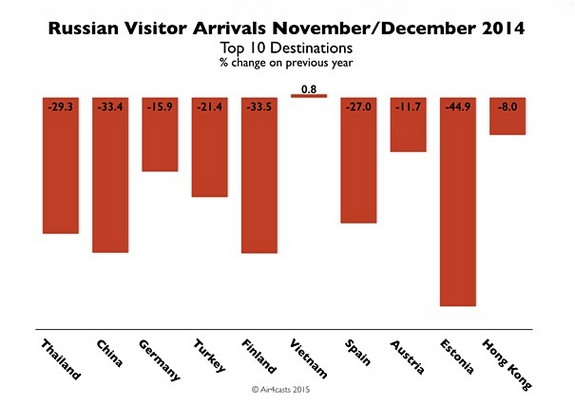
For example, in November-December last year, visitor arrivals for the top 10 Russian destinations were dramatically down in all but one case – but the slides were very different (see below).

    The Russian tail spin is uneven


Firstly, Vietnam was still growing, albeit at only +0.8%, and Air4casts says that another three markets [of its 33 country data sets] also had small positive growth. Secondly, Hong Kong, while down, showed just a single-figure reduction of -8% whereas the tourist market of Thailand – the most popular destination for Russians – was struggling at almost -30%.

2015 FORECASTS

Air4casts describes the numbers as “bleak indeed” and the reductions as “eye-watering” adding: “The international pax forecast (for 2015) is negative and sure to get worse. It shows a probable decline of just a little short of -10% this year. There is a much larger reduction in the number of departing Russian nationals this year and that will also deteriorate from forecast to forecast.”

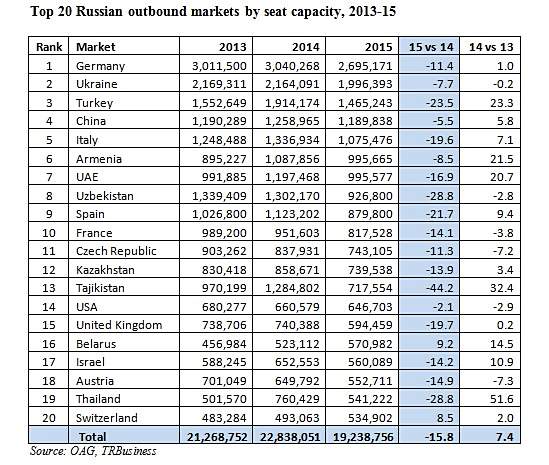
Meanwhile, exclusive forecast seat-capacity data provided to TRBusiness in the February magazine issue by aviation analyst OAG, also point to a -15.8% reduction this year for the top 20 markets (see below). Least affected among these countries are Belarus, which is set to grow by +9.2%, Switzerland (+8.5%) and the US (-2.1%).

         Just two of the top 20 markets show growth in 2015


DOMESTIC GROWTH

On the other hand, Air4casts says that domestic travel is benefiting strongly – as TRBusiness has already noted – and for 2015 it projects a +14% increase over 2014.

So, how much worse is the situation likely to get and what might be the duration? The latter depends on a combination of economic, currency and political/security factors and is therefore hard to predict.

For the former, Air4casts says: “Forecast reaction over time does display a pattern of sorts and so is, in itself, partially forecastable. If the pattern is repeated for Russian traffic in 2015, it is probable that the end-of-March forecast will display a year-on-year fall of around -14% with the end-of-April reduction moving towards -18%. If the actuals generated in the intervening months are worse, that change will be reflected in the new projections almost immediately.”

300 delegates and counting for TFWA CCC

TFWA is promising 20 major Chinese airport authorities and a powerful number of DF&TR operators and airlines amongst the 300 registered delegates attending next month’s TFWA China’s Century Conference in Shanghai (10-12 March).


As reported, the event is being organised jointly by TFWA and APTRA and will take place at Shanghai’s Jing An Shangri-La Hotel.

In addition to airports and operators the Shanghai Association of Enterprises with Foreign Investment (SAEFI) is also sending a 10-strong delegation of representatives and various Government departments will also be represented at the event.

The first China Century’s Conference in Beijing in 2013 was held up by TRBusiness and many others as one of the most ambitious and memorable DF&TR industry events in the industry’s history.


SENIOR CHINESE EXECUTIVES ATTENDING

TFWA adds that all of these Chinese companies will also put forward senior representatives to actively take part in the ever-popular TFWA ONE2ONE pre-arranged meeting service, which has a good reputation for helping brands and operators maximize business networking opportunities.

The association also promises that the second TFWA China’s Century Conference will deliver a busy programme of fascinating presentations and debate on a number of important issues and projects shaping events now and in the future. As is well known, Chinese travellers and the China market itself are vitally important to the DF&TR market today and well into the future.

The organisers says that due to the Chinese New Year holidays ‘and to the high demand’, pre-registration for the event has now been  extended to 27 February 2015.

DFS recognises benefits of US-China visa policy

Philippe Schaus DFS Chairman & CEO.

Visa facilitation has experienced strong progress in recent years, particularly through the implementation of visa on arrival policies according to UNWTO’s latest Visa Openness Report.


This largely reflects an increased awareness of the positive impacts of visa facilitation on tourism and economic growth and top travel retailers are due to see the positive impact.


According to the Report, 62% of the world’s population was required a traditional visa prior to departure in 2014, down from 77% in 2008. In the same year, 19% of the world’s population was able to enter a destination without a visa, while 16% could receive a visa on arrival, as compared to 17% and 6% in 2008.


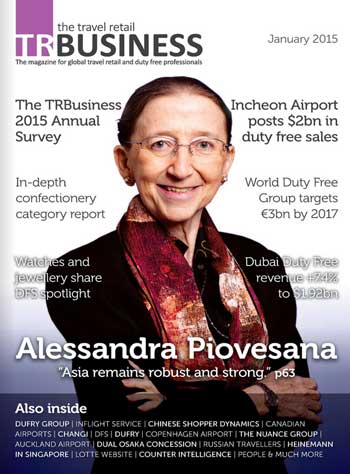
The TRBusiness Annual Survey was published in the January issue.

And visa facilitation seems only to be progressing. According to the US Department of State, as of 12 November (2014), the United States and the People’s Republic of China will reciprocally increase the validity of short-term business and tourist visas and student and exchange visas issued to each other’s citizens.


CHINESE VISITORS TO US EXPECTED TO INCREASED IN 2015
In the TRBusiness Annual Survey [published in the January issue of TRBusiness magazine] DFS CEO Philippe Schaus commented on the impact that the new extended US-China visa will have on the business.


“The new US-China visa policy is good news for the market and we believe Chinese tourists will visit the US in increasing numbers in 2015.


“We are also very optimistic about emerging tourist destinations in Southeast Asia as well as the popular European cities, which is why we recently announced two exciting new destinations for DFS: our first European store at the historic Fondaco dei Tedeschi in the heart of Venice, and a multi-category, large-scale downtown store near the historic ruins of Angkor Wat in Siem Reap, Cambodia.”


Joe Lyons, DFS North America.

Joe Lyons, Vice President of Business Development for DFS Group North America echoed Schaus’ sentiments when he spoke to TRBusiness earlier this month. “With the new extended US-China visa agreement, DFS expects to see substantial growth, in its US business, to come from the Chinese travellers.


“According to the US Department of Commerce, we expect to welcome 3.1m Chinese visitors to the US by 2019, a 172% increase from its 2013 figures. This will also be beneficial for the economy as they will also likely boost the retail industry – last year’s 1.8m Chinese tourists alone spent US$21.2bn while in the US.”


VISA ON ARRIVAL

UNWTO’s latest Visa Openness Report also shows that the most prevalent facilitation measure implemented has been “visa on arrival”. Over half of all improvements made in the last four years were from “visa required” to “visa on arrival”.


“Visa facilitation is central to stimulating economic growth and job creation through tourism. Although there is much room for improvement, we are pleased to see that a growing number of governments around the world is taking decisive steps in this regard”, said UNWTO Secretary-General, Taleb Rifai.


UNWTO Secretary-General, Taleb Rifai.

Countries in the Americas and in Asia and the Pacific have been at the forefront of visa facilitation, while Europe and Middle East have more restrictive visa policies. Overall, emerging economies tend to be more open than advanced ones, with South-East Asia, East Africa, the Caribbean and Oceania among the most open subregions.


“UNWTO forecasts international tourist arrivals to reach 1.8 billion by 2030, and easier visa procedures will be crucial to attract these travellers, especially tourists from emerging source markets like China, Russia, India and Brazil”, added Mr Rifai.


Research by UNWTO and the World Travel and Tourism Council (WTTC) shows that the G20 economies could boost their international tourist numbers by an additional 122 million, generate an extra US$ 206 billion in tourism exports and create over five million additional jobs by improving visa processes and entry formalities. The same research carried out for the APEC and the ASEAN countries indicates that visa facilitation could generate important gains for both groups, including the creation of 2.6 million jobs in APEC and 650.000 jobs in ASEAN.

Dufry Brazil relaunches pre-order website

Swiss headquartered Dufry AG – with approximately 1,700 duty free and duty paid stores – has relaunched its Brazilian duty free pre-order website.


 

The site from Dufry Brazil, which has a ‘more modern layout and new functionalities’, receives 600,000 visitors a month, claims Dufry. The leading travel retailer says that the site is ‘more attractive and dynamic’ and that its next step will be to redesign its smartphone application.


“We have observed the market and identified the need for such improvements, which range from a more functional interface to the introduction of features that enable a better user experience, such as the simplified pre-order process,” said Marcelo Ferreira, Dufry’s Global Webmarketing Manager.


The new website is said to ‘bring the client closer to current promotions’. Later on, it will include ‘exclusive pages’ for luxury brands. “Products that are only available in free shops will also have an exclusive area to make pre-order easier,” adds Dufry.


Dufry Brazil relaunches pre-order website.

This will be the case for Johnnie Walker Explorer’s Club Collection; Kit Kat’s special packages; Victoria’s Secret and The Body Shop products, among others.


“Our website is the traveller’s major point of contact prior, during and after travelling,” said Ferreira. “With enhanced mobile access, we expect to reach 100% of the audience, delivering the same experience as that of website users,” he explained.


With this change, Dufry Brazil expects to increase the number of pre-orders on its website and contribute even more to a better purchase experience for its clients. See the new pre-order website here www.dutyfreedufry.com.br.


Coty shares rally on second quarter results

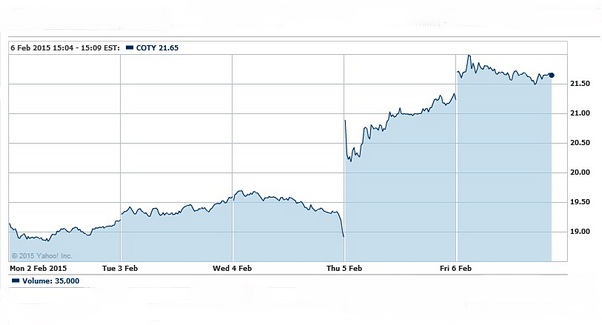
Global beauty house Coty saw its share price reach a high point for this year of $22.00 (earlier this morning EST) on the back of strong fiscal second quarter earnings – released yesterday – for the three months to December. A new CEO is also on the cards for the summer.

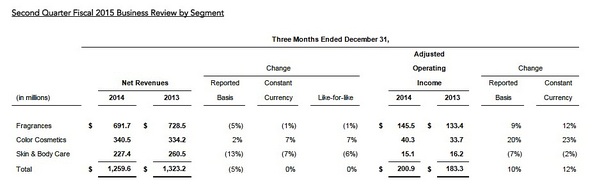
In Q2, net revenue at $1.26bn was flat on a constant currency basis (-5% reported) while operating income hit 183.7m (up +28%) with net income rising to $125.4m (+52%), the equivalent of $0.35 a share which beat analyst expectations.


Travel retail also grew faster in Q2 versus Q1. Patrice de Talhouet, Chief Financial Officer, comments: “In travel retail we grew in the second quarter compared to the prior period and we had a pretty strong result in the Americas and Asia Pacific, offset by some weaknesses in the European region.”

Becht: yielding results

Commenting on the company’s overall performance, Bart Becht, Chairman and interim CEO, says: “Our Q2 and first half results demonstrate that our strategy – as outlined last quarter – of investment in and revenue growth on our power brands and returning Coty to profitable growth behind efficiency programmes is beginning to yield results.

POWER BRANDS GROWTH ‘VERY MODEST’

Coty’s 10 power brands, which include Calvin Klein, Chloé and Davidoff, saw like-for-like net revenues grow very modestly in the quarter and half year, but Becht says that there was renewed strength on a fiscal year-to-date basis in Sally Hansen, Rimmel, Marc Jacobs, Chloé and Philosophy “fuelled by successful innovations”.

He adds: “Our focus on efficiency in the P&L has resulted in significant growth in both operating and net income in the quarter and we are making good progress on our journey to build a better business.

“The implementation of our $200m Global Efficiency Plan is well advanced and we are exploring new cost optimisation opportunities, which we believe will further boost operating margins and provide investment funds for our power brands. Looking forward, we remain very optimistic about Coty’s future and its ability to make steady progress under its new strategy.”

Commenting on the hunt for a CEO after Michele Scannavini stepped down, Becht says: “We are more advanced in the search process. A CEO is expected by the summer.”

COLOUR SETS THE PACE

At constant currency, only colour cosmetics showed growth in Q2 (see table below), up +7% to $340.5m driven by strong growth in the Rimmel, Sally Hansen and OPI, reflecting the success of new launches. The biggest sector of fragrances was down -1% to $691.7m largely thanks to declines in celebrity fragrances (in part driven by pressure in the mass market). Skincare slid -7% to $227.4m which Coty blames on a decline in body care products and, in part, due to the business model change in China.

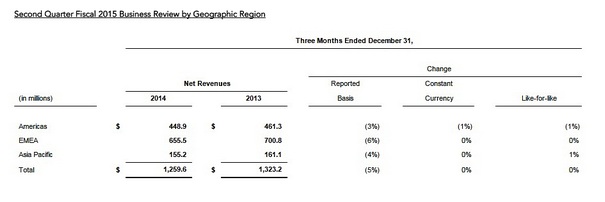
By geographic region, every region was flat with the Americas down -1% (all at constant currency). This was due to weakness in the US and Canada, but partially offset by strength in Brazil and travel retail. Emerging markets grew +5% like-for-like in the quarter.

Coty shares closed on Wednesday at $18.92 and were trading at $21.67 at 3.50pm EST today, a +14.5% uplift.

Lauder gains market share in TR but net sales slide

The Estée Lauder Companies Inc recorded net sales of $3.04bn for its fiscal second quarter ended December 31, 2014; just a 1% increase, compared with $3.02bn in the prior-year quarter, and 5% in constant currency.


According to Fabrizio Freda, President and Chief Executive Officer – who made a presentation and answered questions during the company’s Q2 Fiscal Earnings Conference Call earlier today – net sales in travel retail declined approximately 4% in Q2.


“Retail sales grew mid-single digits in travel retail, while net sales decreased, reflecting a rebalancing of inventory levels at certain retailers; the timing of shipments attributable to a later Chinese New Year and softness of some key foreign currencies affecting travel and consumptions,” revealed ELC in a statement published on its website earlier today.


“The Company expects a more normalised sales growth pattern in the second half of the fiscal year.”


Fabrizio Freda, President and Chief Executive Officer.

Freda told analysts during the conference call, that he believes that the slowdown in travel retail is a result of very specific abnormalities – such as the fact that the Chinese New Year holiday is occurring later this year. He said that currency fluctuations and political unrest have curtailed travel and affected groups, which historically had a high SPH including the Russians, Brazilians and Chinese.


‘WE ARE GAINING SHARE IN TRAVEL RETAIL’

Freda and ELC don’t appear to be fazed by these factors, when providing forward-looking statements: “We are gaining share in travel retail,” Freda told analysts earlier today. “The data we have available for travel retail is for the first nine months of 2014 (calendar year). In these nine months we continue to grow ahead of the market.


“So we continue to grow market share and we plan to continue to grow market share in travel retail. Key drivers of that are the expansion of our brand portfolio and continued expansion of our airport opportunities as well as growth in the existing high traffic airports. This is driven mainly by increased conversion…Today between 10 and 15% of the travellers buy anything, so just one or two points increase with this sort of conversion, is a great growth opportunity.


“The amount of traffic in airports, which is the other factor we monitor…is growing so the slowdown vs the traffic in this last period is not attributable, in my opinion, to any long-term trend, but a very specific situation. It’s to do with the mix of travellers.”


According to Freda there has been an increase of American and European travellers and a decrease in the number of travellers from Brazil, Russia and China [a lot of whom are high-spending travellers].


“It’s a temporary mix of travellers impact that makes the growth of the travel retail sales slightly lower than the growth of traffic and as soon as the balance and mix of travellers evolves, this will change again.” Freda says that once balance is restored he believes that sales growth will be able to push ahead of traffic.


Asia continues to present a long-term opportunity for the company, which Freda attributes to the huge increase in the region’s middle class and although spending in China has become more moderate, ELC believes that China and the Chinese consumers in particular continue to present a ‘long-term opportunity’.


And because Asian consumers tend to travel more frequently Freda said that ELC is, “really going to drive the travel retail channel in Asia.”

Luxury scents from brands such as Tom Ford continued to rise ‘in sharp double digits’, despite the overall decline in fragrance.

DECLINE FOR FRAGRANCES

He mentioned that fragrance saw a sales decline, however luxury fragrance sales experienced ‘sharp double-digit growth’. “In fragrance, sales declined against heavy launch activity in the previous year period. However, our luxury scents from Jo Malone to Tom Ford continued to rise in sharp double digits and we had a nice lift from our successful Michael Kors collection.”


It was clear from the presentation that the company’s mobile and e-commerce business is becoming increasingly important, especially in the US, the UK (the Group’s second largest market) and the company is making ‘good progress’ in China.


In a statement, shared on its website today, Freda said: “We began the second half of our fiscal year by successfully completing the acquisitions of Editions de Parfums Frédéric Malle and GLAMGLOW. These brands, along with RODIN olio lusso and Le Labo, which we purchased last quarter, complement our portfolio in skin care and luxury fragrance and further strengthen our long-term strategic growth plan.


ELC has seen success with the Clinique Sonic System Purifying Cleansing Brush in travel retail and Asia.

“Our second half plans call for an acceleration of sales and profit growth supported by a strong innovation pipeline and current product successes, improving trends in our large heritage brands, emerging markets and our high-growth channels and brands.


“With the agility we have created, we will continue to strategically invest in growth opportunities, even in the face of softness and challenges in certain markets.


“With half of the year behind us, we are reaffirming our full fiscal year constant currency net sales growth estimate of 5% to 6% and earnings per share of 7% to 10%, excluding the effect of the retailer orders accelerated into fiscal 2014 from the rollout of our Strategic Modernization Initiative.”


Skin Care

Skin care net sales increased, reflecting the recent launches of Advanced Night Repair Eye Synchronized Complex II and Re-Nutriv Ultimate Diamond from Estée Lauder, as well as the Clinique Smart custom-repair serum and the Clinique Sonic System Purifying Cleansing Brush.


According to ELC, the skin care category was up against a difficult comparison with the prior-year period, which featured significant launches of reformulated iconic products from certain of the Company’s heritage brands. These included Advanced Night Repair products from Estée Lauder and Dramatically Different Moisturizing Lotion+ from Clinique.


MAC is one of ELC’s stand out makeup brands. Miley Cyrus has been selected as the latest Viva Glam spokesmodel.

Makeup

Higher makeup sales primarily reflected strong growth from the Company’s makeup artist brands and from recent launches, such as Pure Color Envy sculpting lipstick and Perfectionist makeup from Estée Lauder.


Fragrance

In fragrance, sales decreased, primarily reflecting lower sales of certain Estée Lauder fragrances, as well as certain designer fragrances. Partially offsetting these lower sales were the recent launches of Jo Malone Wood Sage & Sea Salt, DKNY MYNY and Tom Ford Velvet Orchid.


The Americas

Sales in the United States increased, primarily due to higher sales from the Company’s makeup and luxury brands, driven by new product introductions, successful holiday sets and expanded distribution. Sales in the Company’s online business grew strong double digits.


Europe, the Middle East & Africa

In constant currency, net sales increased in most product categories and in virtually all countries in the region. The Company estimates that it continued to outperform prestige beauty in many markets.


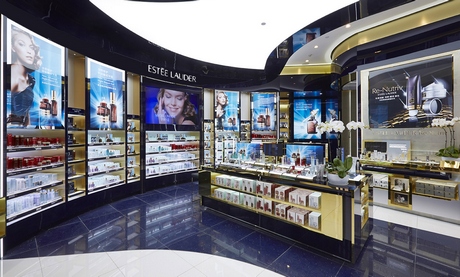
Estée Lauder’s Advanced Night Repair store in Beijing Airport’s Terminal 3.

Asia/Pacific

Sales in the region increased in constant currency with double-digit growth in Australia and solid sales gains in China, Japan and Thailand. The higher sales in China were primarily from increased sales from certain heritage brands despite being up against a difficult comparison with the prior-year period that featured significant launch activity.


These increases were partially offset by lower sales in Singapore, Taiwan and Hong Kong. In Hong Kong, political instability has negatively impacted business and the Company remains cautious of the slower growth there.


In Asia/Pacific, operating income decreased, due to lower results in Taiwan, Korea, China and Hong Kong. The lower results in China reflect increased advertising spending to support sales growth. Higher operating results were posted primarily in Thailand and Australia.


Estée Lauder recently opened a standalone store in Haitang Bay.

Six-Month Results

For the six months ended December 31, 2014, the Company reported net sales of $5.68 billion compared to $5.69 billion in the comparable prior-year period.

Excluding the impact of foreign currency translation, net sales increased 2%.

The Company reported net earnings of $663.8 million for the six months ended December 31, 2014, compared with $733.2 million in the same period last year.


Outlook for Fiscal 2015 Third Quarter and Full Year

The Company continues to estimate global prestige beauty will grow approximately 3%- 4%. The Company expects to grow ahead of the industry by focusing on the fastest growing product categories, channels and countries. The Company also expects to leverage its strong sales growth and increase its operating margin and cash flow from operations.


Third Quarter Fiscal 2015

Net sales are forecasted to increase between 6% and 7% in constant currency.

Reflecting the strength of the U.S. dollar, foreign currency translation is expected to negatively impact sales by approximately 6% to 7% versus the prior-year period.


Full Year Fiscal 2015

Net sales are forecasted to grow between 2% and 3% in constant currency.

Reflecting the strength of the U.S. dollar, foreign currency translation is now expected to negatively impact sales by approximately 4% versus the prior-year period.

The impact of the accelerated retailer orders is expected to reduce the fiscal 2015 full year sales by approximately 3%.

Net sales excluding the effect of the accelerated retailer orders are forecasted to grow between 5% and 6% in constant currency

Canadian airport duty free sales soar in 2014

Sales at Canadian airport stores climbed an impressive 18% in 2014 (up from C$273m) to reach C$322m. December sales were equally robust, up 17% to C$30.5m.

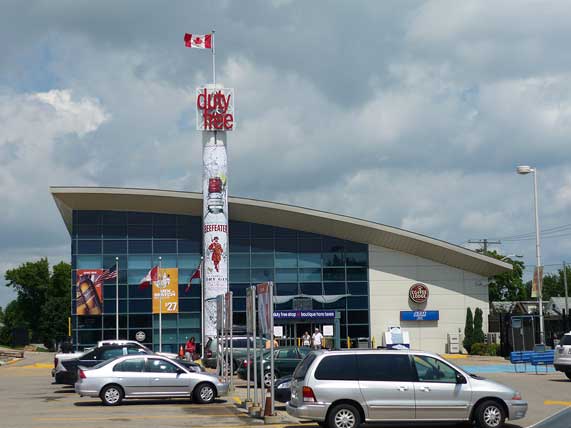
However, border stores did not fare nearly so well recording sales of C$11.2m in December, down by 0.75%, and for the year sales fell by 1.61% to C$143m. Total Canadian duty free sales (including both border and airport sales) reached C$465m in 2014 up from C$419m in 2013.

As previously reported on TRBusiness.com, border shops suffered a more marginal decline of -0.22% to $146m in 2013.

IGL duty free border shop in St-Bernard de Lacolle, Quebec.


Ranked as the top-selling category at airports, perfumes/cosmetics & skincare represented almost 34% of sales at Canada’s airports (C$105m). However, alcohol, the most popular product category at border shops (and overall) hauled in 37.5% of the sales at border stores and 20% of sales at airports.

Sales recorded for the Prairie region in 2014 fell slightly by 1.18% to C$10.5m in 2014, but increased in December by approximately 7.3% to C$774,000.

Sales dropped quite dramatically for the Pacific region in December; down 9% to C$1.8m and 5% in 2014 to C$23m.

Blue Water duty free shop in Ontario, Canada.

Sales were almost flat for Ontario, which recorded a total of C$6.7m (+1.27%) in December and C$79.5m in 2014 (+1.27%).

And finally, sales for the Atlantic/Quebec region hit C$29.7m in 2014, basically flat at +0.92%. In December 2014 the region recorded sales of C$1.8m +1.6%.

The main categories that dominate sales in land border duty free are as follows (in order of sales highest to lowest – based on December 2014 numbers):

Alcohol (liquor, liqueur, wine, coolers)
Tobacco, Cigars, Loose Tobacco
Perfume, Cosmetics, Skincare
Food
Beer (beer, malt-based coolers)
Jewellery, Watches, Clocks
Accessories (purses, wallets, sunglasses, etc.)
Clothing (including hats, fur, leather)
Souvenirs
Office and Travel Supplies
Glassware, crystal, china, figurines, porcelain
Other
Crafts/Arts
Electronics, Cameras, Binoculars, etc.

TFWA’s Jane Grant joins researcher Horizon

Horizon Consumer Science has appointed Jane Grant as Vice President, Business Development covering the duty free and travel retail sector. Grant, a veteran of the industry, takes on the position in addition to her other roles of consultant to TFWA and CEO of Export Marketing Ltd. 

 

Cesa: more consumer focus needed in TR

Ian Cesa (left), President of Horizon Consumer Science, says: “Having Jane on board is a big boost for us because of the esteem in which she is held in the travel retail industry. Through Jane we will now have the opportunity to participate in many more conversations where the voice of the consumer has always been important, but where it has hitherto been poorly represented or not represented at all.”

Grant adds: “A clear understanding of travellers is critical to brands, operators, and travel-related landlords. I am happy to have the opportunity to facilitate this understanding among my colleagues in the industry.”

Horizon Consumer Science is in its 21st year of consulting and research in the DF&TR sector using a combination of qualitative and quantitative research techniques as well as observations and analysis of traffic patterns. The company also carries out the Travel Retail Catalyst Study (TRaCS) which provides a picture of the behaviour of travelling consumers. Some of the findings of the study can be found on Twitter at @dutyfreefacts.

ETRC addresses market fragmentation at forum

“Is the single market fragmenting duty free and travel retail?” was the question addressed through a number of insightful presentations, last Thursday, at the annual ETRC Business Forum event.


Topics such as Air Passenger Rights, tobacco retailing, product labelling, and communication to consumers in travel retail were also addressed through informative presentations and Q&A sessions.


Over 75 member companies and representatives from national and regional associations were represented at the annual ETRC Business Forum, which took place on Thursday 22 January 2015 at the Brussels Airport Sheraton Hotel.


Above: ETRC President Sarah Branquinho speaking at the ACI conference in Zurich in 2014.


The strong member participation contributed to lively discussions on the state of the industry, and examined challenges to the duty free and travel retail industry both today and in the future.


“Faced with increasing demands to provide information to the consumer in prescribed languages and with specific technical requirements, our pan-European business faces complications which, if unresolved, will lead to a reduction in consumer choice – the antithesis of the objectives of the EU,” said the ETRC in a statement released today.


‘LARGEST NUMBER OF ATTENDEES TO DATE’

ETRC was particularly pleased to welcome key note speaker Emmanuelle Maire, Head of Unit Internal Market and Airports from the Directorate-General for Mobility and Transport (DG MOVE), European Commission, who spoke at length about the key challenges for the European aviation market, supported by some fascinating statistics.


Ms Maire was keen to gain a better understanding of the importance of airport retailing as a contributor to airport revenues, and participated in the lively Q & A session that followed the presentation of the ETRC Index for 2014.


Speaking on the success of the day, ETRC President Sarah Branquinho commented; “ETRC relies on the active participation of its members and is delighted that the Business Forum 2015 attracted the largest number of attendees to date.


“Although our industry continues to face challenges, it is heartening to see the level of participation demonstrated by our members who clearly recognise the need to be pro-active in developing appropriate and innovative solutions to meet regulatory demands.


“ETRC looks forward to another successful year working with our members to advance the interests of the duty free and travel retail industry and to drive growth. ”