Now that the numbers are in, the International Air Transport Association (IATA) has reported this week that global air passenger traffic results for November 2016 was recorded at its healthiest and highest level for nine months.
IATA says total revenue passenger kilometres (RPKs) increased by 7.6% compared to November 2015, with capacity up 6.5% and the load factor across the board of its member airlines rising by 0.8 percentage points to a healthy 78.9%.
“Stronger demand for air travel reflects – and is supporting – a pick-up in the global economic cycle.

IATA Director General and CEO Alexandre de Juniac.
OIL PRICE RISES RETURN…
“As the stimulus effect of lower oil prices recedes in the rear view mirror, the strength of the economic cycle will play a key role in the pace of demand growth in 2017,” said Alexandre de Juniac, IATA’s Director General and CEO.
IATA said international passenger demand increased by 8.0% compared to the year earlier, with airlines in all regions showing growth. Total capacity climbed 6.8% as the load factor grew 0.9 percentage points to 77.1%.
European carriers saw demand increase by 8.3% in November 2016, while traffic grew at an annualised pace of 12% over the past five months. IATA says this suggests that the disruption caused by terrorism and political instability has lifted – against a backdrop of a growing Eurozone economy. Capacity rose 6.8% and the load factor climbed 1.1 percentage points to 80.8%.
Asia-Pacific airlines’ November traffic also climbed by 8.3% with capacity up 7.1% and the load factor up 0.8 percentage points to 77.4%. IATA says the strong upward trend in demand has slowed recently, but it is not clear whether this is a longer-term development or just a brief pause.

Air passenger volumes.
MIDDLE EAST CARRIERS LEAD GROWTH
Meanwhile, Middle East carriers continued to lead all regions with a 12.2% demand increase, although the upward trend in the region’s seasonally adjusted traffic has paused, with November’s level coming in unchanged from that of July.
Capacity rose 11.6% and the load factor increased by 0.3 percentage points to 68.7%.
In addition, North American airlines’ traffic climbed 1.5% in November, while Latin American airlines grew by a healthier 7.3% compared to November 2015. .
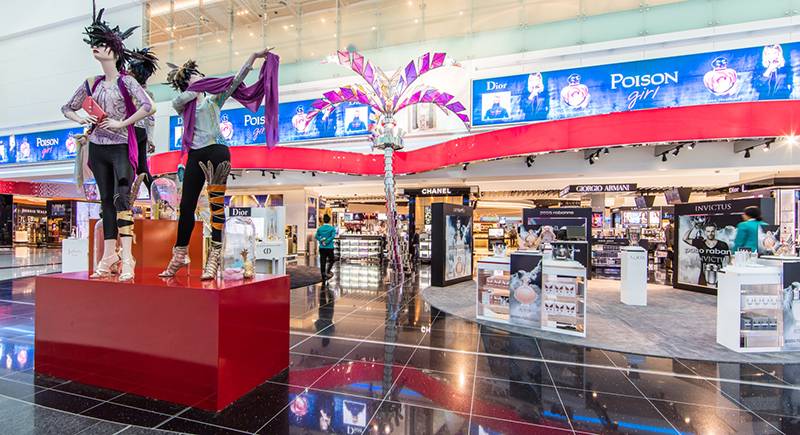
This is an encouraging trend for the DF&TR industry, with international traffic remaining strong.
BETTER NEWS FOR DUFRY AND LATAM DF&TR BUSINESS
This is despite difficult conditions on the North America-South America route, with growth supported much more consistently thanks to the international demand ‘within South America’.
Meanwhile, African airlines experienced an 8.2% rise in demand compared to November 2015, although the economic conditions in much of Africa remain very challenging, particularly in the biggest economies of Nigeria and South Africa.
Last, but not least, domestic travel across the board in all markets saw demand rise by 7.1% in November compared with the same month in 2015, although predictably results varied widely from market to market.
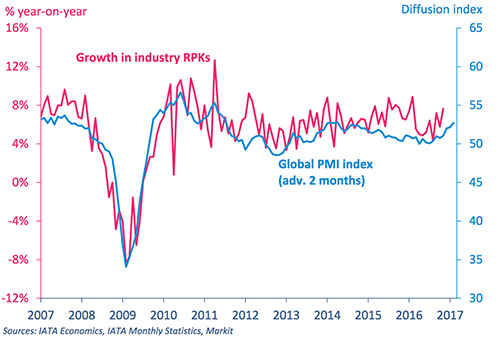
Air passenger volume growth and global business confidence.
RUSSIAN COMPARISON IS NOT QUITE REAL
For example, China, India and Russia recorded double-digit growth while demand declined in Brazil and Japan. Domestic capacity climbed 6.1%, and load factor improved 0.8 percentage points to 82.2%.
Meanwhile, IATA adds that Russia’s 15.5% increase is slightly misleading, since it largely reflects favourable comparisons with the year-earlier period following the collapse of Transaero in autumn 2015.
But the recovery in seasonally-adjusted domestic traffic is continuing, with IATA suggesting there are solid signs that the country’s economic recession is easing.
IATA WARNS OF ‘UNCERTAINTY’ AHEAD
Wrapping up this latest report, de Juniac said: “The airline industry continues to deliver strong results. In 2017, for a third consecutive year, the industry’s return on invested capital will exceed the cost of capital. Passengers benefit from the industry’s success.
“Travel has never been more accessible, with great fares, many options and more destinations. Nevertheless uncertainty lies ahead. The threat of terrorism, questions over the durability of the economic upswing, rising oil prices and increasing protectionist rhetoric are among the concerns.
“The industry has reshaped itself and strengthened its resilience to shocks. We should see another solid year of collective profitability for the airlines in 2017. But we must be vigilant.”

 Trbusiness. The travel retail Trbusiness. The magazine for global retail and duty free professionals.
 Tax Free World Association reports that this year’s Singapore TFWA Asia Pacific Exhibition & Conference at the Marina Bay Sands Hotel in Singapore is shaping up well as the ‘must visit event’ for all those involved in the duty free and travel retail sector in Asia.



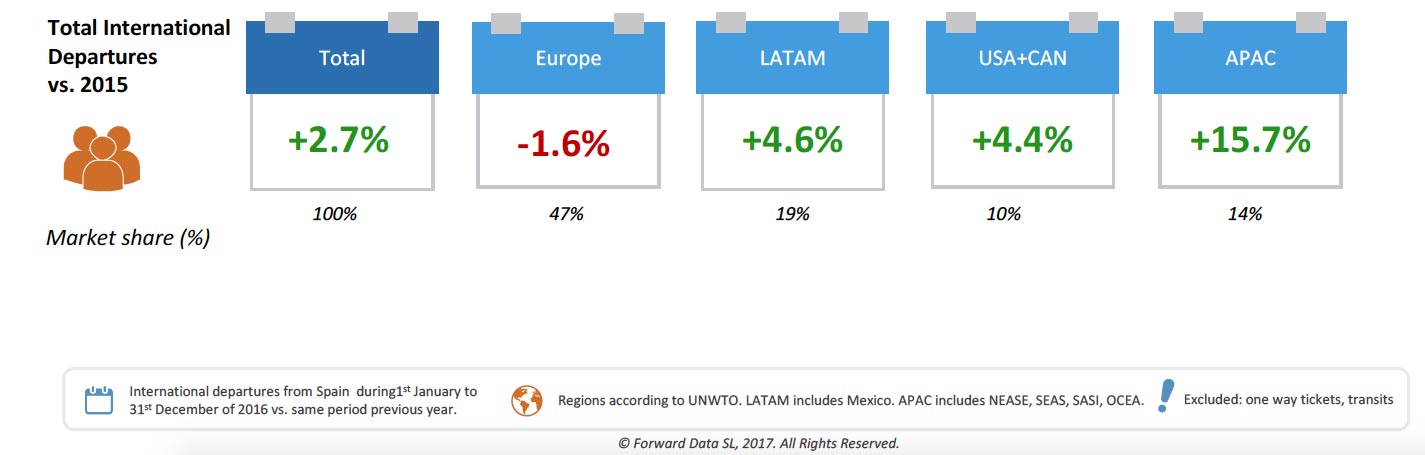
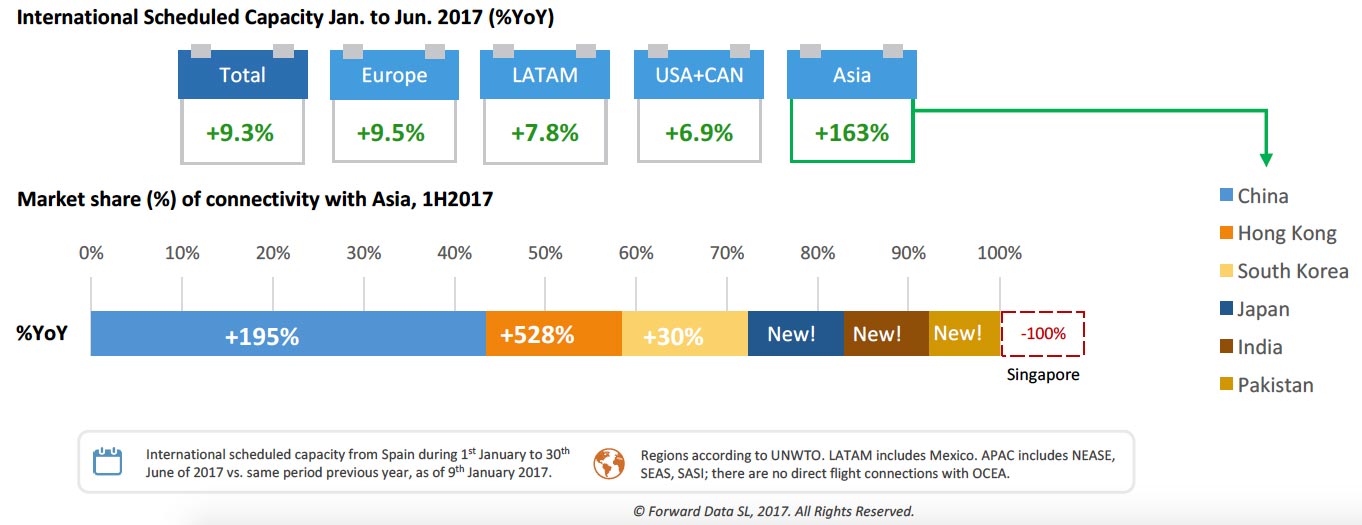
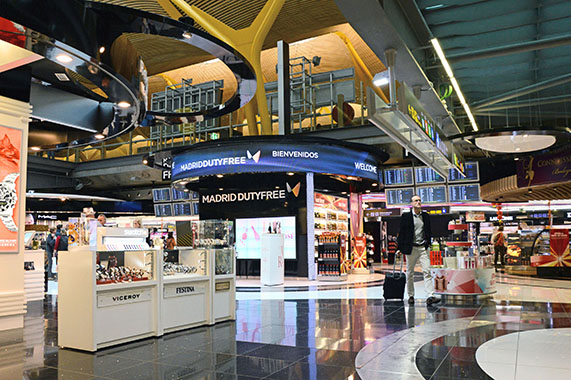 International outbound flights from Spain were up by 2.7% last year with the biggest increase seen from countries in Asia Pacific; a trend that looks like it will continue in 2017, says travel analyst ForwardKeys.
 The Japan National Tourist Organisation (JNTO) says the country registered a record 24m (24,039,000) international visitors in 2016 representing a 21.8% increase on 2015’s total of 19,737,409.





 IAADFS President Michael Payne spoke to TRBusiness on Tuesday, revealing that next year’s proposed joint ‘Summit of the Americas’ event is likely to be staged in Orlando in 2018 and possibly move to somewhere in Southern US after that. However, Payne says there is still a lot to work out.