Archives

DFWC Monitor shows duty free price sensitivity is rising

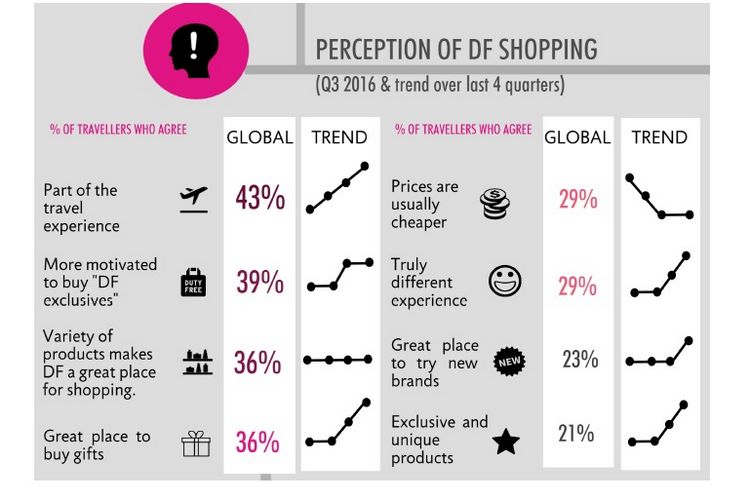
Price is becoming more of an issue (click to enlarge).

Price is becoming more of an issue (see top right of chart and click to enlarge).

Data from the latest quarterly Global Shopping Monitor for Q3 2016 from the Duty Free World Council, in partnership with research consultancy m1nd-set, shows that perception of price is the only parameter to show a negative trend.

The percentage of travellers who agree that prices are usually cheaper in duty free and travel retail has levelled off to 29% in Q3, after falls in the previous two quarters. The percentage of shoppers who find that duty free prices are cheaper than elsewhere has fallen by -2% since the first monitor in Q4 2015.

Others aspects such as offering a truly different experience, exclusive and unique products, a great place to buy gifts have all gained in the eyes of the consumer (see chart right) with none of the other seven parameters going backwards.

Perceived value for money remains the most important contributing factor to shopper satisfaction levels, followed by uniqueness of products and services based on the fourth edition of the DFWC Shopping Monitor, providing a full year analysis of the key indicators. The data is based on a sample of 4,000 travellers.

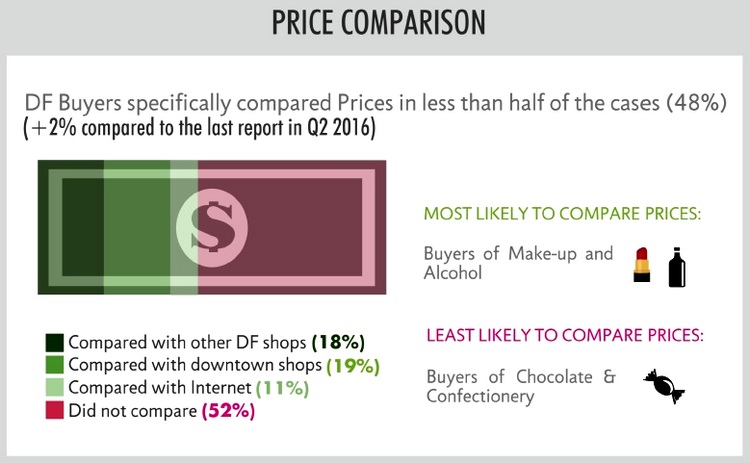
While less than half of DF&TR shoppers price compare (48%), this is up +2% on Q2 2016. They are most likely to compare prices on make-up and alcohol and least likely to do so on confectionery. Although – with the furore today that Mondelez has spaced out the triangles in Toblerone to minimise ingredient costs but sell the product at the same size in the UK domestic market – this category may also come under sharper scrutiny by shoppers in future.

When comparing price, travellers tend to look at downtown shops (19%), other DF&TR shops (18%) and the Internet (11%).

DFWC Q3 monitor

SATISFACTION UP

The DFWC global satisfaction index has seen a two-point gain overall, while Asia Pacific has performed particularly well with a +4% increase compared to the first edition in Q4 2015 and up +2% on the previous quarter this year.

Use of electronic devices to gather information on shopping also shows a strong upward trend, increasing by +2% compared to the previous quarter and+ 4% since Q4 2015. Similarly, the percentage of shoppers claiming to never use their electronic devices for shopping information has fallen sharply over the past four quarters from 53% to 42%. The Monitor reveals that Chinese travellers are particularly avid information seekers on their mobile devices.

Duty free gets a reality check at Hamburg GSF event

Gould: 'When the pie gets smaller, partnership is key'.

Gould: ‘When the pie gets smaller, partnership is key’.

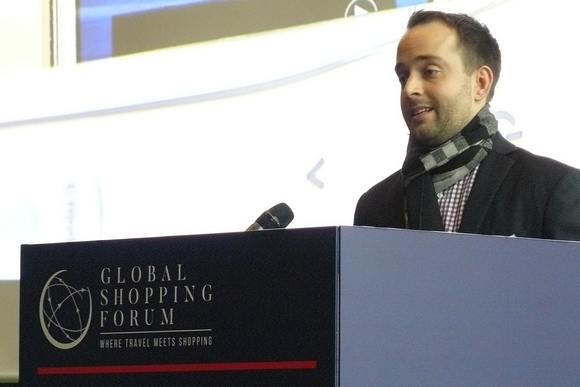
In the afternoon session of the recent Global Shopping Forum in Hamburg [click here for the morning session], Kian Gould, CEO & Founder of AOE (an e- commerce and digital transformation company ) gave the most interesting presentation of the day.

He took a critical look at the duty free and travel retail industry, highlighting the disparity between growing pax numbers and falling sales. He also noted that even in the most buoyant region of Asia Pacific, DF&TR annual growth had fallen drastically and steadily from +25.5% in 2011 to less than +3% last year.

“This is a trend, and it can only be reversed by participating in, rather than fighting, the digital transformation,” he said. “When the pie gets smaller, partnership is key, and stakeholders (airports, airlines, brands, retailers) need to start collaborating in digitalising the entire travel journey.”

Pointing out that airports had ignored the shift to mobile usage and how people interact with their devices, he added: “Airports are not an experience, they’re an annoyance. They used to see other airports as competitors but now everyone is looking for a piece of the pie. Disruption is so fast. There is little incentive to buy anywhere except online.”

He believes that passengers don’t bother with airport apps because they are not interactive or updated enough. “Airports have not provided the technology that people are looking for and have not really worked on enhancing the retail experience,” stated Gould.
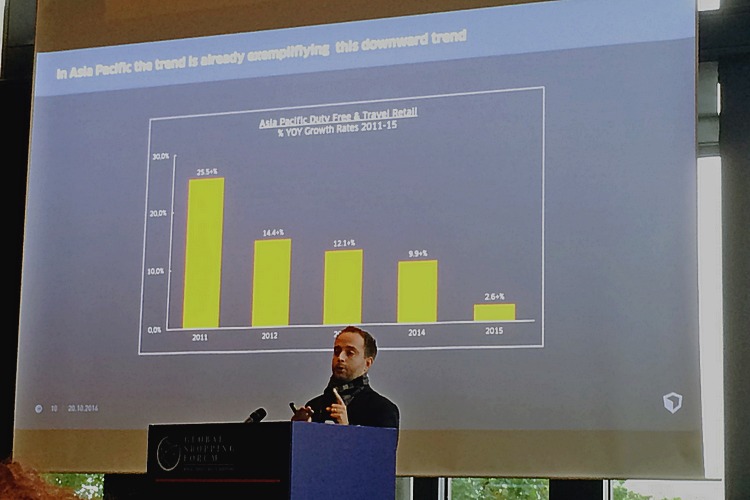
The slowing growth rates in Asia Pacific amount to a trend argues Gould.

The slowing DF&TR growth rates in Asia Pacific amount to a trend, argues Gould.

He was also clear that an omni-channel approach to airport retail was not about click-and-collect, which in fact means arriving at the airport much earlier and perhaps queuing to get your item – not the most convenient way to shop. “What’s the point in that?” he said.

“Travel retailers need to be talking to people at the airport – while they are looking at their devices and while they are receptive.” An example of this is a project that AOE has engaged in for the Lufthansa lounges at Frankfurt Airport where shopping for passengers in these locations has been made possible so that they don’t have to leave the lounge or physically go to the shops.

THE ALL-DIGITAL JOURNEY

That convenience extends to shipping to travellers’ homes, or their airline seat which, he claims, would make more sense. However, this requires stakeholders “to stop looking at each other as competition, but as syndicators that can share information about the passengers and deliver appropriate digital experiences”.

The Global Shopping Forum addressed the whole value chain in travel retail.

The Global Shopping Forum addressed the whole value chain in travel retail.

At Frankfurt Airport, AOE has attempted to fully digitalise the airport journey and any services that FRA offers, from booking shuttle services or car spaces, to ordering products for gate delivery (which can be complex if there are gate changes, missed flights etc).

In the first phase of the project, Heinemann was part of it being the biggest retailer at the airport, plus three others. In the second phase AOE included 20 retailers and two to three are now being added every month.

The advantage of an omni-channel approach is that it can work for everyone, not just a select few – but it can also be used to target specific shoppers like the Chinese, which FRA does. Gould said that through this project, Frankfurt Airport and Lufthansa were now working together. “That’s revolutionary because airports and airlines have never done it to this extent… and it’s only the beginning,” he believes.

Gould also made the key point that airports and airlines in the Middle East often have the same (government) ownership. “They won’t be competing against each other,” he noted, the unsaid inference being that if European airports and airlines did not do the same – and quickly – they could be left behind in the digital race.
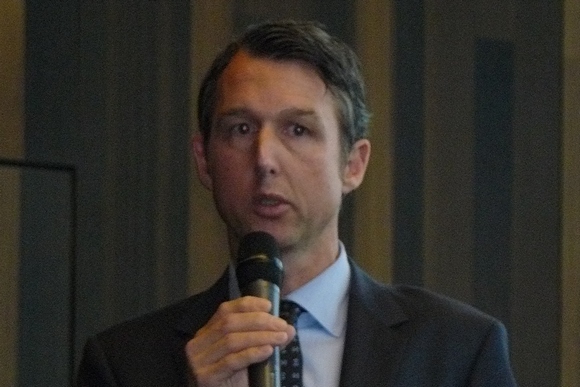
Klemm says that people will share data in return for a personalised experience.

Klemm says that people will share data in return for a personalised experience.

BAIT & SHARE

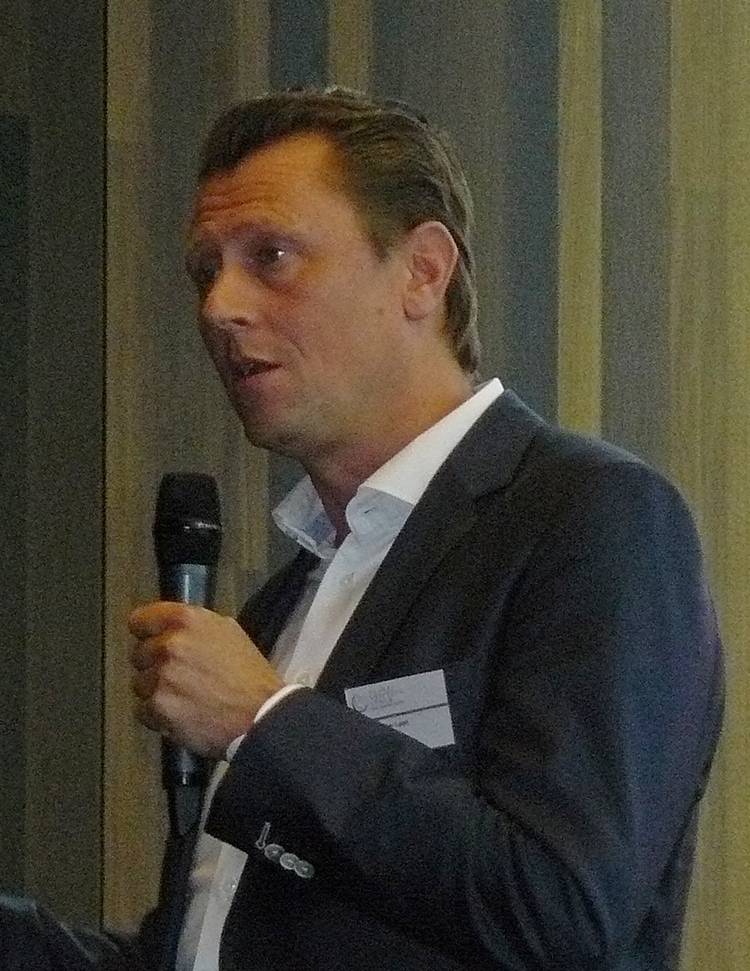
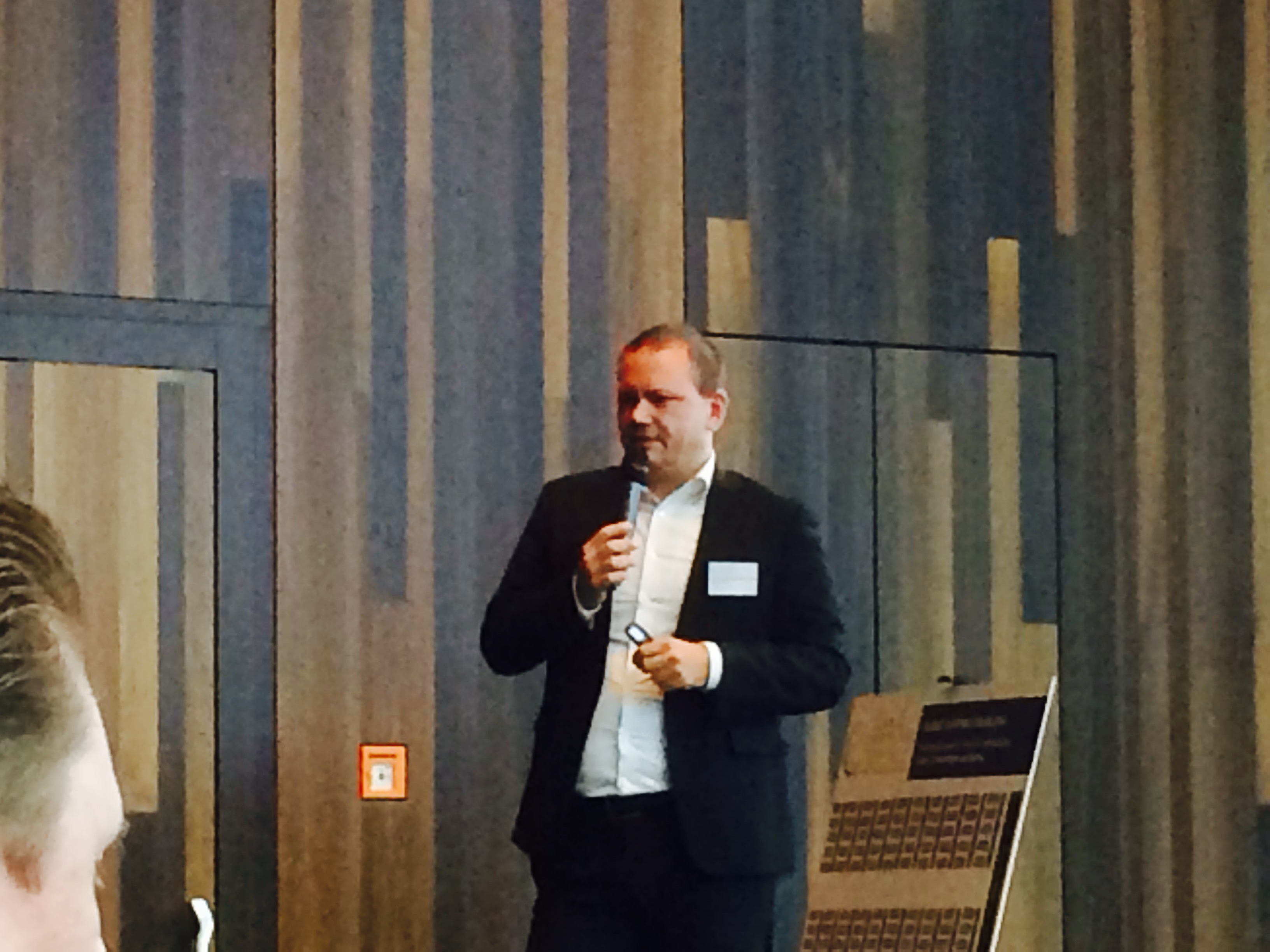
In the next presentation. David Klemm, Head of Acceptance Development Germany at financial services group, Mastercard, discussed how to market to time-poor travellers and how to convince them to share their data. He argued that they would do this if they got a personalised experience in return.

Travel apps already make relevant personal suggestions, and this is better than receiving a €5 voucher he said. Klemm believes that, in the future, data sourced from our daily lives will be combined with beacons, for example, to deliver the correct purchase suggestions.

Mastercard holds large amounts of useful data from transactions. For example, at specific places such as sports grounds or festivals, buyer behaviour for F&B can be analysed in great detail. The company can also benchmark restaurants where the card usage is high to determine sudden changes in sales – and what might be the mitigating factors.

CREATING THE RIGHT EXPERIENCE

Niehaus's lesson to airports: 'We do not want to have the same look and feel every day'.

Niehaus has a lesson for airports: ‘We do not want to have the same look and feel every day’.

Such analysis could well be used by Value Retail, the operator of outlet villages across Europe and further afield. Value Retail’s Business Director Germany, Kay Niehaus, described its first site, Bicester Village in Oxfordshire as London Heathrow’s Terminal 6, due to the high numbers of tourists – the Chinese in particular – who go there.

“We are experts in creating retail platforms where brands are represented in a very good way; we’re not just about hunting for a bargain,” he emphasised. His presentation was less about the digital world and more about the experience that his company goes to great lengths to achieve. “Many of our guests would not typically go to a Gucci or Prada store but they do it with us because they know they can go in and afford the products because they are 30-40% off.”

For high-end brands this offers them a new channel and new consumer target which they would not normally be able to access.

Niehaus says that the types of guests fall into distinct groups who are targeted differently through varied experiences. “We are not a shopping mall we’re a luxury destination with services such as personal shopping and VIP lounges.” The company has a tourism manager in every village and is also investing in hospitality directors who come from the hotel industry in order to build experience in this area.

In the same way, airports need to bring in people from completely different world’s to look at the offer with fresh eyes in order to give passengers a new visual experience, believes Niehaus. “We do not want to have the same look and feel every day,” he says– one lesson airport retailers might do well to learn.
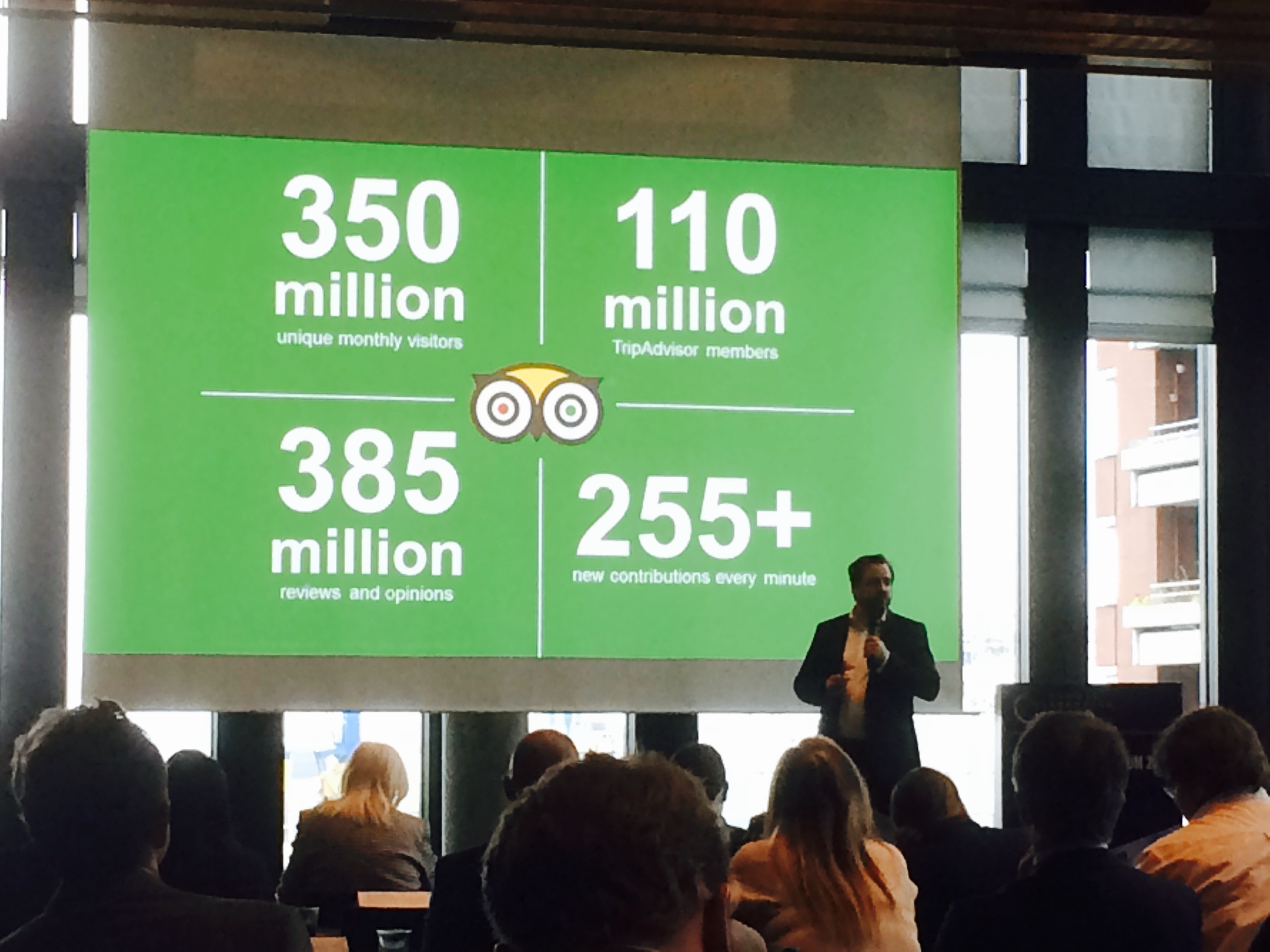
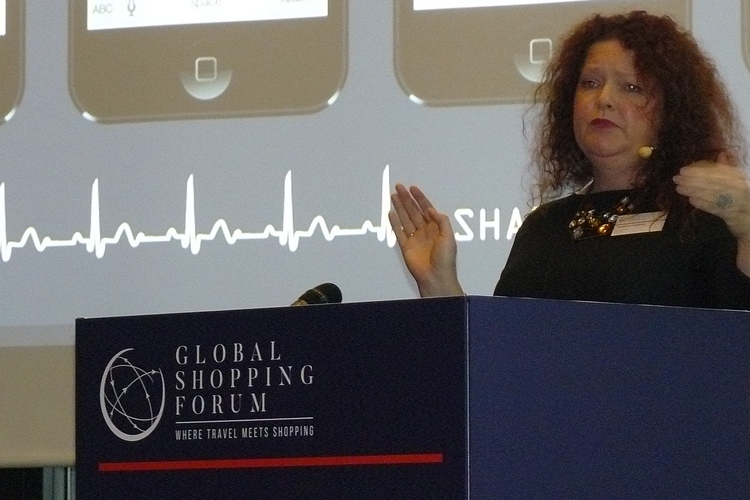
Breckwoldt discussed TripAdvisor's expertise in consumer sharing of information.

Breckwoldt discussed TripAdvisor’s expertise in consumer sharing of information and why that has led to 350m monthly users.

‘PEOPLE LOVE TO SHARE’

Tom Breckwoldt, Territory Manager Germany, Austria & Switzerland at TripAdvisor [the world’s largest travel social media site] stressed the highly interactive nature of the site through the uploading of reviews and images of hotels and restaurants, as well as airlines. The site gets over 250 reviews every minute!

“People love to share,” he said, something FB knows all too well, and this sharing also provides an opportunity to build up a consumer profile. Of TripAdvisor’s roughly 350m monthly users, about half now access the site via mobile, making this platform another that airports might have an obvious affinity with when looking to target passengers.

TRBusiness was not present to hear the final two presentations of the day – but we contacted the speakers to provide us with a summary.

New-Flio-App

Flio has partnered wilh many airports.

André Wessoly, Senior Vice President Sales EMEA at Flio, the global airport app, summarised the advantages of having a centralised source for “all things airport” such as automatic connection to free wifi at different gateways, money-saving discounts, and offers on airport services, retail and food and beverage.

He emphasised that the app generates commercial revenues for airports, brands and retailers and that “38% of our active audience interact with Flio prior to their departure date”. Flio now also allows airports to market the app as ‘their own’ with a dedicated section in their own existing style. The company also offers airports a percentage of brand revenue sold via their section which effectively means they can “earn revenue from brands without lifting a finger”.

Deng markets brands directly to consumers in China via social media.

Deng markets brands directly to consumers in China via social media.

UNDERSTANDING ‘CHINSUMERS’

The final presentation of the day came from Xin Deng, Managing Director of China Smiling, a start-up that markets brands and retailers directly to Chinese travellers via their social media or travel sites such as WeChat or AliTrip, prior to them travelling abroad.

Deng describes these travellers as Chinsumers and broke them down into three segments: regular travelling shoppers, Haitao cross-border online shoppers, and Daigou representative buyers (for others). All three groups are heavily influenced by word-of-mouth which is why China Smiling interacts with them before they travel and after they come back and are leaving comments or reviews on websites.

Brands need to be aware of this whole process in order to, not just gain a sale, but have favourable online commentary afterwards – which could multiply future sales. Brand awareness and business reach to Chinese travellers are therefore both essential to drive new sales and retain – and gain – customers, said Deng.


 

Global Shopping Forum unites wider TR value chain

Facebook’s Catherine Fitzgerald.

Facebook’s Catherine Fitzgerald.

Big social media names such as Facebook and TripAdvisor – plus a number of airports, retailers and suppliers/distributors – attended the third annual Global Shopping Forum last month in Hamburg which brought together the broader duty free and travel retail value chain in an attempt to get these stakeholders to interact more directly.

Entitled, Traveling Shoppers in Times of Digitalization, the event – organised by Eli Fel, Managing Director of Travel Blue Germany – put the emphasis on how digitalisation is radically transforming shopping in the travel industry.

The conference at the Empire Riverside Hotel in Hamburg had about 100 attendees compared to the 60 that participated last year on the topic of the Chinese traveller. This time – and in line with GSF’s tag-line ‘where travel meets shopping’ – the discussion was much more wide-ranging: how do international airports become omni-channel commercial destinations; can legacy airlines combine on-board shopping with ground touchpoints for a seamless shopping experience; and the value of mobile-first social media in connecting with travellers.

GSF Founder Eli Fel.

GSF Founder Eli Fel.

Such an ambitious range of topics was a lot to take in for the audience – most of whom were not digital natives – but the value of GSF is that it has established itself as a place for some disparate parts of the travel value chain to connect; a think-tank from which new ideas and partnerships can be incubated.

What was a lot clearer – as Fel and speakers such as Kian Gould CEO & Founder of e- commerce and digital transformation company AOE noted – was that while air traffic continues to rise, duty free and travel retail sales, last year, took a beating, dropping by -2.7% (source: Generation Research).

Airport landlords and retailers are therefore eager to harness digital to boost those flagging retail sales – but how to do that efficiently is far from clear, and a question that GSF tried to address.

THE ‘ALWAYS ON’ TRAVELLER

GSF lead pic

Today we’re never switched off.

Kicking off the day was Facebook’s Travel Client Partner, Catherine Fitzgerald who talked about connecting with people in a mobile-first, ‘always-on’ world. The idea that travellers, in particular, were always connected was a heavily-pushed theme throughout the GSF especially by technology and social media speakers.

Fitzgerald spoke of the agility of Facebook – in its short 12-year history – moving from the desktop to mobile-first platform where it derives 80% of its advertising revenue. With 1.7bn active users, access to them – and their data – is a potential goldmine for any duty free and travel retailer wanting to target by behaviour or ‘likes’.

Facebook has a trump hand in the world of digital; it owns the world’s top four apps: Facebook Messenger, Instagram, FB, and Whatsapp. Fitzgerald noted that with TV consumption decreasing, knowing which with digital channels to communicate to audiences has become an important consideration.

And for all those airports out there developing their own apps, she had some bad news: “The average smartphone user spends significantly more time on their most used app (46%) than on their next four”. The airport app – much further down the list – therefore may have little more than novelty appeal, while airline apps, at least, have important functionality in that they hold boarding pass information and thus are guaranteed to be used in the airport journey.

GSF Deubel LR

Deubel outlined the digital challenges that airports face.

Fitzgerald said that airports could send messages to FB users through their newsfeeds once they have ‘checked in’ at a terminal location and then tie up with localised beacon technologies which can direct specific retail offers to the user. However, she was unable to share any case study, when asked, of any airports and FB working together in this way.

She added: “There’s a big disconnect between the airport authorities, the airlines and the retailers who are looking to maximise both experience and sales opportunities.” This is a perennial theme in the DF&TR world, and was picked up several times during the event.

THE AIRPORT EXPERIENCE

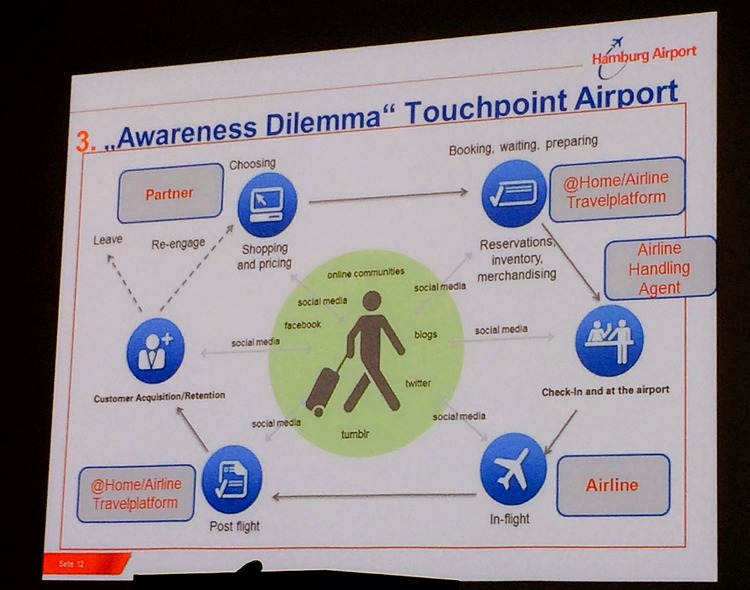
Next on was Hamburg Airport’s Commercial Director & Head of Center Management, Lutz Deubel, who started by showing a ‘trend barometer’ about digital at airports which indicated that while beacons and apps were being implemented, most of the focus was on navigation and wayfinding, while 73% of IT investment was being directed at pax processing.

GSF HAM slide LR

How to create greater awareness along the pax journey.

Retail, it seems, is way down the pecking order. One of the problems he said was the ‘awareness dilemma, “because we still don’t know when passengers will arrive at the airport because airlines are not willing to share that data”. The competitive nature of loyalty schemes, from airlines in particular, but also DF&TR operators was another issue.

Nevertheless he discussed steps that the airport – the fifth biggest gateway in the country – was taking to develop its Passngr app in tandem with two other airports in Germany: Munich and Dusseldorf and build critical mass. Started in July, the rollout of services will be phased in, with retail and F&B part of the guidance function, and store offers also built in – plus the potential of a loyalty scheme to be added to new releases.

LOYALTY BRINGS ADVANTAGES

Wold: 'predictive analytics... this is what success is all about today'.

Wolf: ‘predictive analytics… this is what success is all about today’.

On that subject, one of the biggest loyalty operators spoke next. Miles & More Director Retail, Brigitte Wolf, discussed the multi-channel approach of the loyalty scheme, primarily targeted at Lufthansa and Swiss travellers.

She noted that the physical catalogue remained an essential part of the offer and added that selling exclusive high-end products worked very well in this channel. For example, Miles & More had a special-edition Breitling watch on Swiss for CHF7,000/$7,190, which saw huge demand.

“Passengers can go on Amazon and other platforms but they will not find this Swiss Breitling watch on any other catalogue because it’s unique for the anniversary of the launch of the airline’s Boeing 777 fleet,” she said.

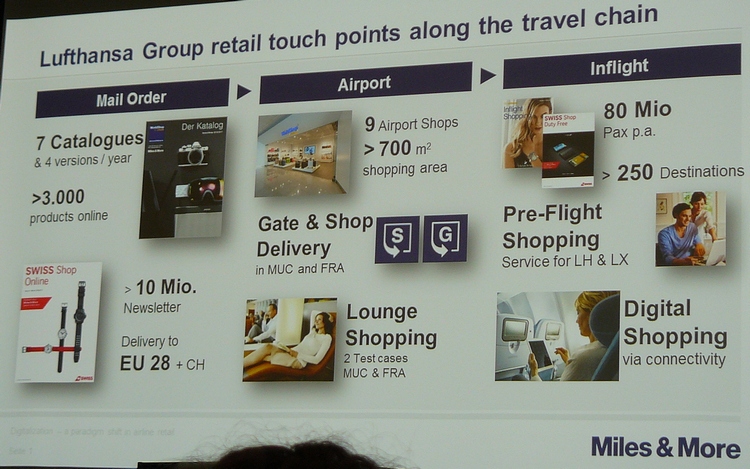
Miles & More also has nine airport shops and airline shopping [renamed from inflight sales to reflect that products can now also be delivered to anywhere in the EU-28 markets].  On the vexed topic of partnering with airports Wolf said the company was working with Frankfurt and Munich airports where two pilots are in place for lounge shopping in order to leverage those passengers who tend to escape the retail offer this way.

Miles & More is retailing to pax at more touchpoints than most.

Miles & More is retailing to pax at more touchpoints than most.

As for the prized data that airlines have, Wolf commented: “We don’t just work with known analytics; we have a big department that looks at predictive analytics so we can target consumers much more accurately. This is what success is all about today and it’s the beginning of bringing together all the channels that we have in retail so that passengers can shop at their convenience at a time when they are receptive to messages.”

SOFTWARE TO SWITCH PAX ON, NOT OFF

Rene van der Laan: 'a relevant and convenient offer leads to acceptance'.

Rene van der Laan: ‘a relevant and convenient offer leads to acceptance’.

Rene van der Laan, Director Global Practice, Customer Intelligence, at SAS [not the airline but a software company] discussed the concept of the ‘loyal chameleon’ – those people who are prepared to spend but who don’t necessarily want to be identified.

His presentation followed the theme of targeting the passenger at the right moment: “a relevant and convenient offer leads to acceptance” he maintained – a simple enough idea but hard to do well when passengers are bombarded with so many messages that they switch off.

SAS analyses data – real time and contextual – to see how, when and why users interact with websites and brands, in order to build a ‘360 degree view’ of customers. Van der Laan noted that retailers were often using technology at some point along the customer journey to drive traffic into physical store rather than for online sales. “But messages to shoppers have to be appropriate and in-sync with the target consumer to be effective,” he added.

He made the interesting point that when shoppers use price comparison sites, to find say a Bluetooth speaker, airports retailers are frequently absent [he cited Capi Electronics in this example]. This is a lost opportunity if that shopper may be a regular traveller and does not see the Capi option because it was not offered.

MOBILE MARKETING

In similar vein, Michael Mauerhaff, Head of Marketing Sales for several country markets at Global Blue, the tax refund specialist, told the audience that globe shoppers like the Chinese and Americans spend, on average, about seven times more than domestic travellers, and that they were increasingly using mobile searches before shopping tax free.

He also urged airports and retailers to find out more about the habits and interests of their potential customers so that when they come to the airport these shoppers can be targeted with relevant offers or vouchers. End-to-end sales can then be measured to see how successful these types of marketing campaigns actually are.

[Part Two of the Global Shopping Forum can be found here.]


M1nd-set partners IATA & ARC for new airline data tool

M1nd-set-IATA-lead-logoM1nd-set says its new ‘Air traffic forecasting tool’ has now been fully deployed, completing the final piece of the four-module Business intelligence Service ‘B1S’ it first announced with Generation Research back in October 2015.


M1nd-set founder Peter Mohn believes B1S will ‘revolutionise’ the industry’s approach to data, due to the level of sophistication, depth of detail, wide ranging information and specific filtering and benchmarking possibilities available.


“[This tool] has set a new standard that will make it difficult for industry professionals to settle for less,” he says. “As the portal incorporates more data over time, the evolutionary analytical capacity of the service will develop and improve.


“The B1S will provide even greater analytical possibilities and a deeper overview of the industry performance from all four pillar perspectives, not only for the present and future but also how each data set has progressed over time.”


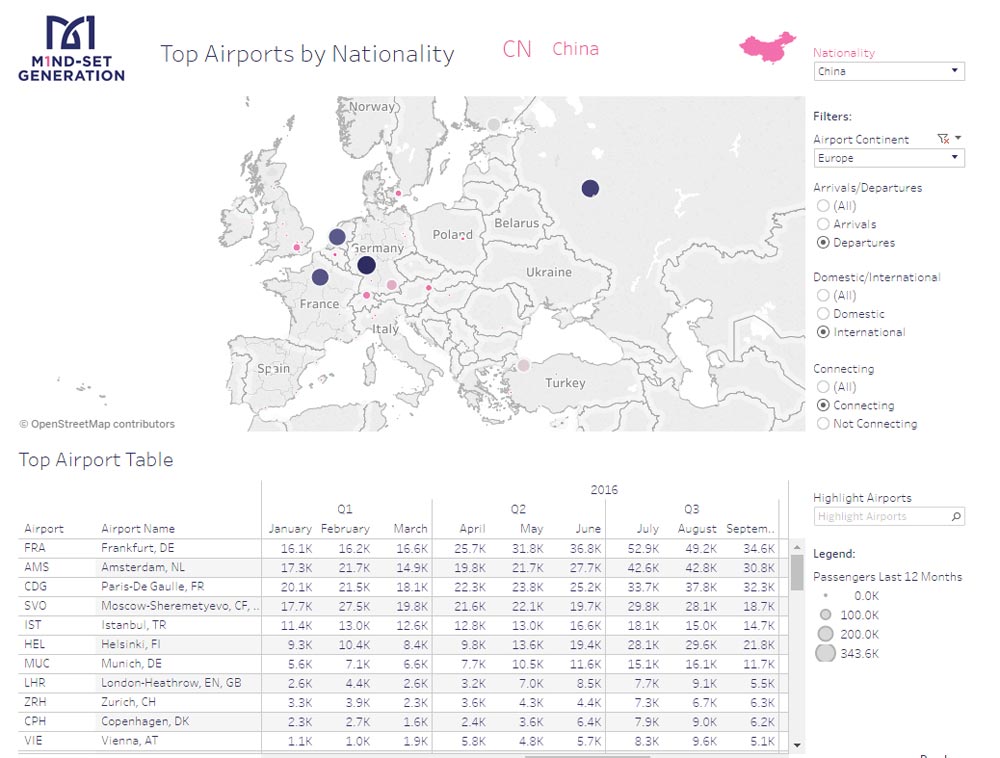
Click to expand charts.


M1nd-set-IATA-traffic-tool-screenshot-1

Chart 1: “In the chart [pictured above] for example, B1S displays the top airports for all Chinese origin departures to Europe,” says m1nd-set.

The ‘highly sophisticated travel forecast data’ which can be accessed through the ‘Air traffic forecasting tool’, is sourced both from IATA and travel technology and data analytics company ARC (Airlines Reporting Corporation).


“These combined sources represent the industry’s most unique repository of airline sales data available,” says m1nd-set. “The data is provided through IATA and ARC’s ‘Direct Data Service’ (DDS) database.”


The DDS program is built on travel agency sales data captured through ARC and IATA’s financial settlement systems and ticket sales contributed by airlines participating in the program, which makes it unique.


WHY IS THIS TOOL UNIQUE?

The world’s leading airlines actively contribute their sales data to the program, which means the DDS can provide unprecedented visibility into both direct and indirect channel activity, says the Swiss analyst firm.


“Together, these sources represent the industry’s most unique repository of airline sales data available with information from over 400 airlines and 80, 000 travel agents across 170 countries and secondary sources such as government statistics and airport data,” it adds.


DDS is able to estimate 100% of global airline sales data, including scheduled and charter flights and low cost airline traffic and will even distinguish between business and economy class.

M1nd-set-ARC-data-Paris-CDG

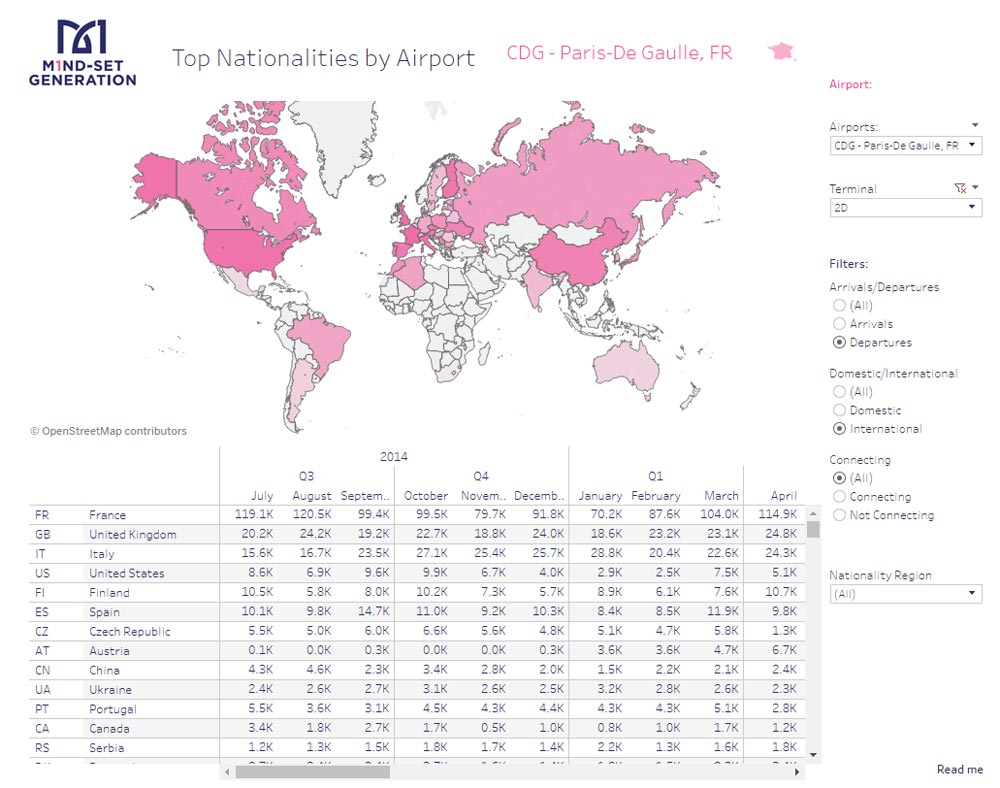
“Inversely, the data can also be displayed by airport so the top arriving and departing nationalities can be seen, not only for the airport, but also for each terminal and by arrivals, departures and even connecting flights. As with the nationality data, the airport specific data can be shown both for actual and forecast traffic.”


“The database is designed to provide detailed traffic estimates by market, based on the cumulative data, using advanced algorithms to scale origin and destination statistics so even non-reported data can be estimated,” says m1nd-set.


The company believes that its four-module B1S will be able to provide a deeper understanding of future traveller trends, thanks to this sophisticated database and its analytical capacity.


The data portal will enable users to select specific airports or nationalities and view both real and forecast traffic data for those selection criteria.


“In the chart [1. pictured above] for example, B1S displays the top airports for all Chinese origin departures to Europe,” says m1nd-set.


“Inversely, the data can also be displayed by airport [Chart 2] so the top arriving and departing nationalities can be seen, not only for the airport, but also for each terminal and by arrivals, departures and even connecting flights. As with the nationality data, the airport specific data can be shown both for actual and forecast traffic.”

Sweden, US seal preclearance deal for Arlanda Airport

001a stockholm arlanda

Preclearance is set to boost US traffic.

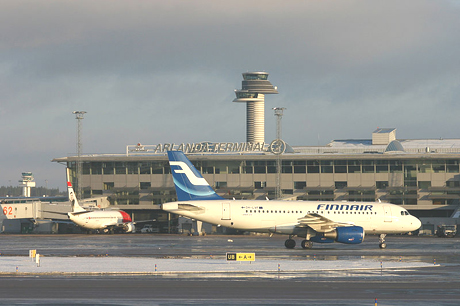
The Swedish and US governments have, today, signed a bilateral pact to introduce US border control at Stockholm Arlanda Airport (ARN) while state-owned operator, Swedavia, and US Customs & Border Protection (CBP) have agreed on how this function will be handled at the SAS hub.

“The US is Sweden’s most important trading partner after Britain,” says Karl c so that a decision on a larger investment in US preclearance facilities can be taken immediately, once the legal process is completed, which is expected in the summer of 2018.”

In 2015, ARN was selected by US authorities as one of 10 airports globally with potential for establishing US border control on foreign soil prior to departure. As a result of today’s agreements, a preclearance facility can be built as soon as the legal process is completed.

Wistrand: 'continuing preparatory work'

Wistrand: ‘continuing preparatory work’

PUBLIC TENDER FOR NEW FACILITY

Swedavia says it will now proceed to the next preparatory phase of completing the project design and preparing a public tender for the coming facility.

Wistrand comments: “The agreement between Sweden and the US will benefit Swedish access. Travel between the two countries has increased sharply in recent years, to more than 600,000 passengers, and the introduction of US preclearance will have a strong positive effect on both foreign investment and Swedish tourism.”

In 2015, about 1.1m passengers flew between Sweden and the US, with 60% of them choosing direct flights. Over the past few years, the trend in air travel has been dominated by increased leisure travel in both directions. It is not yet clear whether the move will benefit outbound duty free and travel retail sales, which will depend on how much time US-bound travellers have to shop before having to enter preclearance.

A Swedavia spokesperson told TRBusiness: “Travellers will have access to the main duty free stores before passing the US preclearance. The planning for the facility is not ready in detail, but there will also be some basic service inside the area.”

Implementation of US preclearance ultimately requires the approval of the Swedish parliament and further capital spending to complete the new facility.

IATA reports return of strong pax demand in September

Planes IATAThe International Air Transport Association (IATA) reports that its global passenger traffic monitor for September (in revenue passenger kilometres, or RPKs) registered a 7% growth compared to September 2015 – the strongest year-over-year increase in seven months.


The airline association added that capacity climbed by 6.6%, while the load factor inched up 0.3 percentage points to 81.1%. In addition, growth in domestic traffic was said to have just outpaced that in international traffic.


“September’s growth in passenger demand was healthy,” said Alexandre de Juniac, IATA’s Director General and CEO. Importantly, this rebound from August weakness suggests that travel demand is showing its resilience in the aftermath of terror attacks. We must, of course, be ever-alert to the ongoing terror threat.


INDUSTRY ‘STILL VULNERABLE’

“And overall the industry is still vulnerable to being buffeted by rising geopolitical tensions, protectionist political agendas, and weak economic fundamentals. This will still be a good year for the airline industry’s performance, but our profitability will continue to be hard-won,”


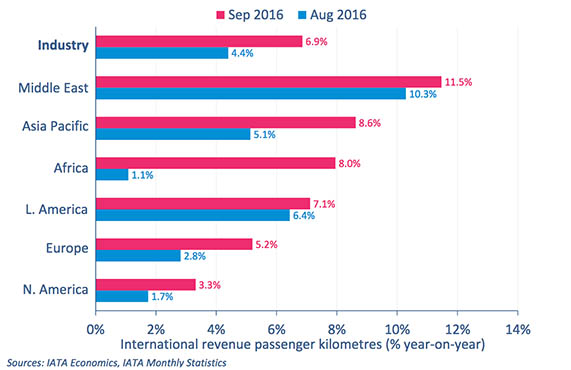
In terms of international passenger markets, IATA said that international RPKs climbed by 6.9%, with airlines across all regions growing compared to 2015. At the same time, total capacity increased by 7.2%, causing the load factor to slide 0.2 percentage points to 80.4%.


IATA de juniac

Passenger growth by region Sept 2016 (Above): Alexandre de Juniac, IATA’s Director General and CEO.


IATA reported the following results in terms of performance by regions:


  • European carriers saw September demand rise 5.2% over September 2015. Capacity rose 5.7% and load factor slipped 0.4 percentage points to 84.8%, which was the highest among regions. Demand growth seems to be returning to normal after the disruption caused by terrorism and political instability.


  • Asia-Pacific airlines’ traffic rose 8.6% in September compared to the year-ago period, although there are still signs of Asian travellers being put off by terrorism in Europe. Capacity increased 7.7%, and load factor rose 0.7 percentage points to 77.9%.


  • Middle East carriers had an 11.5% rise in demand in September compared to a year ago, which was the largest increase among regions. Capacity rose faster, however, up 13.8%, and load factor dropped 1.5 percentage points to 73.9%.


  • North American airlines experienced a 3.3% rise in demand. While the upward trend in international traffic has eased of late, seasonally-adjusted passenger volumes have risen at an annualized rate of 6% since March. Capacity rose 4.2% and load factor fell 0.7 percentage points to 81.5%.


  • Latin American airlines’ September traffic rose 7.1% compared to the same month last year, aided by strong demand on international routes within the region. Capacity climbed just 2.4% and load factor surged 3.6 percentage points to 83.7%, second highest among regions.


  • African airlines posted an 8% rise in traffic, which was matched, by an equivalent rise in capacity. Load factor was almost flat at 72.0%. The strong demand increase largely reflected favourable year-ago comparisons, as economic conditions in much of the continent remain challenging.


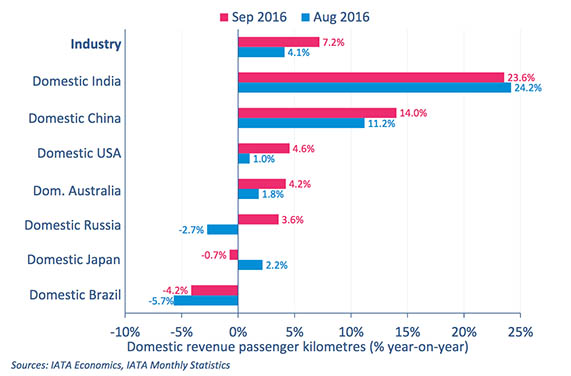
iata-525Domestic Growth by Market September 2016


DOMESTIC DEMAND UP +7.2%

Turning to domestic passenger markets, IATA said that demand rose by 7.2% last September compared with the same month last year, which was up from the 4.1% year-on-year growth recorded in August. India and China continued to experience double-digit annual traffic increases, while results were said to be decidedly mixed elsewhere. All markets except Australia registered all-time highs in September load factors.


IATA added that US domestic traffic resumed its healthy growth pattern after a slowdown in July and August, rising by 4.6% in September year-over-year. By contrast, it also pointed to Japan’s domestic traffic sliding by a nominal 0.7% in September – due mainly to weak consumer spending.


Meanwhile, IATA said that the month of October also saw the global aviation industry take a major step forward to ensure that growth remains sustainable: “The nations of the world came together through the International Civil Aviation Organization (ICAO) to agree a plan to offset the environmental impact generated by future air traffic growth.


“In taking this unprecedented step toward achieving long-term sustainability for an entire industrial sector, governments recognized the immense contribution aviation makes to economic development and global well-being.


“In conjunction with our investments in more efficient technologies, infrastructure and operations, this will ensure that aviation can continue to be the business of freedom, connecting our world with safe, efficient, reliable and sustainable air transport,” said IATA’s de Juniac.


Frankfurt retail weakens by €7.8m in 9M2016

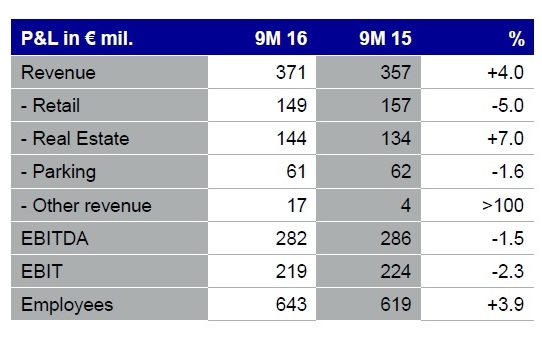
The retail and real estate segment (click to enlarge).

The retail and real estate segment (click to enlarge).

A decline in passenger numbers at Frankfurt Airport (FRA), falling spending from four out of five of the top shopping nationalities (by value), and generally lower spend/pax were all factors in the retail contraction seen at the Lufthansa hub in the first nine months of the year, according to the owner and operator, Fraport.

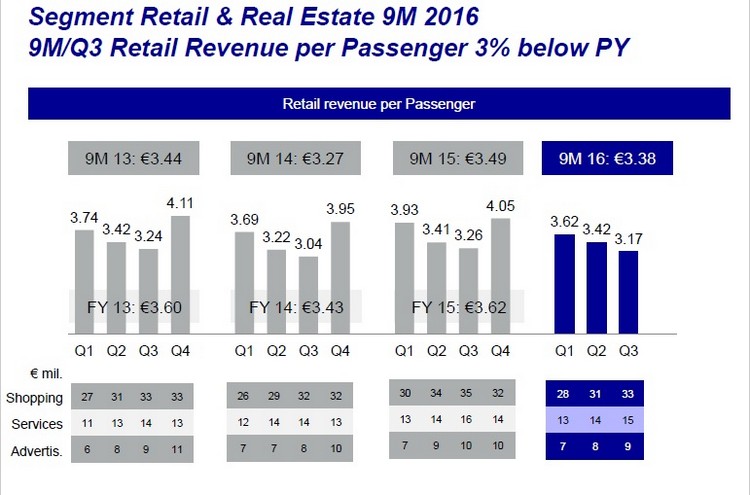
Retail revenue was down by -5% to €149m/$163.3m, while the actual shopping element of that slipped to €92m/$100.9m in the 9M period, a decline of -7.1% year-on-year. Revenue per pax has also fallen to €3.38 (see table below).

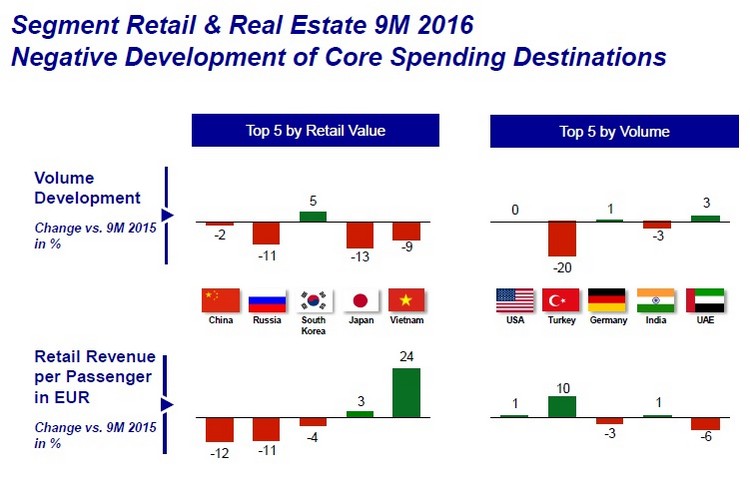
fraport 9m 16 retail by quarterAmong the top five nationalities for retail spending by value, only South Koreans generated an increase (of +5%). The others were down as follows: China -2%, Russia -11%, Japan -13% and Vietnam -9%.

The top five nationalities by volume did not perform much better: USA was flat, Turkey was down -20%, Germany was +1%, India -3% and UAE +3% (see chart below based on Heinemann data).


LOW-COST BOOST STARTS WITH RYANAIR

At FRA – where Gebr. Heinemann is the core duty free and travel retail concessionaire – Fraport notes that passenger traffic fell by -1.2% to 46.7m. The company is now making the case for introducing low cost carriers by claiming that, with a share of LCCs at about 4% [versus the European average of 20-60%], it is losing market potential to other airports such as Cologne-Bonn. The airport has signed a deal with Ryanair, which will launch holiday services to Spain from the hub from March 2017.

On the plus side, the overall retail and real estate segment, saw growth of +4% due to the “decline in retail revenue compensated by other revenue from property sales, and additional real estate revenue” says Fraport.

fraport 9m 16 nationalities

Best US outbound increase in over a decade in 2015

US outbound travel has been surging but the travel retail industry has not made the most of it.

US outbound travel has been surging but the travel retail industry has not made the most of it.

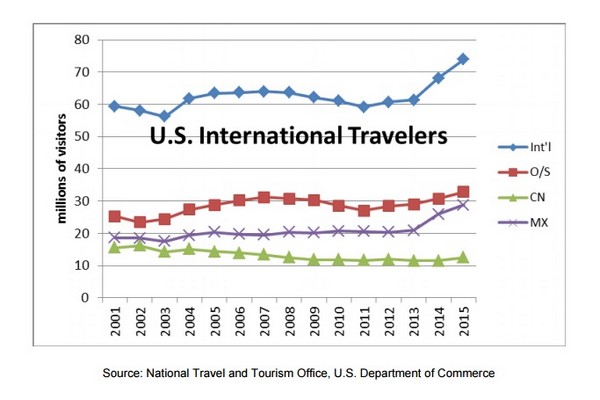
The duty free and travel retail market was helped by a high rise in travel by US citizens last year – with the markets of the Middle East and Mexico seeing the best growth. This is the fourth year of increases in US travel abroad.

US government data from the Department of Commerce shows that the overall global increase of +8.5% in 2015 versus the year before led to a total of 74m outbound travellers – a new record. The last time the US saw this level of growth was in 2004 when the increase was near +10%.

Travel to ‘overseas’ countries– defined as all markets except Canada and Mexico which are counted as the separate ‘North America’ region – rose by +6.5% to 32.8m, also setting a record. Among overseas regions the growth (in order) was as follows: Middle East +14.9%, Asia +7.4%, Oceania +7%, Caribbean +6.6%, Europe +5.9%, South America +5.5% and Central America +3.5%. The only market to decline was Africa at -2.1%. In North America, travel to Mexico rose by +11%, and Canada by +8.3%.

IN ABSOLUTE TERMS…

By absolute numbers, the top two destinations for US international travellers were Mexico and Canada at 28.7m [a 38.8% market share of all US outbound travel] and 12.5m respectively. Combined, the market share of Canada and Mexico of the 74m visits was 55.7%. This is the highest share by the top two destinations since 2004.

The top five individual countries visited by US travellers in 2015 were: Mexico (28.7m) and Canada (12.5m) as stated, followed by the UK (2.9m), Dominican Republic (2.8m) and France (2.4m). Nine of the top 10 destinations visited by US travellers posted increases in 2015. Among the top 10 countries showing the fastest growth over the previous year were Spain (+12%), Mexico (+11%), and France (+11%), despite the terror attacks the latter endured last year.

NTRG commissions regional DF report from m1nd-set

Ferries represent a huge chunk of DF&TR sales in the Nordics.

Ferries represent a huge chunk of DF&TR sales in the Nordics.

Nordic Travel Retail Group (NTRG) has chosen duty-free research company, m1nd-set, to run a comprehensive research programme over two years aimed at mapping the market structure across the region by analysing sales performance, consumer shopping behaviour and macro-economics.

According to m1nd-set, the research is among the first major initiatives launched under its  Business 1ntelligence Service (B1S), a subscription model which provides a single-access platform to four fundamental types of data: consumer behaviour, sales, traffic, and macro-economic.

The Switzerland-based research group says: “The report for NTRG will provide members with a holistic overview of the market in terms of the major air and sea routes, passenger load information and category and sub-category retail sales for each retailer as well as the overall turnover for the market in the region.”

Eva-Rehnstrom-Nordic-Travel-retail-group

Rehnström: “This pan-regional survey and research will provide significant added value’.

The consumer insights segment of the research will consist of insights on ferry and air passenger shoppers across all major markets, offering a pan-regional overview and highlighting specific national trends where there are significant differences from the regional trend.

Shopping behavioural trends expected to be revealed include paths to purchase, motivations and destination of purchases, as well as reasons for not purchasing. M1nd-set says that the project “will be able to provide a benchmark of the regional trends and differences against other world regions”.

Peter Mohn 2015

Mohn: ‘a strong and trusting relationship’.

Eva Rehnström, of Viking Line and Chair of NTRG comments: “NTRG believes this pan-regional, multi-purpose survey and research will provide significant added value for the association and – most importantly – for our members. We will be able to offer comprehensive and actionable data.”

M1nd-set CEO and Owner, Peter Mohn, adds: “We have been working with NTRG and its members for several years now. This type of project requires a strong and trusting relationship between all parties, given the depth and sensitivity of the data and we are grateful to NTRG for the opportunity to work on this ground-breaking research project.”

NTRG represents DF&TR suppliers and retailers in Denmark, Sweden, Norway, Finland, Iceland, Estonia, Latvia and Lithuania.

Juul-Mortensen pays tribute to former President Pacquet

Jacky Pacquet MASTER TopTax Free World Association has advised with regret that its former President Jacky Pacquet passed away last Saturday after a long illness.


As many of those who worked and helped in the formulative days of TFWA know, Jacky became an elected member of the TFWA Management Committee back in 1989, before he was subsequently voted President in 1993 at what was a very important formulative time for the association.


This was the year when TFWA began planning the very first TFWA Exhibition & Conference in Asia, which launched successfully in Singapore in 1995. Subsequently, Jacky Pacquet served out another three years as president until he retired in 1998, when he became TFWA’s Honorary President.


TFWA said that Jacky’s dedication to the duty free and travel retail sector was boundless and he was a true gentleman with a kind word for everyone he met.


A TRIBUTE TO A GENTLEMAN

TFWA’s current President Erik Juul-Mortensen paid tribute to Jacky Pacquet as he returned from attending his funeral in Segonzac, a village where Jacky lived within the Charente department of south-western France, in the Cognac area.


Jacky Pacquet

Jacky Pacquet: a true gentleman and a great contributor to the duty free and travel retail business for many years.


Asked what his best memories were of Jacky and what he contributed, Juul-Mortensen said: “First of all I think he was there at a crucial time for the association – as I said in my statement about the time that he was president.


“It was also a time where we had all of the discussions in the planning of the first Asia Pacific event and looking back that was a major step for the association, with lots of uncertainties and all the rest of it.


‘STABLE, CALM AND COLLECTED…’

“But Jacky being Jacky was a very stable, calm and very collected person in all of these discussions and really kept the cool in all of our talks with our competitors and the management committee, etc etc.


“I think he had a very stable influence on the whole thing, bringing it down to ground level and getting things moved on. He also had a calming influence on all of the hot heads around – including myself I suppose.


“He was also a very good stabiliser in getting things done and also because he had the respect and the acceptance of everybody. Everyone I hear or see mentions the word gentleman and I think that is absolutely correct. Jacky was a gentleman in the true sense and he was also very modest.


“I have just been to his funeral in Segonzac yesterday where he lived and his wife is amazing and very calm and collected and it was all very nice, with a nice ceremony. As you know, he also came to all of the events in Cannes after his presidency and he still had a tremendous interest in the well being of the association.


Jacky Pacquet was a believer

Jacky Pacquet was a believer in the simple but very meaningful TFWA mantra…


JACKY RETAINED HIS INTEREST IN TFWA’S WELFARE

“He also took part in some of our management committee meetings in his capacity as Honorary President and he also came to all of the AGMs and listened in. That is something that people also appreciate that he kept his interest in the association.”


Juul-Mortensen repeated his earlier words and those of TFWA that Jacky will be greatly missed and both his and the association’s thoughts are now with his family at this very sad time.


Doug Newhouse adds: Erik Juul-Mortensen echoes the high regard that Jacky was held in by many and I can personally concur with those sentiments as we always got on. Besides all of the special qualities mentioned by Erik, Jacky was also a very kind person, but nevertheless determined when it came to what was right and wrong. He also had a good sense of humour and many very good friends within the industry.