Trbusiness. The travel retail Trbusiness. The magazine for global retail and duty free professionals.
 In the past two years, Chinese travel patterns – as TRBusiness has documented – have been changing with previously big markets such as Hong Kong and Singapore losing out to nations such as Thailand and, increasingly, the US.
New data from duty free and travel retail analyst, CiR, indicate that between 2013 and 2015, there was a +100% rise in travel to Thailand followed by a +63% increase to the US. Among the top 10 destinations, the only fallers were Hong Kong and Singapore which showed contractions of -2% and -1% respectively (see table below and click to enlarge).
Aside of these two extremes, the other strong performer in the top 10 was Japan (+49%) and this has been translating into high duty free sales in the market – one reason why the fledgling downtown DF&TR business is expected to take off rapidly. Lotte, for example, is targeting $860m in sales within a decade.
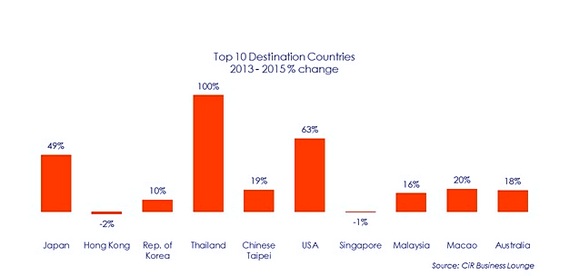
The top 10 growth markets for Chinese travellers.
STRONG CHINESE TRAVEL TO US
Up until now, Chinese travel to the US has also been strong. Excluding Asian countries, the US ranks number one as the country to see the largest increase in absolute Chinese passengers departing for its shores. Since 2013 there have been an additional 627,579 passengers to the US, an increase of +63% compared to 2013.
This growth is significantly ahead of any other destination country outside Asia, with France ranking second at +27%, or 98,128 extra passengers.

LAX is seeing some big gains in Chinese pax.
China Eastern has announced plans to further boost North American capacity in 2016 and CiR’s Business Lounge schedule data show significant increases in China to US routes in the coming six months versus an already strong 2015.
Seat capacity from China to the US is up so far by +24% versus 2015, an additional 537,122 seats, with a large proportion of this into Los Angeles International Airport.
An improving regional airport infrastructure in China, combined with the USA’s relaxation of visa regulations in 2014, have no doubt contributed to the Chinese appetite for all things American, with three of the top 10 airports outside of Asia now in the US.
One factor that may impact this positive trend for US travel retailers is the strength of dollar versus the Chinese yuan. The latter currency has had a fairly precipitous fall since August 2015 with its value against the dollar now back at 2011 levels.
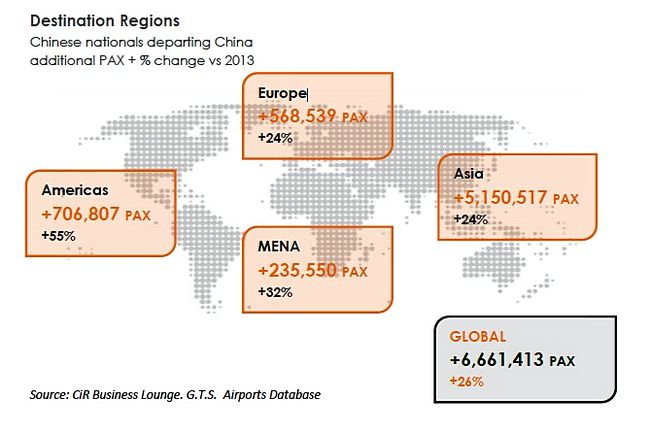
Growth markets by region 2013-15.
REGIONALLY SPEAKING
On a regional basis, the Americas as a whole outstripped the rest of the world for growth, rising by +55% against a global average of +26%.
Both Europe and Asia fell just below that average, both at +24% while the Middle East and Africa – driven by connecting hubs in the Gulf and business interests in Africa – rose by +32% (see chart above and click to enlarge).