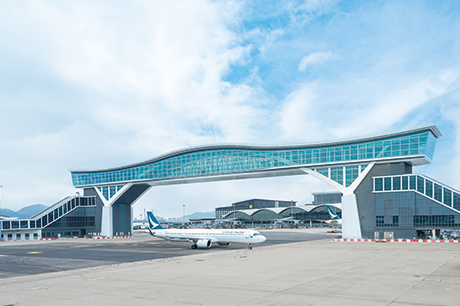
HKIA opened its Terminal 1 Sky Bridge in November.
Hong Kong International Airport (HKIA) handled 5.7 million passengers in 2022 – a year-on-year increase of +318.4%.
The special administrative region began the gradual resumption of cross-border travel with Mainland China earlier this month after ending a sweep of travel restrictions in December.
In a statement today, Fred Lam Chief Executive Officer of AAHK, said: “The airport endured another challenging year in 2022 as the impact of the pandemic continued. Nevertheless, we saw the light at the end of the tunnel when the HKSAR government relaxed travel restrictions and quarantine requirements for inbound travellers in the second half of the year.
“Passenger traffic at HKIA started to pick up in the last quarter of 2022. We also had a good start of 2023 with the resumption of normal travel with the Mainland. We are confident that passenger traffic will continue to recover at HKIA.”
In December, the airport processed 1.6 million passengers – a 938.7% surge on the same month in 2021.
Source: AAHK. Click to enlarge.
Hong Kong residents and visitors stimulated traffic growth in December, with traffic to and from Southeast Asia and Japan enjoying significant momentum.
In the month prior (November), HKIA opened its new 200-metre long Terminal 1 Sky Bridge and announced the phasing in of commercial units.
It is with great sadness that TRBusiness reports the passing of industry pioneer, Founder of Generation Research, Yngve Bia on 1 December 2022, after he suffered a heart attack at his home in Portugal.
His funeral, attended by his closest family and friends, was held in the Själevads Church, Örnsköldsvik, Sweden on 12 January 2023. He is survived by his three children Stella, Alexander and Charlotta, all of whom live in the UK.
Bia lived happily in Portugal with his dog, aka his ‘best friend’, Kiki, since he sold the industry-renowned data & analysis company, Generation Research, to Fredrik Lindh in 2015, after which he retired.
Creating the company 36 years ago, Bia’s Generation Research became an indispensable tool for the industry, producing the following publications: Best ’n’ Most; The Travel Retail Perfumery Report; TRIQ Confectionery; TRAQ Beverage, TRAQ Confectionery & Fine Food & TRAQ Tobacco and TREND News.
A close friend and former business partner of TRBusiness, Bia helmed the joint venture TREND News website and newsletter service, together with TRBusiness owners Nigel Hardy, Janice Hook and former Editorial Director, Doug Newhouse.
While Bia was often described as discreet, his experience and knowledge of the DF&TR industry was unmatched. For his incredible insights documented almost 10 years ago in a superbly comprehensive interview with then TRBusiness Editorial Director, Doug Newhouse, you can watch the below video.
During the exclusive video interview filmed during the 2014 TFWA World Exhibition & Conference, Bia weaves a detailed tapestry of the state of the industry, which serves as a rich and perennially-useful, historical source.
–
Born and raised in Örnsköldsvik, Sweden, Bia studied at the University of Uppsala.
After a spell working for a Swiss retail company, he then decided to start his own company, Generation Research, in 1979.
It was actually when he was living in Hong Kong that he first recognised the lack of data and information available within the tax free and travel retail business.
Yngve Bia held a passion for writing and was a talented pianist.
TRBusiness understands from his former colleagues, Eva Östlund and Helén Hägglund, that in order to build the huge database which has powered Generation Research data for over four decades, he borrowed a friend’s computer in the evenings to in order to document all the products and numbers.
Never fully detaching himself from his hometown of Örnsköldsvik, whilst living in Hong Kong Bia fed his passion for writing by penning articles for a Swedish newspaper under the appropriately titled, ‘Our Man in Hong Kong’, whilst continuing to publish articles in Best ’n’ Most and on the Generation Research website.
Tributes to a ‘true visionary’
Aside his love of writing, he was a talented piano player and dabbled in song writing. Impressively, he released an album of his own songs performed by Brian Frank.
“Yngve was a great man, a true visionary and he will be deeply missed,” said former Generation Research colleague Eva Östlund. “We enjoyed working for and with him during our years at Generation Research.”
“I will always be grateful for the times spent with Yngve at Generation Research, for the generosity he showed and the wisdom he shared,” added fellow colleague, Helén Hägglund.
TRBusiness understands that prior to his passing, Bia had been enjoying his life, playing golf, playing the piano and taking long walks with Kiki.
“Yngve was a true gentleman within the travel retail industry, with the emphasis on the word ‘gentle’,” said TRBusiness Co-Owner, Nigel Hardy.
“Amongst the many louder-than-life characters that populated the business, he stood out from them with his quiet, mild-mannered and almost humble demeanour.
Yngve Bia pictured with TFWA President, Erik Juul-Mortensen at the 2015 World Exhibition & Conference.
“A genuine pioneer, who with his data collection and analysis, provided the travel retail world for many years with invaluable information that formed the cornerstone of endless company business plans, conferences and even job applications.
“I have many fond memories of times spent with Yngve, both working alongside him on our joint venture TREND and listening to his anecdotes that were often laced with his unique strain of observational humour. May you Rest in Peace Yngve.”
TFWA President: ‘Way ahead of his time’
TRBusiness was fortunate to hear from TFWA President Erik Juul-Mortensen, who communicated his sentiments earlier today: “Yngve Bia was a man with a vision.
“He gave us a set of industry data, which may not have been perfect, but which allowed the industry to track itself in broad terms, and to use those figures with institutions, regulators and governments to demonstrate the value of our industry to the aviation and maritime economies. No-one else has successfully achieved that and it is sorely missed.”
“Quiet and understated, way ahead of his time, Yngve developed a platform to marshal and crunch an enormous amount of data from his small office in equally small Örnsköldsvik where he worked with a loyal and dedicated team. For many years, Best ‘n Most was an indispensable tool for the industry.
“Yngve was a ‘one-off’. He was a very private person, but through the sheer force of his personality he convinced leaders of businesses across all categories and channels to entrust their data to him.
“In return he generously shared insights which helped people develop their businesses, and in doing so made friends across the world, including at TFWA whose conferences were enriched by Yngve’s data.”
TRBusiness would like to invite all those who knew Yngve Bia to share your own memories, anecdotes and stories of him via [email protected].
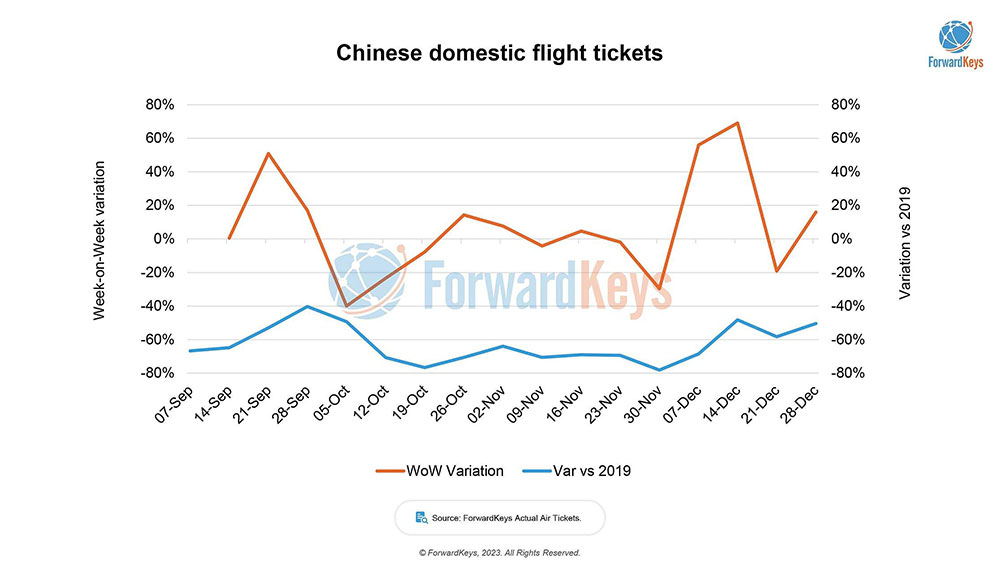
China’s decision to abandon its zero-Covid policy has triggered a wave of flight bookings, according to analysts at ForwardKeys, who reveal that domestic flight bookings in particular spiked 56% immediately following the decision by China to ditch PCR tests for air travel between provinces.
On 7 December, Chinese authorities announced that a negative PCR test would no longer be required for air travel between provinces, confirmed Forwardkeys.
“Domestic flight bookings immediately surged 56% on the previous week and continued to increase 69% the following week,” said the company.
“On 26 December, China removed all Covid-related restrictions on domestic air travel; and bookings surged again, reaching 50% of 2019’s level in the final week of the year.”
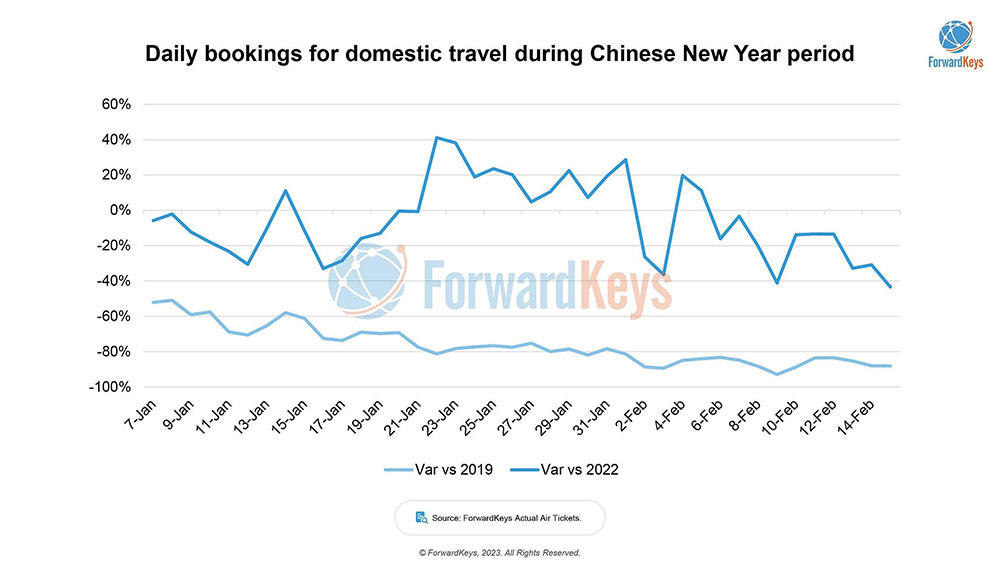
As of 3 January, domestic flight bookings during the upcoming Chinese New Year period 7 January – 15 February, were 71% behind pre-pandemic (2019) levels and 8% behind last year.
The most popular destinations appeared to be Beijing, Shanghai, Chengdu, Kunming, Sanya, Shenzhen, Haikou, Guangzhou and Chongqing. However, before the announcement on 7 December, they were 91% behind 2019, insisted Forwardkeys.
The end of a cap on the number of international flights to China and quarantine measures, (announced on 26 December and implemented on 8 January) are also making an impact.
In addition, Chinese citizens can now renew expired passports and apply for new ones.
Outbound flight bookings between 26 December and 3 January jumped 192% compared to same period last year, but they are still 85% behind pre-pandemic levels, said Forwardkeys.
Currently, the most popular return trips are to Macau, Hong Kong, Tokyo, Seoul, Taipei, Singapore, Bangkok, Dubai, Abu Dhabi and Frankfurt.
Olivier Ponti, VP Insights, ForwardKeys, commented: “Although Chinese New Year is likely to see international travel rebound for the first time in three years, we will need to wait longer before we see a resurgence in Chinese tourists exploring the globe.
“The reasons are; first, current scheduled international flight capacity is only at 10% of 2019’s level and owing to approval requirements for traffic rights and airport slots, it will be difficult for airlines to gear back up in less than a few months.
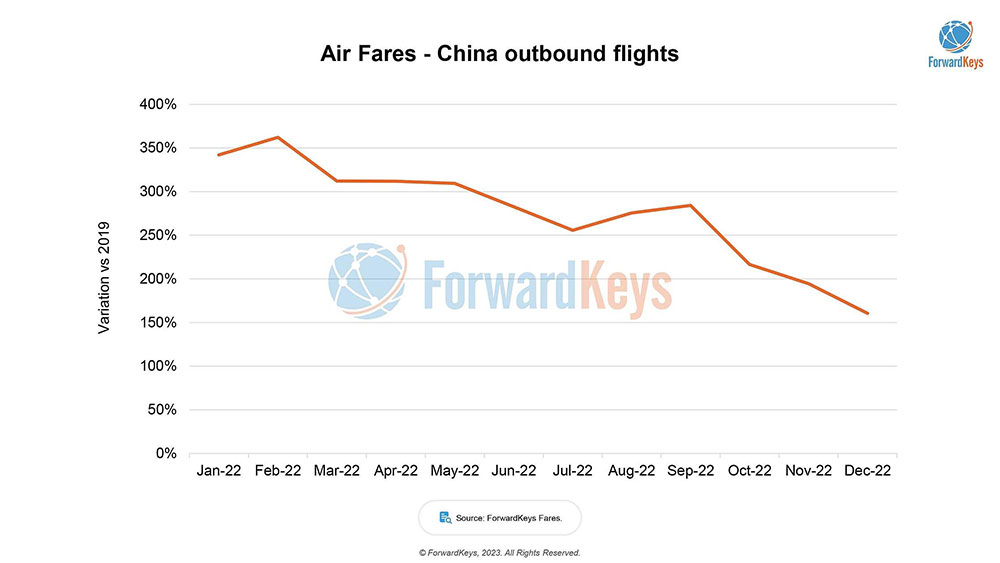
“Second; ticket prices remain high, with average air fares in December 160% higher than in 2019. That said, there has been a downward trend since June, when quarantine was reduced from three weeks to seven days, and then to five days in November.”
“Third; some destinations, including the US, the UK, India, Qatar, Canada, Australia and all 27 EU member countries now require a pre-flight Covid-19 test for Chinese visitors and others, such as Japan, South Korea and Italy, will impose testing on arrival and quarantine for those who test positive.
“Finally, a bottleneck processing passport renewals and visa applications is likely and some countries, such as South Korea and Japan, are restricting short-term visas for Chinese travellers until the end of this month.
“Right now, we expect the Chinese outbound market will pick up strongly in Q2 2023, when airlines schedule capacity for the spring and summer, which include the May holiday, Dragon Boat festival in June and summer holidays.”
Dubai International Airport (DXB) has retained its spot at the summit of the leading international travel hubs measured by connecting passengers in 2022, shows new data from m1nd-set.
The Swiss travel and travel retail research firm’s full-year 2022 B1S traffic monitor report* released today reveals DXB handled 11 million connecting pax in 2022.
Making up the top three were Frankfurt Airport (FRA) and Amsterdam Airport Schiphol (AMS), which both registered 10.5 million connecting passengers.
Leading international transit hubs, which benefit from a broad cross-section of global travellers that often use their time to indulge in duty free shopping, have witnessed a recovery of around 62% of pre-pandemic traffic levels, continues the monitor.
In seventh position, Tocumen International Airport in Panama City remains the only top ten travel hub to have reached pre-pandemic 2019 traffic levels for connecting passengers versus 2019.
While FRA and AMS have clawed back a little over 60% of their respective 2019 levels for transit passengers, Paris Charles de Gaulle Airport nudged across the 66% threshold (against 2019) with Madrid Airport netting over 70% of its pre-pandemic levels.
Top 20 nationalities for travel
The full-year B1S traffic monitor also records the top 20 travelling nationalities and top 20 airlines.
Click to enlarge.
Passengers from the United States emerged at the summit of global international departures with 132 million passengers making trips in 2022.
In second spot was the UK, recording 102 million international trips for the year in question, followed by Germany with 87 million international trips.
France, Spain and Italy remain in the top ten but rose in the rankings compared with their respective pre-pandemic traveller numbers in 2019.
Meanwhile Switzerland, Canada and the Netherlands are all new entrants into the top ten.
Click to enlarge.
Unsurprisingly, South Korea, Japan and China all exited the top ten travelling nationalities in 2022.
Spain and Switzerland are the only two countries among the top ten nationalities to have experienced a full recovery in international traffic, attaining and even moderately surpassing pre-pandemic levels.
The average recovery rate among all top ten nationalities compared to 2019 is 75%, with France at 90% of 2019 levels and the Netherlands and Germany at around 80%.
Elsewhere, the top 20 airlines for passenger numbers recovered 81% of traffic during the first ten months in 2022 through October versus the same period of 2019 with low-cost carrier Ryanair leading the pack with just over 100 million international passengers served above pre-pandemic levels at 104%
*BiS traffic monitor report produced in partnership with the International Air Transport Association (IATA) and air traffic partner ARC. All infographics courtesy of m1nd-set/B1S.
Airport and airline associations have criticised the ‘knee-jerk reaction’ of EU member states in agreeing a raft of recommended travel measures for passengers departing from China.
On Wednesday, state officials in the presence of the Schengen Associated Countries met in Brussels and aligned on a ‘coordinated precautionary approach’* amid the growing wave of Covid-19 cases in China.
One of the recommendations is for Member States to ‘strongly encourage’ all passengers to present a negative Covid-19 test no later than 48 hours prior to departure from China.
In a joint statement, Airlines for Europe (A4E), the International Air Transport Association (IATA), and Airports Council International (ACI) Europe say the recommendation agreed by country officials in Brussels ‘is at odds’ with an assessment published by the European Centre for Disease Prevention and Control (ECDC) on 3 January.
Willie Walsh, Director General, IATA: “We have the tools to manage Covid-19 without resorting to ineffective measures that cut off international connectivity, damage economies and destroy jobs.” Source: IATA.
Measures are not mandatory
ECDC says that given the higher population immunity in the EU/EEA and the fact that Covid-19 variants in China are already in circulation in Europe, a rise in cases is not expected to affect the epidemiological situation.
“As such, systematically testing incoming travellers from China cannot be considered a scientifically driven and risk-based measure,” read the joint statement.
While travellers could be required to present a negative Covid-19 test on departure, undergo random on-arrival testing and wear a mask on flights, the measures are not mandatory and are at the discretion of individual Member States.
The joint statement continued: “While it is regrettable that the recommendations agreed largely amount to a ‘knee-jerk reaction’, it is now vital that they are implemented by EU member states in a fully uniform manner – in full compliance with the addendums to the EU Aviation Health Safety Protocol to be published in the coming days by EASA and ECDC. These addendums will provide detailed guidance regarding passenger testing and wastewater testing.
“A4E, ACI Europe and IATA look forward to further engaging with the EU on the reassessment of these recommendations by mid-January 2023.
“We urge EU Member States and China to work together and to reconsider at the earliest opportunity their requirements for systematic pre-departure testing of travellers based on a scientifically driven risk assessment.”
Wastewater sampling: due diligence required
The associations say they support a move away from testing passengers, but the aforementioned suggestion to test wastewater from airports and aircraft arriving from China must consider ‘technical and operational practicalities’ before any decision is taken to begin sampling.
“When required, airports and airlines will do their utmost to facilitate such sampling – on the understanding that it needs to be carried out by the competent health authorities, as airport and airline staff are not qualified to do so,” added the statement.
Willie Walsh, Director General, IATA added: “Several countries are introducing Covid-19 testing and other measures for travellers from China, even though the virus is already circulating widely within their borders. It is extremely disappointing to see this knee-jerk reinstatement of measures that have proven ineffective over the last three years.
ACI World Director General Luis Felipe de Oliveira: “ACIWorld strongly reiterates that if any health-related travel measures are deemed necessary, that they be risk- and evidence-based.”
“Research undertaken around the arrival of the Omicron variant concluded that putting barriers in the way of travel made no difference to the peak spread of infections. At most, restrictions delayed that peak by a few days. If a new variant emerges in any part of the world, the same situation would be expected.
“That’s why governments should listen to the advice of experts, including the WHO, that advise against travel restrictions. We have the tools to manage Covid-19 without resorting to ineffective measures that cut off international connectivity, damage economies and destroy jobs. Governments must base their decisions on ‘science facts’ rather than ‘science politics’.”
In a statement, ACI World Director General Luis Felipe Oliveira added: “We can’t repeat past mistakes. We are working with ICAO and other international organisations to protect connectivity — which is vital to fully restoring travel, trade, and tourism that provide economic and social benefits to communities worldwide.
“As such, we welcome the government of China’s plan to lift Covid-19 quarantine requirements for international arrivals. As the last major economy in the world to re-open its borders, the decision represents a key milestone in the recovery of air travel. We now call on them to go further and re-assess their testing requirements as well.
“In order to ensure the smooth recovery of air traffic and the benefits this brings, cooperation and the establishment of standards through ICAO, WHO and others that harmonise the processes for international travel between countries are crucial. Several States are now reactively re-introducing Covid-19 testing and other health measures for travellers from China.
“ACIWorld strongly reiterates that if any health-related travel measures are deemed necessary, that they be risk- and evidence-based. It is imperative for governments to have a harmonised response and to coordinate this response with other countries and aviation stakeholders. Let’s not take two steps backwards but continue to move forward with the valuable lessons learned from the past.”
*Member states agree to the following: recommend to all passengers on flights to and from China to wear a medical mask or FFP2/N95/KN95 respirators; issue advice to incoming and outgoing international travellers coming from or destined for China, as well as to aircraft and airport personnel, regarding personal hygiene and health measures; strongly encourage, for all passengers departing from China to Member States, the requirement for a negative Covid-19 test taken not more than 48 hours prior to departure from China. Member states are advised to complement these recommendations with random on-arrival testing of passengers to Member States; testing and sequencing of wastewater from airports with international flights and aircraft arriving from China; and promoting vaccine sharing and the uptake of vaccines, including booster doses.
Evelyne Ly-Wainer spoke to TRBusiness on-location in Cannes.
In an exclusive on-location interview with TRBusiness, Evelyne Ly-Wainer, Vice President Travel Retail Asia Pacific, for beauty giant, Shiseido, revealed that one of the division’s top priorities is to be “200% ready to capture any potential of the recovery,” especially once Chinese travellers recommence overseas trips*.
“We have been all waiting for the traffic to resume,” she told TRBusiness in Cannes this October. “But I think there is, across the whole industry, a dynamic movement going on; everyone wants to do things more innovatively and they realise that we might have been relying too heavily on one nationality in the past.”
Ly-Wainer refers to Chinese travellers who have long been considered the biggest spenders in global travel retail. Since the pandemic prevented these consumers from travelling overseas, global retailers and powerhouse brands have looked to China’s ‘duty free paradise’ of Hainan Island to recoup lost sales, particularly at airport shops.
The Hainan phenomenon
“In a way the whole industry has been blessed with such a phenomenon – the rise of Hainan – but in 2022, recovery in Singapore and Thailand has meant an increase of activities going on, as well as travellers coming back, so we are all very excited about that.
“I think the focus over the last two years has been very much on China and Hainan, but I am glad that now we are able to also talk about the rest of Asia and especially Southeast Asia.”
–
As well as observing a growing consciousness from the travel retail industry of the need to ‘open up’ to other customers, Ly-Wainer believes it is also important to return to the ‘roots of travel retail’ and ensure its solid customer service principles continue to underpin their day-to-day operations.
“We need to make sure that we satisfy our customers in terms of retail experience and retail excellence,” she said. “For instance, we have been working a lot on properly manning our counters, allowing our beauty consultants to bring an elevated experience and service to our consumers to live up to our long-standing customer service principles in the spirit of Omotenashi.”
On its website, Shiseido defines Omotenashi as ‘the key to touching the hearts of consumers around the world’. “For every Shiseido employee – not only those in direct interaction with consumers – the spirit of omotenashi is ever-present,” it states.
Evelyne Ly-Wainer (far right) pictured with her colleagues at this year’s TFWA World Exhibition in Cannes.
Anniversary year draws to a close
Of course in 2022, the Shiseido Group celebrated a huge milestone – its 150th anniversary – so naturally TRBusiness asked Ly-Wainer what specifically she had been most proud of this year.
As she reminisced on many pivotal moments for the recovery of travel retail in recent months, she felt it was pertinent to place these developments in the context of the last decade.
“If we look back to the 140th anniversary of the Shiseido Group there was no mention of travel retail. Travel retail within the span of the last ten years or so – or more specifically the last seven or eight years – we have grown into a very substantial region for the group.
“So we are kind of a latecomer to the game, but I think all my predecessors, as well as Philippe Lesne (President and CEO of Shiseido Travel Retail), and everyone has been really contributing to developing travel retail.
Shiseido’s enviable portfolio of Japanese beauty brands includes, Baum, The Ginza and IPSA.
“For a Japanese group who may not have been fully aware back then of the potential of travel retail, or even the business model of travel retail, I think we have come a long way and I want to celebrate our achievements so far.
“For Asia Pacific travel retail, Shiseido is the No 4 beauty group. In TR China we are the No 3. We hope that we can continue to gain market share and ranking.” TRBusiness understands that the Shiseido Group is also the No 3 beauty company in global travel retail (according to Generation Research 2021 figures).
‘The beginning of a new era’
Ly-Wainer also highlighted the company’s important development on WeChat this year, bringing it closer to retail partner, China Duty Free Group (CDFG). The aim of Shiseido’s first virtual animation mini program on WeChat with CDFG was to strengthen its connection with consumers both online and offline, said the group.
“I think Nars is the most digital-savvy brand in our whole portfolio,” said Ly-Wainer.
“Working more closely with CDFG has allowed us to learn more about who are customers are and to better target them,” said Ly-Wainer.
“What we have started to see is a more positive response from the retailers to collaborate with us on that; to be more open on data and insights sharing. We are now really able to make a difference and personalise our approach with our customers.”
While she told TRBusiness ‘it is only the beginning of a new era’ when it comes to digital advancements for the division (and indeed travel retail), arguably Shiseido has been at the forefront when it comes to developing an omnichannel service to consumers.
“I think we have been placing a lot of focus in the last five years or so on new technologies and on how we should look at the whole digital transformation; how we should reach out to the consumers in a more relevant way, yes.
“We are also very happy with the foray we have made into the metaverse with Nars, for example. I think Nars is the most digital-savvy brand in our whole portfolio.” Ly-Wainer referred to the Nars avatar aptly named ‘Navatar’ which allows consumers to learn more from the brand without leaving their house.
But when it comes to ecommerce, Ly-Wainer highlighted that there are those who have concerns about what role it will play in the future of travel retail. She believes the answer is in a multi-faceted and fully integrated approach.
“I think in the same way that today, Chinese consumers shop a lot on Tmall or Taobao, they also believe the instore experience is equally important…the digital part will continue to be perhaps the preferred or most efficient place to communicate with consumers, but it won’t be the only facet, because customers still need human contact and consultation.”
She also quite rightly points out the personalisation opportunities which can be offered more easily (and more authentically) to consumers in physical stores.
“Ultimately if we go back to the essence of travel retail, people want to discover new things when they travel; bring back a souvenir or something that is unique that will remind them of their experiences while travelling.”
This interview was originally conducted during the TFWA World Exhibition in Cannes, which took place in October.
*This could be sooner that Ly-Wainer had originally anticipated when she spoke to TRBusiness, as China has since appeared to ditch its zero-Covid policy (writing in early December).
Beatriz de Otto Méndez Head of Customer Marketing World Travel Retail, Mondelēz International, spoke of a ‘bright future for confectionery’ during a TFWA-hosted webinar on the category this morning, sharing that 88% of those they surveyed believe a balanced diet can include a ‘little indulgence’.
Méndez suggested that the category is ‘here to stay’ and that its consumption and global footprint is growing. After launching a new category vision ‘Delighting Travelers’ in 2012, the company has been tracking its developments.
‘The category of the future’
According to Méndez, powered by data and insights from partnering research firms, in the last decade Mondelez WTR has increased penetration for the category by 5%, which equates to an additional 200 million shoppers worldwide. It has also observed a +60% growth in category spend during this time.
Beatriz de Otto Méndez Head of Customer Marketing World Travel Retail, Mondelēz International, spoke of a ‘bright future for confectionery’.
During the TFWA webinar today, Méndez said that consumers’ attention to their personal wellbeing, had shifted from physical considerations to mental health.
“As we know, wellbeing is not any more a niche topic. When it comes to our physical health we are all now taking more personal responsibility on this – counting our steps per day etc.
“But our mental health has also become a priority and indulgent moments have grown in importance.”
Experiences and social responsibility
She also confirmed that experiential retail is now expected from consumers when they travel, in addition to efforts from brands and retailers to operate more sustainably.
“Social responsibility; fighting against climate change; offering recyclable packaging; diversity; inclusivity….We need to integrate these values into our DNA. Engage with our shoppers and together have a positive impact on the planet and people.”
Providing Neuhaus’ perspective, Alexandra Bevernage, Travel Retail and Business Development Director, spoke candidly about the challenges the Belgian chocolate company had faced in recent years.
Alexandra Bevernage, Travel Retail and Business Development Director, Neuhaus said sustainable cocoa is now a ‘must do’.
After providing a comprehensive summary of the current state of premium chocolate in travel retail, Bevernage outlined the changes in consumption and emerging trends. She confirmed that consumers had shifted in their shopping habits; preferring to self-treat rather than gift.
She also said that consumers were looking for products containing less sugar and opting for chocolate with higher cocoa percentages.
Products on promotion had become more attractive, while shoppers were looking for sustainability in packaging. “More importantly, sustainable cocoa is no longer an option – it is a must do,” she said.
Challenges felt by manufacturers in 2022
Concerning difficulties with its supply chain, Bevernage said that shortages of ingredients started in Q2 2022 – one of the many consequences of the devastating conflict in Ukraine – which had a direct impact on the production of pralines.
She chimed with other suppliers in commenting on the shortage of containers from Asia to Europe (mainly packaging) due to lockdowns in China. Interestingly, she also highlighted a salmonella contamination crisis at the end of June this year, caused by Barry Callebut, which brought major production and capacity issues for some large Belgian chocolate suppliers.
Finally, Fabrizio Canal, Founder and CEO of Italian fine food specialist Food Accademia, spoke about the potential of the broader food category, echoing m1nd-set statistics presented earlier in the webinar.
Regarding sustainability, Canal advised companies to operate with transparency.
However, as his fellow panellists also mentioned, the rise in price of raw materials and shipping had made business more challenging for Food Accademia in 2022.
“The price of raw materials and supply chain affected everybody,” he said. “This was the case with glass. There was a shortage and crazy price increases. The price of simple shipping boxes increased 35-40%. The future is uncertain here.”
Importantly he also highlighted that a rise in temperature of 1.5-2 degrees in Italy was concerning for producers. While they are looking for solutions to the temperature rise, he did say that Food Accademia was fortunately not affected by the olive oil shortage.
“We use four different manufacturers in olive oil and wine only…2022 was a fantastic year for olive oil. We didn’t struggle from a quantity perspective either.”
Regarding sustainability, he advised companies to operate with ultimate transparency, offering partners and consumers the chance to observe all parts of the production and manufacturing processes.
The Confectionery in Travel Retail webinars will be moderated by TFWA Conference Manager Michele Miranda and DFNI- Frontier Editor Kapila Ireland.
Inbound travellers to Hong Kong will no longer be subject to Amber Code restrictions under the Vaccine Pass, effective 14 December 2022, provided they test negative for Covid-19 upon arrival.
Visitors fulfilling travel requirements will be able to enter premises classed as high-risk, involving mask-off or group activities, including restaurants, bars and pubs, from the start of their trip.
Previously, inbound travellers were not permitted to do so for the first three days of their stay, during the ‘medical surveillance period’.
The Amber Code was issued under the Vaccine Pass on the LeaveHomeSafe Covid-19 mobile app.
The Hong Kong Tourism Board (HKTB) has welcomed the government’s announcement of the removal of the Amber Code restrictions, which was made earlier today.
“The new arrangements marks the opening of the tourism doors of Hong Kong,” said Dr Pang Yiu-kai, Chairman of HKTB.
“Upon fulfilling the vaccination and Covid-19 test requirements, visitors can now enjoy Hong Kong’s full range of diverse and exciting experiences, including our culinary offerings.
“We expect that the new measures will stimulate travellers interests in visiting Hong Kong.
“HKTB is working tirelessly and will soon roll out large-scale promotional campaigns to demonstrate Hong Kong’s eagerness in welcoming back visitors.
“We will also actively attract visitors to Hong Kong. Details will be announced soon.”
People socialising at bars in the Lan Kwai Fong area, in Central Hong Kong. Photo YIUCHEUNG / Shutterstock.com
Cathay Pacific has also welcomed the Hong Kong SAR Government’s latest measures to facilitate travel to the city, saying ‘the adjustments will help further boost sentiment for travel, especially among inbound visitors, thereby facilitating the resumption of travel activities and strengthening of network connectivity at the Hong Kong aviation hub.’
Cathay Pacific Group has added approximately 3,000 passenger flight sectors in Q4 2022.
This includes Cathay Pacific resuming flights to popular destinations such as Tokyo (Haneda), Denpasar (Bali) and Zurich in November, as well as Sapporo, Fukuoka, Penang and Dhaka in December. More popular destinations are set to be resume in 2023, including Phuket and Nagoya in January.
Further to this, HK Express has resumed flights to Tokyo (Haneda), Chiang Mai and Da Nang in December, with services to Jeju and Busan in the pipeline for January.
The Group is on track to achieve its target of operating up to one-third of pre-pandemic passenger flight capacity levels by the end of 2022.
‘We anticipate that we will be operating around 70% of pre-pandemic passenger flight capacity by the end of 2023, with an aim to return to pre-pandemic levels by the end of 2024,’ said the Group.
PCR-based nucleic acid test (‘test-and-go’) arrangements at the airport for inbound travellers, as well as the requirement for a PCR test on day two of arrival, remain unchanged.
Under Secretary for Health Dr Libby Lee has said that the required time period for daily rapid antigen tests (RATs) to confirm negative results has been “reduced from seven days to five days”, as highlighted in a report by news.gov.hk (an online news platform launched by the Government of the Hong Kong Special Administrative Region in 2002).
Alex Anson, COO, 3Sixty Duty Free, pictured during the TFWA World Exhibition & Conference in Cannes in October.
Alexander Anson, Chief Operating Officer at 3Sixty Duty Free has shared a timely update on the flagship retail refurbishment of its main store at Dallas Fort Worth International Airport (DFW).
“Unfortunately the development is running late; instead of being completed in the second half of this year it will be the first half of next year,” he told Luke Barras-Hill during a sit-down video chat at the TFWA World Exhibition in Cannes.
Click below to watch the full interview.
Despite being disappointed at the delay, largely due to circumstances outside the company’s control, Anson makes clear that hasn’t hampered the omni-channel, inflight and ground store travel retailer’s performance.
In September, 3Sixty Duty Free and Chanel unveiled a new travel retail fragrance and beauty boutique for the latter at Terminal D with performances ‘already beating expectations’.
In a wide-ranging interview, Anson reflects on the healthy recovery in PAX and retail trading in the US market, with airports such as Fort Lauderdale experiencing very strong summer peaks with travel and spending indicators continuing to improve following the lifting of international travel restrictions in November last year.
Asia, unsurprisingly, has witnessed a slower recovery, but there have been some ‘hotspots’ in locations such as Singapore, continued Anson, with carrier Singapore Airlines experiencing faster momentum.
_
Also in September, 3Sixty Duty Free opened flagship duty free and duty paid shops at Orlando International Airport’s $2.8 billion Terminal C building, which inaugurated in September in partnership with the Greater Orlando Aviation Authority.
Anson praised the encouraging early trading signs as 3Sixty looks ahead to further store refurbishments at MCO.
“We’ve made a significant amount of investment over the last couple of years and have refurbished a whole lot as well,” he said.
“I’m very pleased to say our shareholders have backed us during the crisis and we’ve got our business in better shape than before Covid. We are in the best possible shape to take advantage of 2023.”
The company announced an exclusive partnership recently with travel retail tech firm Inflyter to broaden the travel retail assortment to more than 900 million domestic passengers in the US.
The agreement twins 3Sixty’s omnichannel expertise and sizeable operational footprint with Inflyter’s proprietary travel retail platform to enable travellers to shop online and receive home delivery to any US address.
While news of the partnership had yet to officially emerge at the time of this interview, Anson did hint towards its potential.
“It’s a real milestone in really being able to offer a travel retail proposition to what is the biggest market in the world – US domestic travellers that today are totally underserved and we believe we can do a phenomenal job with our partners to deliver a real game-changer.”
For more video interviews, see the TRBusiness November/December e-zine November/December e-zine.
The global airline industry is expected to be back in the black in 2023 for the first time since 2019, according to the International Air Transport Association (IATA).
Next year, airlines are tipped to post a net profit of $4.7 billion on revenues of $779 billion – a 0.6% net profit margin – versus $26.4 billion (3.1% net profit margin in 2019).
The forecast comes as airlines battle to claw back losses inflicted by the pandemic amid growing economic uncertainties, as GDP growth slows.
Airline net losses are expected to reach $6.bn – an improvement on the $9.bn loss recorded in 2022.
In 2021 and 2020, the airline industry suffered devastating losses of $4bn and $137.bn, respectively.
Rebounding passenger demand is expected to generate $522bn in revenues and reach 85.5% of 2019 levels over the course of 2023, though the path remains clouded owing to continued uncertainties around China’s zero-Covid policies.
However, it has emerged this week that the country is beginning to distance itself from the strict protocols imposed on towns and cities in recent years following extraordinary public protests, as China begins to ‘live with the virus’ akin to the rest of the world.
Willie Walsh, Director General, IATA: “The expected profits for 2023 are razor thin. But it is incredibly significant that we have turned the corner to profitability.”
‘Significant turnaround’
Willie Walsh, Director General, IATA, said: “Resilience has been the hallmark for airlines in the Covid-19 crisis. As we look to 2023, the financial recovery will take shape with a first industry profit since 2019. That is a great achievement considering the scale of the financial and economic damage caused by government imposed pandemic restrictions.
“But a $4.7 billion profit on industry revenues of $779 billion also illustrates that there is much more ground to cover to put the global industry on a solid financial footing. Many airlines are sufficiently profitable to attract the capital needed to drive the industry forward as it decarbonises.
“But many others are struggling for a variety of reasons. These include onerous regulation, high costs, inconsistent government policies, inefficient infrastructure and a value chain where the rewards of connecting the world are not equitably distributed.”
IATA adds that the economic and geopolitical environment poses several potential risks to the 2023 outlook.
The looming risk of recession for some economies remains, despite indications that more aggressive inflation-fighting interest rate hikes could be curbed.
A continuance of China’s zero-Covid policies ‘would adversely affect the outlook’, adds IATA [though as mentioned more positive signs have emerged of an easing of this approach – Ed] as markets look to the gradual reopening of the country to international traffic in the second half of the year.
Proposals for increased infrastructure charges or taxes to support sustainability efforts could also ‘eat away at profitability in 2023’, states the association.
“Despite the economic uncertainties, there are plenty of reasons to be optimistic about 2023,” commented Walsh. “Lower oil price inflation and continuing pent-up demand should help to keep costs in check as the strong growth trend continues. At the same time, with such thin margins, even an insignificant shift in any one of these variables has the potential to shift the balance into negative territory. Vigilance and flexibility will be key.
“The expected profits for 2023 are razor thin. But it is incredibly significant that we have turned the corner to profitability. The challenges that airlines will face in 2023, while complex, will fall into our areas of experience. The industry has built a great capability to adjust to fluctuations in the economy, major cost items like fuel prices, and passenger preference.
“We see this demonstrated in the decade of strengthening profitability following the 2008 global financial crisis and ending with the pandemic. And encouragingly, there are plenty of jobs and the majority of people are confident to travel even with an uncertain economic outlook.”
This website uses cookies and contains content relating to the tobacco and alcohol industry. Click here to view our cookie policy. By continuing to browse this site you are agreeing to our use of cookies, are aged over 18 and permitted to see tobacco and alcohol content intended for a business to business audience.

 Trbusiness. The travel retail Trbusiness. The magazine for global retail and duty free professionals.




 Dubai International Airport (DXB) has retained its spot at the summit of the leading international travel hubs measured by connecting passengers in 2022, shows new data from m1nd-set.


 Airport and airline associations have criticised the ‘knee-jerk reaction’ of EU member states in agreeing a raft of recommended travel measures for passengers departing from China.


 The global airline industry is expected to be back in the black in 2023 for the first time since 2019, according to the International Air Transport Association (IATA).

