Archives

Industry voices opinion on trade show attendance

Corona-Virus-2020-mainOver a 24-hour period TRBusiness conducted an independent survey to canvas the opinion of travel retail stakeholders on whether two of the industry’s biggest trade fairs, Summit of the Americas and the TFWA Asia Pacific Exhibition & Conference, should go ahead as planned despite the outbreak of Covid-19.


As reported, the Summit of the Americas event has been cancelled. For more details click here.


Asked whether the TFWA Exhibition should go ahead as planned on 10-14 May in Singapore, 50.21% of respondents said ‘yes’ while 49.79% said ‘no’. In a follow-up question, TRBusiness asked ‘if the TFWA Asia Pacific Exhibition & Conference goes ahead, will you attend?’. The percentage of those voting in favour increased to 60.35% (39.65% against).


Whilst these figures provide an accurate barometer for the mood of the industry, TRBusiness felt it was imperative to uncover how the enforcement of travel restrictions – by individual companies – was impacting our respondents’ decisions to attend the events in question.


MAJORITY SAID THEY WOULD ATTEND IF THE TFWA SHOW GOES AHEAD

Of those who have no travel restrictions imposed, a much higher 70.55% said they thought that the TFWA Asia Pacific event should continue as planned (29.45% voted against). The percentage in favour of attending the show (should it go ahead as planned) rose even higher to 80.71% amongst those who have no travel restrictions.


Covid-19 survey TFWA chart 1

This chart includes all respondents, including those who have travel restrictions imposed.

The same set of questions were asked of the Summit of the Americas event, which was due to take place 30 March-2 April.


Taking all respondents into consideration (those with travel restrictions as well as those without) 63.43% voted that the SOA should have gone ahead while 36.57% voted against. Of those who have no travel restrictions in place, the percentage of those in favour of the show going ahead rose to 85.22%, while 14.78% were against.


If the Summit of the Americas had gone ahead, 60.74% of all respondents said they would have attended. This percentage was understandably a lot higher at 81.31% among those with no travel restrictions.

Covid-19 survey TFWA chart 3

Almost 71% of respondents who have no travel restrictions imposed upon them say the TFWA Asia Pacific show should continue as planned.


TRBusiness was furnished with more detailed insight on the industry’s current mood through reams of comments submitted by our respondents. Whilst there were far too many to list here, we are able to provide a cross-section of opinions.


GO ON AS NORMAL OR FOCUS ON RECOVERY?

While some suggested that ‘all conferences should go on as normal’ and that we should not panic or make knee-jerk decisions, others had reservations.


“Given the impact to both suppliers and retailers, most specifically at the moment in Asia, it feels we should be tightening our belts a little and focusing on recovery. Whilst the Singapore show is always an important one, it feels to me, at this point in time, it is too risky to go ahead, both commercially and for the health risks associated.”

Covid-19 survey TFWA chart 2

This graph is representative of all respondents, including those with travel restrictions imposed.

However, some of those closest to the worst affected areas were keen to see a de-escalation. “Currently travelling in Asia (apart from HK and China), as business still goes on despite a large slowdown,” said one respondent.


Another claimed that the situation was being ‘over-hyped’ through informal news sources and social media platforms, which are ‘full of fake news’.


TIMELY DECISION

One respondent suggested that it was still too early for the TFWA to make a decision on the Asia event either way.


“For TFWA it’s too early to decide to proceed or cancel. Hopefully the virus will be contained by that time. [We should wait] a minimum of two weeks or more although I appreciate it is late [to let people know] at that time. However, currently events are cancelled a few days before or even during.”


Covid-19 survey TFWA chart 4

Eighty percent (no travel restrictions) said they will attend the TFWA show if it goes ahead.

Responding to questions about the Summit of the Americas just hours before an announcement was made to cancel it, one respondent relayed their concerns.


“The (US) Government is not sure what they are yet dealing with; the risks are high. It stated that warm weather would kill the virus. It seems not so as Florida and Texas (both warm climates) and California also a warm climate have not affected the virus. It’s time to let people cancel and get their money back before it’s too late.”


While there were others who disagreed. “No excuse to cancel Orlando show this will all move on and we will look back and realise the media has over-hyped this whole unfortunate event.”

Covid-19 SOA survey chart 2

This question was asked of our respondents just hours before the Summit of the Americas show was cancelled.


WEIGHING UP THE RISKS AT HOME

Others believed that the risks involved in domestic travel were just as high as in international travel. “I’m just as likely to contract Covid-19 in a supermarket in the UK as I am at a trade show in Singapore.”


“I think this is being taken out of context,” said another. “Airports are still operating; I think staff working at airports are more at risk than people attending the conferences.”


Others are attempting to find clarity on the rapidly evolving situation through statistics.


“Whilst I appreciate that Covid-19 presents a health threat and should be taken seriously, we have to take everything into perspective. This is not the killer that SARS or MERS was. Unlike the time when SARS was a threat, we now live in a world greatly influenced by social media sending out fake news that is taking control of our thinking, influencing our lives, businesses and even our stock markets.”


“We must keep everything in perspective. I have more chance of winning the Lottery than contracting and dying of Covid-19. Influenza kills over 500,000 people every year worldwide, we don’t cancel our trade exhibitions because of the flu virus so why cancel them for Covid-19? If our industry is to survive and thrive we must move forward.”


In the below video, an experienced cross-section of travel bloggers from across the globe spoke to TRBusiness frankly and dispassionately about the ongoing impacts of the coronavirus outbreak (Covid-19) and what it means for their travel plans.


Some revealed that they had already taken measures to mitigate the threat of catching the virus.


“Will still undertake business travel for meeting etc to ‘lower risk’ countries/areas, but will be cancelling attendance at large conferences until further notice. Hopefully business as usual soon; I intend to go to postponed events if at all possible.”


METHODOLOGY:

TRBusiness conducted a 24-hour survey beginning on Monday 2 March and concluding at the same time on Tuesday 3 March. The survey was completed by 262 members of the duty free & travel retail industry. The details of the respondents and their comments shall remain anonymous.

Exclusive: M1nd-set creates Covid-19 analysis tool

Corona-Virus-2020-mainSwiss research agency m1nd-set has developed a unique module in its Business 1ntelligence Service (B1S) traffic analysis tool to help assess the impact of the coronavirus outbreak on global air traffic.

Widespread uncertainty among travel retail industry stakeholders, including many concerned m1nd-set clients, prompted the agency to develop the module.

B1S subscribers can input any combination of scenarios to assess how their business may be affected by the temporary route and border closures introduced to stop the spread of the virus, named Covid-19.

As recently reported, m1nd-set published a list of the destinations most likely to be impacted by traffic restrictions from Wuhan. As the virus has spread to other regions since this initial report, the new module enables B1S users to assess the full impact, from any Chinese airport and to any destination.

It also allows for various levels of severity: mild, moderate and severe, with varying degrees in the percentage decline of traffic demand to and from China, as well as demand around Asia and in the rest of the world over the months of February, March and April. This can be assessed both for domestic and international, separately or combined.

GLOBAL TRAFFIC DECLINE AT -7.1% IN ‘MILD SCENARIO’

To demonstrate the analysis, m1nd-set has created three different models as samples of possible scenarios, where specific airlines, airports, routes and borders have been restricted to, from, or within China.

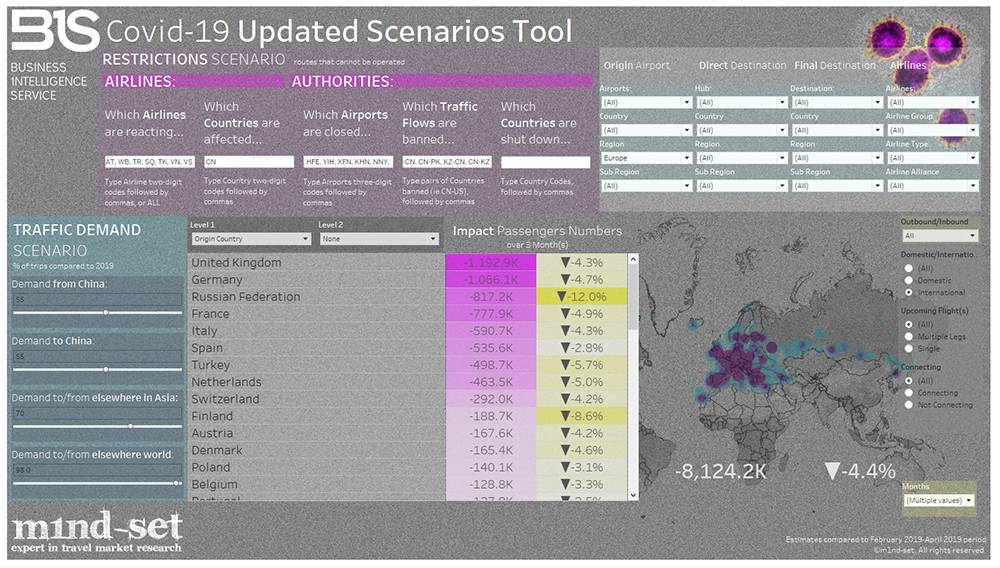
B1S - Covid-19 Scenarios Tool (updated)

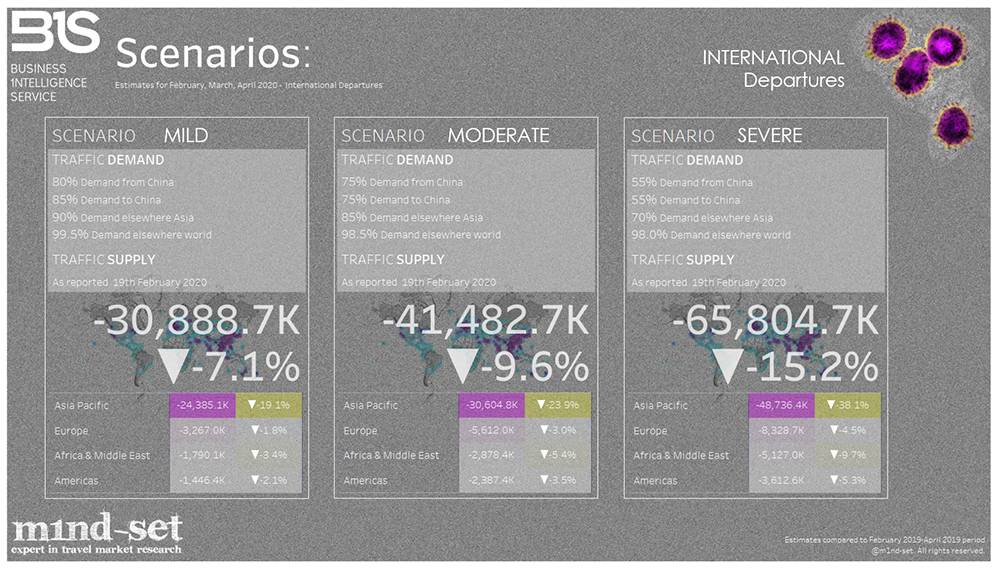
Looking at the impact on international departures alone, global air traffic would see a 7.1% decline in the ‘mild’ scenario, a 9.6% drop in traffic in the ‘moderate’ scenario and a 15.2% decline in a ‘severe’ scenario.

The impact by region in the mild scenario shows a potential 19.1% decline in international departures within the Asia Pacific region; a 3.4% decline in the Middle East and Africa; a -2.1% drop in the Americas and a -1.8% decline in Europe.

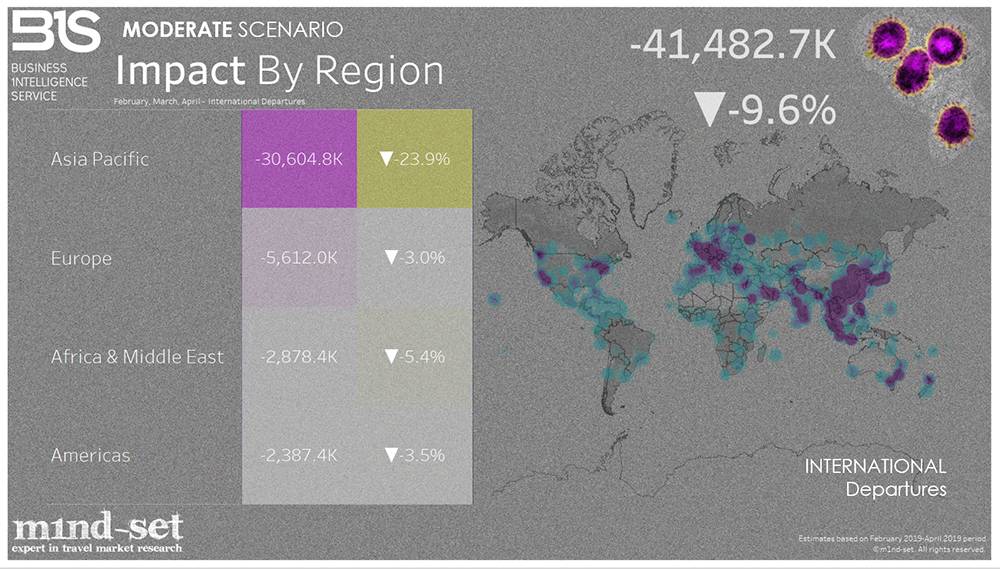
The same parameters in the moderate scenario show a 23.9% drop in Asia Pacific; -5.4% in the Middle East and Africa; -3.5% in the Americas and a 3% decline in Europe.

IDENTIFYING IMPACT BY INDIVIDUAL AIRPORTS

If levels are severe, the potential traffic declines are shown to be -38.1%, -9.7%, -5.3% and -4.5% for each region, respectively.

In all scenarios, the impact of the traffic restrictions on individual airports can be identified. Focusing on the severe scenario, in Europe, Helsinki and Moscow’s airports will record the largest percentage declines, while London Heathrow, Paris Charles de Gaulle, Frankfurt, Amsterdam and Istanbul would suffer the largest drop in passenger numbers.

B1S - Covid-19 Scenarios Summary 19.02.2020

In Asia Pacific, Macau, Bali, and Hong Kong would experience the largest percentage drops in traffic while in actual numbers, Hong Kong, Seoul, Singapore, Bangkok and Taipei would be the most affected.

In the Americas, Guam, Honolulu and San Francisco experience the largest percentage declines, while Los Angeles, San Francisco, Toronto, New York (JFK) and Vancouver, would suffer the largest fall in passenger numbers.

In the Middle East and Africa, Dammam, Sharjah and Jeddah would be open to the highest percentage declines, while Dubai, Doha, Jeddah, Abu Dhabi and Muscat would experience the highest overall drop in passenger numbers.

B1S - Covid-19 Moderate Scenario Summary 19.02.2020

DROP OF 10% IN BOOKINGS TO ‘CERTAIN DESTINATIONS’

M1nd-set’s CEO and owner Peter Mohn explained: “Since the outbreak hit the news, we have received a significant number of requests from companies in the industry, seeking to understand the full picture on how traffic numbers will change as a result of the traffic restrictions.

“We see a circa 10% drop in bookings to certain destinations, which comes as no surprise, but this does not give a holistic overview of the short or long-term impact, whether real or potential. We have developed this tool to enable our partners to accurately monitor the impact of the virus in real time based on real simulations.”

M1nd-set’s B1S Director Pablo Saez-Gil added: “Given the highly specific criteria selection B1S provides, we are able to select a wide range of scenarios with multiple combinations, which demonstrate the percentage and actual declines in traffic per region, country and even by individual airport.

“This is possible both with the actual closures of routes, airports and borders with China as well as prospective closures, to provide real and potential traffic changes. This is proving vital to management and boardrooms across the sector so they can assess the impact and adapt strategies and business plans accordingly.”

B1S - Covid-19 Severe Scenario European Impact 19.02.2020

B1S Methodology

M1nd-set’s Covid-19 scenarios tool uses the B1S airline traffic destinations database, which contains the full flight path (airline-origin, airport-direct destination and airport-final destination) for every single (more than 3.4 billion) unique flight path as well as ticket sales data from more than 4 billion passenger flight tickets over the past 12 months.

The model calculates the scenarios based on actual passenger numbers from the previous 12 months and adapts the data based on current restrictions, including airlines that have ceased operations to airports in China, countries that have banned passengers on certain routes or that have locked down the borders for all air traffic from China, all of which have a direct impact on actual traffic.  

In addition, the model integrates traffic demand data, both to and from China as well as within Asia Pacific and across the rest of the world to take into account how the coronavirus is affecting demand globally. The traffic demand scenarios are then applied to every individual flight path to provide the most probable and realistic estimates on how traffic will be affected over the coming weeks and months.

For more information, contact m1nd-set: Pablo Saez-Gil, [email protected] or Peter Mohn, [email protected].

Coronavirus: Weak demand pushes Singapore Airlines to slash flights

SIA-takeoff-coronavirus

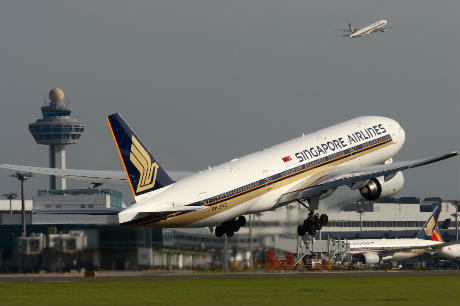
Source: Singapore Airlines.

Singapore Airlines and its regional carrier SilkAir will temporarily curb services across the globe during the three months until the end of May as passenger demand weakens due to the coronavirus (Covid-19) epidemic.

Key destinations affected include those to London, Paris, Frankfurt, Copenhagen, Düsseldorf, New York, Los Angeles, Seattle, Tokyo, Seoul and Mumbai (for a full list of routes impacted, click here).

“We will continue to monitor the situation and make further adjustments as necessary,” read a statement. “Affected customers will be notified and re-accommodated onto other flights. “We apologise for the inconvenience caused.”

Passengers who have booked tickets via a travel agency are advised to contact their agent for assistance or contact the Singapore Airlines reservations team in the case of direct bookings.

Disruption to flights covers the period coinciding with the TFWA Asia Pacific Exhibition & Conference (10-14 May).

The TFWA last week maintained that preparations for the tradeshow are continuing despite the situation, as it continues to liaise with appropriate authorities. It has previously stated that it would take ‘appropriate action in the interests of the industry as and when necessary’.


[UPDATED] Covid-19: Travel retailers continue to react swiftly and decisively

Corona-Virus-2020-main

Covid-19 (as it is now officially known) was first identified in a cluster of acute respiratory illness cases in Wuhan, Hubei Province in December. Source: CDC/ Covid Alissa Eckert, MS; Dan Higgins, MAM.

DF&TR operators have told TRBusiness they are responding quickly and efficiently to protect the welfare of their staff and customers while mitigating against operational impacts in the face of the intensifying novel coronavirus (Covid-19) outbreak.

TRBusiness continues to seek important comment and reaction from the travel retail community and will be updating this story as necessary [Additional reporting by Charlotte Turner and Andrew Pentol].

According to China’s state-run news arm Xinhua, 14,840 new confirmed cases and 242 deaths were reported on Wednesday (13 February), a significant rise in the number of new cases and fatalities recorded in a single day.

Xinhua quoting figures from the Hubei Provincial Health Commission reports that this figure includes 13,332 clinically diagnosed cases, bringing the total number of confirmed cases in the province to 48,206, with the death toll at 1,310 [although the situation is changing all the time – Ed].

The province discharged 3,441 patients from hospital after recovery. Among the 33,693 hospitalised patients, 5,647 remained in a severe condition and another 1,437 in a critical condition.

FIGHTING ‘A COMMON ENEMY’

At the time of writing, the number of infections worldwide totals more than 60,000 people with the virus claiming the lives of more than 1,300.

The World Health Organization (WHO) has given the virus an official name (Covid-19). This emphasises that the coronavirus disease started in 2019. According to the organisation, naming the virus will avoid stigmatising any specific geographic location, animal, individuals’ names, animal species, culture, population, industry or occupation.

The WHO continues to work closely with China to contain the spread of the virus, having declared the situation a public health emergency on 30 January. This followed a reconvened committee meeting under the International Health Regulations in Geneva.

Covid-19-13 Feb

Source: European Centre for Disease Prevention and Control.

The organisation convened a global research and innovation forum aimed at mobilising action against the novel coronavirus (2019-nCov) on 11-12 February in Geneva.

Drawing more than 300 health professionals, scientists, government ministers and other key players, the forum discussed several areas of research and identifying the source of the outbreak.

“This outbreak is a test of solidarity – political, financial and scientific,” said WHO Director-General Dr Tedros Adhanom Ghebreyesus. “We need to come together to fight a common enemy that does not respect borders, ensure that we have the resources necessary to bring this outbreak to an end and bring our best science to the forefront to find shared answers to shared problems.

“Research is an integral part of the outbreak response. I appreciate the positive response of the research community to join us at short notice and come up with concrete plans and commitment to work together.”

Covid-distribution-13Feb

Source: European Centre for Disease Prevention and Control.

As reported, a wave of carriers including British Airways, Air Canada, Delta Air Lines, SAS, Cathay Pacific, American Airlines, Vietnam Airlines and many others have have either reduced or cancelled flights to and from Mainland China, as China fights to control the spread of the coronavirus from its epicentre in Wuhan.

British Airways announced it was cancelling flights to and from Beijing and Shanghai until 31 March following continued advice from the Foreign Office against all but essential travel to mainland China.

A statement read: “Flights to and from Hong Kong remain unaffected. This situation will remain under review and we will continue to provide regular updates. If you have a booking with us, please make sure we have your contact details.”

The UK government has released ‘robust infection control measures’ amid the roll out of new regulations to combat the virus’s spread. The number of cases in the UK is being reported at nine.

The government had previously dubbed the coronavirus ‘a serious and imminent threat to public health’.

Health Secretary Matt Hancock said in a Twitter post: “The transmission of coronavirus would constitute a serious threat – so I am taking action to protect the public and isolate those at risk of spreading the virus. Clinical advice has not changed about the risk to the public, which remains moderate. We are taking a belt and braces approach to all necessary precautions to ensure public safety.”

Lotte Duty Free last week announced the closure of its Myeongdong downtown store in Seoul having reopened its Jeju outlet.

South Korea’s The Shilla Duty Free (Shilla) has established a ‘Safety & Environment Management Group’ charged with addressing issues at its shops.

“As the health ministry has risen the country’s infectious disease alert to level orange, the third highest from yellow, The Shilla Duty Free has been taking prompt action to ensure the safety of customers and staff in responding to the Novel Coronavirus,” said a spokesperson.

“The Shilla Duty Free will continue its response through close cooperation with relevant organisations such as the Korea Centers for Disease Control and Prevention, Ministry of Health and Welfare, and Incheon International Airport Corporation.”

Similar to Lotte Duty Free, Shilla is complying with guidelines from the Centers for Disease Control and Prevention on hand washing, increasing the volume of hand sanitisers, implementing regular disinfection procedures, and checking the temperatures of customers and staff (twice per day) at store entrances using thermal imaging cameras.

Shilla-Gimpo

The Shilla Duty Free has established an emergency response committee chaired by Shilla Travel Retail President Ingyu Han as part of a package of safety measures.

Face masks have been made mandatory for store staff and are available to customers. Shilla has urged employees to refrain from face-to-face meetings and business trips, including to China, are prohibited.

To tackle the ongoing risk of infection, an emergency response committee chaired by Shilla Travel Retail President Ingyu Han has been set-up.

The company said it remained too early to share any information on the possible financial implications caused by the outbreak on operations in Korea, Macau and elsewhere, instead stating it ‘will keep responding to the situation calmly and sternly’.

The travel retailer closed its Seoul and Jeju downtown stores on 2 February and these reopened on 7 February. A Shilla spokesperson said: “After the Korea Centers for Disease Control and Prevention confirmed that one of 15 confirmed Coronavirus patients in Korea had visited our Seoul store, we closed the shop to ensure the safety of our customers and staff.”

DFS CLOSES STORES

Travel retailer DFS Group has confirmed to TRBusiness it has closed two of its Hong Kong stores to help curb the spread of the coronavirus and protect employees and customers in the current health environment.

In Hong Kong, the Government has restricted cross-border travel, hitting railways – including the city’s high-speed connection – buses and flights.

Gebr. Heinemann, which runs its ‘Sweet Dreams’ confectionery shops at Hong Kong International Airport as part of a store presence in more than 100 countries, provided the following statement to TRBusiness: “We are cautiously monitoring any new information about the coronavirus and the situation at the airports. We are also exchanging information with travel risk consultants and industry associations on a constant basis.

“All of our partner airports are very well prepared for this challenge and are in close contact with the responsible authorities. The airports have been equipped for years with emergency plans and strict safety guidelines for handling dangerous infections, which have proven their worth in the past. As a company, we have already coped well with other pandemics (SARS, Ebola, etc) and we fully rely on the airports’ processes.

“Naturally, anything that influences passenger movements has a commercial impact. The effects of the coronavirus are not yet foreseeable at present. However, we are broad-based and thus able to counterbalance and compensate for fluctuations in certain regions or of specific passenger groups. Our current focus lies on assuring all of our employees safety and their ability to follow their daily routines and provide a consistent level of service towards all passengers.”

Li Gang, Deputy General Manager of China National Tourism Group and other officials visited China Duty Free Group’s Hong Kong downtown beauty store on 29 January to implement epidemic prevention measures.

Heinemann-Sweet-Dreams

Gebr. Heinemann, which runs its ‘Sweet Dreams by Heinemann’ shops at HKIA has stated: “Naturally, anything that influences passenger movements has a commercial impact. The effects of the Coronavirus are not yet foreseeable at present. However, we are broad-based and thus able to counterbalance and compensate for fluctuations in certain regions or of specific passenger groups […]”

During the inspection, which included cashier desks, counters and back-office areas, employees received reassurance on the situation and officials ensured staff retained a thorough understanding of the current operations and ‘rigorous’ emergency plans.

The store is fully equipped with prevention and control supplies, with Li Gang reiterating that the prevention of the epidemic through responsible collaboration remains the top priority for CDFG.

He stressed that provided staff are motivated and confident, shops will ‘usher in better and faster development and stronger sales expectations on the day the epidemic is over’.

Dufry Group told TRBusiness it was expecting some temporary impacts locally, through the lack of passengers in airports where it serves Chinese customers. “We expect this to apply to the whole industry and are coordinating actions with the respective airport authorities on a local basis.

“In addition, we are considering the recommendations of local health authorities where possible,” a spokesperson commented.

Wuhan Opening 2

Lagardère Travel Retail runs the master concession at Wuhan Tianhe International Airport.

Lagardère Travel Retail operates more than 4,600 duty free, travel essentials and fashion and foodservice outlets globally, including the master concession at Wuhan Tianhe International Airport Terminal 3, the liquor and tobacco concession at Hong Kong International Airport in a joint venture with CDFG and numerous other points of sale across Mainland China and in Asia Pacific.

A spokesperson told this publication: “Our priority is to take care of our staff working directly in China or who could be exposed to the virus and make sure they are safe and protected.

“We run some outlets at Wuhan Airport, and recognise the particularly difficult situation colleagues and individuals in the region are facing.  China has issued stringent restrictions and guidelines to contain the outbreak, which apply to our operations on the ground. We are closely monitoring the situation and adjusting our operations there and in any other markets where we operate, in liaison with the local authorities and our airport partners.

“It is too early to assess precisely the impact and evaluate short and mid-term consequences on our business as things are evolving by the day. However our  three business lines and geographically diversified strategy makes us less dependent on China-related sales (less than 10% of sales, including in airports outside of China), and the impact will depend on whether the situation aggravates and continues over a longer time.”

Air-Canada-flights 1

Air Canada has temporarily suspended all direct flights to Beijing and Shanghai until 29 February. Source: Air Canada.

Sky Connection/Anway Limited, which operates major concessions at Mass Transit Railway (MTR) Corporation stations Lok Ma Chau and Lo Wu serving the Hong Kong-Shenzen border crossing spur and at Hung Hom, confirms its employees are safe and well.

“At present, we treat safety of our staff as a top priority,” said Chief Executive Simon Au. “We are confident that our motherland China has the ability to win the battle against the virus. The HK Government has taken all necessary measures to control the spread of the virus into the community.

“Border control is one of the ways to scale down the number of travellers between the Mainland & HK. Actually, the number of PRC travellers has already dropped by half since June 2019 because of the social protests.

Asked about the extent of the impact on tourism, Au said: “It is very difficult to answer. It largely depends on the effective control of the spread of the virus. Of course, our business will certainly be hit hard during this period.”

One authoritative industry source, who TRBusiness has decided to keep anonymous, added: “The impact from this epidemic on top of the recent pro-democracy protests is going to be a massive body blow for all tourism related industries in Hong Kong. The worst is yet to come as the epidemic is spreading exponentially. I truly hope that I am wrong in my assessment as I had experienced the impact of SARS & this Coronavirus is supposedly more contagious.

“The HK Government is way behind the curve in handling this epidemic, mouthing platitudes & excuses instead of taking resolute actions.”

CALL FOR CALM AND SOLIDARITY

In Taiwan, were 18 cases have been confirmed, a source who TRBusiness has chosen not to name said: “It’s becoming a concern as people are scrambling to buy mask but it’s out of stock everywhere in Taiwan.

“My concern in the next couple of months is if the coronavirus gets out of hand in the region and can be another SARS. But for the past four years since our Taiwan government in power are pro-Taiwan, Mainland China has stopped most tourists to Taiwan and our government has changed direction to promote tourists from Korea, Japan, and South East Asian countries. We are carefully monitoring the situation for the moment.”
Corona-single-day-spike

Correct as of 13 February, the number of infections has reached almost 60,000 in China alone, with Hubei Province recording a surge in the number of cases and deaths. Source: European Centre for Disease Prevention and Control.

Meanwhile in the Philippines, the Government response has been ‘quite good and very proactive’, according to Regent Asia Group Chairman Jose Maria ‘Chim’ Esteban III.

“As with all operators we are in discussion with landlords on how to mitigate and cushion the short term impact,” said Esteban.

The country has suspended issuing visas on arrival to Chinese nationals to deal with the growing risk of infection.

Esteban says the suspension of Chinese tour groups in China, however, spells a more worrying picture.

“The outbreak will certainly have major impact to both domestic and foreign tourism. We are preparing for the negative impact and are in close touch with our supply partners and brands. Essentially the first quarter forecasts are out the window.

“A a group we have implemented steps to protect our staff and customers: mandatory masks for store staff, thermoscans for staff prior to store entry, hand sanitiser stations and continuing store sanitisation.”

WHO-reconvene

The World Health Organisation declared the Coronavirus a public health emergency following an emergency committee meeting and has since given the virus an official name. Source: WHO/C.Black.

International media reports have concentrated on the the link between coronavirus and SARS, the epidemic which hit 26 countries resulting in more than 8,000 cases in 2002/2003 and 774 deaths. The death toll from the novel coronavirus has exceeded that of SARS.

Esteban continued: “The situation is serious, however, as with SARS the health impact to our country is as of now minimal. I think that with the proactive steps being taken we should be ok. But certainly travel and tourism has been seriously dampened. Most especially since travel to and from China is certainly far more important to us now compared to the SARS epidemic.

“The industry should join hands to cushion the impact to our business. In our opinion this epidemic will have a significant negative impact for at least a year, Especially since PRC tourism is the core of travel retail in our region today.”

Chinese President Xi Jinping has again echoed his commitment to winning the battle against the outbreak.

The WHO’s Ghebreyesus previously ‘called for calm’ in Twitter post which read: “I reiterate my call for calm. I reiterate my call for solidarity – human, financial and scientific solidarity. Any breach in solidarity is a victory for the virus.”


International traffic ‘dynamic’ in Europe while growth overall decelerates again

ParisCDGTerminal3_Hall

Collectively, the top five biggest European airports added 6.5m passengers in 2019, with 60% of that incremental growth coming from Paris-CDG alone (+5.5%).

Passenger traffic across the European airport network (46 countries) grew by +3.2% to a record 2.43bn in 2019; just over half the growth rate registered in 2018 (+6.1%) and the weakest performance in five years, according to ACI Europe. However, international traffic outpaced domestic with a growth rate at 4.6%.


The passenger growth slowdown in 2019 was more significant at non-EU airports and largely driven by a decline in domestic traffic (-1.1%), as international traffic kept growing ‘dynamically’, said ACI.


“It also reflected airline consolidation and limited airline capacity expansion, as aircraft movements only increased by +1.1% during the year and even became negative in the last Q4 (-1.2%).” Meanwhile, freight traffic dropped by -1.9% in 2019, the worst performance since 2012.


Olivier Jankovec, Director General of ACI Europe said: “Over the past five years, Europe’s airports have increased their passenger traffic by more than +32%, meaning they have actually accommodated an extra 595m passengers since 2014.


2019: ‘A PIVOTAL YEAR’

“But 2019 has been a pivotal year. Volumes were still up, but the deceleration has been notable on the back of both supply and demand pressures.”


ACI_TRAFFIC_REPORT_TOP 5S_FULL YEAR 2019

Looking at the months ahead, Jankovec noted that many airports have planned for continued lower growth in passenger traffic in the face of uncertain trading conditions.


“Some of the supply side pressures might start easing, especially if the 737 MAX is finally approved to fly again and if the recent decrease in oil prices is not reversed. However, there are for now few if any signals that airlines may be considering more capacity expansion – and further airline consolidation remains an ongoing reality.


“The immediate big question mark is what happens with the coronavirus (Covid-19) outbreak. Europe’s airports have been coordinating closely with and assisting public health authorities in their containment efforts.


Olivier Jankovec, Director General ACI EUROPE

Olivier Jankovec, Director General of ACI Europe.

MARGINAL IMPACT FROM COVID-19 SO FAR IN EUROPE

“The traffic impact so far has been marginal and mostly limited to those airports with direct air services to China. We estimate that in February, the top10 EU/UK airports1 will collectively lose 475.000 passengers, which should amount to just 1.2% of their total traffic for the month.


“But as wider economic consequences start kicking-in in China and potentially beyond, the impact on air traffic could become more widespread and significant for Europe’ airports.”


EU airports saw passenger traffic increasing by +3.3% in 2019 (compared with +5.4% in 2018). This resulted in 57.8m additional passengers over the previous year; the equivalent of the yearly traffic handled by Madrid-Barajas airport. The EU market accounted for 76% of the total passenger traffic growth in Europe in 2019.


The pace of growth halved as the year progressed (from +4.8% in Q1 to +1.9% in Q4); although it somewhat rebounded in December (+3%). This mainly reflected the exposure of EU airports to airline bankruptcies as well as EU airlines generally limiting capacity growth and network expansion on the back of less favourable economic conditions and Brexit uncertainties.


Airports in Austria, Estonia, Latvia, Poland, Hungary, Croatia, Romania, Malta, Luxembourg and Portugal grew at more than twice the EU average. Airports in the UK, Germany, the Netherlands, Belgium, Denmark and Greece underperformed while those in Sweden, Bulgaria, Slovakia and Slovenia registered declines in passenger traffic.

Vienna_hero18

Airports in Austria (such as Vienna, above), Estonia, Latvia, Poland, Hungary, Croatia, Romania, Malta, Luxembourg and Portugal grew at more than twice the EU average. 

VIENNA TRAFFIC +17.1%

Amongst capital & larger EU airports, the highest growth in passenger traffic came from Vienna (+17.1%), Milan-Malpensa (+16.6%2), Riga (+10.5%), Berlin-TXL (+10.1%), Luxembourg (+9.5%), Budapest (+8.8%), Tallinn (+8.6%), London-Luton (+8.1%), Lisbon (+7.4%), Madrid (+6.6%), Bucharest (+6.4%) and Warsaw (+6.2%).


Passenger traffic growth at non-EU airports stood at +3% in 2019 – a significant deceleration compared to the previous year (+8.3% in 2018). This resulted in non-EU airports only adding an additional 18.3m passengers in 2019.


FrankfurtAirportKering_Gucci

Frankfurt Airport traffic grew marginally by +1.5% in 2019.

While airline bankruptcies (WOW) also affected the non-EU market, macro-economic conditions generally played a bigger role in shaping their fortunes – resulting in a significant impact on domestic passenger traffic (-3.6%).


“These factors explain the considerable variation in passenger traffic performance within the non-EU markets; from the impressive growth posted by airports in Ukraine (+22.3%) to the severe slump in Iceland (-26.1%),” said ACI. “Amongst the largest markets, Russia grew above the non-EU average (+5.8%), while Turkish airports grew only marginally (+0.4%).”


MAJORS & SMALLER REGIONAL AIRPORTS UNDERPERFORMING

Passenger traffic at the top five European airports increased by +1.8% in 2019, down from +4.8% in the previous year.


Continued physical capacity constraints and airlines limiting expansion were the main factors containing their performance, insisted ACI.


“Collectively, the majors added 6.5m passengers, with 60% of that incremental growth coming from Paris-CDG alone (+5.5% – the second-largest airport in Europe with 76.2m passengers), followed by Frankfurt (+1.5% – No. 4 with 70.5m), London-Heathrow (+1% – No. 1 with 80.8m), Amsterdam-Schiphol (+0.9% – No. 3 with 71.7m) and Istanbul (+0.2% – No. 5 with 68.5m).


ACI insists that this is the only air traffic report that includes all types of airline passenger flights to, from and within Europe (full service, low cost, regional, charter and others).

Retail inMotion to roll out vPreo duty free pre-order solution for airlines

Alaska-Airlines

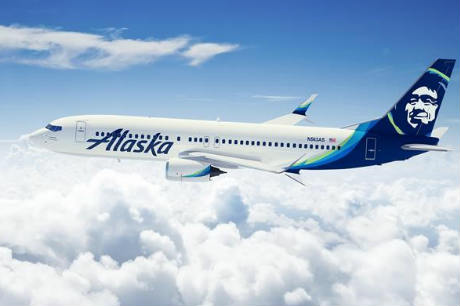
Alaska Airlines is utilising vPreo with more carriers set to follow.

Retail inMotion (RiM) has released a new duty free and catering pre-order interface enabling airline passengers to pre-select items for delivery to their seats.

The LSG Group member’s new vPreo solution will eventually replace the current end-to-end pre-order function, which is either in operation or being deployed with clients.

VPreo has already been implemented onboard Alaska Airlines, although passengers are able to pre-select meal options only for delivery to their seat.

This can be done up to three weeks in advance of their departure through the airline’s app or website by clicking on a ‘pre-order now’ link that presents a number of meal options for order, with duty free pre-order working in the same way.

Jan-Blanchard-RiM

Jan Blanchard, CCO, Retail inMotion.

‘SIGNIFICANT INVESTMENT’

Passengers can also choose to pre-order duty free and meal items for other passengers on the same booking.

RiM would not disclose the amount invested in the solution, nor the names of specific airlines set to adopt it, instead stating that a number of carriers have expressed strong interest in the solution.

“This new pre-order product is built using proven micro-services architecture technology, allowing to build, test and deploy new features and customisations in a fraction of the time originally needed for a new release,” Jan Blanchard, Chief Commercial Officer, RiM told TRBusiness.

“This is done while keeping a unique code base for all our clients, hence greatly improving the company capacity to onboard new clients and adapt the solution to their specific needs.

“Retail inMotion is constantly investing in improving its technology platform. We’ve made significant investments in the pre-order solution as it is a core element of our strategic plan. We have a dedicated pre-order team who specialised in developing the product further with new integrations and functionalities.”

Additionally, home delivery is part of the functionality of the new vPreo solution.

“We plan to deploy a solution for an airline later this year which will include an ecommerce service for browsing products, placing and paying for an order,” added Blanchard. “This will include home delivery combined with advanced reporting and marketing capabilities.”

TRBusiness Global Industry Survey 2020; read it now

Global Industry Survey 2020 leadInside this year’s Global Industry Survey TRBusiness presents the industry’s appraisal of 2019 along with its views and opinions on the most pertinent issues and defining characteristics of the DF&TR industry as it enters a new decade.

While 72% of industry respondents believed that 2019 was a ‘good’ or ‘very good’ year, almost 10% described it as ‘bad’ or ‘very bad’; an increase on the percentage from 2018.

Interestingly, almost 30% said they experienced a ‘very good’ year in 2019, much higher compared to 2018 when just 13% of respondents said the same thing.

Respondents to the 2020 Global Industry Survey weighed in on topics such as intensifying competition in South Korea; escalating trade wars; civil unrest; the outcome of Brexit, the continued evolution and influence of technology and last but by no means least, sustainability.

In last year’s survey (published in January 2019), just under 60% believed the trading environment in 2019 would be better than 2018.

To read the the industry’s individual survey responses; including those from Dufry’s Julián Díaz, Lotte’s Chang-Young Park, Shilla’s Taeho Kim among many, many more, click here.

Global Industry Survey 2020 graph 1

INTENSE COMPETITION

Indeed, many forecasted correctly. External pressures, including political tension between the US and China, violent pro-democracy protests in Hong Kong, the collapse of Jet Airways in India, continued socio-economic problems in parts of South America, uncertainty surrounding Brexit among others, adversely affected the bottom line of many companies in 2019.

Lotte's Chang-Young Park quote for Global Industry Survey 2020For the world’s largest DF&TR market of South Korea, it was not only macro-economic pressures that were to blame for the softening of trade for some companies in the region – Doota Duty Free being the biggest casualty in 2019 – as the leading operators complained of intense competition.

“2019 was a miraculous year for the Korean travel retail industry in spite of disruption due to the entrances and retreats by players, economic environment changes thanks to the diplomatic row between Washington and Beijing, and the introduction of China’s new e-commerce law,” revealed Lotte Duty Free’s Vice President Head of Global Business Headquarters Chang-Young Park.

Shilla Duty Free’s Korea Executive Vice President, Taeho Kim said that competition would only intensify in 2020.

“2020 will be a lot more competitive because there are several important events, such as bids for Incheon International Airport duty free concessions and new business operators,” he said.

SUSTAINABLE PRODUCTS AND PRACTICES

Aside from trade wars, military disputes, unfavourable FX rates and economic uncertainty, respondents were most concerned about the industry’s ability to respond to the growing consumer demand for more sustainable products and practices.

Prompted by a survey question on the topic, DF&TR stakeholders spoke loud and clear about the need to act now before losing loyal or potential customers. Some even described 2019 as the ‘year of sustainability’.

Via its Travel Retail Sustainability Forum and TR Plastic Pledge launched in July last year, TRBusiness observed the collective will of companies to start implementing small or large changes to their respective businesses.

Global Industry Survey 2020 graph 2

We are delighted that so many companies responded in such great detail to this particular question in the survey concerning their efforts to introduce greener procedures or more ethically sourced ingredients, cutting their waste production, or simply to reduce, reuse and recycle single-use plastic.

Click here to see the industry’s responses to the sustainability question here.

We encourage companies to continue communicating with TRBusiness about their endeavours for the monthly TRSF column inside the magazine or for the website, where we frequently publish exclusive interviews on the subject. [January’s TRSF column will appear online soon.]

GIVING CONSUMERS WHAT THEY REALLY WANT

Another theme that emerged from your answers to this year’s survey questions was the growing concern that the channel was not accurately identifying what products consumers actually want. There were numerous respondents who criticised retailers for assigning the multinational organisations vast swathes of retail space, leaving little room for independent or ‘smaller’ brands and companies.

Some believed the outcome would leave customers unimpressed with a clearly undifferentiated offer at each location. While some believed the answer to this was introducing niche or new-to-market brands, others believed it was introducing more local and destination-specific merchandise. Others believed the answer was simply down to price differentiation compared with the online marketplace and the High Street.

In order to arrive at these varying conclusions, many referred to their own customer data and research that they had conducted. However, what almost all of you agreed on was that the availability of the right sort of industry data, along with its accuracy, was a hindrance to progress and success. While some assigned the blame to retailers, others to the airport authorities or airlines, Julián Díaz, CEO of the leading global duty free and travel retailer offered his thoughts.

“Travel retail is a very opaque industry as every location has unique conditions and business realities, which are hard to replicate.

“This makes operators very concerned about the public disclosure of information, which can provide location specific insights to competitors. This concerns all travel retailers whenever they want to add a new location to their portfolio, as there is no direct access to dedicated performance data.”

Lalitha Sivanaser Ourshop quote Global Industry Survey 2020DATA: THERE IS STILL A ‘MISSING PIECE’

Anthony Kenny, Chief Commercial Officer and Deputy CEO, Aer Rianta International admitted the quality of data was questionable: “Travel retail [data] does lag behind the quality of that in downtown retail.

“There needs to be a forum for better sharing between operators, airports and suppliers. Decisions will improve based on better data.”

Lalitha Sivanaser, CEO of AirAsia’s Ourshop said that the ‘missing piece’ was still airline input. While we know that this is a request (or demand) which has been asked of the airline industry for many years now, Sivanaser believes that a couple of carriers have finally identified the opportunity in travel retail.

“As it stands, industry data is missing a key piece. The airline data is crucial in completing the end-to-end picture. The airline brings so much more depth to retail data, especially if the airline is like AirAsia where data is digitalised across the entire eco-system, including payments, loyalty, mobile, insurance, inflight wifi and so much more.”

Sivanaser said that with airline input, the industry can ‘increase the accuracy of targeted marketing through data optimisation’.

INDIA ‘IS ONE TO WATCH’
It was not surprising when TRBusiness asked which region could be classed as the ‘most important for global travel retail in 2020’; an overwhelming majority replied with Asia as their top choice.

Keith Hunter quote Global Industry Survey 2020In a similar vein, many commented on the continued importance of Chinese travellers to the growth of our industry in response to question four: ‘The Chinese have long been the highest-spending travellers in our industry. Which demographic do you see emerging on a similar scale in 2020 and beyond?’

However, TRBusiness was interested to read about the growing significance of other emerging nationalities such as Thai and Vietnamese customers. Other companies mentioned the rebound in Russian travellers, which was actually providing an unexpected boom in sales for some. But above all others, it was Indian customers who appeared in the majority of responses to the above question.

“Chinese and Indians are the ‘super spenders’ in travel retail and will continue to outperform other nationalities,” said Lindt’s Global Duty Free Division Head, Peter Zehnder.

Industry veteran Keith Hunter, now Partner of consultancy firm Hunter Palmer – Global Retail Solutions, added weight to this argument in his responses.

“While no single demographic looks set to usurp the Chinese dominance, India is the region to watch. Growth continues apace and the middle class is on a sharp increase (estimated to be 32% by 2025).

“Recent double-digit passenger growth shows an impressive increase in air travel, especially domestically, and that has given rise to significant investment in airport development and expansion. This focus has seen the retail offer and the customer expectations evolving to become more inline with the rest of the world. LCCs have made air travel more accessible and affordable than ever.”

Coalition targets UK aviation net zero carbon emissions in next three decades

Airline-window-sustainabilityUK aviation can become one of the future ‘green technology leaders’ following a commitment to cut net carbon emissions to zero by 2050, according to Sustainable Aviation.

Members of Sustainable Aviation, a coalition of major UK airlines, airports, manufacturers, air navigation service providers and key business partners, will sign a pledge that commits to reaching the target by 2050.

Neil Robinson, Chair of Sustainable Aviation, said: “Climate change is a clear and pressing issue for people, businesses and governments across the world.

“We know aviation emissions will increase if decisive action is not taken, and that’s why UK aviation commits to achieving net zero carbon emissions by 2050, through an international approach, working with governments around the world and through the UN.

“The UK is well positioned to become one of the leaders in the green technologies of the future, including sustainable aviation fuels and electric flight, creating highly-skilled and well-paid jobs in the process, and we look forward to working in partnership with ministers to help realise these opportunities.”

Travellers-genericBIO FUELS: ROLE TO PLAY

A new ‘Decarbonisation Road-Map: A Path to Net Zero’ published today (4 February) by the organisation outlines a plan to help slash emissions through smarter flight operations, new aircraft and engine technology, modernising UK airspace, the use of sustainable aviation fuels and market policy measures.

Sustainable Aviation claims these actions will mean getting rid of 30 million tonnes of CO2 per year – this is despite current passenger growth projections of +70% to 2050.

In a statement on Twitter, Trade body Airlines UK called the development ‘a significant step for UK aviation and our commitment to grow our sector sustainably.”

In addition to the Decarbonisation Roadmap, a ‘Sustainable Aviation Fuels Road-Map’ has also been released identifying the specific role played by sustainable fuels.

Sustainable aviation fuels could meet 32% of the UK’s demand for aviation fuel by 2050, forecasts the coalition.

In a television interview with Sky News today, John Holland-Kaye, Chief Executive at Heathrow Airport said that ‘the big breakthrough’ will come with sustainable aviation fuel.

“This is fuel that can be used in existing planes today mixed in with kerosene – and that is happening already – and it is made from either agricultural or domestic waste or with synthetic fuel made by combining carbon and hydrogen.”

Sustainable-aviation-info

An excerpt from the Sustainable Aviation Fuels Road-Map infographic. Source: Sustainable Aviation. Click to enlarge.


The Rt. Hon Grant Shapps MP, Secretary of State for Transport added: “The fight against climate change is one of the greatest challenges facing the modern world, but the aviation sector’s commitment today is a huge step forward in creating a greener future.

“Aviation has a crucial role to play in reducing carbon emissions, and with the help of new technologies, renewable fuels and our continued international co-operation through the UN agency, the International Civil Aviation Organization, we’ll be able to strike that balance, creating a greener and cleaner future.”

British Airways announced in October plans to offset carbon emissions for all its UK domestic flights in 2020.

The airline operates approximately 75 flight daily between London and 10 cities including Manchester, Leeds, Newcastle, Isle of Man, Edinburgh, Glasgow, Aberdeen, Belfast City, Inverness and Jersey.

Charter urges inflight ‘to make big retail statement’

Main-Ethos-Farm-Gatwick

TRBusiness was the sole travel retail media in attendance at the ‘Taking Inflight Retail to New Heights’ workshop, which took place in January.

A voluntary ‘best practice charter’ aimed at airlines and concessionaires will tackle onboard retail’s ‘unsustainable situation’ and encourage brands and suppliers to invest in sales crew, according to Ethos Farm.

The customer and employee experience experts believe the charter, which relates to the recently launched role of onboard ‘Category Specialists’ [see below video], can help arrest the malaise of inflight retail and its loss of market share in global travel retail by delivering an industry-wide ‘statement of intent’.

The charter covers a number of elements, including (but not limited to) ensuring a robust procedure for recruiting category specialists; providing them with the necessary category, brand and product information; introducing standard operating procedures; setting unit sales targets; and embedding the role into the airline’s long-term retail strategy.

Ethos Farm has issued interested parties with a draft copy of the charter. They have been given until 14 February to suggest amendments/changes.

CONCESSIONAIRES INTERESTED

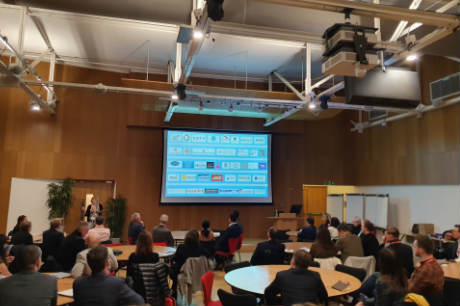
As reported, Ethos Farm unveiled its ‘Category Specialists’ initiative earlier this month at the ‘Taking Inflight Retail to New Heights’ boutique workshop at Virgin Atlantic’s head office and ‘Base’ facility for cabin crew near Gatwick Airport.

3Sixty Duty Free & More says it is signing up and Retail inMotion has also expressed interest in the initiative. Several other concessionaires and suppliers that TRBusiness has approached directly are keen to understand in more detail if/how it could work in practice.

Utilising product/brand and category e-learning training courses, the new fleet of specialist inflight sales ambassadors are tasked with fostering more collaborative approaches to crew training and development to champion greater customer engagement and retail revenue.

Ethos Farm is recommending that the Category Specialists earn a 10% bonus on total incremental retail sales generated per category, provided they hit their targets.

During the workshop, Business Development Director Christine Martin illustrated the potential sell-through using the fictitious ‘Ethos Airways’.

Drawing on category sales data supplied by a number of airlines, Ethos Farm has devised average forecast estimates for the product segments.

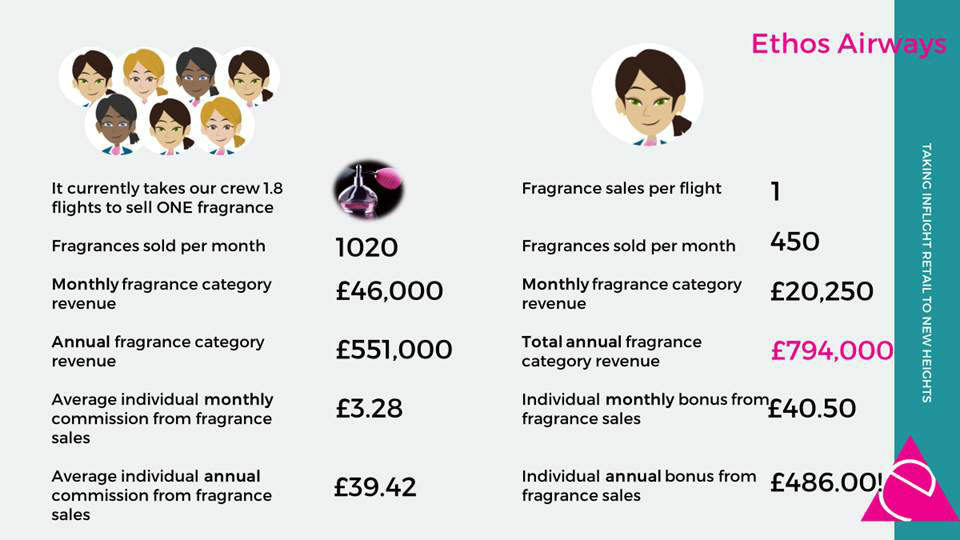
As an example, if one fragrance is sold every 1.8 flights, the airline would sell 1,020 based on 1,800 flights per month.

Virgin-Category-Specialists-1

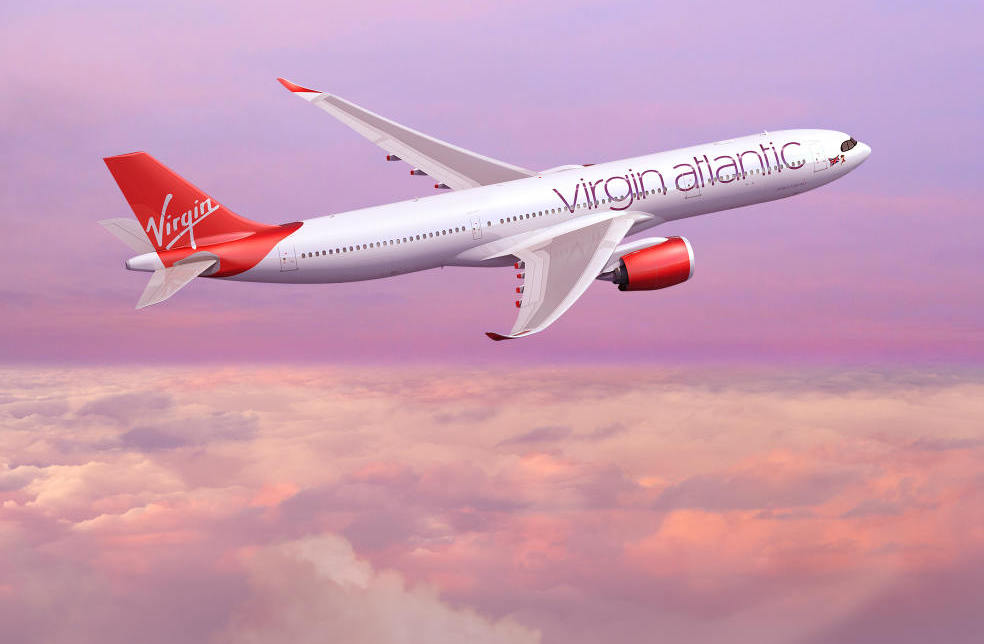
Ethos Farm is aiming to demonstrate proof of concept to Virgin Atlantic by May. Source: Virgin Atlantic.

At an average cost per unit of £45/US$57, this would generate monthly fragrance category sales of £46,000/US$60,000.

Applying a 10% commission to the total, 1,400 sales crew would each receive £3.28 in monthly commission.

However, Ethos Farm suggests that by appointing 50 category specialists, each selling one fragrance on nine flights per month, the fragrance category could generate an estimated £20,250 in incremental category sales per month and £243,000 per year.

A 10% bonus on incremental monthly sales of £20,250 would mean the 50 Category Specialists each receive £40.50. Decided by the airline/concessionaire – and not impacting suppliers’ existing margin agreements agreed with their partners – this bonus would be payable only if the crew hit their targets.

Ethos Farm says that by achieving a sales target of one unit per flight, per category specialist, an airline could improve its sales by up to a factor of 1.44.

Ethos-Farm-Category-Specialists-maths

Left column: Average fragrance category sales based on information supplied by a number of airlines; right column: An example of projected incremental sales based on the assumption that 50 category specialists sell one fragrance at £45 on nine flights per month. Source: Ethos Farm.

Following feedback since the workshop was held, Ethos Farm has made several refinements to the initiative [click here to see the original proposals].

It will be up to the airline/concessionaire to approach suppliers to secure participation. There may also be a cost attached to category training modules of no more than £500 per airline, per year, dependent on whether sponsorship is secured.

Supplier/brand investment concerns are being addressed via five proposed ‘story telling’ options, with prices ranging from £299 (plus VAT) up to £2,500 (plus VAT) depending on the requirements of the supplier and the complexity of the information received.

IDEA TO CONCEPT

As the set-up phase commences, TRBusiness asks Ethos Farm Business Development Director Christine Martin to explain what the Category Specialists idea is all about.

Christine-Martin-TRBusiness

Christine Martin, Business Development Director, Ethos Farm.

Why did you decide to launch the role of ‘Category Specialists’ and when was the idea first conceived?

The idea was first conceived many years ago. Airlines around the world have tried the role of retail ‘ambassadors’ and ‘specialists’ or have a group of the top 100 sales people who they give extra training to and/or additional rewards. This is great and I applaud it, but it is the 80% of crew who aren’t engaged in retail we need to focus on.

It was part of a content discovery piece with Virgin Atlantic last summer, looking at all the various touchpoints we could use to drive home the retail message. This came out of that conversation. It has taken from last June to now to come up with a cunning plan. We think all stakeholders stand to win.

In our world, you need to give the crew the tools to be more proactive and ‘category confident’ and make people feel special within that large community and not just another number so they stand out among colleagues, customers and airlines. We are using resources available to us now to really make a difference.

Where is the initiative at in terms of interest and rollout following the boutique event?

We have been talking to Retail inMotion (Etihad), Inflight Sales Group (French Bee) and 3Sixty Duty Free & More (Virgin Atlantic) and that is why we wanted to put the workshop together to test the water. We were delighted with the number of airlines that turned up from the UK. The next meeting will be for airlines, hopefully in February, where we will work out their standard operating procedures for the role and a code of practice. The timeline we are looking at for Virgin is May with their range change and we want to have something to go to the airline with by then.

What the airlines absolutely understand is they need to get the communication, proof of concept and reward and recognition right if they expect the suppliers to invest. We are going to be facilitating a meeting with airlines to work all of that through and to work with suppliers, per category. We will invite (not in any order) fragrance, skincare & cosmetics and liquor companies to work out what the category training, ‘must-knows’ and e-learning actually looks like. The brands and suppliers are helping to shape that communication.

Why do you think this ‘Category Specialists’ approach will succeed where other programmes haven’t?

I don’t think the technology was available to us before. The e-learning offers 24-7 accessibility and that is the key. We want a combination of blended online and offline learning , but the lion’s share of the information can be delivered in an engaging way online in the crew’s own time. This is an industry-wide initiative. If the concessionaire is doing it, they aren’t going to pass it on to another concessionaire or airline, they will do it themselves or expect the suppliers to pay for it.

Is there a limit on the number of category specialists an airline can elect and is it possible to have one person representing one or even multiple categories?

It is entirely up to the airline which categories they wish to focus on [dependent on] the size of their crew, whether its short- or long-haul flights, one or two people or everyone who gets involved in the sales service… there is an awful lot of ‘what ifs’ to consider before you say you want [for example] 10, 50 or 300 fragrance categories specialists. It really depends on the airline.

Does the supplier or concessionaire decide on whether the former joins the initiative?

It’s up to the concessionaire or airlines to have those conversations with the suppliers. If they say yes, they are pushed towards us. The commercial relationship is between us and the supplier. We want to keep it simple.

For suppliers, there is an argument to say the ‘big guns’ have bigger budgets and therefore investing won’t be expensive, but smaller brands, particularly those coming to market for the first time, will be more cost sensitive…

It’s interesting as on first impression, it’s the other way round. The smaller ones look at it as a way in and that means a lot. The bigger brands may have 20, 30 or 40 products already online, so it’s a bigger investment. We need to make sure we look after the smaller suppliers as well as the larger ones.

What are the main challenges now in getting this off the ground in the coming months?

It’s great everyone wants to talk, but it’s about getting this over the line and connecting all the dots; the airlines and suppliers can’t do this in isolation. That is why we are planning the category and airline meetings to keep everyone engaged. We are only going to get one chance at this as far as the crew is concerned, so we have to get it right first time.

I noticed a subtle reference to ‘awards’ during the roadshow. Is this initiative a way of reviving ISPY?

I can’t see we will do another ISPY for at least two years. My focus is getting this role embedded into the psyches of airlines and suppliers and ensuring all stakeholders benefit. My mission is everybody comes together to make a real difference to inflight, we’re not just waiting for technology and connectivity, and we can start grabbing back that market share.

For industry reaction to the new initiative, watch out for the February edition of TRBusiness.


Heinemann: Inflight retail still a valid, credible and profit-making channel

Inflight-stock-serviceGebr. Heinemann expects growth from its inflight retail business in the coming years despite the sector’s challenging climate.

“Being a wholesaler, our airline business is growing – both with existing and new customers,” John Baumgartner, Sales Director for Inflight & Catering, Gebr. Heinemann told TRBusiness.

“One of the reasons is we have a very strong network for logistics: We can deliver almost globally – certainly in Europe – and cover all the product groups, from buy-on board wines to high-end gadgets and everything in between.

“My team has 26 people and we are 100% focused on airlines. We have a lot of concessionaires and airlines coming to us with more and more business because we make life easy for them.”

Baumgartner-Heinemann-inflight

John Baumgartner, Sales Director for Inflight & Catering, Gebr. Heinemann.

SETTLING IN SCORPIO

As reported, a tranche of airlines including TAP Air Portugal, Qatar Airways, SAS and KLM have either re-appraised their approach to inflight retail sales or suspended/cancelled programmes altogether.

In November, TRBusiness revealed that KLM is exploring a new ‘digital ecosystem’ to replace its boutique service.

The carrier cancelled its onboard tax free programme on intercontinental routes this month having axed the service on European flights in July.

Asked about the health of inflight, Baumgartner echoed a point made at a recent inflight workshop hosted by Ethos Farm in collaboration with 3Sixty Duty Free and Virgin Atlantic that the reason for carriers cancelling their inflight retail programmes is not necessarily linked to profitability.

“It might be a disagreement with the concessionaire, or not represent the business model and image given by the airline to customers, but many airlines are not in those positions – they still have retail and it is profitable.

“[Inflight retail] is and will continue to be a valid, credible, profit-making business channel for many airlines for many years to come – services are not going to drop off in the next two, three or five years. Ahead, certainly there will be many airlines who will continue and want to do better.”

During a busy year, the Hamburg-headquartered firm acquired the remaining shareholding in UK-based inflight specialist Scorpio Worldwide having held a 51% share in the firm since 2007.

Scorpio’s office and warehouse near Gatwick closed in December as Heinemann’s inflight division absorbed 70 airlines and around 25 new accounts. Its total airline customer base (direct and indirect via concessionaire) now stands at around 150.

“It is more complex than we initially envisioned; we are still not anywhere near saying it is working perfectly,” commented Baumgartner on the transition.

“We are still struggling with long lead times from our suppliers, long lead times to our customers…. some pure logistical challenges such as new routes, certificates and administrative challenges we haven’t handled before.

“But we are getting better day by day [..] in regard to taking care of new processes and getting things up and running. We have a full team and slowly but surely we are learning to run with the business now.

“I think Scorpio’s motto was work hard and play hard; we definitely want to keep that spirit alive, work even harder and play even harder. We keep delivering that in various different ways.”

For the latest on the Scorpio Worldwide acquisition, watch out for the February issue of TRBusiness and see the October edition for a more detailed report on the transaction and personnel changes. Click here to subscribe.