Archives

PATA says 600m arrivals set new Asia record in 2016

Top Mario Hardy Pata

PATA CEO Dr. Mario Hardy.

The Pacific Asia Travel Association (PATA) has finally collated its numbers to report that the Asia Pacific region as a whole received a record-breaking 600m international visitor arrivals in 2016 (PATA).


The organisation says these numbers still remain ‘preliminary’ in its PATA Annual Tourism Monitor 2017 Final Edition, which covers inbound visitor movements to 47 destinations across the Asia Pacific region for the period 2012 to 2016.


VARIED APAC GROWTH RATES

The report also covers other metrics including (where available), resident departures, visitor average length of stay and visitor expenditure.


In its introduction to the results, PATA said: “Annual growth rates varied widely across Asia Pacific destination regions between 2015 and 2016, ranging from a high of 7.4% for the Pacific, to 3.8% for the Americas and 2.3% for Asia, averaging out at 2.9% for Asia Pacific as a whole.


Info 2

Source: PATA. Click to enlarge all tables.

“From a volume perspective however, the strongest destination region in 2016 was Asia with a 72% relative share of foreign arrivals into Asia Pacific, followed by the Americas (24%) and the Pacific (4%).


“This ranking sequence held true for the incremental increases in absolute arrival numbers between 2015 and 2016, with Asia showing the strongest increase of almost 10m foreign arrivals, followed next by the Americas with an annual increase of almost 5.4m and then the Pacific with an incremental annual increase of almost 1.7m in absolute numbers.”


Turning to the regions, PATA says that South America registered the highest annual growth rate of 17.6% in 2016 after Central America with 9.1% and North America with a 0.4% gain. In total, the Americas received 146.7m foreign arrivals in 2016, with North America alone accounting for 95.6m of those arrivals.


SOUTH ASIA ‘STRONGEST’ BETWEEN 2015-2016

Within Asia, South Asia had the strongest annual growth rate between 2015 and 2016 at 11.2%. Southeast Asia followed with 8.6% growth, then Northeast Asia with 3.7% and finally West Asia with ‘a rare contraction’ of 24.6 %.


PATA says Northeast Asia remained the dominant destination sub-region within Asia in 2016 receiving 277.4m foreign arrivals, followed by Southeast Asia with 114m. Asia in total received 435.8m foreign arrivals in 2016.


Info 2

Source: PATA.

Oceania reported the strongest annual growth rate within the Pacific during 2016 at 11.2% and was also the dominant sub-region by volume of arrivals, receiving 11.8m of the 24.5m into the Pacific in that year.


This was followed by Micronesia, which was the next strongest destination sub-region, by annual growth rate with a 7.1% increase followed by Melanesia with 4.1% and finally Polynesia with a 3.4 % annual growth rate.


PATA says that at the individual origin-destination level there were ‘even more significant growth increases between 2015 and 2016’, as evidenced by three of the strongest: Haiti into Chile: +258.0%; Argentina into French Polynesia: +162.4%; and Chinese Taipei into Lao PDR: +128.4%.


CHINA INTEGRAL TO MAJOR VOLUME FLOWS

It adds that in terms of incremental volume increases between 2015 and 2016, the top three origin-destination pairs were: Hong Kong SAR into China: +3.2m; China into Korea (ROK): +2.1m; and China into Japan: +1.5m.


The dominance of the intra-regional flows within Northeast Asia is very evident. Excluding the Northeast Asia pairs gives another perspective on some strong incremental volume increases as well, with the top origin-pairs now becoming: USA into Canada: +1.4m; USA into Mexico: +1.0m; and Argentina into Chile: +0.954m.


Commenting, PATA CEO Dr. Mario Hardy said: “Intra-regional flows of international visitors continue to be the backbone of foreign tourism for most of the Asia Pacific sub-regions and this is likely to continue over the medium term. In an uncertain world, international travel will not necessarily stop, but rather be diverted to destinations that are better known and often closer to home.


“This is a trend that PATA has been monitoring for some time and one that we will continue to track carefully in order to offer data-driven support for the efficient marketing resource allocation of our members and the industry at large”.
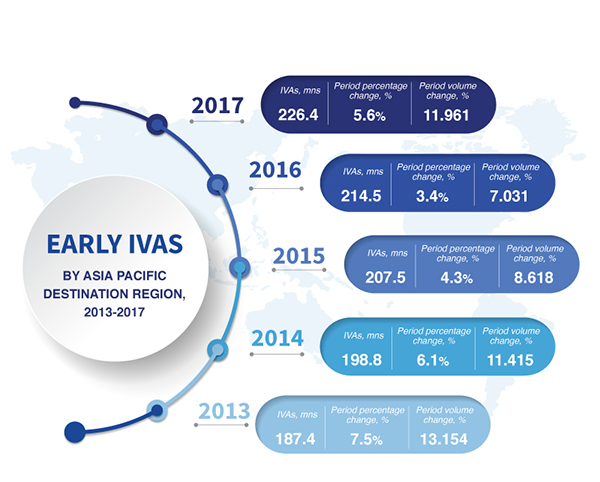
 

Visitor Arrivls 2013 to 2017

Visitor arrivals 2013-2017. Source: PATA.

PRELIMINARY 2017 DATA

Moving on within the Asia Pacific region PATA says 34 destinations have released preliminary data for 2017 and collectively this shows that the growth momentum of recent years has continued, with a year-to-date rise from an annual growth rate of 3.4% in 2016 to 5.6% in 2017.


This is the strongest year-to-date performance over the last five years, since 2013 and 2014.


The Pacific is once again ‘leading the way in period to period growth’, with an annual gain of 6.4% in early 2017, followed by Asia with +5.9% over the same period and the Americas with a +4% rise.


PATA says that overall, the incremental increase in foreign arrivals into Asia Pacific has been close to 12m relative to the same period of 2016. Of the 34 destinations covered, 13 have double-digit period-to-period increases between 2016 and 2017, led by the Northern Marianas with a 37.4% rise, followed by Vietnam with a 31.9% gain and Vanuatu with a 28.9% progression.


FIVE COUNTRIES SAW 1.5M+ ARRIVALS GAINS

The association adds: “By incremental growth in absolute numbers five destinations, namely Japan, China, Mexico, Turkey and Vietnam, have increases in excess of 1.5m each period to period between 2016 and 2017.


“It is significant also that Turkey, with an incremental gain of more than 1.5m foreign arrivals and a 14% period-to-period growth rate appears to be on the rebound, after taking a severe drop in foreign arrivals in calendar year 2016.


“At the other end of that volume increase spectrum however, are very strong reductions in foreign arrivals into for example, the Republic of Korea (-1.4m) and the USA (-0.7m). In total only six of the 34 destinations covered have reported early 2017 decreases in their respective foreign inbound counts.


“A number of origin markets are showing strong growth into specific destinations, particularly the following with period to period volume gains between 2016 and 2017: Russian Federation into Turkey: +1.5m; Hong Kong SAR into China: +1.3m; and Korea (ROK) into Japan: +0.8m”
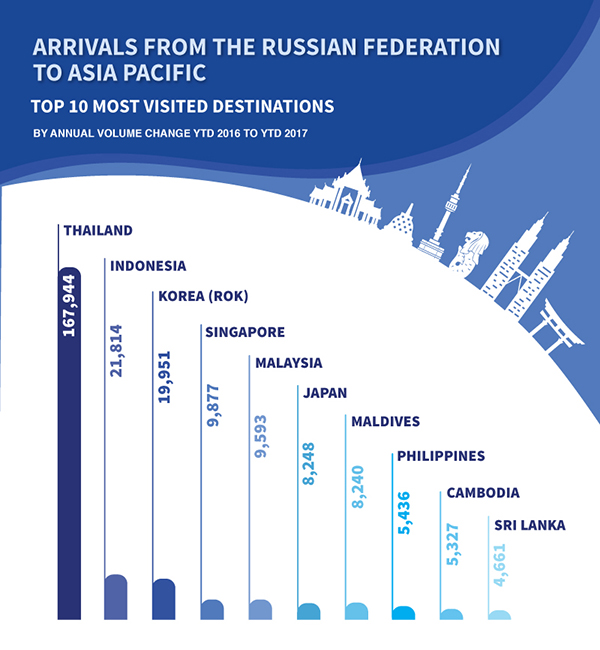
 

Arrivals from Russia to Asia Pacific

Source: PATA.

RUSSIAN TRAVELLERS ARE BACK

Russian travellers are also consistently on the move once again, despite the slowing of arrivals into the Asia Pacific region (and several others) in recent years.


PATA says this nationality of traveller – traditionally high spenders – is now showing strong incremental volume increases into a number of destinations, which, apart from Turkey, include Thailand with a net, gain of 170,000 so far this year and Indonesia with an increase of 22,000 over the same period.


Commenting, PATA’s Mario Hardy concluded: “The occasional volatile nature of tourism is evident in the way some destinations expand and sometimes contract their respective foreign inbound counts.


“So too is the speed with which tourism rebounds, as evidenced by the early strong growth into Turkey and the re-emergence of the Russian traveller into the Asia Pacific region in 2017.


“Even as the numbers of international visitors grow we must remain mindful of the interconnected issues of sustainability as part and parcel of that growth and embrace the UN Sustainable Development Goals when pursuing our mandate for the responsible and sustainable development of tourism.”
 

WTCE returns to Hamburg again with travel retail focus

Top lead Onboard Hamburg show 2017

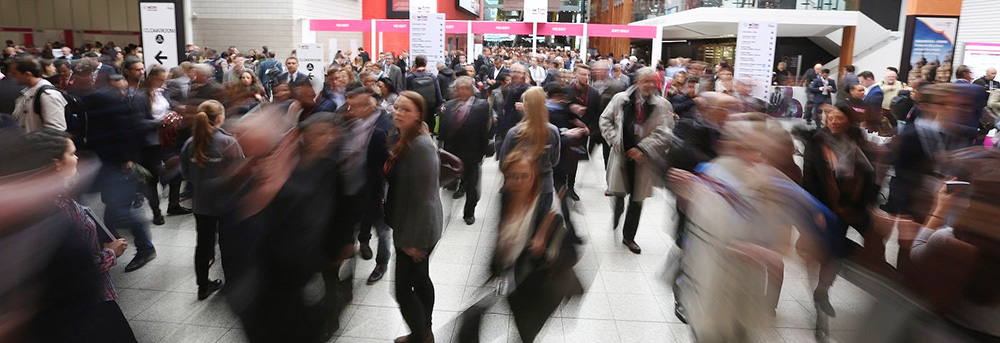
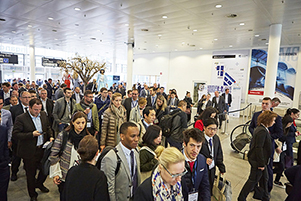
The crowds surge into last year’s WTCE show in Hamburg, Germany.

Following on from its successful launch in 2017 the World Travel Catering & Onboard Services Expo (WTCE) will once again stage its ‘Focus on World Travel Retail’ dedicated showcase for the onboard travel retail industry in Hamburg next year.


Set to return to Hamburg between 10-12 April 2018, the entire event will span four halls and feature more than 350 suppliers of products and services for the travel catering, passenger comfort and travel retail industries.


FOCUS ON WORLD TRAVEL RETAIL

As one part of this the ‘Focus on World Travel Retail’ will feature products and services available for inflight purchases from several exhibitors, including Animaux, Laduree, Butlers Chocolates, Caffe di Artisan, Bottega SpA and St. Patrick’s Distillery.


Gebr. Heinemann at last year's show

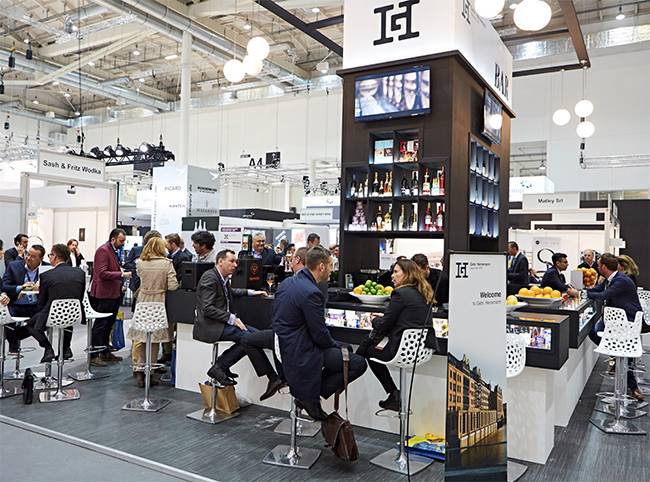
Gebr. Heinemann had a major presence at last year’s show in the company’s home town. Click to enlarge.

A networking bar, sponsored by Gebr. Heinemann will also offer exhibitors and visitors a chance to sample the future of travel retail, with the full schedule of events set to be announced nearer the event.


The free-to-attend event attracts more than 3,700 onboard industry professionals and the organisers say that many have already confirmed they intend to attend.


NEW DIGITAL ITINERARY TOOL

Interestingly, the organisers say they will also have their very own ‘My Event tool’, which is scheduled to go live soon and which allows visitors to build their own itineraries at the show.


The tool enables all attending WTCE to create a personal list of must-see contacts and book meetings before and during the show, as well as earmarking key products and Taste of Travel sessions of interest.


Bottega wines

Bottega wines were also on show in the exhibition.

‘NUMBER ONE BUYER EVENT FOR AIRLINES’

The organisers of WTCE say that this remains the number one event for buyers from the world’s international, charter and regional airlines and rail operators, as well as cruise and coach companies.


They add: “It also offers a unique platform to see the newest products and innovations, benefit from expert insight and advice and network with peers. Registration to attend the show in April opens in November.”


For more information visit https://www.worldtravelcateringexpo.com

Minister reassures MEADFA that Beirut is ‘safe and stable’

MEADFAweb

MEADFA President Haitham AL Majali.

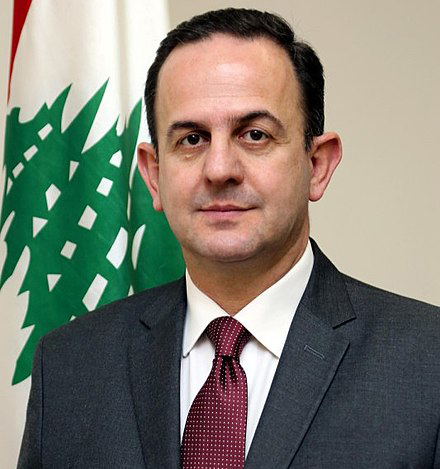
It will be ‘business as usual’ at MEADFA in Beirut this month, following an official letter from Minister of Tourism H.E. Avedis Guidanian reassuring the association that it is continuing to support the upcoming event. 


In a statement today, MEADFA said: “The 2017 MEADFA Conference will proceed as scheduled in Beirut from November 20-21 at the Phoenicia Hotel. 


“Amidst the recent changes in the government, the Minister of Tourism H.E. Avedis Guidanian immediately issued an official letter to MEADFA reassuring its continuing support of the upcoming event.”


[Ed’s note: Prime Minister Saad Hariri resigned suddenly without warning over the weekend after claiming from his location in Saudi Arabia that there was an assassination plot against him. See story here: https://www.trbusiness.com/regional-news/middle-east/meadfa-address-unlikely-as-lebanon-pm-hariri-resigns/130837].


Quoting the letter from the Minister of Tourism, MEADFA added in a statement that His Excellency Avedis Guidanian said the resignation of Prime Minister Saad Hariri ‘has no impact on the security or the economic stability of the country’. 


The letter added: “We reassure that all Lebanese parties are as attached to the country’s security as its stability.  It is this desire that protects us today and makes our country a safe and stable destination.”  


MEADFA CLOSELY MONITORING THE SITUATION

MEADFAVAT

MEADFA President Haitham AL Majali addresses the press at the TFWA World Exhibition in Cannes last month.

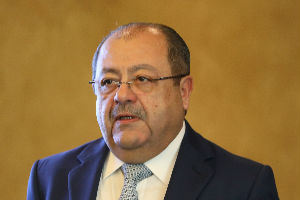
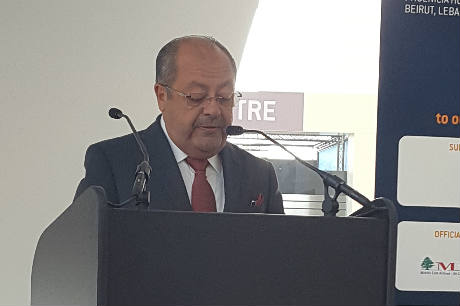
Meanwhile, MEADFA said it is closely monitoring the situation in Lebanon and will advise delegates of any information if and when necessary. MEADFA President Haitham AL Majali said: “The MEADFA Board and myself are, of course, monitoring the situation in Lebanon closely, and we understand the need for clarity among those registered for the event.


“Given the apparent stability on the ground, the high level of security at the venue and the reassurances we have personally received from the Minister of Tourism, we continue to prepare for what we are confident will be a great opportunity for our industry in the Middle East and Africa to gather, exchange and debate. 


“We are in constant contact with our partners in Beirut and will not hesitate to contact our delegates should the situation change. In the meantime, we look forward to welcoming our industry to another enjoyable MEADFA Conference.”


CLOSE TO 400 DELEGATES NOW REGISTERED

Avedis Guidanian, Minister of Tourism, Lebanon

The Minister of Tourism for The Lebanon, His Excellency Avedis Guidanian.

The association has confirmed that close to 400 delegates within the industry and beyond are expected to attend the MEADFA Conference in Beirut.  It added today that after its participation in last year’s event, the United Nations World Tourism Organization (UNWTO) will once again send one of its highest representatives to attend the MEADFA Conference.


“With an excellent line up of speakers covering consumer trends, business outlook in the region and the latest in technology – just to name a few of the topics to be discussed – the networking opportunities in the upcoming social programme is also not to be missed.”


MEADFA adds that Beirut and the Lebanon is ‘famous for its fascinating history and warm hospitality’ and tourism has increased by 12% in the last year, with the location now one of the favoured travel destinations in the Middle East.


Long-haul tourism to London slowing warns ForwardKeys

OLYMPUS DIGITAL CAMERA

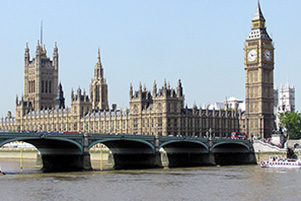
Is visitor growth to London slowing?

Inbound tourism to London ‘is slowing significantly’ in the fourth quarter, according to respected analysts ForwardKeys, who is also predicting that ‘all good things must come to an end’.


The company – which claims to analyse ‘around 17m flight booking transactions a day’ fully acknowledges that 2017 has been ‘a spectacular year for inbound tourism to London’, with impressive growth of +13.5% in long-haul arrivals during the first nine months compared with the same period in 2016..


‘SIGNIFICANT SLOWING’ EXPECTED

However, it adds that further analysis of bookings for the final quarter of this year indicates ‘a significant slowing in demand’ as growth is down to a more modest +7% compared to the comparative period last year.


ForwardKeys says this slowdown is ‘most notably’ evident in the Americas – the UK’s most important origin market by volume and value – representing 50% of all long-haul visitors. It says arrivals in the first nine months are 16.9% up on 2016, but bookings by Americans for the fourth quarter are currently just 4% ahead of where they were at this time in 2016.


ForwardKeys UK inbound 2017 onwards

Year-on-year variations of arrivals from long-haul markets to the UK in Q1 to Q3. Source: ForwardKeys.


The company adds that the slowdown in bookings from the USA directly correlates with the decline in the relative strength of the US dollar against the pound sterling. For example, last October, the pound sterling traded at a five-year low of $1.22, but this exchange rate has since recovered to over $1.30.


In a statement, ForwardKeys added: “Analysis of long-haul bookings for London reveal that a series of terror attacks coincided with dips in demand and those dips were significantly more marked in the fast-growing Chinese market.


DECLINE IN DOLLAR SLOWS TOURISM

“However, within a matter of just a few weeks, there was a return to growth, suggesting that the inbound travel industry is becoming increasingly resilient to terrorism.”


Addressing this week’s London World Travel Market, ForwardKeys’ Vice President Sales, Seb Cron said this just shows that the appeal of a weak pound is more important to visitors to the UK than being put off travelling to London due to terrorist attacks or threats.


The World Travel Market in London on the second day

Yesterday (November 7) at the World Travel Market London where ForwardKeys gave its presentation and Euromonitor presented its research on tourist arrivals to the UK specially commissioned by WTM.


ForwardKeys also points to ‘a slight slowdown in growth’ of the long-haul outbound market. The company said: “In the first three quarters of 2017, departures have been 7.5% up on last year. However, bookings for the last three months of 2017 are currently running 6.3% ahead of where they were at the same moment in 2016.


The most popular long-haul destination by far is the USA, with a 29% share of the market. It is followed by the UAE (7%), India (6%), Canada (5%) and Thailand (4%).


“The destinations showing the most substantial growth are Saudi Arabia, which is showing 4th quarter bookings 29.2% ahead of the same point in 2016, Australia, 15.4% ahead, Japan, 13.5% ahead, UAE, 11.9% ahead and Mexico 11.6% ahead.”


In his concluding remark, ForwardKeys’ Cron said: “One has to be particularly impressed with the UAE and Australia in attracting visitors from London, because both have a substantial market share and are showing strong growth.”


London bomb incident Sept 15 2017

Even though noone was hurt, scenes like the London bomb incident last September do little to reassure tourists that the problem has ‘gone away..’


TERRORISM WILL IMPACT ON UK GROWTH RATES

Most of the top line findings of ForwardKeys also appear to be backed up by the separate analysis by Euromonitor International, although there are also some differences in opinion over the positive and negative drivers.


In Euromonitor research released yesterday for the World Travel Market London event, the company said that the attacks in London and Manchester ‘mean that growth in those cities will lag behind the rates seen in other UK cities’, according to its top 100 City Destination Ranking WTM London Edition.


The Euromonitor report states: “Brexit, and the subsequent fall of the pound, have had a major impact on the travel industry in the UK, with arrivals growing strongly by 5.2% in 2017, while outbound departures are forecast to decelerate in 2017 as UK consumers have less money to spend abroad.


“With the terrorist attacks in London and Manchester, arrivals growth is expected to slow in 2018 to 2.6%.”


EUROMONITOR EXPECTS +3.4% LONDON GROWTH TO 19.8M

The report predicts that London will see growth of 3.4% year-on-year in 2017, rising from 19.19m inbound arrivals to 19.84m. Manchester – with 1.2m inbound arrivals in 2016 – is expected to see that figure grow by 3.7% year-on-year in 2017.


However, other cities which have not been affected by terrorism will grow at a faster rate in 2017, the report predicted. For example, Edinburgh – the second ranked UK city with 1.6m inbound arrivals – will grow by 4.8%; Birmingham (1.2m) will grow by 4.4%; and Glasgow (688,000) will grow by 4.5%.


Nonetheless, the report says that London is relatively unscathed compared with other European cities hit by terrorists – especially Paris, which saw numbers fall after two high-profile attacks in 2015. London is still expected to continue growing, reaching 22.34m in 2020, and 25.80m by 2025.


Chinese tourists in London

Chinese tourists have infused new life into central London and Heathrow Airport’s retail outlets in particular in recent years. However, as both ForwardKeys and Euromonitor note, nothing is forever…


INBOUND UK ARRIVALS OF 40.6M BY 2020..?

“It seems the size and nature of any attack, as well as the size of the city and local response, has a clear impact on travellers’ decision-making,” noted the report.


More long-term, Euromonitor predicts that the UK will see 40.6m inbound arrivals by 2020 – just surpassing VisitBritain’s target of 40m by that date – thanks to strong inbound demand from Europe, North America and Asia due to the pound’s expected depreciation post-Brexit.


Commenting, WTM London, Senior Director, Simon Press said: “Tourists are bound to take precautions when considering where to travel in the wake of any attack, but the robust response of Londoners and Mancunians this year has helped to mitigate damage to the tourism trade in those cities.


“This report does predict a lower growth rate next year, but it is heartening to see that numbers will still rise despite terrorism, thanks to the resilience of those cities and campaigns by their tourist boards.”


British holidaymakers are still very worried about terrorism

TUI-Mourning-pic-Tunisa-300x200

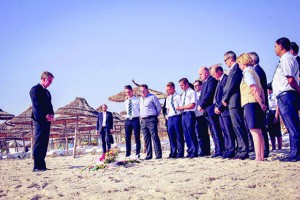
TUI management respectfully mourn the dead after the 2015 shootings in Tunisia.

British holidaymakers are becoming increasingly concerned about terrorism, with more than half of those asked in a 1,000-plus sample survey this year admitting they are much more concerned about an attack than they were a year ago.


According to research for the World Travel Market London, slightly more than a third of those polled in last year’s respected World Travel Market 2016 Industry Report survey said they were concerned, while this year’s poll shows that number has risen to 52%.


Within this year’s concerned sample, 14% say they are ‘extremely concerned’ – up from 9% last year.


INCREASED NUMBER OF ATTACKS THIS YEAR

In news released at yesterday’s World Travel Market London, the organisers point to the increased number of high-profile attacks this year – including those in Manchester, London and Barcelona – plus the smaller incidents in France, Canada and Sweden.


The organisers said: “2017 also brought back to the fore the 2015

The beach killings in Sousse, Tunisia will hamper Africa's progress

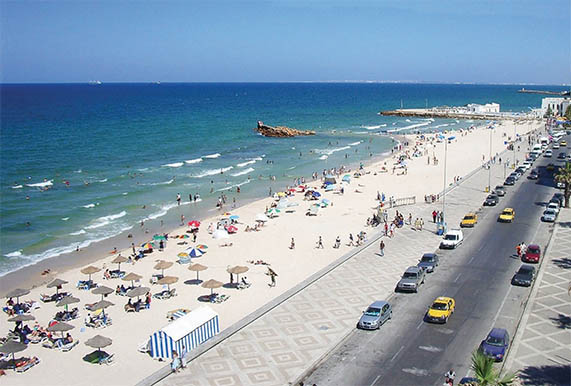
Tunisia has only just recovered from the beach killings in Sousse, in 2015.

terror attack, when the inquest into the deaths of Britons who were among 38 holidaymakers killed by a lone gunman got underway.


“The inquest started in January and was reported in detail over the next seven weeks, culminating in the Coroner recording a verdict of unlawful killing.


“Terrorism remains the number-one concern for British holidaymakers, far higher than other travel worries, such as natural disasters and the refugee crisis, both of which are of concern for 38% of respondents, and political instability a concern for 35% of travellers.


“Terror attacks also continue to have the number-one impact on travel businesses, yet the number of industry executives who said it has impacted their business has actually dropped by four percentage points over the last year.


Las Ramblas Barcelona (Photo credit Jens Cederskjold)

Las Ramblas in Barcelona was yet another terrorist target where 13 people were killed and over 130 injured in last August’s van attack. (Photo credit Jens Cederskjold).

TERROISM IMPACTED MOST BUSINESSES

“Almost three quarters (72%) of top industry executives taking part in the World Travel Market 2017 Industry Report said terrorism had impacted their businesses, with 26% reporting a ‘significant’ impact and 46% ‘some’ impact, while 28% reported no impact.”


World Travel Market management added that last year some 76% of key industry executives said terrorism had impacted their business in the previous 12 months, with one in three reporting terrorism had a ‘significant’ impact and 43% saying it had ‘some’ impact. One-quarter (24%) said ‘terrorism had had no impact at all’.


The impact of terrorism is also recorded as higher on businesses than Brexit and other worldwide challenges. Over half of respondents say Brexit has impacted their business, while 12% said it has has had a significant effect.


REFUGEE CRISIS IS ALSO TAKING ITS TOLL

Significantly, many also point to the impact of the refugee crisis which has impacted on 34% of executives’ businesses, with 7% reporting a ‘significant’ impact. Health scares such as the Zika virus have also hit 33% of businesses, with 7% significantly; 44% of executives say they have been impacted by travel company failures (6% significantly); 40% have been affected by industrial action (6% significantly), while 25% say their business has been affected by false sickness claims.


WTM London’s Paul Nelson, said: “When we looked at last year’s findings, it was reassuring that, despite several high-profile attacks, the fears of terrorism had not actually increased over 2015 figures.


“Worryingly, more high-profile and frequent attacks in the past 12 months seem to have dented holidaymakers’ confidence, with the result that one-third more holidaymakers than last year are worried about terrorism, with the number who are extremely concerned up 55% on last year.


“Tourism is hugely important to breaking down barriers and making the world a better place. Promoting safe and secure travel is now absolutely crucial and the challenge of encouraging tourism and keeping travellers safe is one of key issues that will be hotly debated during World Travel Market 2017.”


‘No deal Brexit’ tops London World Travel Market debate

Brexit negotiator

European Parliament’s Brexit negotiator, Guy Verhofstadt, MEP, warned on the dangers of ‘a no-deal’ Brexit outcome. 

The impact of Brexit and the consequences of ‘a no-deal scenario’ dominated proceedings on the first day of industry debate at the World Travel Market in London yesterday.


The European Parliament’s Brexit negotiator, Guy Verhofstadt, MEP began by telling travel industry leaders in the audience that a ‘no-deal’ outcome would be the very worst-case scenario for the travel business and other sectors.


[Verhofstadt is charged with leading the European MEPs’ negotiating team. Any deal on the UK’s post-Brexit relationship with the rest of the EU will have to be ratified by the European Parliament-Ed].


At the same time, the former Belgian Prime Minister offered his vision for a ‘United States of Europe’ – along the lines of the United States of America – at yesterday’s Leaders’ Lunch attended by 200 pre-eminent heads of commercial travel organisations.


WILL UK CITIZENS APPLY FOR EU CITIZENSHIP?

Curiously, Verhofstadt explained that he is looking at whether it will be possible for UK citizens to apply for EU citizenship after Brexit, and he took the same view as UK Prime Minister Theresa May that ideally there should be a transition period to avoid disruption to the UK economy.


At the same time it has also accepted that a ‘no-deal’ Brexit would also be the worst-case scenario for the travel budgets of UK consumers.


According to Caroline Bremner – Head of Travel at Euromonitor International – the forecast for GDP growth in 2019 will be just 0.5% if there is no Brexit deal – but if a transitional arrangement is struck, then growth rates could remain between 1.5% and 2%.


BREXIT man

The European Parliament’s Brexit negotiator, Guy Verhofstadt, MEP offered his vision of a ‘United States of Europe’.

SPAIN COULD LOSE 1M BRITS BETWEEN 2017-2022

“The outbound market will bear the brunt of a no-deal Brexit, as it will reduce demand by 5%,” she said. “Spain will be the worst hit, losing one million Brits between 2017 and 2022.”


There was also a consensus of agreement at the World Travel Leaders debate that UK consumer confidence could be hit next year, although most agreed that UK citizens are still likely to prioritise spending on holidays above other expenditure.


Having said that, there were widespread concerns for EU migrant workers based in the UK and the uncertainty about their future.


It was also pointed out that inbound operators are also reaping benefits from the Brexit effect, thanks to the weak pound.


STERLING WILL FALL IN ‘A NO-DEAL BREXIT’

At the same time, Euromonitor International is predicting that a ‘no-deal’ Brexit will lead to further falls in sterling, which will make the UK an even better value destination for overseas visitors.


Meanwhile, Verhofstadt emphasised the importance of no barriers to the audience: “We want to keep the free movement of people. The single market means free movement of people, goods, services and capital, but you cannot just pick one or the other – it must be all of them.”


Adding his comments about labour mobility across Europe, he said there were almost three million job vacancies across the continent – so economic growth rates were lower than the US, where there was much higher mobility.


“There is no need to destroy the EU – it needs to be reformed,” he said. “There must be more trading and more integration, and we need to fix the decision-making process. “We need to make this divorce work and create certainty for all industries.”


BA ‘mixed fleet’ crew accept deal to end 85-days of strikes

Top britishairways-planesAfter a total of 85 days of industrial action and a fight lasting most of this year, 84% of British Airways ’mixed fleet’ cabin crew at Heathrow Airport have voted to accept a new fixed salary deal, so bringing the long running dispute to an end.

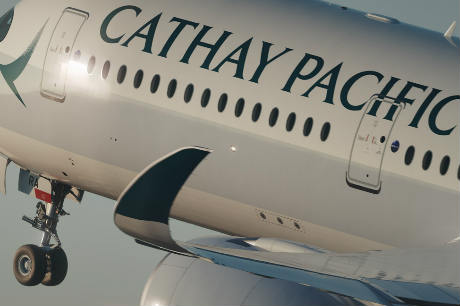
 

The Unite Union has announced that this will now result in crew receiving minimum pay increases £1,404 to £2,908 ($1,860-$3,860) by March 2018, depending on the experience of the individuals and ‘subject to inflation’. Travel concessions and bonuses will also be restored.


BA HOPES FOR CLEAR SKIES AHEAD…

Commenting on the result, Unite General Secretary Len McCluskey said: “A great deal of credit should go to Unite members and their shop stewards in British Airways’ mixed fleet for their determination and solidarity in securing this settlement.


British Airways GMB Union

Both the airline and the union will be hoping that scenes like these (seen over the past year) won’t be repeated again any time soon.

“Through thick and thin Unite members stuck together to secure a decent pay rise and a just resolution to this long-running dispute.


“Not only does this pay deal start to seriously address long-standing concerns on low pay in British Airways’ mixed fleet, but it also shows that it pays to be a member of a union and of Unite.”


Cathay shares rally after Qatar Airways takes 9.6% stake

Cathaymain

Doha-based Qatar Airways has taken a 6.9% stake in Cathay Pacific. Source: Cathay Pacific Airways.

Cathay Pacific Airways’ share price dipped by nearly 5% this morning (Hong Kong local time) following Qatar Airways’ move to acquire a 9.6% stake in the East Asian carrier.

Tremors were felt in early morning trading as Cathay’s share slipped to HK$12.56 (US$1.6) – a drop of -4.6% – after opening at HK$13.14 (US$1.68), but climbed to trade at approximately HK$13.00 (US$1.66) in the afternoon session (correct at the time of writing).

Qatar’s flag carrier had earlier announced an agreement to purchase 378,188,000 shares in Cathay Pacific Airways Limited, equivalent to approximately 9.6% of the total issued share capital, from Hong Kong-based Kingboard Chemical Holdings.

The average price per share is valued at HK$13.65 (US$1.7) with the transaction valued at HK$5.16bn ($US661m) according to a Hong Kong Stock Exchange filing. The transaction is expected to take place later in Hong Kong.

CHINA TRAFFIC BOOM

The deal means Qatar Airways will be Cathay Pacific’s third largest shareholder next to Swire Pacific Limited (45%) and Air China Limited (29.99%).

Qatar Airways Group Chief Executive, His Excellency Akar Al Baker said in a statement: “Qatar Airways is very pleased to complete its financial investment in Cathay Pacific.

“Cathay Pacific is a fellow oneworld member and is one of the strongest airlines in the world, respected throughout the industry and with massive potential for the future.”

CathayQatar1

Cathay shares traded up at HK$13.00 in the afternoon after falling by almost 5% to HK$12.56 at one point during the morning session. Source: Hong Kong Stock Exchange (HKEK). Click to enlarge.

A stake in Cathay will provide Qatar with leverage to tap into the fast-growing Chinese and Asian aviation market, with outbound Chinese tourist numbers increasing by 50% in the three years to 2017 and domestic tourists travelling within China reaching 705m during the Golden Week celebrations in October alone, according to research from the China National Tourism Administration and China Securities Journal.

In May, Cathay announced plans to cut around 600 jobs to ‘improve the speed and quality of decision-making and putting a greater focus on its customers’ as a response to increased competition from Asia’s low-cost carrier market.

However, the airline said at the time that it would continue to invest in its frontline capabilities to deliver ‘high-quality products and services to its customers’.

Global pax demand slips up in September due to hurricanes

Top britishairways-planesThe International Air Transport Association (IATA) reports September’s global passenger demand rose by 5.7% , although his was the slowest year-on-year increase since February thanks to he negative impacts of Hurricanes Irma and Maria.


At the same time, IATA says that growth was already ‘tapering’ as capacity rose 5.3% and the average load factor edged up 0.3 percentage points to 81.6% – albeit a record for the month of September in isolation.


Alexandre de Juniac, IATA’s Director General and CEO said: “September’s growth in passenger demand was healthy, notwithstanding the heavy impacts of extreme weather events on the Americas.


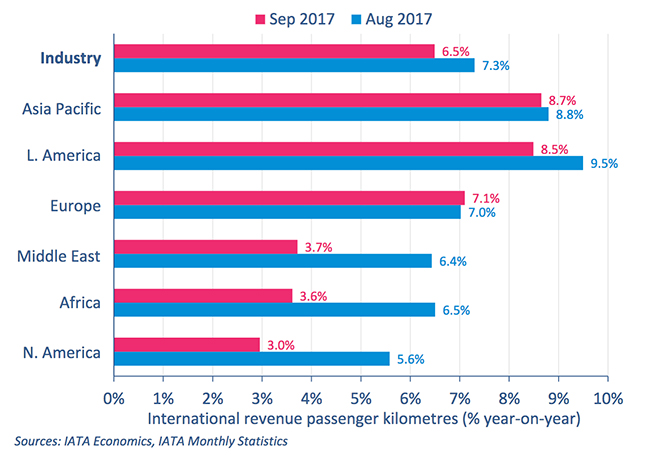
International Passenger Growth by Region 2017. Click to enlarge.

LOW COST DEMAND CUT?

“Global economic conditions support rising passenger demand, but with higher cost inputs, the demand stimulation from lower fares has waned, suggesting a moderating trend in traffic growth.”


The good news was that international revenue per kilometre (RPKs) increased by 6.5% with airlines in all regions recording growth compared to 2016. At the same time, total capacity climbed 5.6%, and load factor rose 0.7 percentage points to 81.3%.


IATA said: “Asia-Pacific airlines’ traffic rose 8.7% in September compared to the year-ago period, the strongest growth among regions. Capacity increased 7.8%, and load factor climbed 0.6 percentage points to 78.3%. A solid regional economic backdrop, helped by robust growth in China, is supporting passenger demand within the region.


EUROPEAN CARRIERS FOLLOW ASIA GROWTH

IATA airline passengers“European carriers saw September demand rise 7.1% over September 2016, in line with August growth of 7.0%. The upward trend in seasonally-adjusted demand has slowed considerably since May, but business confidence remains high and the economic backdrop is supportive. Capacity rose 5.2% and load factor surged 1.6 percentage points to 86.8%, which was the highest among regions.

 

“Middle East carriers had a 3.7% rise in demand, the slowest rate of increase since February 2009. The Middle East-US market has been hit hard by the now lifted cabin ban on large portable electronic devices, as well as the various proposed travel bans to the US.


“Traffic between the region and the US has fallen for six consecutive months through August (the most recent month for which route data are available). Capacity rose 4.3%, and load factor slipped 0.4 percentage points to 74.5%.”


SECURITY SAID TO BE A BARRIER TO INBOUND US TRAVEL

The association added that North American airlines experienced a 3.0% rise in demand in September, while capacity rose 3.6% and the load factor fell 0.5 percentage points to 81.0%. In addition to the impacts of hurricanes Irma and Maria, anecdotal evidence continues to suggest that inbound traffic to the US is being deterred by additional security measures now involved in traveling to the country.


IATA planes header

New Generation aircraft are coming. which are far more efficient than their predecessors.

The association said: “Latin American airlines’ performance was also affected by hurricane activity, but strong underlying demand meant that traffic rose 8.5% compared to the same month last year. Capacity climbed at the same rate and load factor was flat at 82.2%, the second highest among regions.


“African airlines posted a 3.6% rise in traffic in September, down from 6.5% in August. Capacity rose 0.3% and load factor jumped 2.4 percentage points to 73.8%. Conditions in the region’s two largest economies – Nigeria and South Africa, are diverging again, with business confidence levels in South Africa consistent with falling output.


DOMESTIC DEMAND +4.2% IN SEPTEMBER

Meanwhile, by contrast with the international numbers, domestic demand climbed 4.2% in September compared to September 2016. IATA says this was heavily affected by weather disruptions in the US market, which accounts for more than 40% of all domestic RPKs.


Top Alexandre de Juniac IATA

Alexandre de Juniac, IATA’s Director General and CEO.

India and China continued to lead all markets with double-digit annual traffic increases while elsewhere, results were mixed. Capacity rose 4.7% and load factor slipped 0.4 percentage points to 82.2%.


US domestic traffic fell by 1.2%, reflecting the hurricane impacts. IATA adds that with operations at affected major airports having returned to normal, it now appears that the disruption will be short-lived.


Commenting on the personal cost to some of the hurricanes, de Juniac said: “Our hearts go out to all those affected by the recent extreme weather events, which uprooted lives and communities and dealt heavy blows to local economies in the affected areas.


“It is at times like these that we truly see the vital role that aviation plays in disaster relief, bringing in much needed first responders and aid workers, as well as supplies, food and medicines to those in need.”


‘Observers’ hope China and Korea relations set to improve

Thaad-Missile-testing-US-Army topTRBusiness pointed solidly yesterday to hopes that a potential thawing of relations between Beijing and Seoul might actually be taking place right now over ‘THAAD’ – and it would appear that other industry observers, including Lotte Duty Free are getting similar messages.

 

This follows the effective ‘banning’ of organised Chinese tour groups to South Korea this year by the Beijing Government – a move that has literally decimated the country’s tourism industry and severely damaged its duty free business.


TRBusiness picked up on the general rumour in Seoul last week that some form of new detente/compromise might be in the air between the two governments. We were also able to confirm that goodwill gestures and sentiments appear to be in good supply on both sides.


DIPLOMATIC MOVES

This was reflected in our comments at the end of yesterday’s Lotte Duty Free store opening story related to Danang International Airport in Vietnam, when we wrote: “These latest formal store openings also coincide with the 24th Asia-Pacific Economic Cooperation (APEC) Summit in Danang on 10 November, where coincidentally South Korean diplomats are hoping to meet on the side-lines with their Chinese contemporaries to try and resolve their diplomatic differences over the location of the THAAD missile defence system on South Korean soil.”


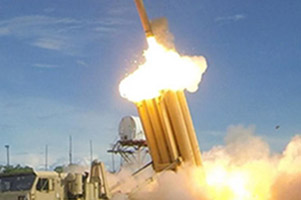
Terminal High Altitude Area Defense (THAAD) interceptor system being tested by the US army is designed to knock down other missiles but Seoul has upset China (imge credit US Army

The Terminal High Altitude Area Defense (THAAD) interceptor system being tested here by the US army is designed to knock down other missiles, but its powerful radar system is said to be capable of snooping on Chinese military bases, which has upset Beijing. (Image credit: US Army).

This positive vibe was confirmed yet again when we asked Lotte Duty Free directly whether the company is taking these reports seriously and as a possible precursor to some sort of resolution…


Asked directly whether South Korea’s leading retailer is pleased with these reports and whether it believes this might lead to an immediate rebound in duty free sales – or yet more shockwaves ahead – the company gave us this official statement: “We are expecting that the APEC summit will provide a momentum in the normalization of the cooperative and interactive relationship between Korea and China.


CAUTIOUSLY OPTIMISTIC

“However, it seems that it will take a considerable amount of time before the reactivation of the Korea’s duty free market, since there are certain steps that should be preceded, such as securing flights and organizing travel packages. We will carefully watch how the local situations in China develop and take actions accordingly.”


TRBusiness also wrote a detailed comment piece for its November print issue yesterday which examined the seemingly warmer relations that appear to be developing between Seoul and Beijing – an article that we have subsequently decided to share here now, considering the fast momentum this story is gathering as it develops.


Entitled ‘Can Beijing and Seoul compromise?’ the article will appear later this month and here is the preview as follows:


(ARTICLE BEGINS):

There is a huge amount riding on better China-Korea relations being firmly established at this month’s APEC Summit in Vietnam.


Lotte World Tower pictured back in March before the THAAD tour group ban really began to bite

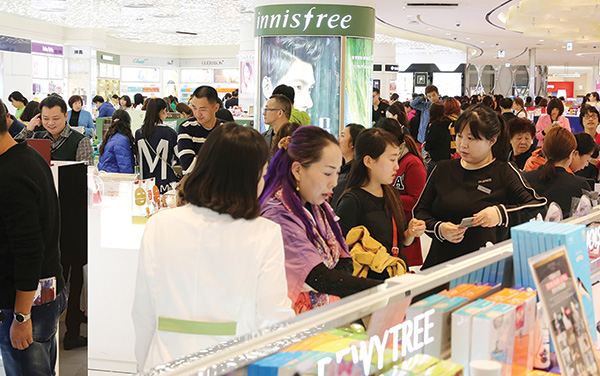
The Lotte World Tower duty free floors were packed with Mainland Chinese shoppers back in March, but that was before the THAAD tour group ban was ‘launched’.

Particularly following the strengthening of Chinese President Xi Jinping’s rule over all things China, at the recent week-long political summit in Beijing last month.


While this may not look so important in the West, most experienced commentators in the East know all too well that Jinping is now one of the most powerful leaders that China has known ‘in modern times’ – and that includes the legendary Chairman Mao.


JINPING: NOW EVEN MORE IN CHARGE…

How he personally views foreign relations issues in future will arguably dictate real-life foreign policy more than ever – and that naturally includes national defence, the deployment of US THAAD missiles on South Korean soil and Chinese overseas tourism – to South Korea and ‘everywhere else’.


As is well known, China objects to the location of these missiles near Seoul as it claims the radar is so sophisticated that it has sufficient range to spy on its own military installations. Efforts to persuade South Korea’s previous administration under [the now jailed] President Park Geun-hye obviously fell on deaf ears and this issue has since become all the more complicated.


Sporadic dummy firings and recent threats to launch live missiles by North Korean leader Kim Jong-un have obviously caused ‘deep concern’ amongst the South Korean population. These events have also effectively tied the hands of South Korean President Moon Jae-in, who might otherwise have been able to help dismantle the THAAD ‘deterrent’ with a lot less fuss (or public concern) than now exists.


Incheon-International-Airport

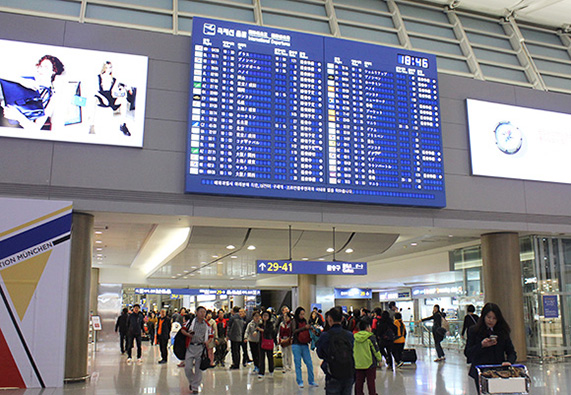
Incheon International Airport has also felt the cold wind as Chinese passenger numbers have fallen and some of its airport retailers have become ‘less enthusiastic’ than they were and much more vocal about it.

Instead of which, Moon now faces the prospect of trying to persuade China’s most powerful man – both ahead, during and after this month’s APEC – that THAAD does not represent a threat to China and full relations should therefore be restored.


CHINA LOOKS TO HAVE MADE ITS POINT

The good news here is that China now appears to be listening a lot more intently. However, a good deal of damage has already been done to South Korea’s economy, with Chinese visitor numbers reduced by more than half and many Korean non-duty free businesses in China now closed due to anti-Korean sentiment.


The most recent figures from the Bank of Korea are there for all to see, with organised Chinese tour group numbers all but absent, foreign exchange earnings down by nearly 25%, tourism hit like never before and major Korean corporations pulling their businesses and hair out.


However, it does now appear that there might just be some light at the end of the tunnel after all. This follows signs that diplomatic relations between Seoul and Beijing are beginning to show early signs of improvement.


While the cigars are still firmly in the cabinet,  there are some very learned commentators in Seoul who are already suggesting [only for now] that the diplomatic temperature is cooling, as the goodwill continues to grow.


A DIPLOMAT SOLUTION IN WORDS…

The essential diplomatic message that appears to carry the most favour with several commentators at present is that Seoul will need to publicly accept China’s misgivings about its location of missiles.


At the same time, the theory is that China may also be prepared to show more understanding if South Korea insists these are purely for defensive purposes – especially following the more recent test firings by North Korea which have clearly irritated both Seoul and Beijing.


[This article was researched and written by Luke Barras-Hill and Doug Newhouse].