Archives

WDF approves €10.25 price of Dufry share offer

Dufry WDF heroThe World Duty Free board, yesterday, approved the pricing of remaining shares in the duty free and travel retailer related to the mandatory takeover bid from Dufry [which already has a controlling 50.1% stake in WDF].

The price set for all outstanding WDF ordinary shares, except for the shares held directly or indirectly by Dufry, is €10.25/$11.44 (at this morning’s exchange rate).

The WDF board has approved the pricing as “fair from a financial standpoint” based on independent opinion from Mediobanca Banca di Credito Finanziario and Barclays Bank according to a Dufry statement. An offer document from Dufry will be published in due course.

CDN duty free cashes in on US exchange rate

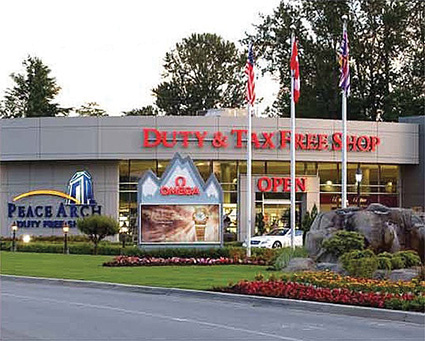
The Canadian duty free market continues to see strong double-digit sales growth in July spurred by a favourable exchange rate with the US dollar, which has seen a big influx of US customers.


Sales at airport duty free stores grew by 18% and land border stores experienced growth of 12%.


“The FDFA National Duty Free Marketing Contest ‘Win What you Know’, which spanned seven weeks during the months of June and July 2015, had an amazing 22,000 entries from Canadians and Americans regarding their knowledge of Canadian Duty Free.”


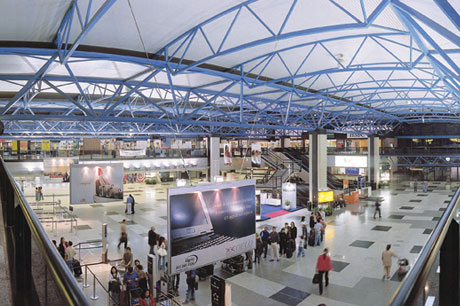
The Loop duty free shop, operated by Aer Rianta International (ARI) at Montreal Airport.

The grand prize-winner won a pre-paid visa gift card worth $5,000 and winners of the secondary weekly prizes walked away with gift cards from Apple Stores etc worth $500.


The main categories that dominated sales in land border duty free were as follows (in order of sales highest to lowest – based on July 2015 numbers).


Alcohol (liquor, liqueur, wine, coolers); tobacco, cigars, loose tobacco; perfume, cosmetics, skincare; food; beer (beer, malt-based coolers); jewellery, watches, clocks; accessories (purses, wallets, sunglasses, etc.); clothing (including hats, fur, leather); souvenirs; office and travel supplies; other; glassware, crystal, china, figurines, porcelain; crafts/arts and finally electronics, cameras, binoculars, etc.


Korea takes action to remedy market volatility

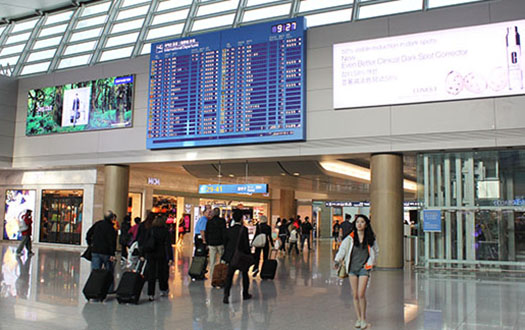
Yesterday, Korea’s Financial Services Commission (FSC) held a second meeting within a week to discuss the nation’s measures to weather current economic volatility, following a widely reported market slump in China.

As has been well documented by TRBusiness, duty free shops suffered a major slump in sales in June following the MERS outbreak. Now, volatility in global markets, spurred by China’s market wobble in the last week, could threaten the DF&TR industry’s fragile recovery.

The FSC Chairman Yim Jong-yong convened a meeting with the Financial Supervisory Service (FSS), Korea Exchange (KRX), and the Korea Centre for International Finance (KCIF) yesterday to address global and domestic financial market conditions.


“Korea’s stock market is undergoing tough times with heightening concerns over external factors such as China’s stock market plunge, the Chinese yuan devaluation and the prospect of Fed’s rate hike,” said the FDC Chairman.


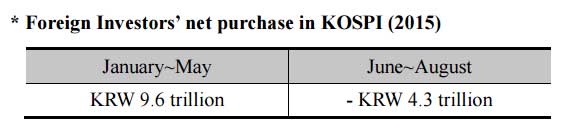
He also pointed out that since the MERS outbreak in June volatility in the Korean stock market has increased as foreign investors began to sell and stock prices stumbled with growing external uncertainty.


DUTY FREE SALES SLUMP

Duty free sales in South Korea’s downtown and airport shops fell by an overall 20% to 30% in June, due to the drop in foreign visitor arrivals following the MERS outbreak, according to Lotte Duty Free, South Korea’s leading duty free operator.


Apparently, duty free cosmetics and perfume sales took the brunt of June’s sales declines in many of South Korea’s duty free shops as Chinese tourists cancelled travel plans to Seoul, Jeju Island and other popular destinations.


Jong-yong has called on ‘relevant institutions’ to join the FSC’s efforts to take actions to reduce volatility in Korea’s capital markets. “To this end, we need to continue our efforts to restore market confidence and keep foreign investors informed accurately about Korea’s economy and financial sector.


Click to enlarge table. 

“As recent market turmoil mainly came from increasing volatility in global financial markets, I would like to urge the relevant organisations to closely monitor global financial market and economic trends, and effectively share relevant information.


END TO MARKET CONFUSION

He also asked that they help to prevent proliferation of wrong information and market confusion: “I would like to ask relevant institutions to transparently disclose necessary information in a timely manner to prevent market confusion based on wrong information and misunderstanding.


“It is crucial to disclose correct data and, when necessary, provide accurate explanation on the current situation in case foreign media or institutions report false information and analysis about Korea’s economic status and market condition.”


This comment from the FSC Chairan is apt at a time when the Korean IT Times reports that there may have been an information leak which led to surging stocks for Korean travel retailer, Hanwha Galleria, in July.


The report suggests that there may have been an information leak prior to last month’s announcement of duty free license awards resulting in Hanwha’s stock rising significantly in the run up to the official announcement.

Chinese devaluations: little likely impact on duty free

Duty free and travel retailers need to look at Tuesday’s -1.9% devaluation of China’s currency against the US dollar, in some historical – rather than hysterical – context before being taken in by sensationalist media reports about the effects of the move.

The government devaluation is designed to cheapen exports in order to re-boot the slowing Chinese economy [which at a six-year low of +7% in Q1 is still far better than any European market can muster].

In the domestic retail sector this will undoubtedly mean higher priced goods – and this will impact luxury players in particular.

One investment analyst told TRBusiness on the day of the -1.9% devaluation: “Take a look at all the luxury goods names today… they’re getting smoked on the China news.”

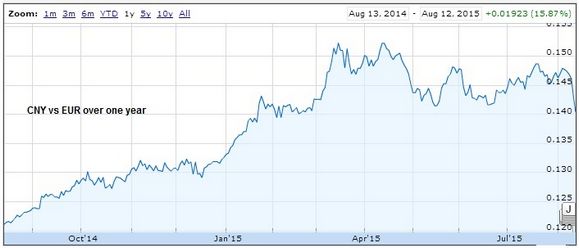
CNY vs EUR over 1 year

True, proxies for the luxury market in China, such as LVMH and Swatch Group, saw large share price falls this week.

LVMH is currently trading at -7.8% off its Monday night price while Swatch is down by -7.7% over the same time period.

NOT A BIG WORRY…

However, DF&TR players should not be unduly alarmed, and certainly not those in the Eurozone. A glance at historical exchange rates comparing China’s currency the Yuan (CNY), against the US dollar, the euro, and UK pound show that the Yuan still has enough strength to keep Chinese travellers shopping.

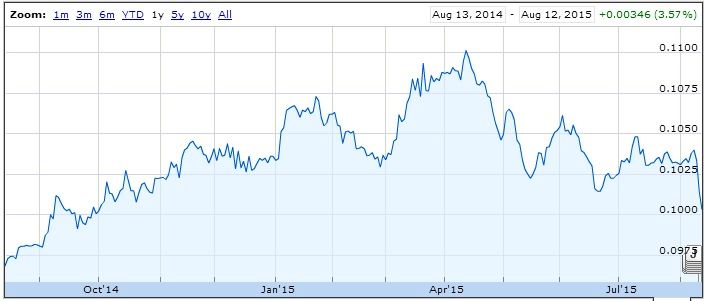
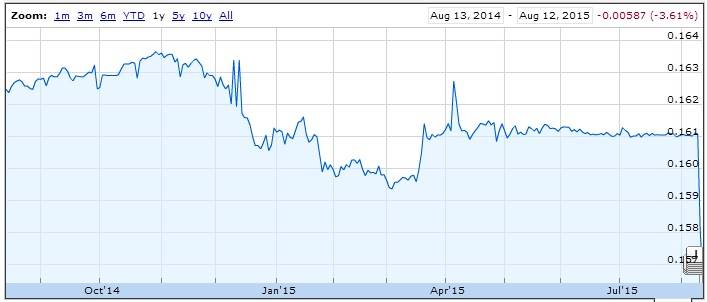
CNY vs USD (below) and CNY vs GBP (above) over 1 year

Taking into account two of this week’s three devaluations [there have been three on successive days], CNY is still trading at +5.4% up against the euro, year-to-date; and -2.8% versus the US dollar and -3.0% against the UK pound over the same period.

On a one-year scale, the picture for CNY is +15.9% versus the euro, -3.6% against the dollar and +3.6% against the pound (see charts courtesy of Google Finance). And the five-year picture shows CNY gains against all three currencies.

By comparison, the devaluation of the Russian rouble – which is really hurting DF&TR – has led to declines of -32.6% against the euro, -44% versus the US dollar, and -39.8% against the UK pound [all over a one-year period]. The five-year picture is far worse.

If anything, higher priced luxury goods in the domestic Chinese market should spur spending abroad given the yuan’s currently still strong value.

…NOT YET ANYWAY

However, continuing headlines about the devaluing yuan could trigger uncertainty from Chinese travellers, who may postpone trips abroad – even if the currency still represents good value – on fears it will fall further.

Mohn: “no significant impact”

At research group M1nd-set, CEO Peter Mohn says: “In recent years we have conducted various studies in different markets on this subject for our clients, and results have shown that currency devaluations always have some effect on the travelling and shopping behaviour of international travellers.

“However, these effects are usually stronger in the short term and mostly recuperate significantly after a while, but of course it depends on the level of the devaluation. We don’t think this -1.9% devaluation will have a significant impact on the shopping behaviour for luxury goods, especially not on travellers from tier 1 and 2 cities.”

MORE SERIOUS STRUCTURAL ISSUES?

The worry is the possibility of a more serious meltdown of the Chinese economy leading to further small currency adjustments – or one big one. The investment analyst comments: “The devaluations might imply they [the Chinese government] could be in trouble and signalling (or partially admitting) they have a problem.”

This could also mean that the consumer in China is losing some of his steam and that there might be other structural issues in the market. However, if those materialise, the impact won’t be purely on the DF&TR channel but on the entire global economy.

Lauder comments on DFA Appeals Court case

Following last Friday’s US Court of Appeals decision to dismiss Duty Free Americas’ case against Estée Lauder Companies (ELC) in which the duty free and travel retailer claimed that the beauty house had violated federal and state laws, ELC has issued a short statement.

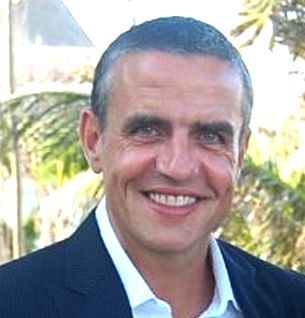
ELC’s President Travel Retail Worldwide, Olivier Bottrie (left), told TRBusiness yesterday: “We are pleased with the outcome of the US Court of Appeals decision. The verdict confirms two previous decisions by the District Court of the Southern District of Florida. As the leader in global prestige beauty, we remain committed to growing the travel retail channel.”

Duty Free Americas is yet to make a comment on this latest legal outcome, and on whether it plans to make any further appeal in this long-running saga.

[To read the 60-page Appeal Court document about this case, and how the verdict was reached – together with detailed accounts of several historical US airport bids – please click here.]

Does appeal loss mean end of DFA/Lauder case?

The US Court of Appeals has upheld a previous district court dismissal of Duty Free Americas’ case against Estée Lauder Companies (ELC) in which DFA claimed that the beauty house had violated federal and state laws.

The core elements in this long-running saga were based on the travel retailer’s claim that ELC’s refusal to do business with DFA, and its communication of that fact to airport authorities evaluating whether to offer rental space to DFA, breached the said laws.

In a court document issued on Friday, Circuit Judge, Stanley Marcus, states: “DFA also says that Estée Lauder places anticompetitive restrictions on duty free operators’ display space and ability to select their own inventory; it seeks injunctive relief from these requirements.

“Finally, DFA claims that its competitors disparaged its business methods and financial projections to airport authorities and seeks to hold Estée Lauder accountable for all of those statements.”

DISMISSED IN ITS ENTIRETY

DFA’s multi-count lawsuit against ELC had been dismissed in its entirety for failure to state a claim by the district court. This time around the Appeals Court upheld that decision.

Court of Appeals: “In pleading its antitrust claim, DFA did not adequately allege that Estée Lauder engaged in predatory or anti-competitive conduct.”

DFA was contacted by TRBusiness today for reaction and about its potential next step, but the company has not yet come back with a statement.

On the Court of Appeals decision, Marcus says: “On each claim, DFA failed to allege basic facts sufficient to state a claim to relief that is plausible on its face. Thus, in pleading its antitrust claim, DFA did not adequately allege that Estée Lauder engaged in predatory or anti-competitive conduct.

“Nor has DFA come close to establishing standing to seek injunctive relief from the requirements that Estée Lauder places on its competitors, inasmuch as DFA no longer does any business with Estée Lauder.

“As for its false advertising claim, DFA failed to plead sufficient facts from which a court could find that Estée Lauder made false statements, or, for that matter, was responsible for any such statements made by DFA’s competitors.

Ties are severed between DFA and Lauder

“Finally, the complaint failed to allege any improper conduct sufficient to constitute tortious interference with a business relationship in violation of Florida law.”

DAMAGED RELATIONSHIP

While at face value, ELC looks, now, to be in the clear, the case will, no doubt, have left a sour taste in the mouths of both parties as a result of the bitter court battle that goes back to 2012.

ELC is the largest manufacturer of beauty products sold in DF&TR outlets in the US – with some of the most recognised brands such as Estée Lauder, Clinique and MAC. Without this key portfolio in the mix, DFA is at a potential disadvantage in tender processes at airports.

According to DFA estimates, in 2010 Estée Lauder’s market share of cosmetics [make-up and skincare] sold in duty free stores in the US was approximately 45.7%.

$14.5M AT WHOLESALE DOWN THE DRAIN

As far back as June 2008 – just after ELC announced plans to consolidate dual wholesale domestic and duty free pricing into one – DFA took a stand and terminated its dealings with ELC in response. This cost the beauty house an estimated $14.5m each year. When DFA tried to revive relations, ELC refused, preferring to forego this revenue.

[To read the extensive 60-page Appeal Court document about this case, and how the verdict was reached – together with detailed accounts of several historical US airport bids as well as relevant letters from Estée Lauder’s President of Travel Retailing Worldwide, Olivier Bottrie – please click here.]


European Commission clears Dufry/WDF deal

The competition department of the European Commission has cleared the planned acquisition of Milan-listed World Duty Free by its larger Swiss rival Dufry without taking the process to a second – more rigorous – stage.

Under EU Merger Regulation rules, the European Commission has given the deal a green light on the grounds that the concentration of market power by Dufry is not significant enough, describing it as “moderate”.

In a statement to TRBusiness it says: “The Commission concluded that the proposed acquisition would not raise competition concerns given the companies’ moderate combined market positions resulting from the transaction, the presence of strong competitors, and pricing constraints imposed on travel retail companies by airport operators.”

The transaction – which at 2014 values will give Dufry revenue of CHF7.8bn/$8.1bn – was examined under the normal merger review procedure.

STAKEHOLDERS CONSULTED

In coming to its conclusion the EC tells TRBusiness that it consulted with “a number of stakeholders (including competitors, customers, distributors)” but did not say which companies or how many.

In this process, if the EC identifies any competition concerns that cannot be addressed by the end of the first phase investigation (normally 25 working days) – in this case from 1 July when Dufry sent its official notification – then it has to open an in-depth review.

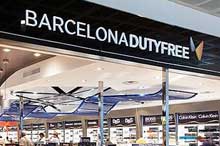
Dufry will take control of the Spanish DF market

“As you see, there are quite a number of checks and balances and public consultations, if a merger is likely to cause competition concerns,” says a competition department spokesperson.

A NEW ADDITION TO THE DUFRY STABLE

To recap, on 28 March Dufry agreed to acquire 50.1% of the issued shares of World Duty Free from Schematrentaquattro, pursuant to which it will acquire sole control of World Duty Free.

WDF, with 2014 sales of €2.4bn/$2.6bn, controls almost the entire duty free retail business in Spain, and also has a dominant presence in the UK, plus other global operations in the Americas and the Middle East and parts of Asia.

Dufry, with 2014 revenue of CHF4.2bn/$4.36m, operates retail outlets in airports and other transport hubs and is particularly active in North America and South America plus Europe and the Asia Pacific region.

With this key competition hurdle crossed Dufry will likely manage to keep to its planned merger and integration timetable of 18-24 months ending in early 2017.

DFA ambitious in Brazil despite pax slowdown

Duty Free Americas President, Leon Falic has told TRBusiness the drop in Brazilian travellers and their spend has affected the company’s operations in the first half of the year, but that hasn’t put them off bidding for retail contracts in the country.

As previously reported, Duty Free Americas won a 10-year contract to operate its first airport duty free concession in Brazil at Afonso Pena International Airport in Curitiba.

Although this is DFA’s first airport contract won in Brazil, many of DFA’s biggest assets hail from South America.

“The Brazilians are affecting us a lot; they’re not travelling, they’re not spending much,” says Falic. He also admits that sales have been disappointing in Uruguay where the travel retail industry heavily relies on Brazilian travellers

“It affects us less so in Miami because it’s so diverse, but it does still have an affect,” adds Falic. “But the thing with this market is they’re always flying somewhere else. I think the ones that are travelling are buying, but there’s just not as many travellers – as you said – and they’re not buying quite as much. They’re still there, but it’s not what it used to be. If anyone tells you it is, it’s not true.”

Duty Free Americas President, Leon Falic.

As previously reported, this sentiment was echoed by those making presentations at the annual ASUTIL conference in June and by exhibitors speaking to TRBusiness at the IAADFS (Duty Free Show of the Americas) in March.

Falic told TRBusiness earlier this year that he’d be happy with 2% sales growth to $1.25bn in 2015. “I think in certain categories we’re going to be very down and I think certain categories are going to be very up.”

Falic predicts that sales of luxury goods will suffer, but that the company should make up sales in liquor and fragrance. “Not everybody can buy an expensive watch or bag, but they’ll always buy when they see savings and value for money. They will buy fragrance, they will buy liquor, that’s our biggest business. So we’ll get our growth from there because we focus so much on it, but I think we’re going to get hit hard on the other categories.”

‘WE DON’T GO INTO A COUNTRY LIKE BRAZIL FOR ONE STORE…’

Despite Falic predicting an unfavourable impact from the slowdown in Brazilian pax, he confirmed that DFA has big ambitions for expanding its footprint in the country. “We don’t go into a country like Brazil for one store, so we’ll look at it.”

Falic also says that Brazil is concentrating on clearing up its act at the moment. “There’s a lot going on in Brazil in terms of internal corruption, political issues, so I think they’re cleaning that up and I think it’s going to be even better for anyone who wants to come in. I think it’s going to be a fairer process. I think it will be good.”

Falic also says that the slowdown in Brazilian passengers can be partially offset by Asian passengers, which have increased in number, especially in Miami, New York and the wider Latin America region.

“Latin America was not really somewhere where you’d see [Asian travellers] previously, but now we’re seeing them often, so Asian travllers are helping us; that I can tell you.”

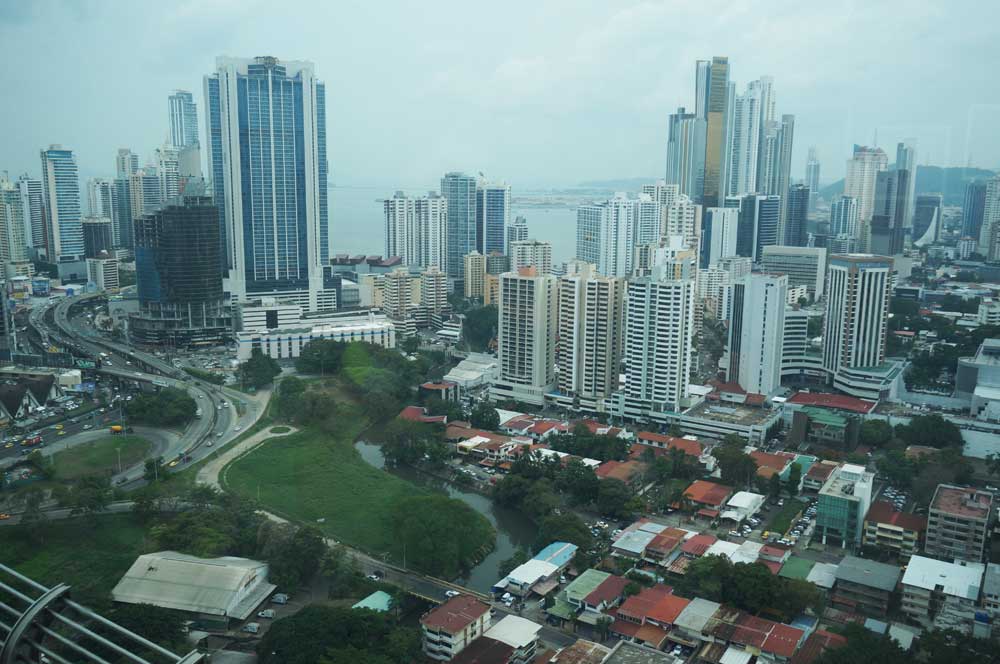
Room with a view: TRBusiness interviewed DFA’s Leon Falic at the company’s HQ in Panama City earlier this year.

Falic specifies that of the Asian passenger contingent he speaks of, the Chinese and Koreans are most notable.

“I think the Koreans are looking to invest a lot in this region, so they’re coming to LatAm, travelling through Miami to get to other regions and they’re buying. We’re selling all kinds of Asian cigarettes, which we didn’t do before and various expensive products, such as whiskies, Cognacs and there’s a lot of people travelling for business coming to this region.

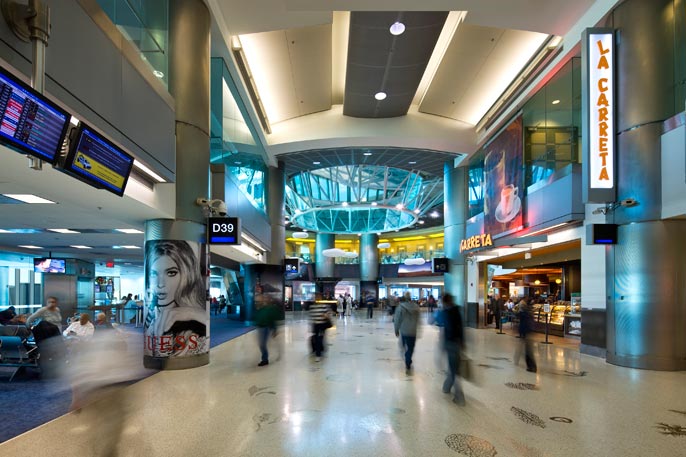
Falic says DFA is seeing more Asian passengers travelling through Miami International Airport.

“You have huge companies in Latin America: Samsung, LG, etc and big Chinese companies are buying steel and oil. They’re coming to the region and travelling around. Also they buy a lot of food; they go to Paraguay to buy a lot of food.”

The influx of Asian passengers requires a shift in the retail offer at some of DFA’s stores, but Falic assures TRBusiness that the company is flexible and can adapt very quickly. “We’ve got a small team of buyers and they’re in touch with the stores all the time. That’s one area where we’re very strong. We adapt very quickly and if we get enough requests for something we’ll immediately pull it in, we’ll list it and see how it does. If it fits in well we’ll keep it.”

The full-length interview with Leon Falic will appear in the September issue of TRBusiness.

DFS invests in major beauty store strategy

DFS Chairman and CEO, Philippe Schaus has told TRBusiness that beauty is a ‘key pillar’ for the group and will continue to represent ‘a significant portion’ of its total sales in the next few years.


The company has already invested heavily in three T Galleria Beauty by DFS stores, which are opening in phases in Macau and Hysan Bay. In an exclusive interview with TRBusiness, he also says that he believes that beauty is one of travel retail’s most resilient categories.


As previously reported, on 27 May DFS Group opened an 11,133sq ft T Galleria Beauty by DFS store at the Galaxy Macau, to add to the retailer’s two existing store presences at the Four Seasons and City of Dreams.

 

DFS Chairman and CEO, Philippe Schaus.

The retailer opened its second standalone 18,000sq ft Beauty by DFS store in Hysan Place, Causeway Bay at the end of June and will open a third store at Studio City in Macau this September.


“T Galleria Beauty by DFS is a new beauty hall concept – a standalone luxury beauty store, focused purely on cosmetics, skincare and fragrances, and, contrary to most stores of this type, developed with a unique design approach,” Schaus told TRBusiness.


“We provide our customers with a whole new level of choice and excitement, offering luxury and accessibility at the same time. Indeed we offer a mix of luxury and trend products in a single space, encouraging shoppers to mix and match, experiment, have fun, and ‘play’ with looks and products before they make a purchase. We’ve also added more travel essentials and sample sizes in a bright and welcoming environment that stimulates the senses.”


As with DFS Group’s other projects, such as its Masters Series, which progressed from one category to another, it seems natural to assume that the group might open T Galleria Wine & Spirits or T Galleria Watches and Jewellery stores in the future. TRBusiness asked Schaus if he thinks these are viable retail concepts and where we might see them.


“Our strategy is simple – to serve our customers. To serve them, we need to listen to them – to ask them what they want, and then respond. So that as their needs shift or change, we can develop new concepts and product offerings to meet their needs.
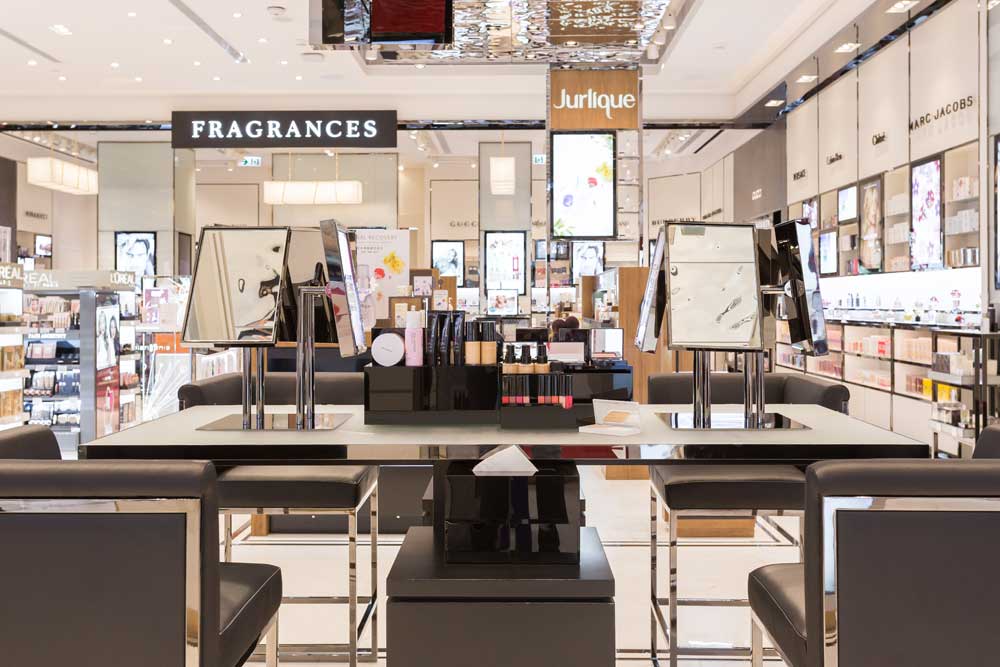
 

On 27 May DFS Group opened an 11,133sq ft T Galleria Beauty by DFS store at the Galaxy Macau, to add to the retailer’s two existing store presences at the Four Seasons and City of Dreams.

“Beauty is one of travel retail’s most resilient categories, primarily because personal grooming isn’t considered a ‘nice to have’, it’s an essential part of modern day living. So right now it makes sense to offer a standalone beauty store to our customers. If we see similar demand in other categories in the future, of course we would need to consider how best to respond.”


Beauty is clearly a big strategic focus for DFS – it is understood that the category represents about 50% of its total business – taking into account the new Beauty Galleria and a major beauty promotion it is running in 19 of its key stores. ‘The largest beauty promotional programme in the world for the traveller’ takes place in seven countries between July 1-31.

DFS Group opened its second stand alone 18,000sq ft T Galleria Beauty by DFS store in Hysan Place, Causeway Bay at the end of June.

Besides discounts in some locations, DFS says this will focus on product exclusives, events and tutorials from leading skincare and makeup experts in the world’s largest beauty promotional programme.


TRBusiness asked Schaus if the category is still considered a growth area for the group and if it is more protected from lower spend per pax. “Beauty is a key pillar of our business and it will continue to represent a significant – and indeed very resilient – portion of our sales.”


The new T Galleria Beauty by DFS store in Macau has been designed by French luxury retail design firm Malherbe to reflect an ‘experiential world’ and will also feature the first Hermès Parfums and Hermès Le Bain stand-alone fragrance boutique in Macau.

The Hysan store is the first of its kind in Hong Kong concentrating solely on luxury cosmetics, skincare and fragrances.


A total of 22 world-renowned beauty brands will be on show, including Dior, Estée Lauder, Guerlain, Hermès, La Mer, La Prairie, and Lancôme. The retailer adds that DFS exclusives will also include Clé de Peau’s Radiance Trio Set and L’Occitane’s Perfect 10 Hand Cream Set.


“Our customers are on a constant quest for quality, regardless of price, and they are as excited by high–end luxury as they are by more fun, trendy items,” adds Schaus.


Read the full-length interview with Philippe Schaus in the August issue of TRBusiness magazine.

Register now for latest APTRA insights

The Asia Pacific Travel Retail Association – the trade association for the duty free and travel retail industry in the region – has opened registration for its Insights Seminars in Seoul, Delhi and Hong Kong this September.

The seminars – designed to present the latest consumer research commissioned by APTRA, plus other insights from partner companies – are free to member companies (two passes) and also to non-members (one pass) per location, with extra places subject to availability.

SPEAKERS

The speakers are diverse. David Perroud (left), Joint Owner & CEO, m1nd-set will present new research on Asia Pacific travellers commissioned by APTRA with a special focus on Korean, Indian and Chinese travellers and their behaviour towards specific categories, their attitudes to airport shopping and technology.

Anson Bailey (right), Principal Business Development at KPMG will be looking at Chinese e-commerce and how Chinese consumers are behaving in the online retail environment. He will examine spend levels across categories and the multichannel marketing potential of online and offline including mobile.

Smriti Kataria (left), AdNear’s Marketing & Research Director will look at the multiple opportunities to reach consumers while they are on the move in airports. She will focus on how mobile, Internet and in-store environments can be used for cross-promotional opportunities and at the phenomenon of time- and location-specific messages to consumers to optimise penetration levels.

CIDF Global Business Development Manager, Amy Coghlan (right), will offer a practical guide to China’s biggest tech phenomenon ‘Wechat’, a potential platform for airports, airlines, retailers and brands to engage with Chinese consumers. With more Chinese tourists shunning package tours and going independent, social media has become an important information source .

The first Insights Seminars tour in 2013 covered seven cities in Asia Pacific, and this year’s programme relaunch started in Singapore during the TFWA show in May.

DATES & PLACES

The Seoul event will take place on Friday 11 September 3pm – 6pm hosted by Incheon International Airport at 424-47 Gonghang-gil, Jung-gu, Incheon, 400-700, South Korea. To register email Miss NA Noon Hee at [email protected].

The Delhi seminar is hosted by Delhi Duty Free and Pernod Ricard and will be staged on the afternoon of Monday 14 September at the JW Marriott hotel in the New Delhi Aerocity near the airport.

The Hong Kong meeting will be on the afternoon of Wednesday 16 September at the KPMG Insights Centre, Prince’s Building in Central, Hong Kong. To register for Delhi or Hong Kong email [email protected]

Besides Delhi Duty Free and Pernod Ricard, other sponsors of the tour are Brown-Forman, Diageo, Moet Hennessey, Phillip Morris and Puig. Anyone interested in sponsorship opportunities or further information can contact Michael Barrett, Executive Officer: [email protected]