Trbusiness. The travel retail Trbusiness. The magazine for global retail and duty free professionals.
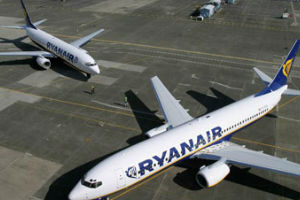
Ryanair is banking on fare declines of -5% to -7% in FY18. Source: Ryanair.
Ryanair says it is raising its medium term guidance estimate for ancillary sales to account for 30% of total revenues by March 2020.
In its full-year results issued today, Europe’s leading low-cost airline says it is already “well on track” on achieve the target, as its ancillary revenue grew by 13% to €1.8bn ($2bn) to occupy a 27% share of total revenues compared to a 24% share in the period ending 31 March 2016.
Improvements to its website and mobile technology has boosted ancillary income, which includes onboard sales, as passengers continue to benefit from a tranche of improved options such as “Plus” products, reserved seating, priority boarding, excess baggage, travel insurance, car rental and security fast-track options.
Although revenues from these non-flight scheduled operations account for the majority of the total, the carrier increased its revenue from in-flight sales by 19.8% to €153.4m ($170.3m), according to its FY2016 results, with a spokesperson from Ryanair confirming to TRBusiness that the figure for onboard retail and F&B sales would be updated in July.
Total operating revenue grew by 2% to €6.6bn ($7.4bn) year-on-year as the airline netted 120m customers off a +13% rise in traffic.
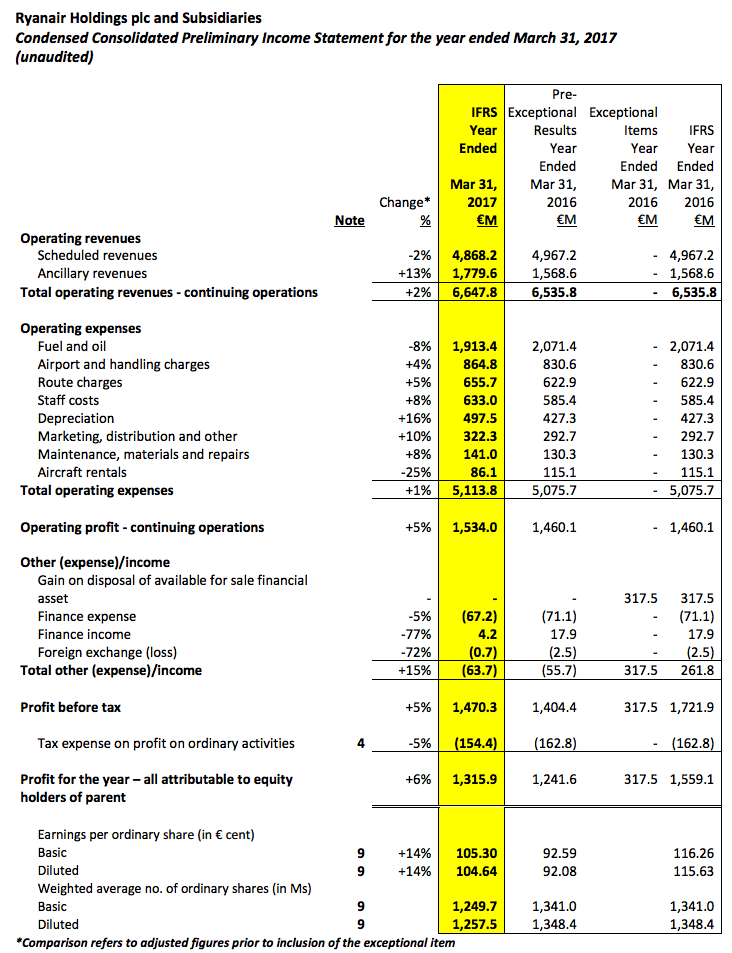
Click to enlarge. Source: Ryanair.
FARE DECLINES ‘EXPECTED TO CONTINUE’
Despite the weakness in sterling following the UK’s decision to Brexit, which resulted in average fares falling by 13% to €41, Ryanair’s net profit after tax grew +6% to €1.3bn ($1.5bn) year-on-year.
Ryanair CEO Michael O’Leary said in a statement: “We are pleased to report a 6% increase in profit after tax to €1.316bn, despite difficult trading conditions in FY17 caused by a series of security events at European cities, a switch of charter capacity from North Africa, Turkey and Egypt to mainland Europe, and a sharp decline in sterling following the June 2016 Brexit vote.
“We reacted to these challenges by improving our customer experience, and stimulating growth with lower fares.”
Looking ahead, Ryanair points to a decline of -5% to -7% in FY18 fares due to the weaker sterling and continuing excess capacity in Europe.
FLEET NUMBERS TO RISE
New routes, bases and fleets underpinned expansion during FY17, as Ryanair took delivery of 52 new B737’s, launched 206 routes and opened 10 new bases at airports in Bucharest, Corfu, Frankfurt Main, Hamburg, Ibiza, Nuremberg, Prague, Sofia, Timisoara and Vilnius.
Fleets are expected to grow to 427 aircraft by March 2018 as traffic reaches 130m.
These have already been bolstered by the recent launch of charter airline Ryanair Sun, which is set to operate in summer 2018 with a five-strong fleet, with expectations this will grow to 15 aircraft by summer 2019 to become Poland’s number one charter airline.
In April, Ryanair opened a base in Naples and it is set to open bases in Memmingen, Munich and Poznan in addition to launching its first flights to Tel Aviv and the Ukraine next Autumn.
Pointing to the scale of its airport growth negotiations, Ryanair says it continues to juggle more opportunities in 2018 and 2019 than its fleet can cater to.
‘Accordingly, we are engaged in a fleet review with Boeing, and are taking up opportunities to accelerate fleet growth in 2018 and 2019 by extending 10 of our planned lease returns in these years, and adding selectively to our current order where Boeing may have some delivery opportunities over the next 24 months,’ the statement added.
‘As competitor airlines undergo deep restructuring, we are aware of the need to have additional short haul aircraft to respond quickly as these unique growth opportunities arise.’
On the issue of Brexit, the carrier states it is concerned with the ‘significant uncertainty’ surrounding a ‘post-Open Skies regime’ for flights between the UK and EU from March 2019, as it awaits clarity on Britain’s future trading relationship with the EU.
For the full results statement, click here.