 Trbusiness. The travel retail Trbusiness. The magazine for global retail and duty free professionals.
Airport Dimensions unveils global ‘Explore the Experience Era’ study
By Trbusiness Editor |
 Airport Dimensions, a specialist in airport experience innovation and traveller trends, has launched a new ‘Explore the Experience Era’ study.
The research aims to highlight the growth opportunities available for airport locations that are ready to evolve into experience-centric hubs, prioritising flexible spaces, digital innovation and personalised services.
The study interviewed C-suite and other senior executives at airports worldwide. Of the 100 executives interviewed, 82% reported that their airport terminals required significant or moderate improvement. Importantly, the study found that a lack of space and variable retail revenues are hitting profits and compromising passenger satisfaction.
In addition, 94% of airports said developing digital capabilities is ‘absolutely essential’ or ‘important’ to improving commercial returns, with 95% exploring the use of AI to enhance passenger journeys. However, 38% admitted they face setbacks due to outdated digital infrastructure and fragmented technology adoption.
Airport Dimensions’ research identifies four priority areas which can be leveraged to enhance the passenger experience. These are Overcoming the Space Squeeze, Prioritising Personalisation, Streamlining Digitalisation, and Reinventing Retail.
Overcoming the space squeeze
The report noted that many airports are already embracing change as part of a broader transformation, driven by increasing passenger volumes and a commitment to continuous improvement.
A key finding was that 82% of airports acknowledge the importance of optimising terminal space. Progress is already underway, as 40% of airports are investigating flexible, modular spaces to better serve travellers worldwide. By creating adaptable environments, airports can more effectively respond to fluctuating passenger volumes and concession needs.

The Airport Dimensions study interviewed 100 C-suite and other senior executives at airports worldwide.
Efficiency and comfort remain key priorities, alongside reducing congestion. To support smoother passenger flows, 44% of airports are considering implementing targeted zoning strategies as the most viable solution, while 43% are focusing on enhancing waiting areas with additional seating and amenities to better accommodate passengers during peak times.
The report noted that smaller airports face challenges in keeping pace with larger international hubs. While flexible, modular spaces are a priority for 40% of airports, resource constraints can make implementation more complex. And as demand for premium lounges grows (33% of airports are seeking more common-use lounges) smaller airports are exploring ways to remain competitive in the evolving landscape.
Airport Dimensions’ study shows that digital innovation is emerging as a key differentiator. With 94% of airports recognising its potential for improving commercial returns and growth, investment in technology can help airports of all sizes enhance the passenger experience and remain competitive with major hubs that are already leading the way in innovation.
To create future-ready travel experiences, ongoing investment in strategic innovation will be essential, the report underlined.
Reinventing retail
The study acknowledged that today’s passengers are increasingly seeking curated, engaging retail experiences. However, only 40% of airports surveyed recognised its value in enhancing the passenger experience.
Product differentiation and sustainable options were identified as key elements of an improved retail offering, with 32% of airports surveyed now focusing on exclusive, locally sourced products Next-generation airport retail strategies are likely to go beyond transactional sales and instead focus on delivering curated, immersive experiences that align with passenger preferences, Airport Dimensions noted.
The future of retail in airports is evolving toward spaces that integrate shopping, dining, wellness, and entertainment. Many forward-thinking airports are exploring hybrid experiences designed to enhance dwell time and create more engaging environments.
Streamlining digitalisation
With 62% of airports highlighting digital capabilities as important for commercial success, digitalisation – through personalised offers, mobile ordering, and seamless omnichannel experiences – is playing an increasingly significant role in modernising airport retail, the study revealed.
With 94% of airports confirming that digital capabilities are ‘absolutely essential’ or ‘important’ for improving commercial returns, exploring and deploying emerging technologies is essential for commercial success.
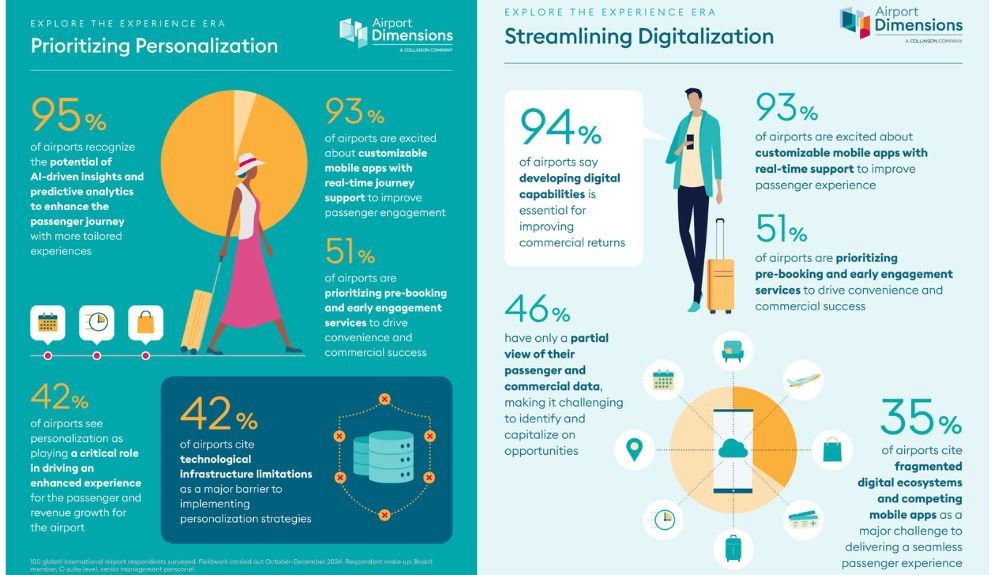
The research identifies four priority areas which can be leveraged to enhance the passenger experience: Overcoming the Space Squeeze, Prioritising Personalisation, Streamlining Digitalisation, and Reinventing Retail.
Consequently, airports are actively exploring emerging technologies, with 92% expressing excitement about the potential of biometric security; 95% highlighting AI-powered journey personalisation as transformative; and 42% increasing investment in self-service innovations such as automated check-in and baggage drop.
Mobile apps providing real-time journey updates are a significant focus, with 93% of airports expressing strong interest in customisable solutions. However, achieving a seamless passenger experience remains a challenge, as 38% of respondents identified fragmented digital ecosystems – particularly multiple competing apps – as a major obstacle to improving digital services.
The lack of a single integrated platform creates confusion for passengers, dilutes engagement opportunities, and can prevent airports from delivering a streamlined, personalised journey, the study suggested.
Without cohesive digital strategies, airports risk frustrating passengers rather than enhancing their experience. Unsurprisingly, 47% of respondents said that in ten years’ time, an app that streamlines and supports the end-to-end journey across the airport will be key.
The push towards seamless, integrated experiences continues to gain momentum. Airports are interested in engaging passengers earlier in their journey, with 51% expressing excitement about the ability to offer pre-booking options and early engagement services.
By consolidating digital touchpoints and leveraging AI-driven personalisation, airports can bridge the gap between technology investment and enhanced passenger satisfaction, ensuring a more intuitive and engaging experience for the next generation of travellers.
Prioritising personalisation
The study showed that personalisation is shaping the future of airport experiences, with airports playing an important role in driving this innovation. The ‘Explore the Experience Era’ research shows that 95% of airports recognise the potential of AI-driven insights and predictive analytics to enhance the passenger journey with more tailored experiences.
As travellers increasingly seek seamless, efficient, and customised interactions, many airports are exploring AI-driven personalisation across retail, food and beverage, and passenger engagement to meet these evolving expectations.
However, challenges remain. While passenger demand for personalisation is clear, 42% of airports identified technological limitations as a key hurdle, and 41% expressed concerns about passenger data privacy.
Airports are also balancing personalisation efforts alongside competition with airlines and concessions. While just 5% of airports see personalisation as having a limited role, the vast majority (95%) view it as a valuable component of the passenger experience.
As the industry continues to evolve, personalisation strategies will play an important role in shaping more engaging, efficient, and commercially viable passenger experiences, the research noted. Strengthening digital infrastructures and data capabilities can help airports enhance traveller satisfaction, increase dwell time, and build long-term loyalty.
Airport Dimensions CEO Mignon Buckingham commented: “Airports are adapting their strategies to stay competitive in today’s evolving travel landscape. Passengers increasingly seek more than just transactional experiences – they appreciate seamless, personalised journeys enriched by technology, comfort, and a strong sense of place.
“Airports that recognise these shifts and invest in smart infrastructure, flexible spaces, and digital-first services can enhance their role, not just as transit hubs but as integral parts of the overall travel experience.”
She added: “The opportunity is especially significant for smaller airports, which face the challenge of keeping pace with larger, innovation-driven hubs. While the landscape is changing rapidly, airports that embrace new approaches have the potential to drive greater passenger engagement, diversify revenue streams, and foster long-term loyalty through memorable, experience-led offerings. Airport Dimensions is committed to partnering with airports globally to support them in navigating this transformation and unlocking new opportunities.”
READ MORE: Airport Dimensions identifies passenger ‘tribes’ among airport shoppers
READ MORE: Airport Dimensions: Travellers ‘disenfranchised’ with airports

Winners revealed: Global Travel Retail Awards 2025
TRBusiness is thrilled to reveal the winners of the 2025 Global Travel Retail Awards, which...

M&M’S and Crocs unveil limited-edition collection fusing fashion and fun
Mars Wrigley International Travel Retail is debuting the first-ever M&M’S collaboration...

Valentino Beauty debuts Anatomy of Dreams collection at Dubai Duty Free
L’Oréal Travel Retail and Valentino Beauty have introduced the Anatomy of Dreams fragrance...

In the Magazine
TRBusiness Magazine is free to access. Read the latest issue now.