The FTE APEX webinar explored and discussed new ideas, product propositions, visions and learnings to prepare aviation for the post-Covid-19 recovery. Source: FTE APEX/PPS Publications.
The coronavirus (Covid-19) crisis has handed airports an incubation period for innovation to enhance the passenger journey and re-position the retail offer, agree voices across aviation.
Speaking yesterday (13 May) during the Future Travel Experience and Airline Passenger Experience Association (FTE APEX) Webinar and Pitch Session: Post-Covid-19 Airports, Javed Malik, Group Chief Operations Officer, AirAsia urged travel retail to bring about change in the airports.
“This is an incredible opportunity for airports to repurpose the retail space – to really start to move towards a display-type model, scan barcodes, make the purchase, bring in pop-up retail and demo products.
“You are giving the chance for innovation to happen. It allows you to vary the proposition, with vibrancy for the passenger. We have a bit of a window to think about propositions at the airport and increasing revenue with the space.”
CHANGE BREEDS AGILITY
Attendees to the circa 180-minute webinar heard from a cross-section of industry leaders, including airports and airlines, on how aviation can restore traveller confidence amid Covid-19.
Meanwhile, separate ‘Pitch Sessions’ allowed suppliers to showcase products and technologies to support the recovery.
Jan Richards, Head of Insights and Planning at Dublin Airport outlined in a presentation how Covid-19 has instigated huge levels of global change that are influencing the reputations of businesses, including retailers.
Lockdown presents a range of issues, in airports but also more generally, she continued.
The net result will be a ‘rightsizing’ of organisations, reconnecting with personal space and the environment, and reassessing the balance between work and office life.
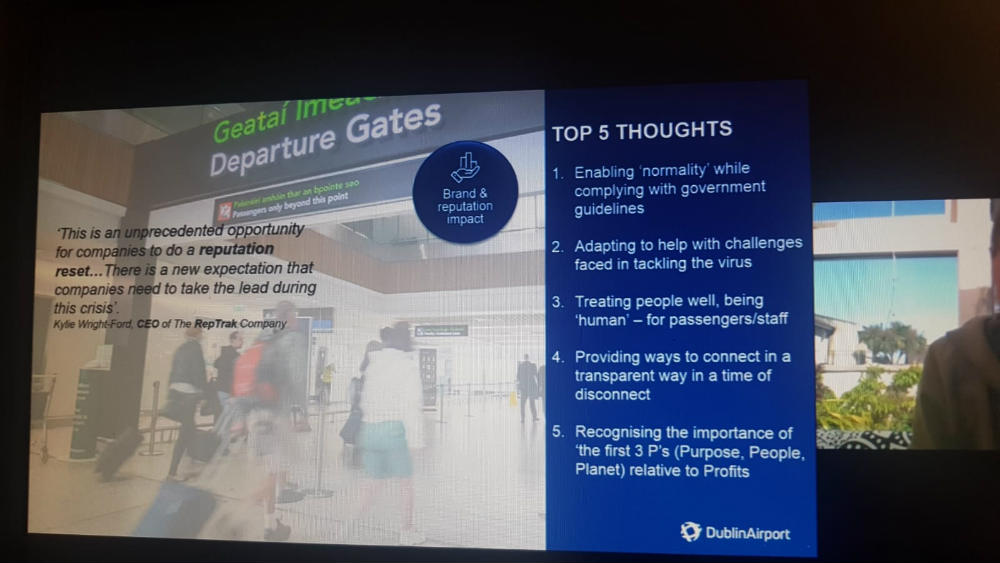
A greater emphasis on passengers trends and associated needs is essential to deliver a greater passenger experience while maximising returns, stressed Dublin Airport. Click to enlarge.
Practically, much thinking has and will continue to take place around social distancing.
“The aviation sector is known for its resourcefulness and ability to overcome challenges,” said Richards. “Until a vaccine is found, ‘workarounds’ will have to be developed and this will need not a little ingenuity, but solid business planning.
“It’s important to have people working not just on the short-term view but the long-term view. Short term is putting into effect the operations now and the long term is strategy for brands etc.”
BRAND EQUITY IN THE SPOTLIGHT
She pointed out that heightened consideration will be paid to consumer trends, restructuring the consumer journey, and brands’ equity.
“Aviation will look very different – supply and demand will be different and ‘purposeful’ brand behaviour will be crucial.”
In the airports, customer needs will pivot around behavioural trends and the physical passenger journey, with a future return to ‘normal’ necessitating a passenger differentiation strategy.
As such, focusing and delivering on customer experience through understanding pax will become even more important and will lead to greater total returns, continued Richards.

Webinar attendees heard from a number of leading industry executives, who discussed how the airport experience should be optimised to foster greater operational excellence while restoring travellers’ confidence.
To that end, Dublin Airports Authority (DAA) is investing time in studying existing and future passenger trends.
Identifying several factors, Richards said that demand will speed up and nuances will become more important, for instance understanding personal space and hygiene practices.
It will be about making things more effortless, as passengers will be apprehensive and not sure of how things will work, she continued.
“For an airport having to implement social distancing guidelines gives us an awful lot less room in which to operate,” she added.

 Trbusiness. The travel retail Trbusiness. The magazine for global retail and duty free professionals.