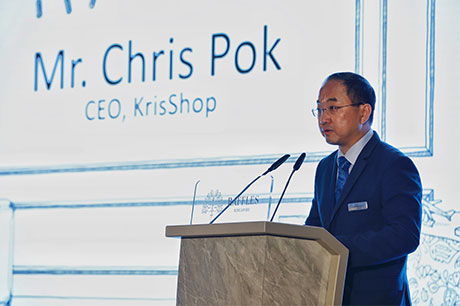
The DFWC ‘Planning to Restart’ webinar took place on 3 June.
Strengthened dialogue with key commercial executives across the airport and maritime industries are boosting travel retail’s multilateral advocacy efforts.
During the Duty Free World Council (DFWC) ‘Planning to Restart’ webinar on Wednesday 3 June, President Sarah Branquinho explained that the Council has been working hard to ‘cascade’ work to regional associations and their retailer members.
The industry continues to rally hard to recover from the devastation in trading suffered across much of the world due to the coronavirus (Covid-19).
Answering a question from TRBusiness on how the Council and regional associations are coordinating efforts in the immediate term, Branquinho said: “A lot of work has already been done from retailers in talking to airports and authorities in which they operate. Most of our retailers have extremely good contacts with government entities, customs and the airports.
“We’ve realised in the past that sometimes airport safety executives get involved in negotiations on the framework under which we operate – I think we’ve done very well this time through ACI to talk to the commercial people within airports. It has been a tremendous joint effort.
“We are very lucky that most of the big retailers and many of the small ones too are very supportive of what the associations are doing.”
‘KEY WINS’ IN DUTY FREE
The pandemic has wreaked havoc for global duty free operators, with shops forced to close following the collapse of international flights and restrictions on travel.
But there have been positive signs of late of a revival in domestic travel markets, including most recently in Australia and Malaysia and the green shoots of recovery witnessed in China has already been well documented.
During a presentation updating the industry on the DFWC’s lobbying activities, Branquinho highlighted a partnership with the International Civil Aviation Organization (ICAO) on the Covid-19 Aviation Recovery Task Force (CART) report, the recommendations of which were unveiled last week.
She went on to outline the council’s broad ranging engagement with associations across the travel and tourism ecosystem, including IATA, CLIA, UNWTO, OECD, WEF, ETRC and ACI.
In the case of the last two, DFWC has worked to secure favourable amendments to the EASA/ECDC aviation restart guidelines.
The DFWC’s key submission areas to CART centred on safeguarding customers and colleagues and implementing appropriate in-store measures in a manner that are easily discernible to the public while fostering maximum safety and confidence.
A central tenant is high-trafficked post-security areas with limited physical barriers are characteristic of airport terminals, thereby requiring sensitivity to passengers’ use of commercial areas such as retail and F&B spaces.
As a result, appropriate access control and flow management protocols such as floor markings, physical installations and adapted wayfinding are a necessity, together with enhanced cleaning and hygiene routines.
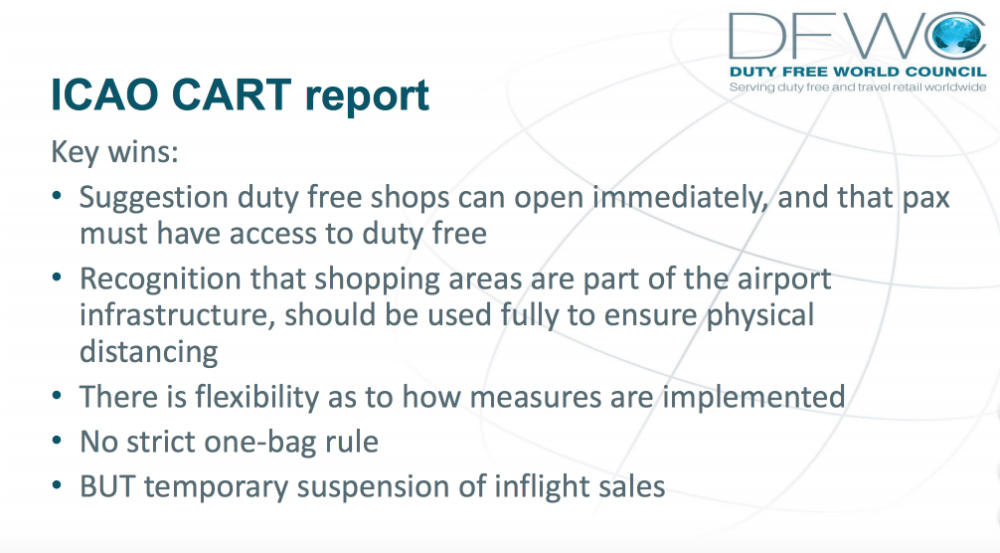
Persuasive arguments from the Council manifested in ICAO suggesting duty free shops – when traffic returns – could reopen immediately and that passengers must have access to duty free.
More broadly, ICAO has recognised that shopping areas form an essential part of airports’ infrastructure and play a vital role in promoting physical distancing.
Click to enlarge. Source: DFWC.
There is flexibility in how the measures are implemented, for instance no limiting ‘entry’ or ‘exit’ points, said DFWC.
Although there is no strict one-bag rule, there was a comment that during the early stages of the restart phase the use of overhead lockers for carry-on baggage should be ‘limited’ to ease boarding for passengers.
The DFWC has outlined to regulators why it is important to avoid the boarding gate ‘chaos’ caused by the one-bag rule, but it is expected that there will be some ‘pushback’ from the airlines on this issue.
ICAO, similar to recent EASA/CDC guidelines, have recommended a temporary ban on inflight sales.
“We’ll need to raise this with our airline partners and get them to work with us to bring this back at the first available opportunity,” said Branquinho.
DFWC has hailed the ICAO CART report as ‘extremely positive’ in efforts to restart international air travel and duty free, but the onus is now on international countries to implement their own rules and regulations.
“The next step is to encourage duty free and tax free retailers to bring these guidelines to the attention of their airport partners and national aviation and safety regulators in each country,” said Branquinho.
“It was important that the Duty Free World Council and each of the regional associations fed into the representatives on the taskforce early on in the proceedings.
“We were keen to avoid unworkable regulations being imposed on us through a lack of understanding of our revenue-generating role in the aviation sector and indeed the maritime sector.”
MID-JUNE HOPE FOR EUROPE
The ICAO guidelines also chime with work on the recently announced recovery protocol.
This is now being used to spur on talks with local partners and will act as a framework for reaching out to key stakeholders with broader details relevant to particular jurisdictions in due course.
To that end, the DFWC has already asked questions with regards to tastings, activations and sampling activities – pertinent to many categories but particularly liquor, fashion and beauty – to name just a few examples.
A wealth of information has already been received in response to the protocol and it is understood that DFWC will be addressing the detail with ICAO in due course.
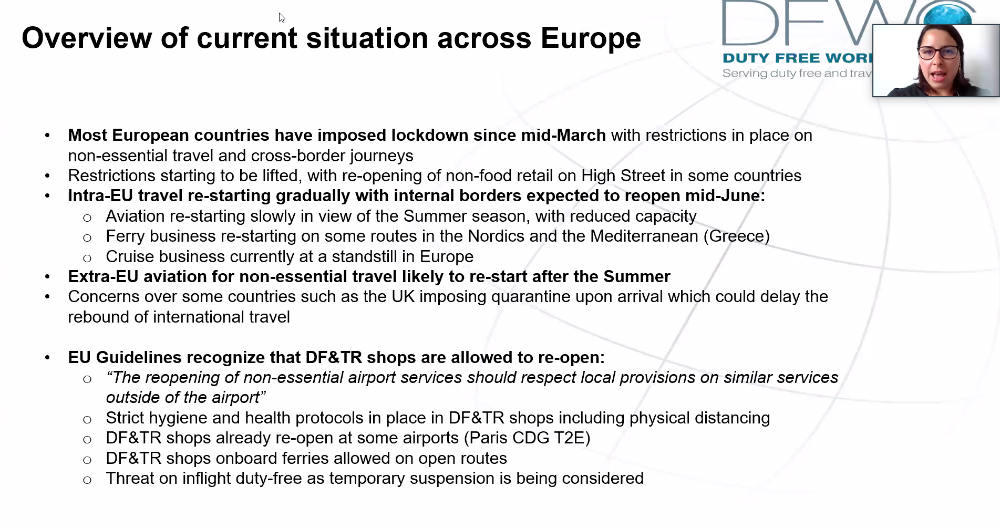
Julie Lassaigne, Secretary General, ETRC provided an important snapshot of the travel situation in Europe. Click to enlarge. Source: DFWC/ETRC.
Attendees to the webinar were provided with a wealth of detailed and granular-level insight on the Covid-19 strategies being implemented by each regional association, plus their lobbying efforts on a variety of interrelated issues.
ETRC, ASUTIL, MEADFA, IAADFS and FDFA provided timely updates on the regulatory landscapes affecting each territory and their supporting lobbying efforts.
For Europe, particularly hard hit by the outbreak and subject to some of the strictest travel restrictions, ETRC Secretary General Julie Lassaigne provided a timely appraisal.
Importantly, intra-EU travel is starting to slowly revive, with the 15 June earmarked for the resumption of internal market travel, with extra-EU aviation tipped to resume after the peak summer period.
On the other hand, the cruise industry is still at a standstill across the region, with no further clarity on when ships will begin voyages. In the UK, the quarantine measures that began today could impact the rebound efforts, suggest ETRC.
‘COMBATTING ECONOMICS OF FEAR’
In a keynote presentation, Patrick Lucas, Director, Economics, ACI World suggested that global airport losses are estimated at $97.4 billion in 2020, with Europe and Asia Pacific bearing the brunt of that hit with growth declines of -63% and -59%, respectively.
He pointed to March when transatlantic flights were banned as the ‘game changer’ for the industry.
“Right now we are in the abyss and deep into the crisis,” said Lucas. “In Q2 we saw declines of up to 90% globally in terms of passenger traffic, representing a loss of over two billion passengers in a single quarter.”
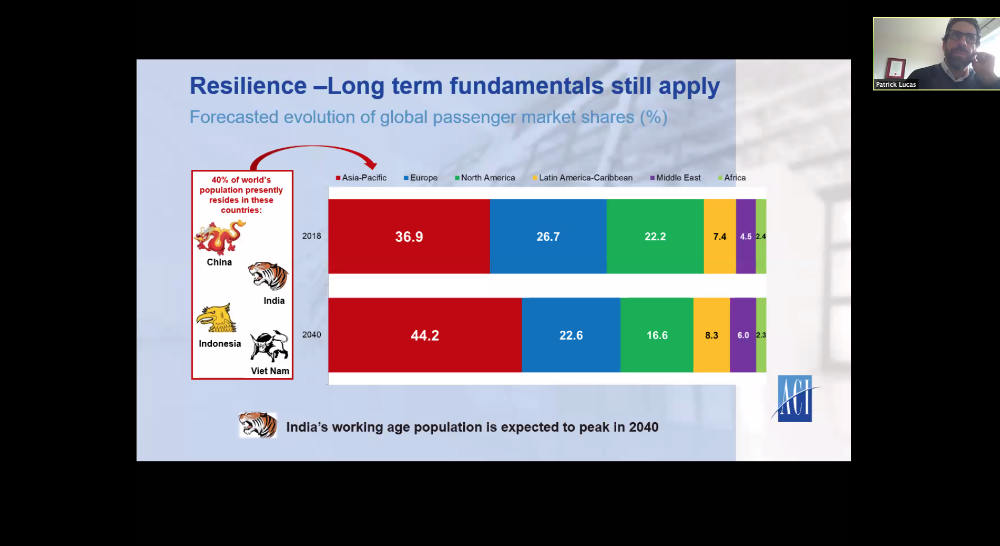
Patrick Lucas, Director, Economics, ACI World urged the industry to consider the long term dynamics of passenger demand. Click to enlarge.
That translates to estimated revenue losses of just under $100bn (-57%) in 2020.
“We are looking at a quasi-U shaped or L-shaped recovery and it will take at least three years or more to get back to 2019 levels,” commented Lucas. “We see in Asia Pacific, routes opening up and intra-EU markets opening up as well.
“As an industry, we really have to combat the economics of fear in mitigation measures, ensuring the virus does not spread.”
He said that the shift from domestic to international travel will definitely happen; if not in the coming months then the coming years.
The risks associated with seasonal pax markets means that while short- and medium- term recovery strategies are important, the long term recovery fundamentals still apply, he added.

 Trbusiness. The travel retail Trbusiness. The magazine for global retail and duty free professionals.
 The Hong Kong government is spearheading a HK$39 billion/US$5 billion funding package for Cathay Pacific, it has been announced.