Trbusiness. The travel retail Trbusiness. The magazine for global retail and duty free professionals.
The first tender code since 2001.
Airports Council International Europe (ACI Europe) this week released its first tender code since 2001, marking a significant shift in how airports are encouraged to structure retail concessions, share risk with partners, and assess long-term value over the full life of a contract.
[Main photo credit: Tupungato / Shutterstock.com]
For many years, travel retailers in some key locations have claimed to be limited in their abilities to innovate because of the financial strictures of their contracts with airport landlords. The new code aims to overcome this and other barriers.
Steered by a working group within ACI Europe’s commercial forum, the code was developed with inputs from airports, the ETRC travel retail association, major retailers, brand representatives, and investors. The previous one mainly sought the views of airports. It follows an ETRC-initiated study about business models in travel retail overseen by the Institute for Retail Studies at the University of Stirling in the UK.
Netherlands-based Kinetic Consultancy led the research, development and drafting of the tender code, and its managing director Martijn Steur comments: “For an airport board or executive team, a major commercial tender is ultimately a long-term decision. It can shape revenues, investment, passenger experience and the allocation of risk for the next five, seven or 10 years. That makes tender design part of commercial strategy, not simply a procurement exercise.”
He adds: “The strategic decision is not simply whether to use a minimum annual guarantee (MAG), revenue share, or another commercial structure. It is about understanding what behaviour, investment and allocation of risk the airport wants that model to create.”
Key points of the new code focus on lifecycle value over upfront bids, flexible commercial structures, risk-sharing, pre-tender consultation, and data transparency.
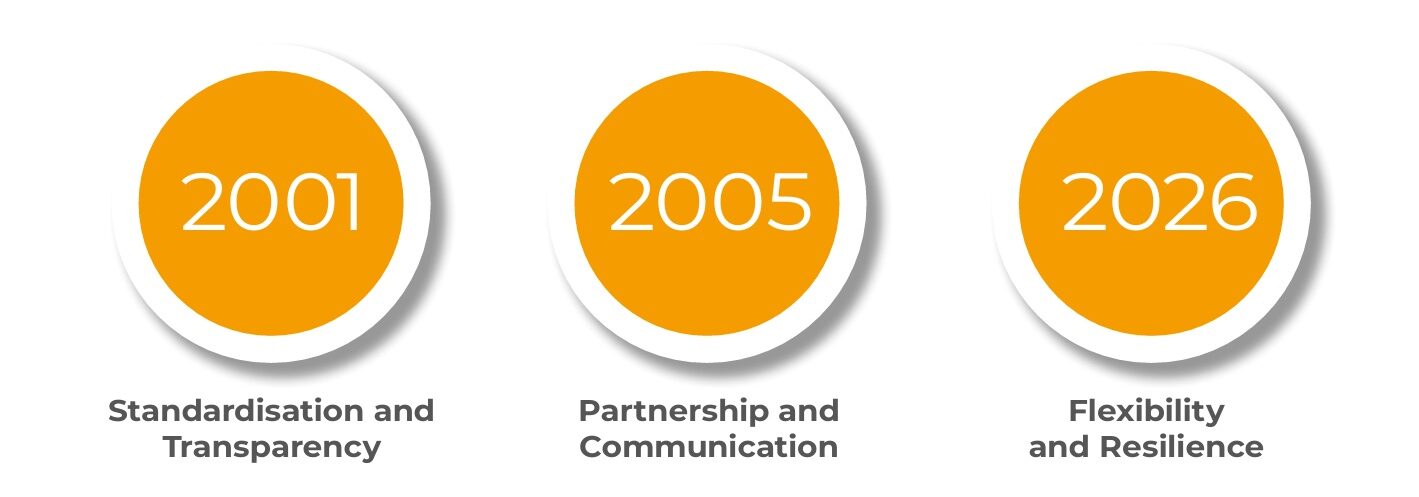
ACI Europe’s changing tender focus through the decades.
A framework, not a template
Steur argues that the code provides is not a set template because the same principles can lead to different solutions at different airports. He comments: “The more mature conversation is no longer about how much rent an airport can extract from a concession. It is about how financial return, investment, passenger experience and resilience work together to create sustainable value over the life of the contract.”
By bringing together a more diverse group of stakeholders and representing different airport sizes, governance structures, and commercial maturity levels, the code now “reflects real-world conditions across the European airport landscape”, according to ACI Europe. The collaborative process has helped move the code beyond theory towards more practical, operationally grounded guidance.
This should add up to better decision-making, not a prescriptive rulebook. It is structured around contractual terms as well as the quality of preparation, alignment, and dialogue before the tender is launched. ACI Europe says it wants to improve the quality of tender discussions, and, in that regard, a central insight from the working group is that many tender challenges arise not from a lack of rules, but from insufficient agreement between stakeholders early in the process.
Why a 25-year hiatus?
Addressing the long time taken to update the code, ACI Europe says in a statement: “Since 2001, the airport commercial environment has changed substantially. Passenger expectations have evolved, digital channels have developed, airport retail categories and operating models have become more complex, and commercial partnerships increasingly need to respond to market volatility and changing traffic profiles. Major disruptions, most notably the Covid-19 pandemic, also highlighted the importance of building greater resilience and adaptability into commercial structures.”
The most consequential change in the new code is a shift from focusing primarily on the tender award to considering performance over the concession’s full life. A strong financial offer on award day is only valuable if the resulting business remains capable of investing, innovating, maintaining service levels, and generating sustainable revenues in the years that follow.
The stakeholders that helped put together the new tender code.
The data dilemma
By taking the longer view, the updated code looks at the commercial business more broadly, and ACI Europe is very clear: “Good tender decisions depend on good information. Potential bidders need sufficient information to understand passenger volumes, passenger mix, historic performance, expected developments, commercial space and other relevant trading conditions. Better information allows for more realistic proposals and gives airports a stronger basis on which to compare them.”
Within the travel retail business itself, that data discussion remains unresolved. Speaking to consultancy Oliver Wyman for a travel retail report commissioned by TFWA, Joost Rosmuller, Vice President & Managing Director, World – Mondelēz International, said: “Shared data ecosystems that are privacy-safe, real-time, and actionable create competitive advantage for the entire travel ecosystem.” TFWA’s Managing Director Charlène Tourneaux adds that a crucial question is “how we turn a decade of data siloed between airports, retailers, and brands into something that actually serves the traveller”.
Whether airports are prepared to embrace greater transparency and more balanced risk-sharing structures remains to be seen. But after a 25-year gap, the revised code signals a shift away from maximising concession income at the point of award and towards building commercially sustainable partnerships over the life of a contract.
To download the full tender code, click here.
READ MORE: London Gatwick to bring airport advertising in-house