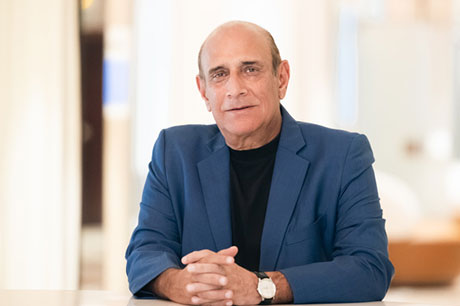
APTRA President and Group Chief Executive of King Power Group Sunil Tuli.
The Asia Pacific Travel Retail Association (APTRA) has welcomed the Indian government’s decision to raise airport arrivals duty free value allowances, describing the move as a positive step for one of the world’s fastest-growing travel retail markets.
Announced as part of India’s Union Budget and introduced under the revised Baggage Rules 2026, the changes come into effect on 2 February 2026. The allowance for international passengers who are residents or tourists of Indian origin has been increased by 50%, from INR 50,000 to INR 75,000 (approximately US$820). For foreign tourists, the arrivals allowance rises by 66.6%, from INR 15,000 to INR 25,000 (approximately US$270).
APTRA President and Group Chief Executive of King Power Group Sunil Tuli said the announcement reflects years of industry engagement with policymakers.
“For several years, the duty free operators in India have made the case to the federal government to review allowances and APTRA has actively supported them in these efforts,” he said.
While welcoming the increase, APTRA noted that further progress could still be made. “Although we welcome today’s announcement as an encouraging step in the right direction, the industry believes there is further scope to increase allowances to a more realistic level comparable to other markets, simply by reflecting levels of currency devaluation and inflation increases since the last review in April 2016,” Tuli added.
According to APTRA, higher allowances would help unlock the full potential of India as a travel retail market, while also supporting wider aviation and infrastructure ambitions. The association points to the government’s plans to grow the number of airports in India from 147 today to more than 400 by 2047, alongside a target of handling one billion passengers annually by the same date. Over the next decade, India’s airline fleet is also expected to almost triple to around 2,000 aircraft, positioning the country as the world’s third-largest aviation market.
The topic is expected to feature prominently at the APTRA India Conference 2026, which will take place at Bangalore International Airport from 25–27 March 2026.
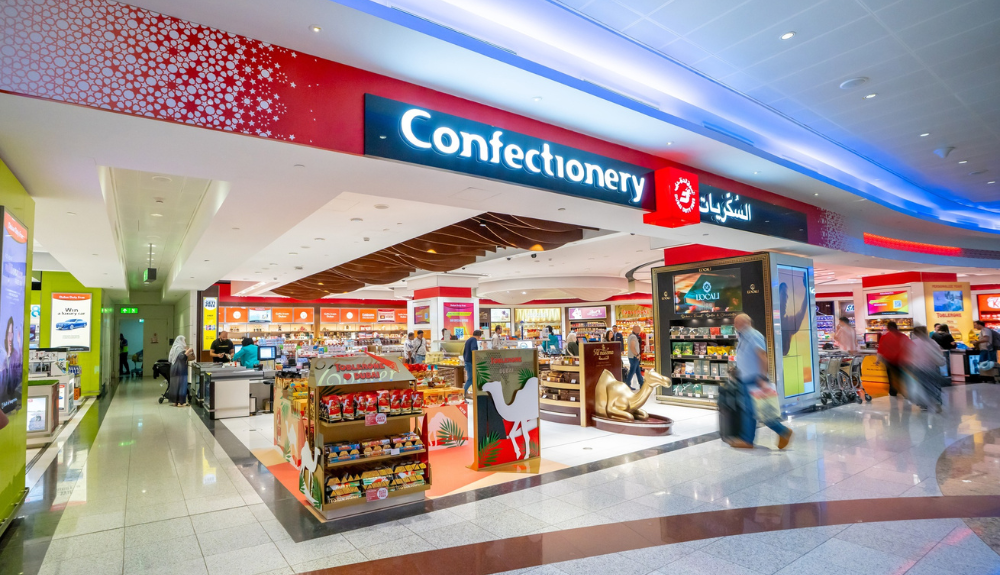
Dubai Duty Free has kicked off 2026 with its strongest January performance on record, reporting sales of AED858.21 million (US$235 million), an 18.53% increase year-on-year and a clear signal that momentum from last year is carrying forward.
The result makes January 2026 Dubai Duty Free’s third-highest sales month ever, behind only December and November 2025. The strongest trading day fell on 31 January, when sales reached AED35.6 million (US$9.76 million).
Importantly, sales growth once again outpaced passenger traffic at Dubai International Airport. While final passenger figures for the month are still to be released, Dubai Duty Free estimates that sales outperformed passenger growth by around 13.5%, pointing to higher spend per passenger across the operation.
“We are extremely pleased to begin 2026 with our strongest January performance ever, following a record-breaking 2025,” said Ramesh Cidambi, Managing Director, Dubai Duty Free. “What is particularly encouraging is that sales growth has significantly outperformed passenger growth, demonstrating higher spend per passenger, strong demand across key categories and growth in all major geographical regions.
“I want to thank our Dubai Duty Free team for their hard work and commitment and for maintaining the strong momentum from last year in the month of January.”
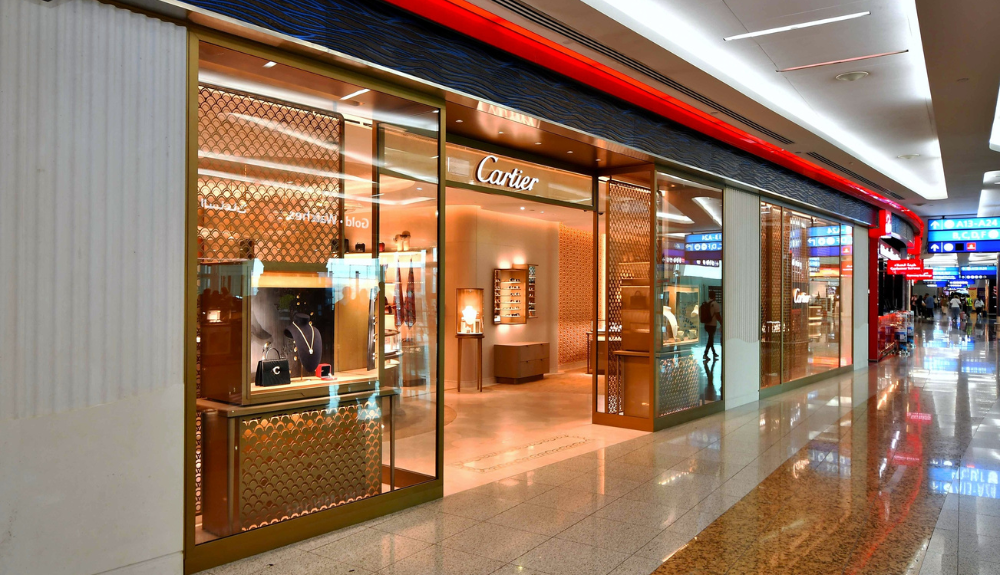
Several core categories delivered standout growth during the month. Gold led the way with sales up 45.74% to AED104 million (US$28.55 million), while Fashion increased by 36.68% to nearly AED82 million (US$22.53 million). Electronics rose by 36.61% to AED65 million (US$17.74 million), and Precious Jewellery recorded the highest percentage growth, surging 69.51% to AED28 million (US$7.63 million).
Perfumes continued to perform strongly, growing 13.61% to AED147 million (US$40.29 million), while Confectionery climbed 15.35% to AED80.69 million (US$22.11 million). Watches were up 30.94% to AED33 million (US$9.10 million), Cosmetics increased 7.67% to AED40 million (US$10.97 million), and Delicatessen grew 8.36% to AED27.77 million (US$7.61 million).
Image Credit: Dubai Duty Free
Sales of Dubai Chocolate reached AED36 million (US$10 million).
Dubai Chocolate remained a standout sub-category, with sales reaching AED36 million (US$10 million) and volumes rising to 83 tonnes, compared with AED24 million (US$6.59 million) and 42 tonnes in January 2025.
Fashion boutiques delivered particularly strong results, with sales in Concourses A and B up 56%. Average daily sales reached a record AED3.4 million (US$931,500), while the average transaction value hit a new high of AED8,820 (US$2,416).
From a regional perspective, Europe and Russia led growth with increases of 35% and 36% respectively. Africa followed with growth of 29%, the Americas rose 22.5%, the Indian subcontinent increased 11%, the Far East grew 10.5% and the Middle East recorded a 5.3% uplift.
With a record-breaking January, strong category performances and rising passenger spend, Dubai Duty Free has set a confident tone for the year ahead and is well positioned to sustain growth through 2026.
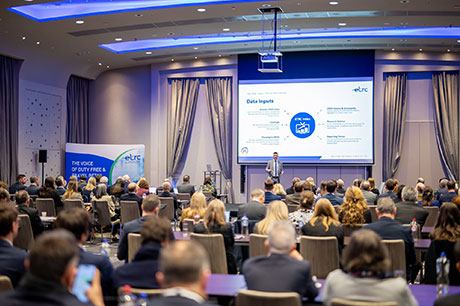
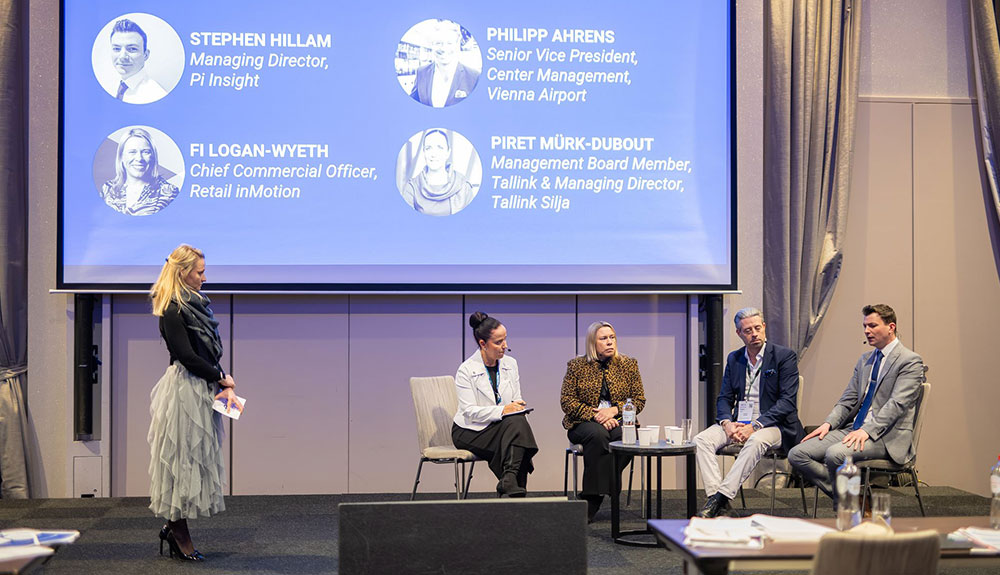
Stephen Hillam, MD, Pi Insight, presents the ETRC Business Performance Index for Q3 2025 at the 2026 ETRC Business Forum in Amsterdam.
Duty-free industry in Europe is experiencing a ‘new dawn’, with the highest level of year to date (YTD) value sales ever seen in the region, according to the ETRC Business Performance Index for Q3 2025.
The European airport duty-free sector has continued to progress on a positive trajectory during the first three quarters of 2025, with total value sales of €7.63 billion, the equivalent to growth of 5.8% YTD 2024, according to the study, which was presented by Stephen Hillam, Managing Director, Pi Insight, at the ETRC Business Forum in Amsterdam last week (22 January).
Furthermore, unit sales were up +4.9% while passenger (pax) numbers rose by +5.4% over the period.
Unit sales showed progression of 4.9% on YTD 2024 and pax showed growth of 5.4%. Additionally, average spend per passenger performed slightly above 2024 levels (+0.4% YoY).
Plus, there was positive growth across all major categories, with the exception of a marginal decline in spirits.
Hillam noted, however, that while rising passenger numbers and an evolving category mix are having a positive impact, external pressures remain, from the cost of living to the shifting preferences of younger generations.
Referencing the headline €7.63 billion value sales figure identified by the latest Index, Hillam said: “From this very initial and headline sales performance perspective, it’s a very positive start. We have an industry that has reached that point of full recovery from the pandemic back in 2024 and is now progressed through 2025 showing the strong levels of growth continuing to be the case.
“However, what’s really positive about this is the growth we’ve been seeing through 2025 – that 5.8% – is now back in line with where we’d expect it to be within the context of a stable European marketplace.”
In turn, this provides a good level of confidence in the short- to medium-term on where the industry is headed.
“In terms of the full year 2025, when we look at this level of performance we currently have, and also look at Q4, which generally contributes around 25% of total annual sales, our industry is currently very much on track to reach total annual sales for 2025 of €10.15 billion – effectively the highest level of value sales we’ve ever seen in Europe, but also the first time that our industry has approached that €10bn mark here in Europe.”
Hillam warned an air of caution however, due to background dynamics that continue to fluctuate and so could have an impact on performance moving forward. For instance, the realignment of passenger levels and value sales following the post-Covid adjustment period.
The ETRC Business Performance Index for Q3 2025 shows YTD pax traffic as 735.4 million – up 5.4% vs. YTD 2024 – and €7.63bn in value sales – up 5.8% vs. YTD 2024.
This growth in pax traffic within the region is being driven by East European locations. In contrast, North and Western locations, even though they continue to be in growth, are lagging behind.
“On the face of it, this doesn’t look like such a factor, but one thing we do need to remember is that one of the major precursors to shopper behaviour is that of nationally and if we are therefore seeing certain locations increasing at a more robust rate than other locations, we could consequently therefore be also seeing certain nationalities become more prominent within that mix at an overall European level.
“In turn, this can impact factors such as that traveller mix’s propensity to shop and spend, as well as factor such as interest in certain categories. All of this, in turn, can then impact that all-important spend per pax (SPP).”
Hillam went on to detail the relationship between value sales and unit sales, with a “significant level of realignment returning” through 2025.
“We could potentially take from this that our industry is out of the other side of that significant level of inflation and price rises that we were previously seeing. However, this does also act as somewhat of a ‘watch-out’ here, as whilst our industry is certainly resilient, it’s not immune to some of those external pressures. And if inflation were to increase again, which no doubt it will do at some point, it will no doubt also have an impact on that value sales and unit sales relationship – and we will probably see some of that alignment being undone to some extent.”
During the presentation, Hillam also gave delegates an update on how category performances have tracked over time, from Q1 2027 to Q3 2025. Notably, as we’ve moved though 2024 and 2025, it has become more evident that average category selling prices are increasingly growing further apart, as opposed to the trend lines being close together.
Ultimately, the Index shows that each individual category has showed positive year-on-year growth versus YTD 2024, although the spirits sub-category experienced a slight decline in both volume and value sales, with value falling by -0.4%.
As a welcome addition to the session, Pi Insight also presented the new Nordic & Baltic Ferry Index, which details full-year performance from 2019 to 2024, with value sales for the sector in 2024 at €686.4 million – representing -5.2% vs. 2023 (alongside pax being -3%) and -24.7% vs. 2019 (alongside pax being -22%).
The full year 2025 edition of the Nordic & Baltic Ferry Index is set to be published in the coming months (available to ETCR members) and there is the intention to bring unit sales or volume sales into the report in the future.
Image Credit: ETRC
Channel experts brought their perspective on performance insights to the data-led session.
A subsequent discussion took a deep-dive into four key travel retail sales channels and their characteristics and opportunities for growth, with a panel of industry experts comprising Philipp Ahrens, Senior Vice President, Center Management, Vienna Airport (VIE); Fi Logan-Wyeth, Chief Commercial Officer, Retail inMotion; and Piret Mürk- Dubout, Management Board Member, Tallink, and Managing Director, Tallink Silja.
In a summary discussion that circled back to the findings of the ETRC Business Performance Index for Q3 2025, the speakers aired their thoughts on the elements that most hit home for their respective businesses and sales channels.
“The dynamics of our economies, and also what happens in politics around the world, has been a hindrance – at least that’s what we saw in the sales numbers last year at our airport,” commented Ahrens. “Yet surprisingly, as of October [2025], there seems to be a switch and the cycle of sales went up.”
Indeed, as he revealed “sales numbers are higher than passenger growth” at VIE.
“There seems to be a certain dynamic of our travelling guests that they are reluctant to spend money when there are crises in the world,” he added. “But it also seems to be the time for rewarding again and having some fun again, and this is our chance, and it will be really interesting to see how this new year will develop.”
Logan-Wyeth brought the onboard retailing view, adding: “Certainly, for us, the opportunity is participation from a boutique perspective. From an F&B perspective, we are seeing spend per pax increase and we’re seeing engagement and participation doing really well too – particularly with the LCCs.
“So, I think for us it’s about how do we use data and some of those consumer trends and real customer understanding to drive boutique from an onboard perspective and really try to start to re-engage our customers. And equally [it’s about] the way we communicate to them. How we choose the right products, communicate in the right way, try and address customer need-states in the right way and shape-shift some of that more traditional retailing that we had onboard into something more innovative and customer-led. That’s how we will start to see spend per pax increasing and bring back some of that relevance onboard.”
Finally, for Mürk-Dubout, tailoring the offering to the specifics of the channel is key: “What we are increasingly looking at it is the assortment and also the presence, so besides the physical presence there needs to be much more digital presence.
“I think the key word is partnership, that we understand how to promote this brand, this product, seasonality, how to cooperate – and how to make the play in the best way together.”
The opening marks a new phase in the company’s development in Senegal.
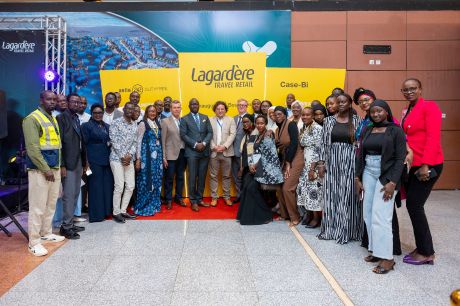
Lagardère Travel Retail has officially inaugurated its reinvented Aelia Duty Free and CASE BI stores at Blaise Diagne International Airport in Dakar.
The opening marks a new phase in the company’s long-term development in Senegal, and builds on a successful first phase of operations at Blaise Diagne International Airport, where Lagardère Travel Retail opened its first stores in 2017.
Fully redesigned, the two stores are said to reflect Lagardère Travel Retail’s international standards of operational excellence, premium brand curation and customer-centric design.
The refreshed commercial space features a more fluid layout, immersive digital tools, upgraded services, and an expanded selection of leading international brands across duty free and travel essentials.
Lagardère centres a strong sense of place
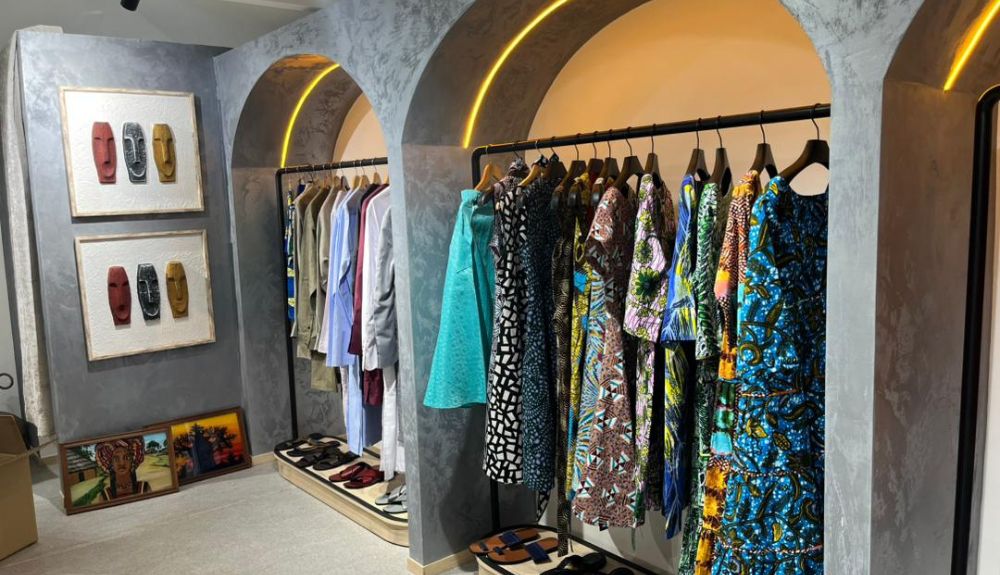
With a strong sense of place at the heart of the shopping experience in Dakar, Lagardère Travel Retail aims to make its stores at Blaise Diagne International a showcase for Senegal, offering travellers an authentic and meaningful connection to the destination.
Accordingly, the retail spaces feature a curated selection of Senegalese and African brands, including Notabané, Land of Africa, Réserve d’Afrique, Scent of Africa and Teasse, highlighting regional craftsmanship, creativity and savoir-faire.
Alongside this local focus, the stores also showcase a refined selection of prestigious international brands, including Parfums de Marly, a niche haute perfumery house, and leading British fragrance brand Jo Malone, further elevating the premium positioning of the airport’s retail experience.
Image Credit: Lagardère Travel Retail
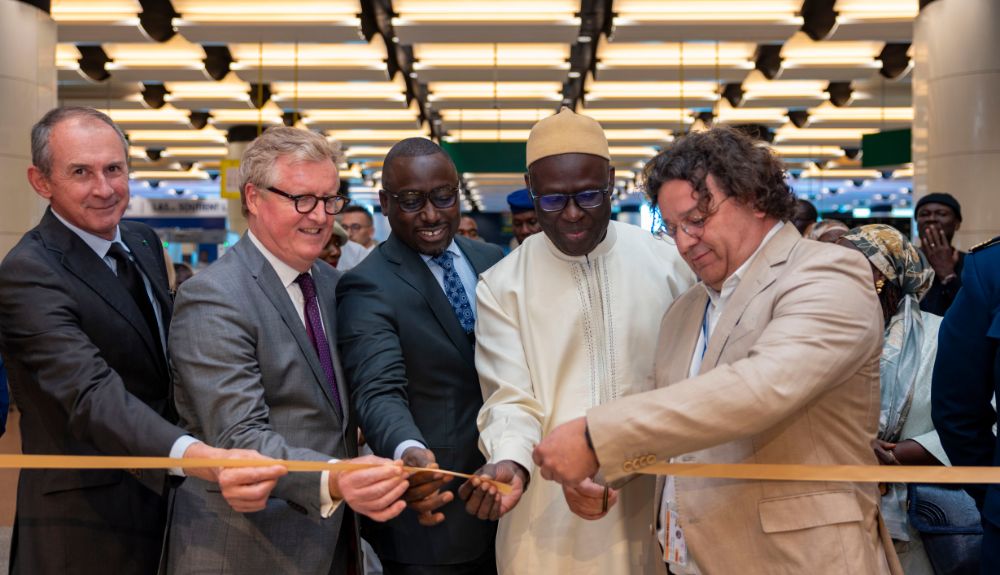
Left to right: Jean Martin Jampy, Managing Director, Teranga; Vincent Romet, CEO France & Luxembourg, COO Middle East, South East Asia & Africa; Sountou Bousso CEO Lagardère Travel Retail West, Central & East Africa; Cheikh Bamba Dièye, CEO of Blaise Diagne International Airport; Askin Demir, CEO of LAS.
New-generation digital screens, electronic shelf labels providing clearer and more dynamic product information, and an innovative children’s retail concept – deployed for only the second time within the Lagardère Travel Retail global network – are designed to make the shopping journey more engaging for families.
Lagardère Travel Retail West, Central & East Africa CEO Sountou Bousso commented: “The reopening of Aelia Duty Free and CASE BI at Blaise Diagne International Airport reflects our long-term commitment to Senegal.
“After a successful first phase of operations spanning almost a decade, we continue to invest and reinvent our concepts to meet the evolving expectations of travellers and our business partners.
The retail spaces feature a curated selection of Senegalese and African brands, while incorporating international standards of operational excellence.
“By combining international excellence with a strong local identity, our ambition is to deliver ever more meaningful travel experiences and to continue setting the benchmark for travel retail in the region, while positioning our stores as true showcases of the countries in which we operate.”
Blaise Diagne International Airport CEO Cheikh Bamba Dieye noted: “It is a great honour for us to celebrate the reopening of Lagardère Duty Free stores at Blaise Diagne International Airport. This opening reflects the strength, reliability, and durability of our partnership with Lagardère Travel Retail, built on professional rigor and respect for Senegalese culture.
“Together, we share a common ambition: to offer passengers a modern, high-quality retail experience that highlights the identity of Senegal, contributes to the airport’s attractiveness, creates jobs, and strengthens the country’s position as a leading aviation hub in West Africa.”
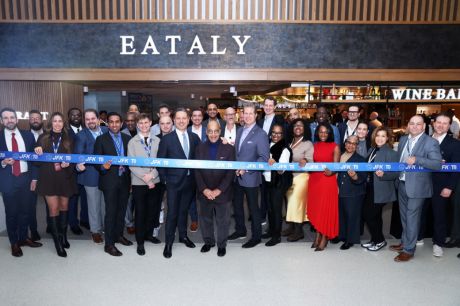
Avolta subsidiary HMSHost has opened the first of three Eataly locations planned for John F. Kennedy International Airport (JFK).
The opening, in Terminal 8, is part of a new partnership agreement to bring the Italian marketplace and retail concept to airports across North America.
The approximately 640sq m space brings together a full-service restaurant, wine bar and retail offer in a single integrated format. It is the first Eataly in an airport in the region, and will soon be followed by locations in JFK Terminals 4 and 5.
“The opening of Eataly marks several significant milestones and the beginning of an exciting partnership between HMSHost and Eataly in North America,” commented Avolta North America President and CEO Steve Johnson.
“Eataly is a globally recognised and beloved brand with deep roots in New York, and we’re proud to bring its world-class Italian cuisine to travellers looking for a superior dining experience. This collaboration underscores our commitment to reimagining the airport journey, making it as memorable and rewarding as the destination itself.”
“Eataly’s mission is to champion Italian food and wine culture across the globe, transporting our guests to Italy through each of our touchpoints, whether they dine in one of our flagship stores or in new outlets such as the airports,” added Eataly Group CEO Andrea Cipolloni.
“Our partnership marks a monumental step for our brand in North America as we expand into major transportation hubs, allowing us to connect with our audience during their travel journey.”
The announced openings are said to represent only a portion of Paradies Lagardère’s planned 2026 dining lineup, with additional locations to be announced throughout the year.
Paradies Lagardère has outlined a strong pipeline of new dining openings across major US airports, with a series of high-profile restaurant brands set to debut from spring 2026.
The planned openings form part of the concessionaire’s wider strategy to deliver sense-of-place dining that blends local flavour, chef-driven concepts and well-known national brands, while responding to evolving passenger expectations around quality, variety and authenticity.
According to Paradies Lagardère, the 2026 line-up will span multiple regions and airport sizes, reinforcing the group’s focus on tailoring food and beverage offers to the character of each location rather than taking a one-size-fits-all approach.
“This line-up showcases some of the most exciting culinary partners in the country,” said Leigh Allan, Senior Vice President of Operations – Dining Division. “Travellers are eager for thoughtful food and beverage options, and these forthcoming openings reflect our commitment to bring elevated choices and authentic hospitality to every airport we serve.”
Among the first openings confirmed for spring 2026 are Berkshire Farm to Flight and CAVA at Boston Logan International Airport, adding to the airport’s growing mix of health-forward and guest-favourite concepts.
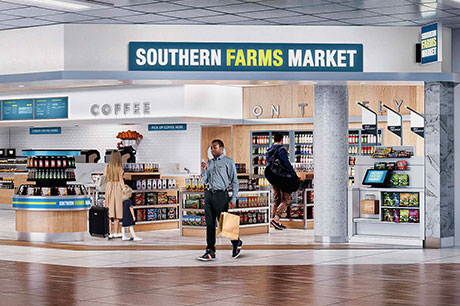
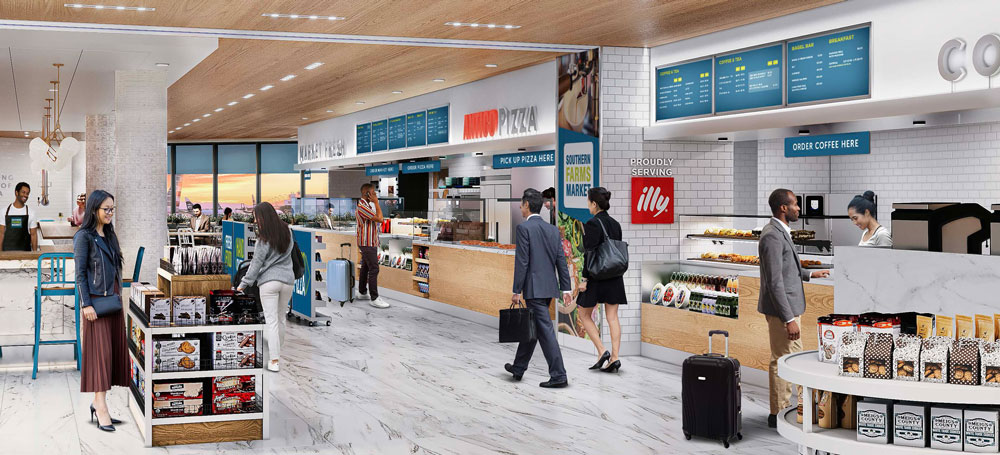
In Atlanta, activity will ramp up ahead of the 2026 FIFA World Cup, with Hartsfield-Jackson Atlanta International Airport set to welcome a cluster of locally inspired and nationally recognised brands. Planned concepts include Southern Farms Market with Antico Pizza Napoletana, Local Green and Starbucks, reinforcing Atlanta’s position as a major international gateway with a strong culinary identity. Additional Atlanta openings are expected later in the year.
Image Credit: Paradies Lagardère
Ahead of the 2026 FIFA World Cup, Hartsfield-Jackson Atlanta International Airport will welcome a collection of locally inspired and nationally recognised names, including Southern Farms Market.
Further launches are scheduled for autumn 2026, including Pistache French Bistro and Coastal Cask by Bulleit Frontier Whiskey at Palm Beach International Airport, both designed to reflect the region’s coastal lifestyle and dining culture. Vino Volo is also slated to open at Long Beach Airport during the same period.
Paradies Lagardère said the announced openings represent only part of its 2026 dining pipeline, with further concepts and locations to be revealed throughout the year as the company continues to expand and refine its airport food and beverage portfolio.
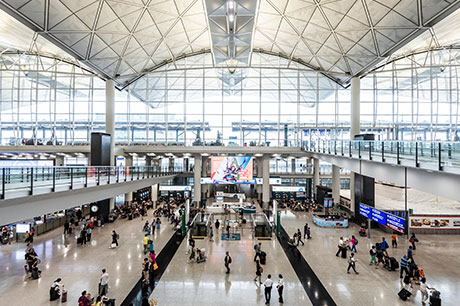
Hong Kong International Airport (HKIA) has issued an invitation to tender for a Premium Athleisure Concession (RAD/ 26-003).
Located on Level 6 of the Departures East Hall in Terminal 1, the approximate shop area spans 2,616 sq. ft.
The closing date for submissions is 12 March 2026, 4:00 pm (Hong Kong Time).
The move will build on the HKIA’s already strong fashion offering, with brands currently listed as active at the hub including Adidas, Balenciaga, Bottega Veneta, Brunello Cucinelli, Burberry, Decathlon, Dior, Gucci, Hermès, Homeless, Loewe, Longchamp, Lululemon, plus many more.
For the details, interested parties can view tender documents via HKIA’s ePROS Website (http://epros.hkairport.com).
Potential tenderers must hold a valid Registered Account as “Retailer/ F&B Operator” and pay a fee of HK$5,000 (non-refundable) to access the documents.
Wine remains a key category across ARI North America’s Canadian operations.
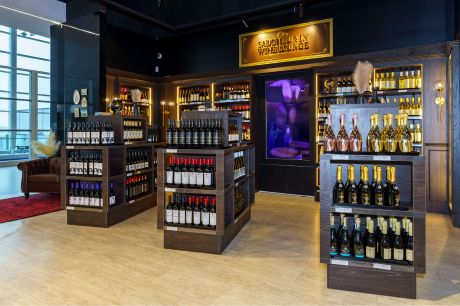
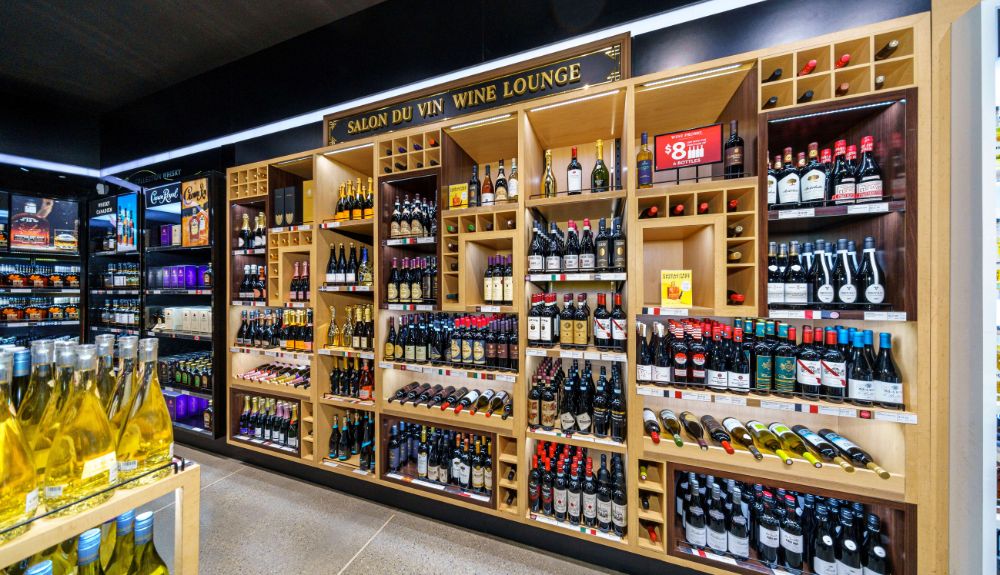
ARI North America has introduced a new Salon du Vin category concept at Montréal Duty Free and Quebec City Duty Free, reinforcing its commitment to creating a strong Sense of Place.
The newly developed wine lounge concept was inspired by the speakeasy bars, lounges and wine bars found throughout Montréal and Quebec City. It has been designed to offer passengers an authentic experience as they shop a curated range of leading wines from across the world.
Salon du Vin is intended to drive growth within wine, which remains a key category across the retailer’s Canadian operations. It has also been designed to meet passengers’ growing demand for distinctive and memorable retail experiences.
The concept features a premium design aesthetic, incorporating dark woods, leather, velvet and brass materials. Black and gold accents, alongside a 1920s-style font, add an art-deco influence to the overall look and feel.
Passengers can explore an assortment of wines, ranging from local Canadian producers to leading vineyards from France, Italy, Spain, Portugal, South America, Australia and South Africa. Each range is curated to suit the key passenger demographics at each airport.
Image Credit: ARI
The newly developed wine lounge design was inspired by the speakeasy bars, lounges and wine bars found throughout Montréal and Quebec City.
ARI North America Head of Marketing Katherine Sullivan commented: “Wine is one of the strongest categories in our Canadian stores, in particular with outbound Canadian passengers who purchase their favourite wines before escaping to key winter sun destinations.
“The new Salon du Vin concept elevates their shopping experience to something that feels more premium, tailored and unique. Throughout the winter season, special tactical promotions will also help to drive sales, for example with multibuy discounts and exclusive gift with purchase value-adds, and we look forward to seeing continued growth for the category.”
The new pier can accommodate up to six million additional passengers annually.
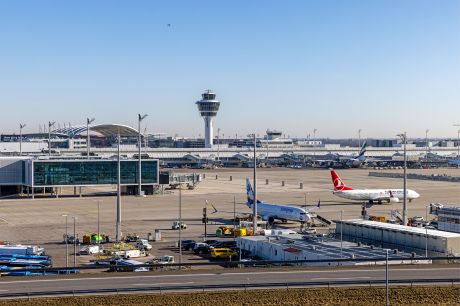
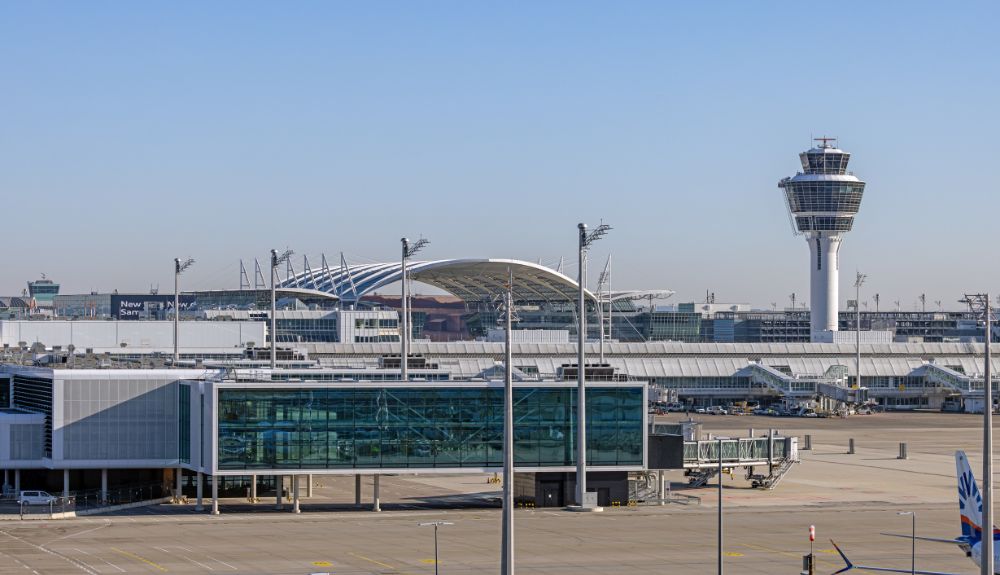
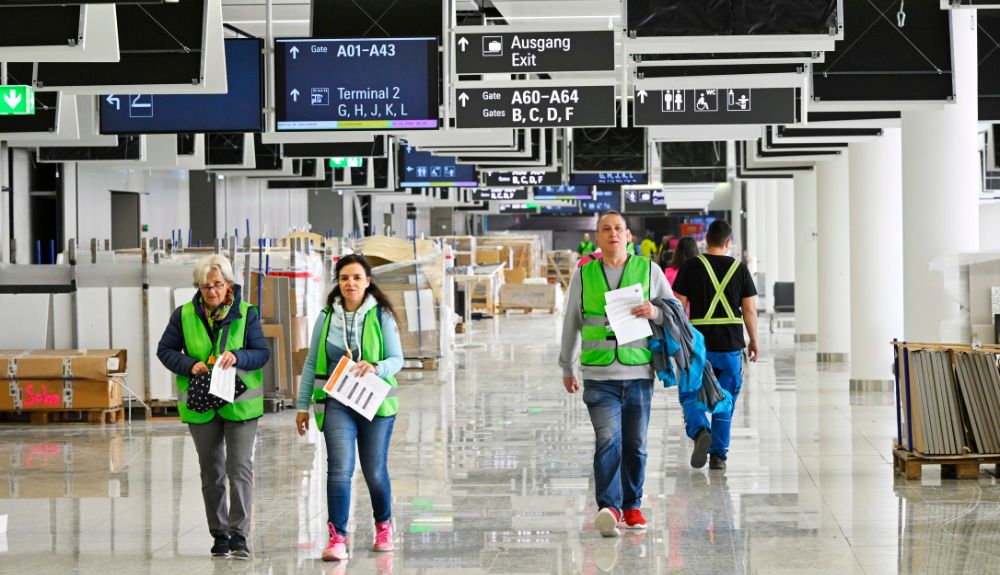
Munich Airport will open its new Terminal 1 Pier on 13 April, marking another significant step in the strategic expansion of its infrastructure, including spaces for retail and F&B.
“With our new Terminal 1 Pier, we are making a targeted investment in the future viability of our airport,” noted Munich Airport CEO Jost Lammers. “The pier not only strengthens our capacities, but also sets new standards in quality, efficiency and passenger comfort – especially for non-Schengen traffic. The pier is a central element of our long-term infrastructure strategy.”
Bavarian Minister of Finance and Chairman of the Supervisory Board of Munich Airport Albert Füracker added: “The new Terminal 1 Pier at Munich Airport stands for a premium expansion of our five-star airport and for Bavaria as an attractive, future-oriented business region.
Munich Airport pier aims to set new standards
“Financed entirely from our own resources, the upcoming opening crowns the completion of a huge location project. With state-of-the-art technology and generous spaces, the new pier offers mobility, comfort, and sustainability at the highest level.”
Designed to accommodate up to six million additional passengers annually, the new pier is among Bavaria’s largest infrastructure projects. Stretching around 360m into the west apron, and covering a total area of around 95,000sq m, it integrates parts of the existing Arrivals Module B of Terminal 1.
Image Credit: Munich Airport/Michael Fritz
Organised across six levels, the new pier includes commercial spaces for retail and dining, waiting areas, and dedicated relaxation and recreation zones.
Munich Airport is financing the €665m (US$791m) investment entirely from its own funds, underlining its long-term commitment to growth and commercial development.
The pier can handle up to twelve short- and medium-haul aircraft, or six wide-body aircraft, and is organised across six levels, three of which are dedicated to passenger processes.
Image Credit: Munich Airport
An extensive trial operation phase has been running since last October, along with the final construction work and preparation for full operation.
These include centralised security screening with advanced CT technology, waiting areas, commercial spaces for retail and dining, and specially designed relaxation and recreation zones. Energy-efficient building and systems technology further reinforces the airport’s sustainability credentials.
The pier will also feature two exclusive lounges: the new Airport Lounge World, a 1,200sq m two-storey space operated by Munich Airport. The second lounge is operated by Emirates.
From 21 April, passengers from around 40 airlines serving non-Schengen destinations from Terminal 1 will travel via the pier. Since October, an extensive trial operation phase has been running, along with the final construction work and preparation for full operation.
CTG Duty Free’s Sanya International Duty Free Shopping Complex in Hainan will benefit from the seal-off.
Duty-free sales have surged in Hainan since an island-wide ‘seal-off’ was introduced on 18 December. According to data released by the General Administration of Customs and reported by state media, between 1 December 2025 and 10 January 2026, revenue hit RMB38.9 billion/$5.6 billion, with sales volumes rising by 49.6% year-on year.
Customs reported that transactions of “regulated off-island duty-free purchases” rose 32.4% to 585,000, suggesting that spend per head had risen over the five weeks. On average, the island saw about 24,000 duty-free shoppers collectively spending RMB160 million/$23 million per day. The customs administration said this is higher than before the island-wide special customs rule was in place.
Seal-off plans had been in the making for several years as a way to establish a free trade port system to boost trade and investment. The move has created a fully independent customs territory – similar in concept to Hong Kong or Macau – separated from the rest of mainland China for customs purposes. It is a prominent symbol of China elevating its international trade status.
New policy lowers the cost base
While the term ‘seal‑off’ sounds restrictive, the commercial implications for duty‑free are overwhelmingly positive. The policy changes the operating model due to zero tariffs on most imported goods, no import VAT, and no consumption tax on most, but not all, goods. This dramatically lowers the cost base for retailers and brands, leading to more competitive pricing and higher volumes.
Image Credit: CTD
Subramania Bhatt: “Expect continued strength, but likely a peak then normalisation.”
At Singapore-base China Trading Desk (CTD), a digital marketing and advertising agency specialising in the PRC consumer, CEO Subramania Bhatt told TRBusiness: “The 18 December seal-off is best read as a structural upgrade to Hainan’s duty-free environment: it formalises the island as a customs supervision special zone, and it explicitly expands the zero-tariff goods regime while keeping controls at the mainland boundary. This includes the 30% value-added pathway for qualifying goods moving to the mainland.”
Bhatt added: “This aligns with the immediate post-implementation sales surge, supporting higher conversion and bigger baskets – with the caveat that the surge period also overlaps with holiday travel and strong promotional activity.”
In that sense, the revenue hike is due to a combination of the policy change plus retail activation, not the seal-off alone.
Hainan duty-free sales in Q1 and Q2
Nevertheless, the five-week stats look promising, at least for current quarter sales. For Q1 2026, Bhatt said: “Expect continued strength, but likely a peak then normalisation. Launch momentum and holiday travel support demand, and the holiday calendar matters: Lunar New Year falls in mid-February, which typically concentrates travel into a defined peak period. We’ve already seen how concentrated holiday weeks can be: Haikou Customs cited offshore duty-free sales of RMB712 million/$102 million from 1-3 January up 128.9% YoY.”
In the second quarter, the effects of the seal-off should be clearer as a new baseline will begin to emerge. Q2 2026. “I’d expect a moderation after the holiday peak, then event-driven (sales) lifts later in the quarter. The bigger story is whether the new customs regime translates into sustained advantages – particularly assortment breadth and replenishment efficiency – rather than just short-term promo-driven spikes. Expanded zero-tariff scope and more efficient facilitation support the possibility of a higher run-rate, but Q2 is where you’ll see if it really holds up once promotional intensity and holiday travel normalise.”
From CTD’s latest outbound sentiment signals, travellers are research-heavy and price-verifying, with high levels of pre-trip research, and near-universal price comparison against online. Social platforms are also materially raising shopping propensity, with in-person service still vital in closing a sale. That combination, says Bhatt, “favours destinations and operators that can deliver proof + convenience + confidence” – exactly the model Hainan is trying to implement with the seal-off.
This website uses cookies and contains content relating to the tobacco and alcohol industry. Click here to view our cookie policy. By continuing to browse this site you are agreeing to our use of cookies, are aged over 18 and permitted to see tobacco and alcohol content intended for a business to business audience.

 Trbusiness. The travel retail Trbusiness. The magazine for global retail and duty free professionals.