Archives

Coty’s sharper focus on six brands is working as Gucci exit nears

Image Credit: Coty
Coty brands

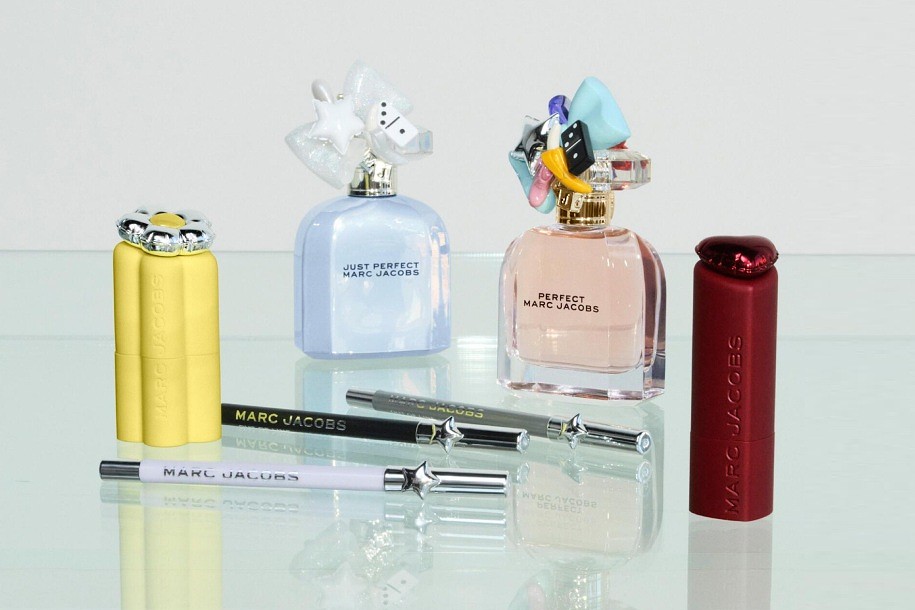
Marc Jacobs makeup has seen a strong start since its debut.

Global beauty house Coty is consolidating marketing investment efforts behind its ‘big six’ brands – Burberry, Hugo Boss, Marc Jacobs, Calvin Klein, Kylie Cosmetics, Chloé – as it continues a strategic review in the wake of the loss of the Gucci licence, which transfers to L’Oréal from July 2027. Five of the six grew in Coty’s fiscal Q1 2027, ending 30 September.

As part of the Coty.Curated framework, which has a strong focus on the Prestige division, the company’s new Chief Financial Officer, Soraya Benchikh, said in an analyst call earlier this month: “Our focus is on returning the business to sustainable quality growth through more disciplined, concentrated investment. In Prestige, we are beginning to see some early evidence of the potential of that approach.”

Image Credit: Coty
Coty brands

Strobel: “In Prestige, our launches in the first half of fiscal 2027 are tracking ahead of target to date.”

Markus Strobel, Coty’s Executive Chairman and Interim CEO, added: “In Prestige, our launches in the first half of fiscal 2027 are tracking ahead of target to date. And in Consumer Beauty, we are moving toward fewer, more accretive and focused innovations, to improve overall profitability. We are also evolving the way consumers discover our brands.” For example, Coty has teamed up with Brandlight to strengthen visibility in AI-driven consumer searches.

Some of the key launches in H1 included Boss Bottled Beyond for Her fragrance, Marc Jacobs Beauty makeup, Burberry Goddess Amber Vanilla, and the Mood Stones by Kylie Jenner fragrance collection.

Over the past year, Coty has increasingly concentrated its advertising and consumer promotion (A&CP) investment behind its six core brands. They represent 73% of Prestige sales, Coty’s most important division in travel retail.

Prestige brands return to growth

The proportion of total A&CP investment behind the top six rose from 64% in the first half of fiscal 2026, to 68% in the second half, and to 76% in Q1 2027. “We are beginning to see evidence of stronger performance alongside our increased focus,” states Benchikh, citing a material shift in revenue for the six brands. From a -6% like-for-like (LFL) decline in H1 2026, they were down -1% in H2, and then moved up a gear to +5% growth in Q1 2027, with another rise expected in Q2.
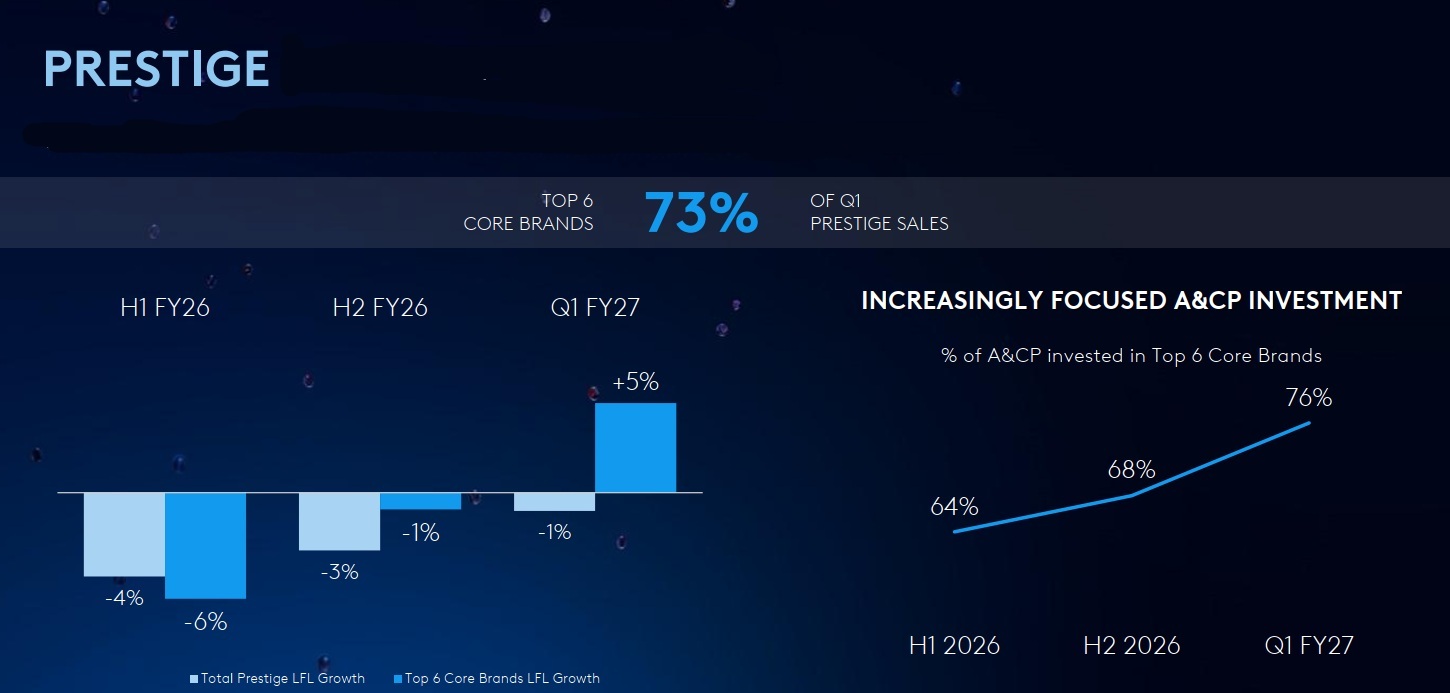
Image Credit: Coty
Coty brands prestige

How the Coty Prestige division has progressed.

The CFO stresses that the Q1 upturn was “broad-based” rather than dependent on a single brand or a single initiative, such as the roll-out of Marc Jacobs Beauty. The makeup collection had its travel retail debut with Avolta at New York’s John F. Kennedy (JFK) Airport T8, and Palma de Mallorca Airport (PMI) in Spain this summer.

Image Credit: Coty
Coty brands

Benchikh: “Our focus is on returning the business to sustainable quality growth through more disciplined, concentrated investment. In Prestige, we are beginning to see some early evidence of the potential of that approach.”

“As we concentrate, we will shift to fewer and bigger launches,” explains Benchikh. “And that will help us in terms of planning and having less obsolescent stock as we work the inventory down. These benefits will build over time.” She accepts, however, that quarterly progression “will not necessarily be linear” but that the new approach will hold.

The Gucci question

While Gucci is to exit the Coty portfolio next summer, the company still sees it as valuable, but outside of the selected six. Benchikh says: “Gucci is not included among our core brands, but we are continuing to invest behind it in line with our contractual commitments.”

On Gucci’s exit from the portfolio, Strobel comments: “We are addressing this at the moment as part of our overall savings package that we’re also going to come out with before Christmas. Gucci has a low double-digit percentage of our portfolio, and profitability in line with our Prestige portfolio.” The Interim CEO describes the brand’s departure as “a sizeable impact” but said Coty is developing plans to address it. “We’re finalising them and will be back to you with those by January,” he says.

For the full financial data on Coty’s Q1 27 performance, see the earnings release here.

READ MORE: Coty launches Marc Jacobs Beauty at Sydney Airport

READ MORE: Marc Jacobs Just Perfect rolls out globally in travel retail

MEADFA Conference in Rabat: 400 delegates registered, 500 targeted

Image Credit: Kevin Rozario
MEADFA delegates Rabat

Three of MEADFA’s board addressed the media at the TFWA show in Cannes: (from left) Munif Mohammed, CEO of Lagardère Travel Retail Middle East; the association’s President Abdeslam Agzoul, also the CEO of Avolta’s Middle East & Africa business; and Nuno Amaral, CEO of Aer Rianta International Middle East.

[UPDATED] Registrations for the Middle East & Africa Duty Free Association (MEADFA) annual conference had reached around 400 delegates at the time of writing, a sharp rise over the 300 announced at the end of September. This compares favourably with last year’s take-up at the same point in time. The association is aiming for about 500 participants.

This year’s event takes place for the first time in Morocco from 15–17 November in the city of Rabat whereas the 2025 conference, reviewed here, was in the much more easily accessible hub location of Dubai in the United Arab Emirates (UAE).

Micheline El Ammar Enkiri, MEADFA’s Operations Manager told TRBusiness: “Last year we had record attendance of 736 delegates, partly helped by so many travel retail companies being based in Dubai. This year we are aiming for about 500.”

This would be considered a success given that Rabat is not a hub and, as MEADFA President Abdeslam Agzoul also pointed out – this year’s ongoing conflict has meant many companies have understandably cut their travel and marketing budgets.

At the TFWA show in Cannes, he said: “The already fragile situation in the Middle East had become more serious by the end of February. We hope that the worst of the crisis is behind us.” Unfortunately since that press event there has been an escalation.

A conference that reflects current conditions

The crisis is very much in a fluid state after the deadly Riyadh Airport attack in Saudi Arabia and more recently on Saudi Aramco’s HQ. While this may deter attendees, some travel retailers will also consider it essential to visit Rabat – which is far from any current danger zone – in order to get the latest updates on how the industry is managing in the changing circumstances. The event has seen high sponsor engagement despite the situation which is encouraging.

Agzoul was clear: “The crisis has declined in intensity without coming to an end and continues to disrupt traffic flows, infrastructure, and supply chains. The impact in the Gulf region is still there and is felt by all stakeholders.” In this context, the recently released Rabat conference agenda reflects this state of affairs with particular attention paid to driving growth under the strain of reduced traffic, and the African opportunity which is becoming evermore apparent, as Dubai Duty Free’s managing Director, Ramesh Cidambi has confirmed.

The underlying strength of the region will also be stressed. According to Generation Research figures, despite continuing instability, duty-free sales in the Middle East grew by almost +10% in 2025 versus 2024, while Africa’s shot up by more than +16% and topped $1 billion for the first time.

[An in-depth interview with MEADFA President Abdeslam Agzoul will appear in the November print issue of TRBusiness magazine where he talks candidly about conditions in the region, and what retailers are doing to withstand some of the supply pressures.]

READ MORE: Early bird registration opens for 2026 MEADFA Conference

READ MORE: DXB: Solid gains in 2025, but a shockwave in 2026

Ushopal takes airline route into global travel retail via Payot

Image Credit: Kevin Rozario
Ushopal

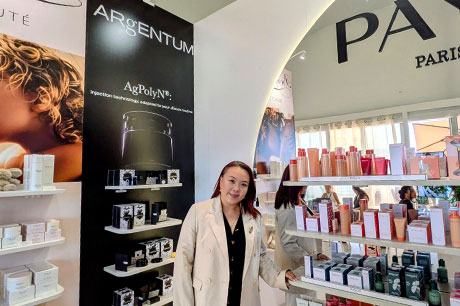
Ushopal CEO Lu Guo at the TFWA show in Cannes.

Expanding China-based beauty group Ushopal plans to make a strategic entry into the global travel retail (GTR) channel via the airline market by securing Payot – a French skincare house acquired in April 2025 – as the first-class amenity beauty brand on Singapore Airlines.

At the TFWA show in Cannes, Founder Lu Guo told TRBusiness: “We’re also pitching to Ethiopian Airlines and Middle East airlines. “Essentially, we’re trying to get Payot, and our other brands, Argentum, and Bonpoint, in the hands of global travelling consumers first so they can experience it.”

This could be a clever move as Ethiopian Airlines has global hubbing ambitions and caters to some high-spending consumers while Middle East travellers, despite recent geopolitical events, remain powerful spenders when they fly to and from Europe. Oliver Wyman analysis puts the Middle East far ahead of other regions in terms of sales per traveller in 2025 at $15.46, the only one to break $10.

A GTR push is coming

Image Credit: Ushopal
Ushopal travel retail

Guo: “Our objective is to become a truly worldwide group, with approximately 60-65% of our business ultimately generated outside China.”

Guo added: “In China, we are moving away from wholesale and looking at places like Sanya, rather than Beijing or Shanghai. Ushopal has been a long-time supply partner with CDFG and smaller Chinese travel retailers, but we are now investigating dedicated airport storefronts for our brands.” The CEO also expects to be in CDFG’s new downtown duty-free stores before long.

Since its founding in 2017, Ushopal has been a very China-centric distribution business. However, in recent years, Guo has added more brands to the portfolio, which also includes a 91% stake in Argentum, a global license for Bonpoint’s skincare and fragrance (since December 2025), and a longstanding investment in Juliette Has a Gun.

With the group’s brands and activities currently representing close to €200m in retail value, Ushopal is now going global. “We never built Ushopal around the idea that China should represent 80% of our business. On the contrary, our objective is to become a truly worldwide group, with approximately 60-65% of our business ultimately generated outside China,” said Guo.

READ MORE: China’s CDFG sees a new era as it moves from traffic to value

READ MORE: Wonderbalm builds travel retail presence with Heinemann listing

Dubai Duty Free carves out exclusive offers for Emirates passengers

Image Credit: DDF/Emirates
Dubai Duty Free

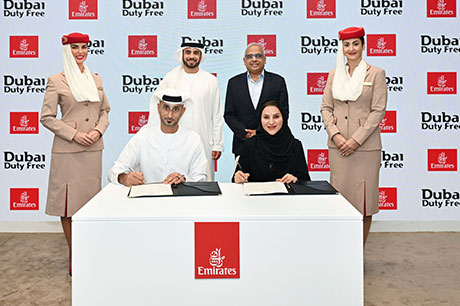
Emirates passengers can now access exclusive offers at DDF.

Emirates and Dubai Duty Free (DDF) have signed an agreement to provide Emirates passengers, travelling to or through Dubai, with exclusive offers at DDF outlets across Dubai International Airport’s Terminal 3.

An agreement was signed by Mohammad Al Hashimi, Vice President, Commercial Products, Dubai, and Mona Al Ali, Senior Vice President – Human Resources at DDF, in the presence of Adnan Kazim, Emirates’ Deputy President and Chief Commercial Officer, and Ramesh Cidambi, DDF’s Managing Director.

The move is said to reflect a shared commitment by Emirates and DDF to enhance the passenger experience on the ground.

The arrangement is also intended to support Dubai’s tourism and aviation sector, and grow traffic to and through Dubai across the Emirates network with joint initiatives.

READ MORE: Dubai Duty Free introduces Crypto.com Pay for eligible UAE residents

READ MORE: Wakefield Wines launches Dubai Duty Free activation

READ MORE: Michael Schmidt to retire following distinguished Dubai Duty Free career

Avolta and Air Canada form North America loyalty programme partnership

Image Credit: Avolta
Avolta Hudson Air Canada loyalty scheme

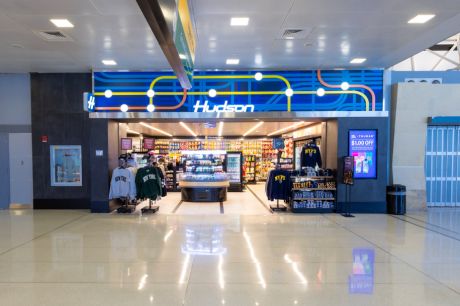
The initiative incorporates over 900 Avolta travel retail stores.

Avolta has partnered with Air Canada to create a new loyalty programme collaboration that features Club Avolta and the airline’s Aeroplan scheme.

The initiative incorporates over 900 Avolta travel retail stores, and will offer more than 16 million members another way to earn, according to the company.

Members who link their Club Avolta and Aeroplan accounts through the Club Avolta app can earn one Aeroplan point for every C$2 (US$1.40) spent on eligible purchases in-store at participating locations operated by Avolta’s Hudson and Dufry, when pre-ordering through Avolta’s Reserve & Collect online service, or through the company’s Club Avolta app.

Later this year, the partnership will extend to Avolta’s HMSHost dining locations, so members can also earn on F&B purchases at casual dining restaurants, quick-service outlets, bars, and Grab & Go spots.

Travellers who join both loyalty programmes will gain access to targeted promotions and offers across Air Canada’s global network, and at Avolta’s duty free, convenience, and participating specialty retail outlets in Canada, including at Toronto Pearson, Vancouver, Calgary and Billy Bishop Toronto airports, as well as at major US airports such as Los Angeles, San Francisco and Chicago O’Hare.

Image Credit: Avolta
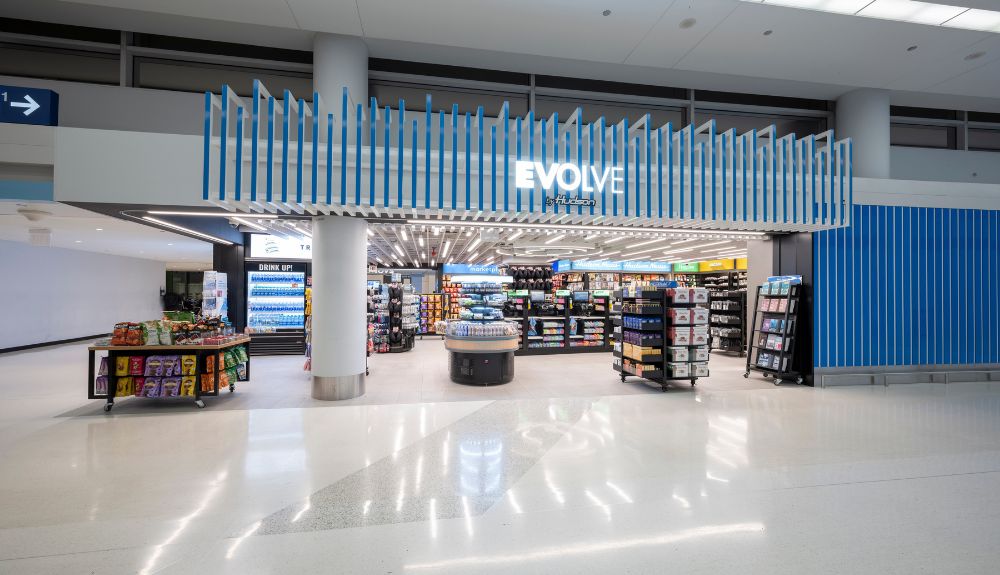
Avolta Evolve by Hudson Air Canada loyalty partnership

In addition to participating locations operated by Avolta’s Hudson and Dufry, later this year the partnership will extend to Avolta’s HMSHost dining locations.

“The Club Avolta and Aeroplan partnership represents a transformational milestone for Club Avolta as our first North American airline loyalty integration,” noted Avolta Senior Vice President of Digital, North America Atousa Ghoreichi.

“With Club Avolta, we’re enhancing the Air Canada customer journey by providing additional earning opportunities to Aeroplan members. As our partnership grows to nearly 1,900 retail and food & beverage outlets in North America, there will be endless ways for travellers to earn.”

“Travel starts well before the boarding gate, and we want to make more of it rewarding for our members,” commented Air Canada Vice President, Loyalty and Product Scott O’Leary.

“Our partnership with Avolta brings Aeroplan into moments that are already part of how people travel – grabbing a bite before their flight, picking up a duty-free deal – creating more ways for our members to earn across the entire trip.”

READ NEXT: Avolta opens FIFA World Cup official merchandise stores in North America

READ NEXT: Avolta secures retail and F&B contracts at MCO

READ NEXT: Avolta CEO Xavier Rossinyol on the rise of hybrid retailing

Immfly, Wizz Air and gateretail launch new integrated digital cabin ecosystem

Image Credit: Immfly
Immfly Wizz Air and gateretail cabin ecosystem

The initiative integrates connectivity, retail and operational data flows.

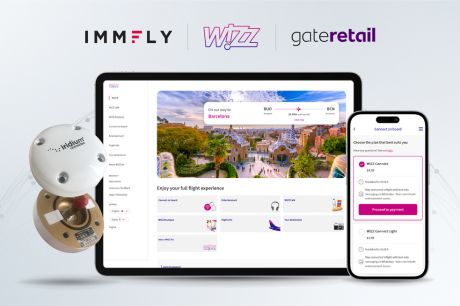
Immfly, Wizz Air, and gateretail have launched an integrated digital cabin ecosystem that unifies onboard retail, passenger and crew connectivity, and operational data into a single platform.

The development is described as a significant step forward in the digital transformation of Europe’s commercial aviation sector.

The collaboration brings together Immfly’s digital cabin technology; gateretail’s inflight retail expertise and understanding of passenger buying behaviour; and the Equilux–Iridium connectivity solution to deliver a more connected, efficient, and engaging onboard experience across Wizz Air’s fleet.

By integrating connectivity, retail and operational data flows, the airline will be able to enhance the passenger experience, improve crew efficiency, and unlock new revenue opportunities – all while enabling real‑time decision support for cockpit and operations teams.

Wizz Air rethinks the onboard experience

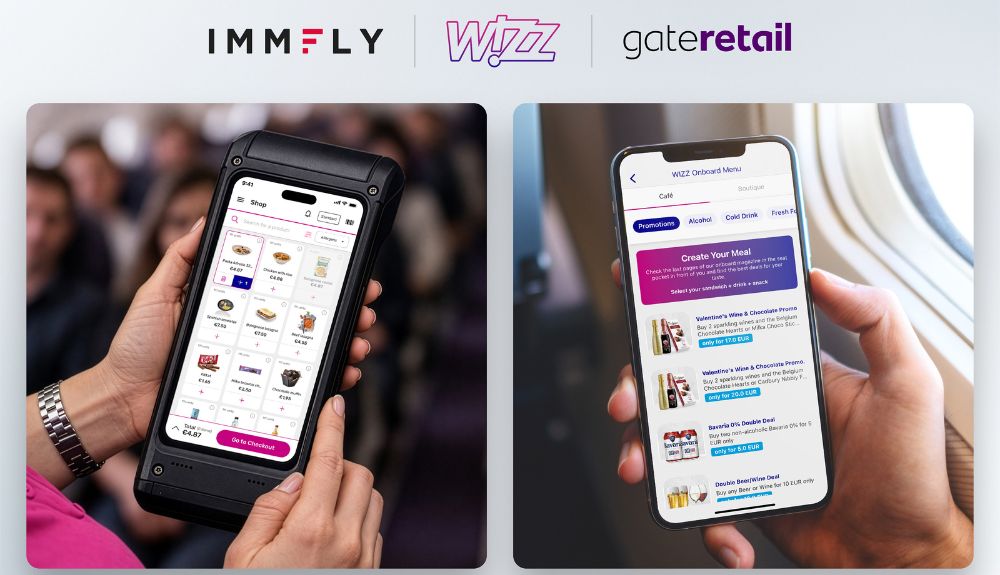
After months of joint development and extensive testing, Immfly and Wizz Air have now deployed Bluetooth‑enabled in‑seat ordering across the entire fleet of more than 260 Airbus A320 and A321 aircraft.

Passengers who download the airline app before their flight will be able to browse and purchase food, beverages, and boutique items directly from their personal devices, even without internet access. Orders are then transmitted via Bluetooth to the crew, improving service efficiency, reducing wait times, and enabling a more personalised retail experience.

This initiative is powered by Immfly’s unified retail and cabin‑digitalisation ecosystem, and integrated with gateretail’s inflight retail systems, helping translate onboard demand into a more intuitive and effective retail experience.

Image Credit: Immfly
Immfly Wizz Air and gateretail integrated digital cabin ecosystem

Passengers who download the airline app will be able to browse and make purchases directly from their devices, even without internet access.

In parallel, Immfly and Wizz Air have also launched a new low‑bandwidth connectivity solution trial, powered by Immfly’s proprietary Equilux server and Iridium’s global satellite network. The Proof of Concept will run for six months across five aircraft in the UK, with results expected in late summer.

The programme enables a new suite of premium onboard services including wireless in-flight entertainment purchases; messaging packages, including multiple WhatsApp bundle options; in‑seat ordering for food, beverages, and boutique items; live payment authorisation enabled through Iridium connectivity; and real‑time operational data, including flight information, moving map, and destination content.

Beyond passenger‑facing features, the programme also introduces cockpit-application integration, a key innovation that enables real‑time data sharing and decision‑support tools. This capability will support improved route planning, fuel optimisation, and new cost‑saving opportunities for Wizz Air, embedding operational efficiencies directly into day-to-day flying.

Wizz Air Chief Commercial Officer Ian Malin commented: “This launch is about rethinking what the onboard experience looks like in a low-cost environment. We are investing in smart, scalable technology that gives customers more control and more choice, from ordering at their seat to staying connected in the air.

“At the same time, it helps our crews deliver a faster, more seamless service. We are constantly exploring smarter ways to operate our fleet and deliver more for our customers, and this is a clear example of that approach in action.”

Immfly President Fernando Guinea noted: “This partnership marks a major step forward in bringing the digital cabin to life. With Immfly’s unified digital ecosystem at the core – combining retail, connectivity, and operational data – we’re enabling Wizz Air to elevate every aspect of the onboard experience.

“From Bluetooth in-seat ordering to real-time operational insights, this programme demonstrates how Immfly’s technology drives stronger engagement, higher retail performance, and meaningful operational and commercial efficiencies across the airline.”

Gateretail VP Jose Lirio added: “In-seat ordering by Bluetooth represents an important breakthrough for both passengers and airline partners. It gives passengers a more seamless way to shop the onboard offer, while giving crew real-time visibility to support efficient fulfilment.”

READ NEXT: Gateretail renews inflight retail partnership with Wizz Air for five years

READ NEXT: Gategroup forges commercial alliance with Immfly ‘to disrupt airline retail’

READ NEXT: Norwegian and gateretail offer pre-order duty free on selective flights

SKYdeals’ optimised inflight shopping platform moves beyond the cabin

Image Credit: SKYdeals
SKYdeals airlines inflight

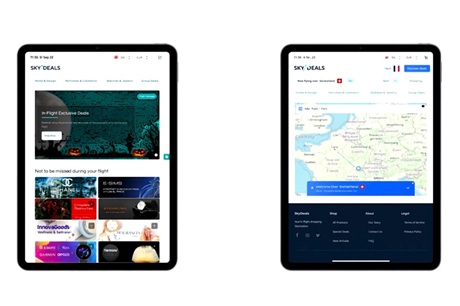
SKYdeals platform homepage with brand catalogue (left) and FlyOver Deals with real-time flight tracking (right).

E-commerce platform SKYdeals is diversifying into the entire travel retail ecosystem, having refined its so-called ‘shoppertainment’ approach with airlines. Over the past five years, they have included major carriers like Air France, Lufthansa, and Etihad Airways, plus the all-business La Compagnie.

The Paris‑based startup, which has been a participant in the LVMH accelerator La Maison des Startups, is now stepping into airports, cruise lines, lounges, and rail networks. It marks a shift in how digital retail is likely to evolve across the travel journey.

Julien Sivan, CEO and Co-founder of SKYdeals, says the timing is deliberate. “There’s a paradox at the heart of travel retail: airports dedicate more than two‑thirds of their space to shopping, yet passengers consistently rank it among their lowest priorities,” he said. “Traditional duty-free catalogues are declining and conversion rates stay flat despite record traffic.”

According to Kearney, for the third consecutive year, the gap between traffic and value has widened, and the management consultancy concluded that what was a temporary mismatch “has now turned into a structural disconnect”.

SKYdeals was built on the simple insight that passengers don’t need to shop – but they do need to be entertained. The solution: make shopping the entertainment. And with operators looking for new ways to create engagement, not just exposure, the company is now taking its shoppertainment model to the entire travel retail ecosystem.

Originally built for the constraints of inflight connectivity and short dwell times, the platform uses a set of psychological levers – exclusivity, contextual discovery, time‑limited offers, social dynamics, and gamification – to transform idle moments into retail participation.

For example, the company’s FlyOver Deals, flash sales, group buying mechanics, and live auctions were tested across various airline environments, and there was a consistent outcome: when the experience was playful and time‑bound, conversion rates rose.

Five years of inflight insights

Armed with this intelligence (and other insights), expansion beyond aviation was a natural next step. Airports offer predictable dwell times and high‑value audiences; cruise ships provide captive communities with strong social dynamics; and rail operators are increasingly digitising the onboard experience. While each of these environments varies, they all share the same challenge: passengers rarely arrive intending to shop.

Sivan said: “Aircraft cabins are the toughest environment in travel retail: limited bandwidth, short windows, and a distracted audience. If shoppertainment works there, it can work anywhere that travellers have to wait.”

For partners, SKYdeals now offers two routes. The first is a turnkey, white‑label e‑commerce platform with shoppertainment built in. This is marketplace‑ready and deployable within weeks, according to the company. The second is a suite of digital services for operators that want to integrate specific mechanics into existing systems, from contextual deal engines to live auction modules.

As the travel retail industry looks for new ways to convert attention into revenue, SKYdeals is positioning itself not as a retailer, but as the technology partner that can rewire the experience – and for the better, it would argue. The next phase of shoppertainment, it seems, will be played out far beyond the aisle.

READ MORE: Former TFWA President Maingreaud named on SKYdeals Advisory Board

READ MORE: Lufthansa and Austrian Airlines trial new Skydeals inflight retail platform

Dnata expands Aer Lingus partnership with new onboard retail programme

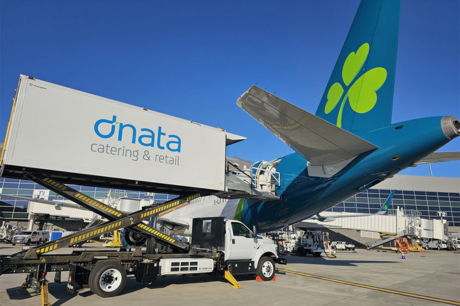
Dnata Catering & Retail expands its partnership with Aer Lingus.

Dnata’s new deal with Aer Lingus includes a five-year retail contract.

Dnata Catering & Retail has strengthened its long-running collaboration with Aer Lingus with the launch of the airline’s new inflight retail programme, expanding the partnership to include a five-year retail contract alongside the remaining five years of dnata’s hub catering agreement.

The expanded scope reflects Aer Lingus’ confidence in dnata’s operational capability across catering, retail and integrated technology.

The new retail operations now cover more than 180 Aer Lingus flights daily from its bases in Dublin, Shannon, Cork and Manchester. Under the agreement, dnata will manage the inflight retail programme end to end, including sourcing, procurement, warehousing and technology provision. The partnership will continue to evolve with new browsing and personalisation features, with the product range shaped by customer feedback to enhance the inflight shopping experience.

Robin Padgett, CEO of dnata Catering & Retail, said: “This partnership takes our collaboration with Aer Lingus to the next level – uniting our expertise in catering, retail, and technology to create an exceptional onboard experience. Together, we’re delivering a modern, data-driven retail programme that celebrates Irish brands, improves efficiency, and enhances passenger choice.”

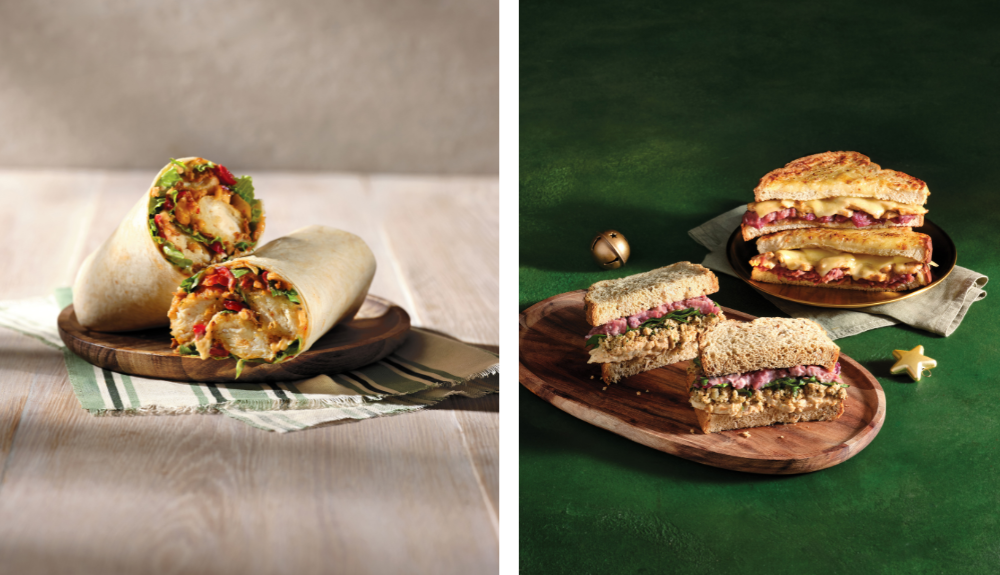
The refreshed range showcases a curated mix of local Irish and international names, reflecting Aer Lingus’ signature hospitality. Travellers can expect homegrown favourites including Sculpted by Aimee, Tan Organic, BPerfect and The Smooth Company, together with Deli-Lites supplying freshly made Irish sandwiches and wraps. The launch also coincides with Aer Lingus’ festive season menu, featuring seasonal dishes such as a turkey and stuffing sandwich, a Christmas cheese and cracker box and holiday-themed gift items.

Dnata Catering & Retail expands its partnership with Aer Lingus.

The launch coincides with Aer Lingus’ festive season menu.

Passenger insight will continue to play a central role in shaping the evolving offer, ensuring the range reflects customer tastes while championing Irish products. To support convenience and pre-engagement, customers can browse the onboard magazine “Bia” digitally before flying and purchase featured items on board. The programme is powered by dnata’s integrated retail technology ecosystem, enabling contactless payment, real-time data analytics and self-serve reporting to support Aer Lingus in operational and commercial planning.

Dnata Catering & Retail expands its partnership with Aer Lingus.

Its DF shopping includes a mix of local Irish and international names, including homegrown favourite Sculpted by Aimee (right).

Adrian Dunne, Chief Operations Officer, Aer Lingus, said: “The addition of inflight retail to the existing partnership we have with dnata will drive significant operational benefits, whilst enhancing our customer experience at the same time. The programme will be delivered via a new crew iOS app, which will allow for a data-driven product range tailored to our customers’ preferences and proudly showcasing a wide selection of Irish brands.”

The new retail experience will reach more than 10.5 million Aer Lingus passengers annually, offering a refreshed onboard proposition and further opportunities for innovation across both catering and retail.

Dnata’s catering and retail division employs more than 10,400 staff globally and produces over 110 million meals per year, supporting full-service, low-cost and VIP carriers from more than 60 locations worldwide.

READ NEXT: Millennial business travellers are TR’s highest spenders, says m1nd-set study

READ NEXT: Carriers react after Lufthansa ends long-haul retail

READ NEXT: Analysis: Changing priorities in inflight retail

Can InterLnkd revolutionise inflight retail with AirMall solution?

InterLinkd inflight retail

The InterLinkd platform could be available as early as the end of this year.

An inflight retail platform for airlines and travel providers claims to have introduced the first solution that can turn an airline’s onboard Wi-Fi into a full-scale digital shopping showroom, connecting travellers to more than 20,000 brands in the air.

Four-year-old InterLnkd, which powers white-label digital shopping malls, says that its two platforms – TravelStylist for pre-departure, and AirMall for inflight – will “unlock a new ancillary revenue stream” from consumer purchases across categories like fashion, beauty, and travel essentials.

The plug-and-play solution from the UK-based startup is said to integrate into existing onboard portals, with passengers using their own devices to browse and buy. Purchases are then delivered directly to their home or travel destination.

Barry Klipp CEO InterLnkd inflight retail

Barry Klipp: “Our vision was to build the largest digital shopping mall for the travel industry.”

Airmall – which might launch as early as this quarter through airlines partnered with Viasat (a WiFi connectivity provider that was cleared to acquire Inmarsat in May 2023) – removes onboard stocking and airport delivery constraints while giving passengers more choice. The platform is deployable across an airline’s entire route network and offers carriers a way to offset the cost of inflight connectivity. It also uses a proprietary matching engine called MotiVatedData so that each mall can curate personalised product recommendations based on a passenger’s profile and destination.

InterLnkd + Viasat = 60 airline options

The tech provider is a PhocusWire Hot 25 Travel Startup for 2025, and CEO Barry Klipp told TRBusiness: “Viasat can monetise the consumer behaviour based on how they shop with a revenue stream back to the airline; it’s a commission model. This solution enables airlines to make the most of their Wi-Fi investments.”

The Viasat deal opens up their 60 airlines to InterLnkd, but there will be agreements with each airline. The tech startup has also signed off on a partnership with an airline that has Starlink. “That will go live next year, but I can’t reveal which carrier,” said Klipp. So far, Starlink, owned and operated by Elon Musk’s SpaceX, has partnered with a number of airlines, including British Airways, Iberia, Qatar Airways, and Virgin Atlantic.

Inflight vision

On a theoretical Airmall-equipped London to New York flight, passengers will have the option of shopping in either the UK or US mall, “the digital equivalent of Westfield,” said Klipp. “Our vision was to build the largest digital shopping mall for the travel industry to monetise from, and that meant opening up the world of High Street retailers and e-commerce retailers, be they Next or Amazon, Macy’s or Bloomingdale’s.”

Klipp told TRBusiness that InterLnkd is currently in talks with seven airlines globally. As for the existing inflight concessionaire model, the CEO said AirMall would be complementary to those operations, but totally separate. “Ours is not the world of duty-free,” he said.

If InterLnkd takes off, it will signal the evolution, even shake-up, of inflight retail into a tech-driven, omnichannel, personalised experience. The model enables airlines to offset high connectivity costs, and gives retail brands direct access to a premium audience in the air, while passengers can shop to their heart’s content, if they want to.

READ MORE: Analysis: Changing priorities in inflight retail

READ MORE: TR Consumer Forum 2025: Thabet Musleh on powering ‘Experiencentricity’

Tourvest unveils first phase of new UK retail fulfilment centre

Tourvest retail fulfilment centre Feltham

The UK facility aims to set a new standard for airline retail fulfilment.

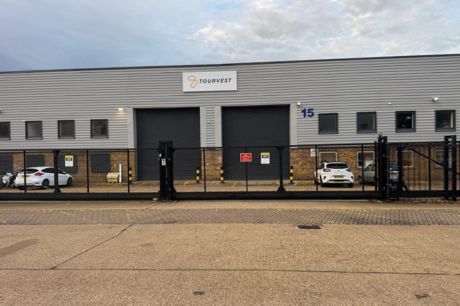
Tourvest Retail & Catering has officially launched phase one of its new retail fulfilment centre in Feltham, UK, in line with its objective of setting a new benchmark for onboard retail logistics and e-commerce fulfilment in the airline industry.

The Feltham centre combines smart automation with agile processes to deliver efficient, reliable fulfilment. Supporting trolley packing, home delivery, e- commerce and drop-shipping, it enables airlines and suppliers to connect with customers quickly and accurately.

The facility has been designed to offer dynamic, accurate, and personalised service while future-proofing operations for years to come.

Key benefits include cost efficiency achieved through optimised operations and real-time data, alongside enhanced risk resilience. The new centre also offers advanced automated stock management, in addition to a commercial advantage gained through alignment with retail agreements that promote savings and growth.

“Today isn’t just about opening a new facility, it’s about setting a new standard for airline retail fulfilment,” noted Tourvest COO Paul Murphy. “Our Feltham Centre gives airlines the tools to improve customer experience, streamline onboard retail, and build towards the next generation of e-commerce and home delivery.”

READ NEXT: Tourvest secures onboard retail services agreement with Virgin Atlantic

READ NEXT: Sustainaholics launches Black Cow Alumini aboard BA with Tourvest Retail

READ NEXT: Delivering ‘crave-worthy’ F&B brings foodies to the airline table