Archives

TFWA reveals further numbers on TFWA Asia Pacific Exhibition & Conference

Tax Free World Association (TFWA) has published addendum figures to the visitor numbers at the TFWA Asia Pacific Exhibition & Conference, as reported by TRBusiness last week.

More than a third (39%) of the 3,039 visitors that attended the event were from travel retail operators, airports and landlords.

In the case of the first, China Duty Free, Avolta and Heinemann were among 16 of the top 20 global travel retailers represented.

A record 1,100 meetings were scheduled via the ONE2ONE meeting service, an increase of 20% over last year.

Tokyo Haneda, Delhi Indira Ghandi, Singapore Changi and Hong Kong International Airports were present in a strong contingent of Asia airports.

Popular workshops

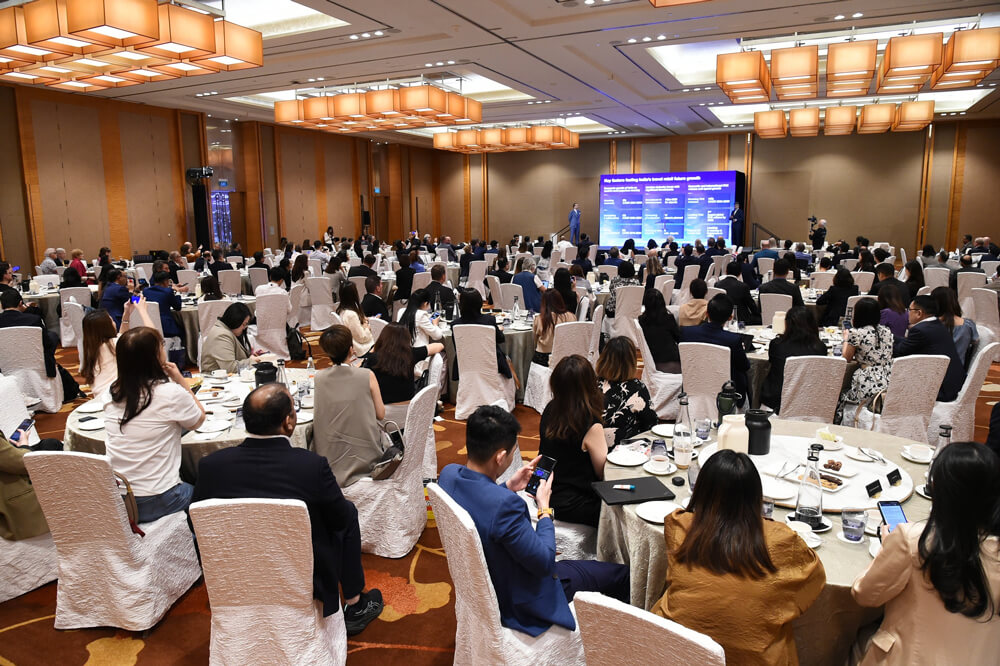
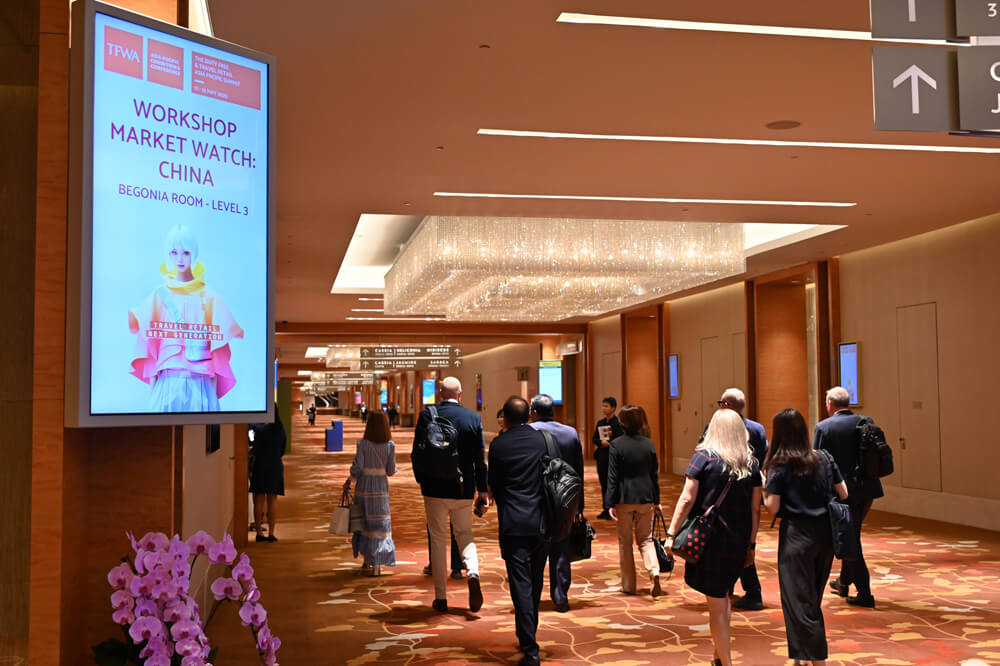
Attendance at TFWA’s regional focus workshops were up by nearly half (49%) with ‘standing room only’ in the Market Watch: China workshop, attended by 319 delegates.

Meanwhile, a total of 237 delegates attended the session on India, a ‘considerable increase’ on last year, said TFWA, after both drew 373 attendees last year.

Attendance at the TFWA workshops was up by nearly half (+49%) with standing room only at the China workshop, was attended by 319 delegates (pictured below) and the India workshop (pictured above) drawing 237 audience members. Credit: TFWA Press Office.

More than 1,500 delegates visited the after-business TFWA Asia Pacific Lounge, with TFWA adding extra seating and space and facilitating events including the Women in Travel Retail reception and an airports’ gathering.

A total of 1,200 people attended the Welcome Cocktail at the Gardens by the Bay on Sunday 11 May.

Across the exhibition floor, an upgraded design aesthetic welcomed visitors with softer and contemporary finishes.

Elsewhere, floral arrangements including live trees and atmospheric lighting in blue and green hues at the Welcome Cocktail greeted guests under the occasion’s ‘Enchanted Garden’ theme.

Credit: TFWA Press Office.

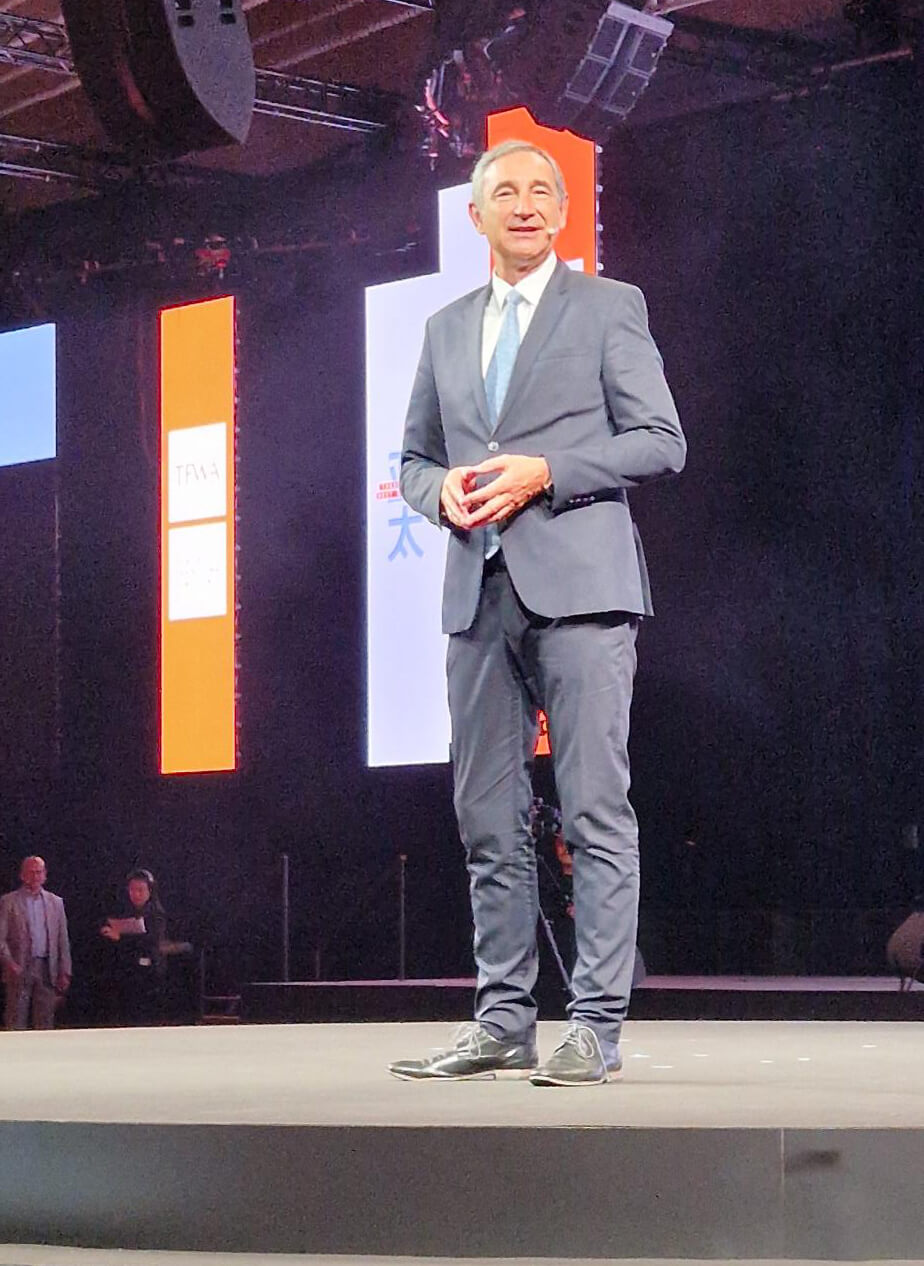
“The debut of new brands at the show and the large numbers attending both formal sessions and networking events goes to show that the region undoubtedly retains its position of huge importance to our industry,” stated TFWA President Philippe Margueritte.

No closing press conference

“With 3,039 visitors, our numbers are indeed slightly down from last year. But in a climate of uncertainty that isn’t helpful to any sector and political unrest such as the situation between India and Pakistan prevented many delegates attending from India, it’s been gratifying to welcome so many of travel retail’s senior decision makers to Singapore. Without any doubt, serious business has been done this week – people were here to make decisions and get deals done.

“As an association whose guiding principle is ‘by the trade for the trade’, we have always striven to deliver the best value to our members. We do this by regularly canvassing their views and then innovating and investing to ensure we continue to meet their changing requirements.

“For Cannes this year, we have a number of new elements planned to ensure the show is even more relevant and has even greater draw as by far the most important date in the travel retail calendar.”

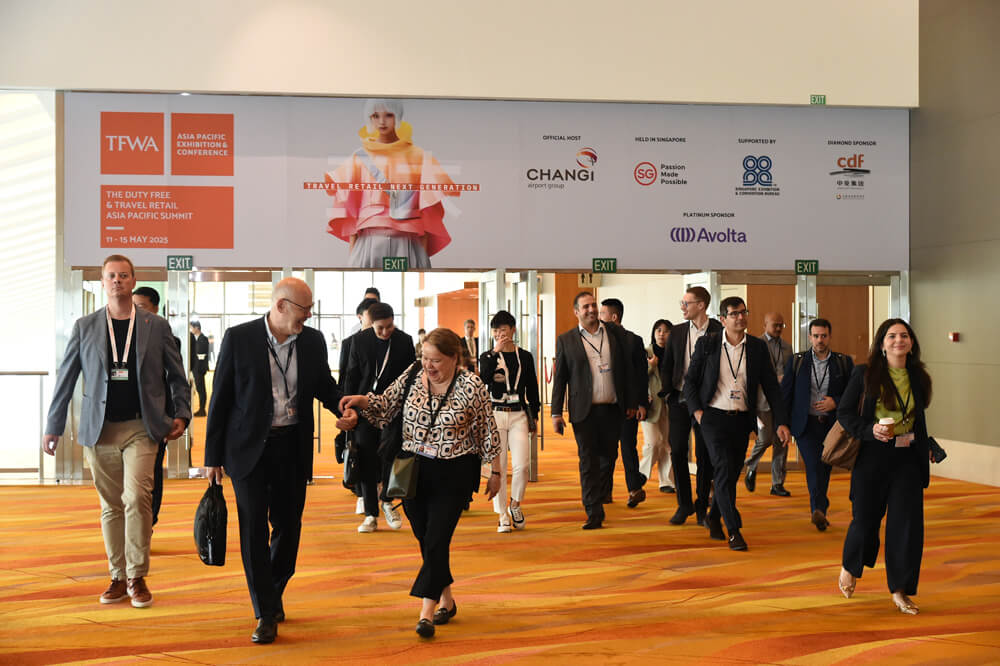
The TFWA Asia Pacific Exhibition & Conference attracted a total of 3,039 visitors, slightly down on last year’s event. Credit: TFWA Press Office.

TFWA chose not to hold the closing press conference at the Asia Pacific, a customary fixture of the week that allows the trade media to engage in important dialogue with members of the Board and put questions to the association on aspects of TFWA-organised event(s) in a convivial environment.

Approached by TRBusiness, a spokesperson from TFWA told TRBusiness: “It was felt by the TFWA board that as it is unable to give final figures at the conference that the conference doesn’t provide much value to the media.

“Also while obviously we have to have the conference as late in the day as possible to give as complete a picture as possible, this is not convenient for some journalists who have to leave. However, if the media does indeed find the conference useful, its reinstatement will be considered.”

TFWA Asia Pacific 2025 attracts 3,039 visitors and 216 exhibiting brands

The TFWA Board and MD Frank Waechter inaugurate the TFWA Asia Pacific Exhibition following the traditional lion dance.

Tax Free World Association (TFWA) has announced 3,039 delegates attended the TFWA Asia Pacific Exhibition & Conference in Singapore.

Of that number, agents/distributors took the highest share (40%), followed closely by DF&TR operators (30%) and other trade visitors and guests (15%).

On the basis of that calculation, approximately 912 buyers and 273 landlords attended TFWA’s Asia Pacific summit.

By region, Asia accounted for the greatest representation of visitors (78%). Europe (12%) and the the Middle East excluding Turkey (12%) emerged in second and third position, respectively,

Perfumes & cosmetics was the most represented category on the exhibition floor (31%); followed by wines & spirits, beers and non-alcoholic beverages (30%); and confectionery, fine food and food supplements (16%).

A total of 216 exhibiting companies were present across 205 stands, with 54 new exhibitors.

This year’s TFWA Asia Pacific summit returned to the Sands Expo & Convention Centre following a 2024 event that attracted 3,126 visitors. The pre-Covid (2019) iteration gathered a record 3,367 delegates.

TRBusiness has approached TFWA for further information.

The TFWA World Exhibition & Conference will take place on 28 September – 2 October at the Palais des Festivals in Cannes.

READ MORE: India fast becoming a jewel in Asia’s travel retail crown

READ MORE: Tech, physical retail and leadership in focus at TFWA Asia Pacific

READ MORE: Tackle dwell issue at airports, urges TFWA President

READ MORE: LIVE: May issue + Leading APAC Operators report

Tech, physical retail and leadership in focus at TFWA Asia Pacific

Charles Reed Anderson, Tech industry innovator and Host of Techburst Talks: “Tech can’t fix everything, but it can help.”

At the 2025 TFWA Asia Pacific Conference on Monday morning (12 May), three sessions brought travel retail delegates some insights into three diverse and relevant areas for their businesses: the latest tech developments, where retail is (or should be) heading, and the types of leadership as examined through the lens of an orchestra conductor.

As the next generation of travellers transforms consumption patterns, the duty-free and travel retail industry must adapt more than ever. Today’s consumers, driven by digital-first habits and a strong commitment to sustainability, place a high value on convenience, personalization, and immersive experiences.

The opening session featured thought leader and tech analyst Charles Reed Anderson, who looked at how the travel retail industry can leverage technology to meet evolving expectations, especially from younger generations. He started off noting that “it has been a pretty weird year so far”, referencing the Trump tariffs situation, which has led to confusion and created a lot of uncertainty.

“Tech can’t fix everything, but it can help,” he said. But he warned that tech for tech’s sake is not valuable, citing the example of the Bluetooth-enabled HAPIfork, a smart fork that is meant to “help you eat healthier”. Reed Anderson argued that sometimes it wasn’t about the tech but simply the need for more innovation. “Tech exists for human outcomes,” he emphasised.

Having moved from Singapore, where he had lived for 16 years, to Europe, he said: “I miss Changi Airport for the ability to have a consistent 30-minute door-to-door journey. He knew all the stores there and would go early to shop. In the same way, he would also go early to Tokyo Narita for a sushi meal and noted that Doha Airport was a connecting destination where he was able to relax “because the staff make you feel valued. He said: “When I relax, I shop and I eat.”
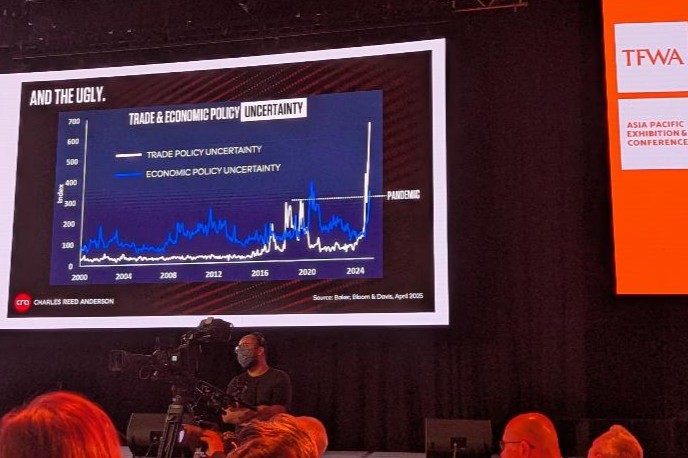
Trade policy uncertainty is off the scale.

Addressing the specifics of technology, Reed Anderson’s suggestion to the audience was to engage fully using digital signage because. When done right, it can engage, offer wayfinding, promotions, experiences and a host of other services. The tech guru noted that Doha has done something very similar to the Apple store by focusing on the environment and the people to drive certain behaviours, including shopping.

“Digital signage is something I love, but it is underutilised at many airports. Your customers like it too: 70% state that digital signage boosts travel retail.” He also added that high prices, or the perception of high prices, are the main reason for not purchasing in the channel. It means more persuasion is needed in communications.

AI step-change needed

He suggested showcasing price differences with other airports where the comparison is positive, so that the perceived value can tip the balance. “Messaging can push people along in the right direction,” he said.

On artificial intelligence (AI), which is taking off in retail, he noted that only 57% of retailers increased spend in this area last year, “when it should be 100%”. Paradoxically, 80% of companies thought AI was critical going forwards.

“What if we combine digital signage and AI?” he asked. A startup in London called Flow City has done that for the digital out-of-home (DOOH) space. From putting billboards up for two weeks, now it’s down to the minute. High upfront costs and the right placements were barriers, but Flow City takes care of many of these elements, including leveraging data.

A use case was a pharmacy retailer in London with 67 stores that wanted to boost sales of products to alleviate hay fever. They only needed to advertise on days with high pollen counts because Flow City simply added a data source that tracked pollen.

This way, brands can focus on the content, making it accessible to everyone with budgets as low as $100 to $1000s. Traditional OOH operators are also onboard because Flow City is bringing new advertisers into the ecosystem.

Reed Anderson provided other examples where AI and digital signage have been used to create marketing opportunities, including social media and leveraging influencer behaviours. He also picked up on Gen AI as having “transformed the way I work and everything I do”.

He added: “Gen AI is going to fundamentally transform our businesses and our lives in the next few years. It is the biggest thing since the Internet.” He marked the line between traditional AI and its automation of tasks and GenAI’s ability to do more, and faster.

“The goal for traditional is automation, and for Gen AI is human-machine collaboration. This is what will change our lives going forward. GenAI is like having the world’s best intern: it’s available 24/7 and never gets bored.” In travel retail, it can be used in customer service to provide quick answers on stock availability, and add-on items to bump up sales, and also for staff training.

The next thing coming down the line is Agentic AI. Regular AI automates and offers recommendations, GenAI will give you ideas of what to make for dinner, and AgenticAI contextualises that dinner by asking what the weather is like to determine a more relevant, tailored meal. It can understand complex situations to deliver shopping and other solutions to travellers.

Future-ready travel retail

Among the most visionary designers in travel retail, Ibrahim Ibrahim, Managing Director of London-based Portland Design and the author of the book Future-Ready Retail, outlined the pace of change that retail is undergoing, and which directions it should take.

He said: “In retail, we are experiencing tectonic shifts: fundamental changes in the relationships between consumers, brands, and places. We are seeing consumers’ expectations shifting faster than businesses can adapt; something we call retail Darwinism.

Ibrahim Ibrahim, Portland Design: “In retail, we are experiencing tectonic shifts: fundamental changes in the relationships between consumers, brands, and places. We are seeing consumers’ expectations shifting faster than businesses can adapt; something we call retail Darwinism.”

“The future isn’t what it used to be, and this applies to the transumer (the travelling consumer) who is a domestic consumer borrowed for a couple of hours from our High Streets. But they think and act differently in airports, and we have to understand that.” This he called ‘travelization’ and it means that brands must offer a different experience to meet travel needs.”

These needs are based on three aspects: easy-to-locate products or services for those passengers who know what they want; an offer that allows exploration of a category for shoppers who are open to trialling products; and the most important aspect: providing inspiration to convert travellers to buyers using newness, surprises, and constant change. The ‘inspire’ customer is also the least price sensitive, noted Ibrahim.

Travellers now have a mindset of asking, How can you surprise me? So, engagement is vital through the practicality, ease-of-use, or exclusivity of products. Portland does a lot of work in the domestic retail market, where up to 40% of physical shops will need to be replaced, but not by more retail.

“Other commercial offers will align and catalyse retail. We need to mix the rhythm and find what works. We call this SWELCH: shopping, working, entertainment, learning, culture, hospitality, and healthcare. They can come together to create a more vibrant place,” said Ibrahim. This, he said, was the future of hybrid retail, at airports as well.

Layered over is the fact that consumers want things fast and seamlessly. People want quick commerce, often via an app, but 74% say they have walked away from retail because they felt overwhelmed. “That is a big part of why they don’t shop in airports; the nature of the environment and its dehumanising effect. Many airports are too large and not at a human scale,” said Ibrahim.

Paradoxically, slowness and shareability are also factors in enhancing desirability. More than half of consumers say they would rather spend money on a good experience than buy a material possession. Ibrahim cited the new Netflix store and Ikea’s new space in London’s Oxford Street with its 25sqm of livestreaming space as examples of immersive retail that airports can learn from.

“This is ‘eventizing’ retail and it’s the future,” he said. “Stop thinking about making retail entertaining but making entertainment shoppable instead.” Blending is coming into its own where co-working, retail, F&B, and the night-time economy can work as one. At airports, lounges can be integrated with retail and F&B for a “dip in, dip out” culture. The business traveller is not the only worker at an airport, said Ibrahim.

Wellness and ethics are also playing a role in consumer choices, with Accenture data showing that 40% of consumers have stopped using a brand because of the way it behaves. Purpose-driven products and brands like Patagonia are in demand and will be the winners, according to Ibrahim.

He added: “Retail is, and always has been, about four things: recruitment, transaction, fulfilment and retention.” But with the middle two largely going online, brands in the physical space will increasingly behave like media platforms (with an abundance of data to go with it), and that is a big challenge.

How do you masterplan a commercial offer in an airport in the next decade, where part is media and part is transactional? What’s the proportion? “This is what we’re grappling with in domestic shopping centres, and these challenges will find their way to airports,” said Ibrahim.

Leadership learnings from an orchestra conductor

The final session of the day involved an orchestra on the stage so that conductor and leadership expert Jason Lai could draw parallels between orchestrating a symphony and leadership roles in business environments such as travel retail.

Jason Lai, Principal Conductor, Yong Siew Toh Conservatory: “We sometimes forget we have real estate below our necks.”

He posed the question: Why do we need conductors? before bringing to the stage several audience members – including Tab Musleh, Qatar Duty Free’s Senior Vice President – to explain how different conducting techniques impact an orchestra.

In what was a very interactive session with the audience, Lai offered up insights into the ways conducting has evolved from a command-and-control mentality to a coaching-and-mentoring approach over the years. He said that as music became more complex music it needed overseeing, just like managements in growing corporations. More responsibility given to the conductors meant more power and control.

The key was to learn how leadership styles – from passion, energy, and even aggression – could be harnessed to get the best out of orchestras or business teams. “Conductors who value their teams, think about how they sound and what kind of performance to give, to get audiences to come back for more,” said Lai. In the same way, a CEO has to commit to a moment. Otherwise, the team doesn’t know where to go or how to react.”

“This is all about inter-personal and intra-personal relationships with the orchestra… the interpretation and understanding of their performances. It is also about the relationship with ourselves and listening to our bodies to be more harmonious. We sometimes forget we have real estate below our necks,” he added, referring to engagement with all aspects of oneself.


Tackle dwell issue at airports, urges TFWA President

TFWA President Philippe Margueritte has challenged travel retail stakeholders to address dwell time problems at Asia Pacific airports to offset the diminishing impact on commercial revenues.

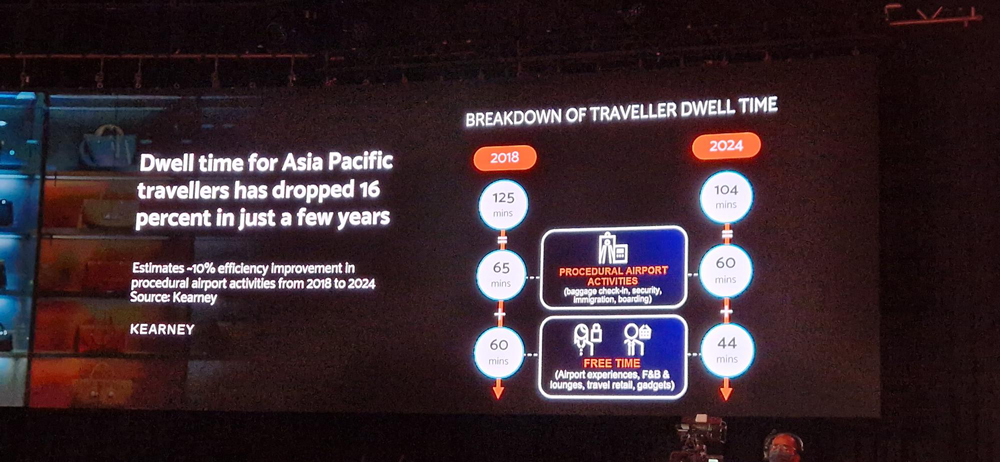
Making his inaugural state of the industry address this morning (12 May), the former Coty leader pointed to total airside dwell time at airports in Asia Pacific declining by 16% in recent years in a worrying sign for the region’s retail operators and brands.

Referencing the data point from Kearney, Margueritte said total airside dwell time was 125 minutes in 2018, with travellers spending an average of 65 minutes in processual activities such as check-in, security, immigration and boarding, leaving 60 mins of free time to engage in airport experiences, including duty free shopping.

In 2024, the portion of ‘free time’ in airside terminals amounted to 44 mins – a decline of -16 minutes (-26%).

“We are making travellers wait far too long to get airside at airports, many of them face lengthy queues for check-in, immigration, security and boarding procedures and things are not getting any better,” he stressed.

“As travellers are no longer choosing to arrive two hours before their flights, this represents 26% less shopping dwell time which translates directly into 13% less spend per passenger. Of course, this is affecting non-aeronautical revenues. This is something we are all very keen to grow and not reduce.

Philippe Margueritte, President, TFWA.

Shifting priorities

“There is little point in offering fantastic retail experiences if passengers are rushing past the airport shop to catch their plane.

“It is in our own financial interest, whether we work for airport authorities, retailers to brands, to invest in seamless passenger processing at airports,” he continued, referencing the typically seamless curb-to-gate experience that passengers experience at Singapore Changi Airport.

In a dynamic performance on stage, Margueritte spoke of his excitement for the globe’s largest regional revenue driver.

“It’s rarely been a better time for all stakeholders to join forces and optimise the shopping journey of our travellers, especially in APAC,” he said.

Addressing the general shifts in buying demography in travel retail, he said: “Traditional airport brick and mortar stores won’t work so well for this new generation.

“They see shopping as more than purely transactional; it needs to be an experience, something to enjoy, share that really stimulates the sense and offers excitement or newness.”

He went on to explain that while footfall among Gen-Z passengers is climbing, conversion rates and average spend, by comparison, is significantly lower.

“Obviously this group is not finding what it wants in our stores and are not attractive enough by what they see. However, it is good to see how some operators are trying to inject more excitement, developing hybrid retail concepts at the airports, or example.”

Promising load factors

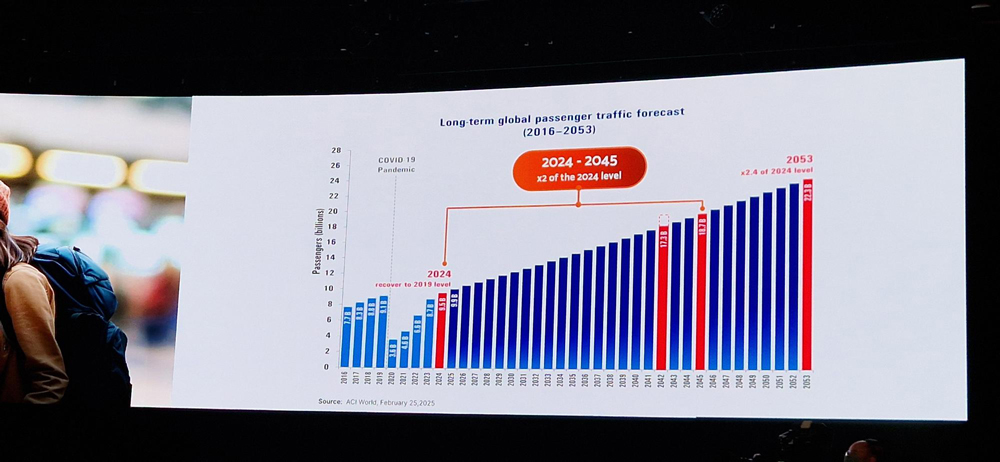
The future prognosis for global passenger traffic remains upbeat, with just shy of 10 billion air travellers expected in 2025 (having recorded 9.5bn in 2024), rising to 18.7bn by 2045, according to ACI World.

He pointed to load factors for the Asia Pacific region’s carriers reaching 83.5% in 2024 year-on-year, according to IATA, representing huge potential for the number of potential shoppers.

“As we know, we seem to be living in an uncertain world where international regulations can change everyday. I believe it has rarely been a better time for all stakeholders in the industry to join forces and optimise the shopping journey of our travellers.

“In Asia Pacific, a combination of factors – economic, demographic and technology – is aligning to help us maximise the appeal of our brands and shops for new kinds of travellers.”

China and India, two economic superpowers, have the “critical mass to drive consumption for decades”, he continued. This is being spurred by rising numbers of middle class in China.

Indeed, global Chinese passenger numbers are forecast to reach almost 200m by 2028 according to m1nd-set.

Meanwhile, 18.9m international travellers were carried by Chinese carriers in 2024 – up 34% year-on-year, said Margueritte, quoting figures from the Civil Aviation Administration of China (CAAC).

He claimed that F&B is currently the fastest growing commercial activity in Asia Pacific’s airports, combining high-quality meals in a quick-service format.

“Introducing a retail element into F&B or vice-versa is a logical development,” he said. “It plays to the desire for multi-sensory experiences, which is why we are more of this kind of outlets at airports.”

Elsewhere, the President referenced the growing importance of sustainability among global travellers with 75% stating they want to travel more sustainably in the coming 12 months, while 55% indicated a willingness to pay more to support sustainable travel options [source: World Travel & Tourism Council].

More to follow…

Carriers react after Lufthansa ends long-haul retail

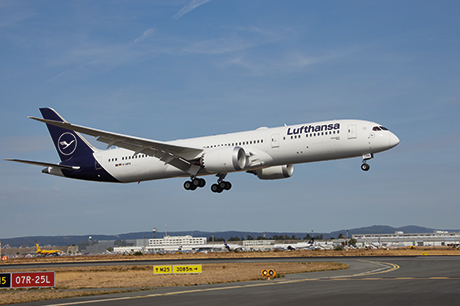
Credit: Oliver Roesler/Lufthansa.

UPDATED: Airlines in the Lufthansa Group portfolio have commented on the future direction of their inflight retail programmes after it emerged this week the Lufthansa brand is to end inflight duty free sales on long-haul routes in the coming months.

As reported, categories such as cosmetics, fragrances and fashion, available via its ‘Inflight Shopping’ catalogue under the Worldshop platform, will be unavailable across the entire Lufthansa network from September.

Until then, Worldshop’s merchandise categories can be accessed online ‘as usual’, with ‘no changes’, a Lufthansa Group spokesperson told this publication.

Onboard retail on Lufthansa’s short-haul routes have already ceased.

A spokesperson for the German flag carrier said: “We only had good business on selected routes, so we decided – also because of the economic situation – to stop onboard sales.”

The decision affects the core Lufthansa brand only, with other airlines in the Lufthansa Group’s portfolio, which includes Swiss International Air Lines (SWISS), Austrian Airlines, Brussels Airlines and Eurowings, responsible for the future direction of their respective inflight businesses.

SWISS told this publication that it is continuing to sell products on board and is ‘satisfied’ with the current business, though it declined to offer specific figures.

It added that it continues to update its product ranges, with cosmetics and accessories ‘particularly popular’.

One inflight source told TRBusiness: “Overall, it’s very sad information. We have been aware [of the decision] for some time.”

Source: Lufthansa Group.

‘Notable impact’

Austrian Airlines says it offers in-flight sales on both long-haul and short-haul routes and as things stand there are no plans to discontinue its inflight sales service.

Brussels Airlines told this publication, it has no intention of ceasing inflight duty free sales on long-haul flights to and from sub-Saharan Africa.

Hanse Travel Retail sources and distributes multiple product categories into inflight retail, among other channels, and has enjoyed a partnership with the airline for more than a decade.

Jakob Barthe, Sales Director, told TRBusiness: “Lufthansa has been one of our longest-standing partners and was among our very first customers when we launched over 16 years ago. Inflight retail has always been at the heart of our business, and with over 25 product listings currently onboard, this change will undoubtedly have a notable impact. That said, we’re actively exploring opportunities to mitigate this and are focusing on growth in other areas of our customer portfolio.

“We were informed [of the decision] well in advance and appreciate the transparent communication from the Lufthansa Group. We’re now working closely with all relevant partners to ensure a smooth phase-out, including managing inventory and minimising returns. At this point, there have been no changes.”

Lufthansa turnaround programme

The development comes in a week that Lufthansa Group posted a 10% year-on-year rise in revenue in the first quarter of 2025 to €8.1 billion/$8.7 billion and an operating loss (adjusted EBIT) of -€722m – an improvement on the -€849m posted in the previous year.

Despite the Group experiencing a period of ‘high volatility’, according to Deutsche Lufthansa AG Chief Financial Officer Till Streichert, its core brand Lufthansa has enjoyed its best operational start to a year in the past decade.

“In this environment, it is good news that we are making progress as planned on issues within our control, such as our turnaround programme at Lufthansa Airlines,” he stated. “At the same time, we are keeping an eye on market risks. We are well prepared to respond should these materialise.

“However, it is not just about risks, but also about positive factors that are already supporting our earnings performance, such as favourable fuel prices and exchange rates. These can help to offset the financial effects of any changes in demand. Overall, we therefore remain confident that we will be able to achieve a full-year result significantly above the previous year’s level.”

While global demand for air travel remains robust and a strong summer is expected, the Group noted that macroeconomic uncertainties, notably trade tensions between the US, the EU and other regions, are making it difficult to accurately forecast the coming quarters, with visibility for the third quarter remaining ‘limited’.

This is an updated version of an article that first appeared on 30 April.

Lead image credit: Oliver Roesler/Lufthansa

Analysis: Changing priorities in inflight retail

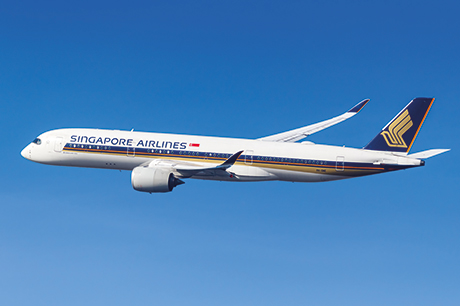
Singapore Airlines is considered the ‘gold standard’ for pre-order. Credit: Markus Mainka/Shutterstock.

The inflight channel continues to experience challenges and needs to reinvent itself, argues Kevin Rozario, who gets the views from a cross-section of stakeholders.

While airlines pursue ways to increase ancillary revenues, onboard retail has not necessarily been high on the priority list. Pre-Covid, some big airlines including KLM, Qantas and SAS dropped their traditional inflight retail services, while Finnair followed in the post-Covid years and British Airways made its High Life magazine digital-only but free to view onboard to view the shopping offer.

At the same time, airline ancillary sales are surging. According to the latest 2024 CarTrawler Yearbook of Ancillary Revenue, ancillaries topped pre-pandemic levels in 2023 with the top 10 airline companies generating $54.1 billion.

This was “far in excess” of the $38.4 billion recorded in 2019 across the top 10. However, retail tends to be a small component; the bulk of add-on sales come from baggage fees and purchases of assigned seating.

There are exceptions. At easyJet, which derives 36% of all revenue from ancillaries, onboard retail “was a real success” during 2023, with spending per seat up by 17% to £2.12/$2.84, and profit per seat reaching £0.60, according to CarTrawler. “The carrier hopes to achieve over £1 profit before tax per seat over the medium term from onboard retail,” noted the CarTrawler Yearbook.

Vimal Rai, Managing Partner, Commercial Excellence Partners.

Fading interest in simply transacting sales

Low-cost carriers like easyJet, Wizz Air and Frontier, lead the way in ancillary revenue as a proportion of total sales, much of it coming from food and beverage (F&B) sold onboard because many airlines have shifted their focus there.

Vimal Rai, a highly experienced former senior executive at inflight retailer Inflight Sales Group (ISG) and now Managing Partner at consultancy Commercial Excellence Partners, told TRBusiness: “Pre-Covid more than 40 airlines, including some big names, had stopped inflight retail. We need to look at the carriers redefining the overall value proposition to see where this is heading, like easyJet and Zipair in Japan, for example.

“The returns may not justify the efforts unless airlines start behaving like real product and service retailers – in other words, investing in marketing, and targeting and leveraging loyalty channels as Singapore Airlines and Cathay Pacific Airways are doing successfully.”

At onboard solutions provider Retail InMotion, CEO John Moriarty acknowledges that the industry has, in general, been waiting for “something new to come along” and “not been particularly innovative” given that pre-order as a concept has been around a long time now.

He told TRBusiness: “Potentially we can see moves towards things like food delivery to gate becoming more prominent, albeit this is hugely reliant on operations that are able to support this.”

There is also a reshaping of the market as airlines look to underline their brand values more clearly post-Covid, which means having a different view of retail investments. For example, Dubai’s airline, Emirates, launched its first Emirates World retail store concept in Southeast Asia, in the Shangri-La The Fort complex in Manila at the end of last year.

The 221sq m destination is described as a “fully immersive Emirates experience redefining the travel retail experience for customers”.

Adnan Kazim, Deputy President & Chief Commercial Officer, Emirates commented: “The new store in Manila is designed as a one-stop shop where customers can explore Emirates’ best-in- class products and services, and provides visitors a glimpse of our onboard hospitality and excellence, ensuring the bar is set high when it comes to retail experiences.”

Digital reach limited so far…

The store showcases a curated selection of Emirates-branded merchandise and travel accessories including the latest NBA collection for basketball fans. However, the focus is on the service element of the airline and part of a broader strategy to get closer to customers.

As part of the airline’s retail strategy, Emirates said it would invest AED100 million/$27.2 million over the next three years in further such stores, having already launched reimagined retail spaces in Dubai, Hong Kong, London and Nairobi.

John Moriarty, CEO, Retail inMotion.

Like airlines, brands are also less centred on inflight than they used to be and several declined to comment for this article. Costs to list and the complexity of the process can be a turn off compared with other channels.

Jordi Valls, Head of International Business Development at jewellery house Coeur de Lion, told TRBusiness: “In general, the inflight business is not a strong channel for us; cruises have, by far, the main share, followed by airports and border stores. Inflight has clearly gone down since Covid times, though we still believe there is room for us to grow.”

Digital platforms have become part of the inflight offer and Moriarty at Retail InMotion credits partners like Alaska Airlines for its slick pre-order service and Ryanair for “doing a lot of good work” with Amazon and the Synthesia video platform, and others, to drive crew engagement.

He continued: “For pre-order, Singapore Airlines is the gold standard. This does involve significant effort in developing a customised solution with a lot of people running the programme.”

From Rai’s point of view, digital platforms will augment the physical inflight channel. “It’s about growing awareness and building demand, not the immediate transaction that inflight was traditionally known for and targeting,” he said.

“Over time these platforms will help transition browsing and retailing behaviour to mimic what we do on the ground: i.e. get inspired, search, and transact online. Therefore, these platforms have to be available to passengers prior to travel and be integrated into the airline loyalty programmes as well.”

To read the full article, see the TRBusiness April e-zine by clicking here.

Lead image credit: Serenity Images23/Shutterstock.

Words: Kevin Rozario
Editing: Luke Barras-Hill

APTRA India Conference: Highlights from a busy day one in Mumbai

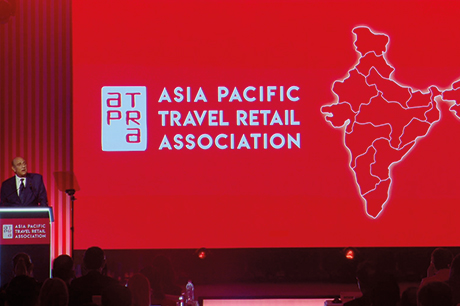
Asia Pacific Travel Retail Association (APTRA) President Sunil Tuli has urged the travel retail industry to capitalise on the ‘remarkable opportunity’ to trap foreign spending from India’s burgeoning middle class travellers.

As reported, the APTRA India Conference is taking place on 7-9 April in Mumbai, India at the Trident Hotel Nariman Point, with approximately 300 executives attending the event.

Addressing delegates in an opening address, Tuli said: “As India’s surging travellers prepare to spread their wings across the world, it is a clarion call for the entire travel retail industry to innovate, adapt and seize this remarkable opportunity.

“The middle classes in India have a passion and the wallet to travel the world. Consumer spending abroad has reached record levels, and the good news for us here is that their spending priority is foreign travel, increasing from 37% of spend in 2020 to 53.6% in 2024 a rise of almost 25% year-on-year to $17 billion in 2024 with over 40,000 new passports issued every day.

“Indians are passionate about international travel, and this desire for new experiences brings them right to travel retail’s shop window.”

Navi Mumbai Airport in sight

A fast-growing economy on course to cross the US$4 trillion mark this year, a figure frequently touted by the local press, and resultantly set to overtake Japan has been bolstered by an $11 billion plan to build around 400 new airports by 2047.

“In tandem, India’s airlines are certainly placing the aircraft orders to use those airports, leading the global industry,” continued Tuli. “In fact, the country’s airlines collectively have orders for approximately 1,700 aircraft [last December] to be delivered by 2030.

“In fact, Air India augmented its existing mandate of 470 planes by an additional 100, reflecting confidence in the market. With new airports and new aircraft comes new travellers, including an anticipated year-on-year, growth rate of 5-6% in traffic.”

On day one of the 2025 APTRA India Conference in Mumbai, Sunil Tuli, Group Chief Executive Officer of King Power Group (HK) and President of APTRA, delivered a rallying call to delegates to capitalise on the exponential growth potential of the Indian travel market.

One of the big opportunities is the new Navi Mumbai Airport, which is expected to begin commercial flights in July or early August following its inauguration in June, with an initial capacity of 20 million pax, rising to 50m by 2029 and eventually 90 million by 2036.

During his address, Tuli referenced the seismic disruption to global economic regimes in the wake of President Donald Trump’s tariff war, with analysts pre-occupied with the extent to which the turbulence will threaten short term economic progress.

The far-reaching nature of the travel retail industry means it will always be susceptible to macroeconomic shockwaves, yet history has demonstrated its resilience through the crises it has successfully navigated – and it will adapt, Tuli reminded delegates.

He said: “India remains the most powerful long-term opportunity in our industry. Perhaps it is not bad timing that we are gathering with this global storm swirling around us. It is an added external pressure we cannot ignore and one we can’t influence, so let’s focus even more intensely on the ideas and actions that will best support the opportunity in India.

“We very much hope that you leave on Wednesday with a clear and inspiring direction of the future opportunities for your businesses in India, travel, retail and with the growing Indian middle classes looking to travel the world and become an even greater force in travel retail.”

A series of challenging dynamics face categories such as confectionery, beauty and wines & spirits – Cognac in particular – and the tariffs “could inflict further and more widespread damage”, continued Tuli.

“And of course, with far fewer of them travelling, the Chinese are no longer providing the fuel to grow our market,” he stated. “For the retailers in the room, a combination of mag obligations and declining sales in many parts of Asia Pacific present a double whammy effect.”

On India’s tariff pressures, Tuli cited the long-running US-India bilateral trade talks and the existing concessions made by the latter, especially in agriculture, to grow trade between both countries by $500 billion.

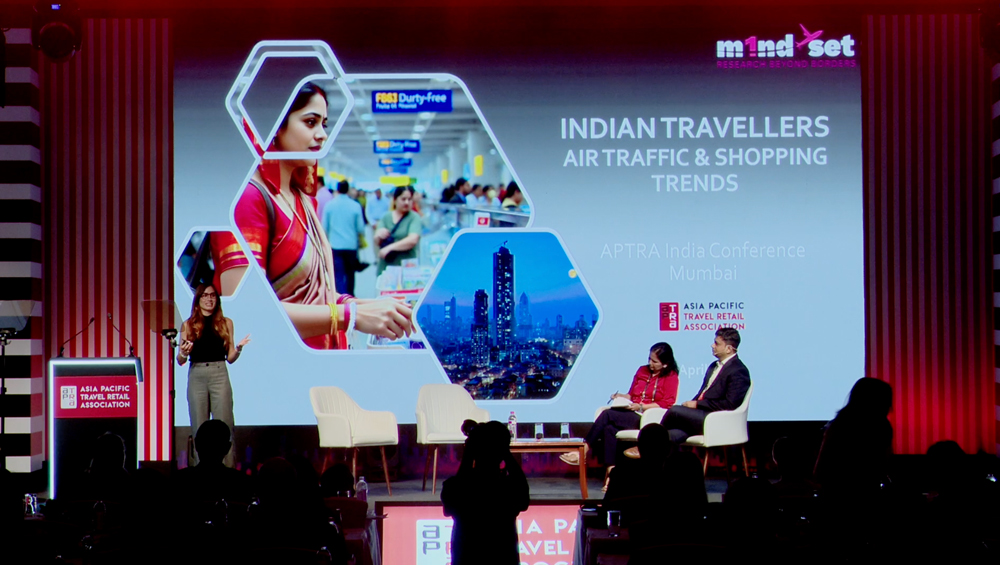
Anna Marchesini, Head of Business Development, m1nd-set presents key indicators on India’s air traffic and travel shopping trends.

“Indian commentators argue that data suggests the country is only around the ninth largest highest in imposing high level tariffs of 60% or more, and is well below the levels imposed by the highest tariff countries such as South Korea and Canada; we’ll have to wait for the dust to settle down before we know how the full impact on the Indian economy will be. But even in the current chaos, although India may emerge battered, I have no doubt it will still be upwardly mobile and maintain its long term growth journey.

“India’s economy […] if it maintains its growth path, will overtake third place Germany in 2027. PwC projection suggests its GDP could exceed that of the US by 2060. India’s population will overtake China this year. Its Gen Z population is the largest in the world, and the Prime Minister has a stated ambition to achieve developed nation status by 2047, the centenary of our Indian independence.”

‘India 101’ panel

Following the keynote address from Tuli, Guarav Singh, Chief Executive of Ospree Duty Free outlined the travel retailer’s ambitions and growth plans in conversation with moderator and DFNI Editor Kapila Ireland.

Among a busy opening day of conference sessions, respected senior executives including Delhi Duty Free CEO Ashish Chopra, recently appointed CEO of Heinemann Asia Pacific Johannes Sammann and George Cherian, Business Development Director India at Avolta, discussed how their businesses are responding to consumer demands in India versus other markets.

Travel retail stakeholders were able to indulge in high volumes of data and research presented by m1nd-set’s Head of Business Development Anna Marchesini, Visa Business Head Cross Border Payments India & South Asia Sridhar Keppurengan and Voiceback Analytics Managing Director Shubhra Misra.

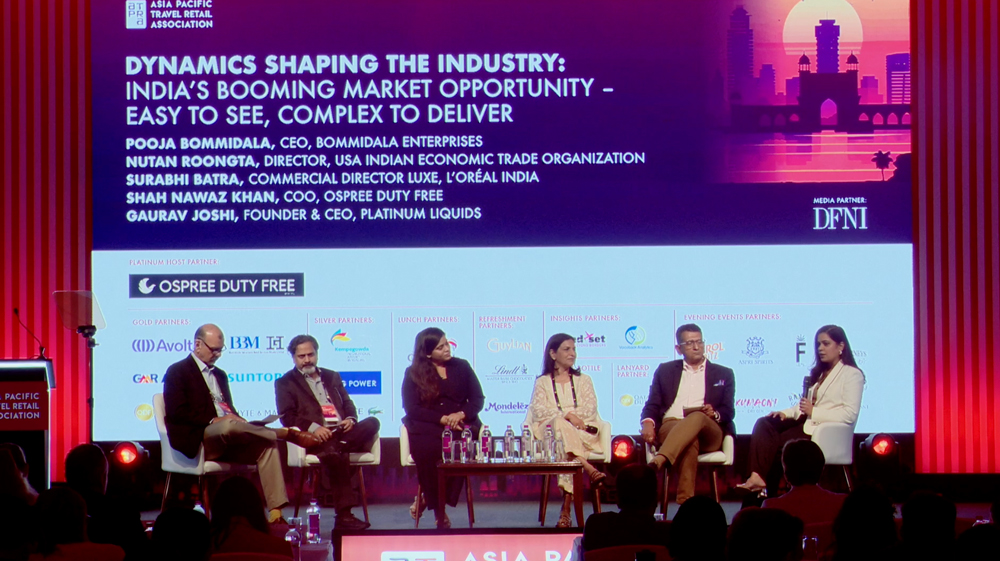
Former Pernod Ricard Global Travel Retail Chairman and CEO Mohit Lal moderated an insightful ‘India 101’ session concentrating on India’s intriguing yet complex market opportunities, including routes to market, distribution options, navigating regulations and customs and arrivals allowances.

The session gathered Pooja Bommidala, MD, Bommidala Enterprises; Nutan Roongta, Director USA Indian Economic Trade Organization; Surabhi Batra, Commercial Director Luxe, L’Oréal India; Shah Nawaz Khan, COO Ospree; and Gaurav Joshi, CEO, Platinum Liquids.

A respected brand, retailer and distributor also offered their respective takes on whether the power of technology and AI can persuade travellers to make travel retail an essential part of their travel journeys.

Looking at the expectations of younger consumers, Vijay Talwar, CCO & CDO Avolta; Kreol Arakulath, Executive Director, Kreol Group; and Erin Lillis, Travel Retail Director Asia Pacific, Lacoste were joined by Karl Walter of Blueprint as moderator, to fathom if technology and AI can make travel retail an essential part of their journey.

Stay close to TRBusiness for further coverage from the 2025 APTRA India Conference…

READ MORE: Avolta joins APTRA India Conference 2025 lineup as Gold partner

READ MORE: Qatar Duty Free joins APTRA Conference 2025 as Gold Partner

READ MORE: APTRA opens delegate registration for India conference in Mumbai

*Images courtesy of APTRA.

TRC welcomes Harrogate Water, Rotary Watches, Transformulas as members

Three new companies have become members of UK-based Travel Retail Consortium (TRC), bringing the number of category specialists in the organisation to 19.

Harrogate Water (F&B), Rotary Watches (watches) and Transformulas (skincare) have all joined in recent months.

Sharon Edwards-Smith, Chair, TRC said: “We are delighted to have welcomed three new members to the TRC community. With their combined expertise across key categories, these brands are sure to add much value and insight to our TRC discussions.

“We look forward to hearing from these brands’ representatives over the course of our in-person and online events programme for 2025.”

Sharon Edwards-Smith, Chair, TRC: “With their combined expertise across key categories, these brands are sure to add much value and insight to our TRC discussions.”

Sam Haley, Export and Travel Retail Manager, Harrogate Water said: “We have joined the TRC to focus on growing our duty free and travel retail partners this year. Our ambition is to continue to lead within the out of home category and expand our travel retail portfolio across all channels to be the number one water in the sky and on the sea.”

Peter Ashfield, Sales Director – Licensed Division at Peers Hardy Group said: “We are delighted to join the TRC as its watch partner with our newly acquired Rotary brand.

“With 130 years of watch making history, we look forward to sharing the brand with a global audience and see travel retail as a key pillar to the brand’s success internationally.

“Whilst Peers Hardy has sold into the travel industry for over 15 years we still have lots of opportunities to explore both in the UK and overseas and are looking forward to networking with TRC members to learn from their experiences, share information and hopefully build new long term business partnerships.”

Janice Smith, Sales and Marketing Director for YV Global, which represents the Transformulas brand in travel retail, added: “At YV Global, we have long admired the TRC community. Now we are seeing Transformulas growing fast in travel retail, the time was right to join TRC’s industry network.”

READ MORE: Donations open for TRC’s ‘Walk for A Cure’ in aid of Alzheimer’s Research UK

READ MORE: Travel Retail Consortium pips Alzheimer’s Research UK as Charity of the Year


Analysis: Understanding the potential of China’s family travel market

Travel motivations can differ significantly depending on the family unit. Photo: Shutterstock/ViewStock.

Dragon Trail International research on the power of Chinese family travellers shows they are likely to budget significantly more for their next trip compared with their child-free counterparts. Benedict Evans spoke to DF&TR stakeholders to determine how they are grabbing a slice of the spending.

China international travel is still in recovery mode, with m1nd-set research tallying 77 million international departures in 2024, representing a 76% recovery rate on 2019. As the numbers grow, the market has become more diverse.

For instance, there has been a marked openness toward being a Free Independent Traveller (FIT), with 42.9% of those who travelled as part of a group in 2023 saying they would choose free independent travel for their next outbound trip and 57.1% wanting to once again choose group travel, according to a 2024 Fastdata analysis.

Now, all eyes are on the high-spending family travel market, with Dragon Trail International’s Chinese Traveller Sentiment Survey (released in September 2024) showing families with children under the age of 18 were more likely to budget RMB30,000-50,000 ($4,000-$7,000) for a trip at 31%, versus 21% for travellers without children.

Spending jump 

Furthermore, a Ctrip report reveals family travellers accounted for 37% of the outbound market during October’s Golden Week last year, up from 34% the year before. Plus, they spent twice as much as the average during the National Day holiday.

“We hear a lot about China’s shrinking birth rate similar to many developed nations around the world, but there are still more than 250 million children under the age of 16 in China, around 18% of the population, and the parents of these children are spending a lot on their kids,” commented Sienna Parulis-Cook, Director of Marketing & Communications, Dragon Trail International.

“Family travel and spending is dominated by parents born in the 1980s and 1990s, the main decision makers for family travel are mothers, and the 30s and 40s cohort are the most important for outbound family travel.”

The motivations for travel often differ significantly depending on the family unit. As noted by Lilly Choi-Lee and Trevor Lee, Co-founders of TravConsult, the tier system of Chinese cities has a marked influence.

“You’ve got so many different types of family unit, and it depends what tier city they come from,” noted Choi-Lee. “It depends whether they’re experienced travellers, and they’re used to navigating travelling, whether it’s overseas or domestic. If they’re first-time travellers or they’re from a lower tier city, their behaviours and what they buy will be different.”

Nancy Liu, President, DFS China.

Trevor Lee added: “Understanding the level of brand knowledge present [within travelling families] is a missing piece in most research presented and delivered. We forget that for first-time travellers walking past duty free and retail areas, if they don’t understand what the store offers in terms of value and price and if there’s not a welcome or familiar language, they are going to walk past because they’re embarrassed, and don’t want to lose face.”

DFS Group tells TRBusiness it attaches great significance promoting to and understanding Chinese families and their travel preferences, especially during peak times such as Chinese New Year.

Catering to the ebbs and flows of the busy seasons – especially the six to eight weeks of the summer holidays from July to September – is key to unlocking potential.

During the 2024 National Day Holiday, average consumption among family travellers was two times higher than the overall travel market, Ctrip data shows.

“Family travel during this festive period has emerged as a new trend,” Nancy Liu, President, DFS China, told TRBusiness, referencing how on 4 December 2024 China’s Spring Festival (Lunar New Year) celebrations was inscribed on the Representative List of the UNESCO Intangible Cultural Heritage of Humanity.

“DFS meticulously designs around the theme of family reunion for the Chinese New Year, highlighting the gift selection for family members and presenting well-considered options,” she continued.

“Simultaneously, we are acutely aware of the convenience needs of family travellers and offer a seamless online and offline shopping experience.”

To read the full article, access the TRBusiness January/February e-zine by clicking here.

Avolta takes prime sponsorship of Summit of Americas in Miami

IAADFS Summit of the Americas 2025

International Association of Airport and Duty Free Stores (IAADFS) has announced Avolta as prime sponsor of the 2025 Summit of the Americas in Miami, Florida (8-11 March).

The global travel experience player will offer its patronage in areas including the conference wi-fi service and badge lanyards.

Avolta joins other sponsors, confirmed as: Campari (Sunday Reception Bar Sponsor); Cincoro Premium Tequila/Duty Free Global (Saturday Reception Bar Sponsor); Essence Corp (Mobile App Sponsor); Fashionphile (Charging Station Sponsor); Four Pillars Gin (Sunday Reception Bar Sponsor); Heineken (Saturday Reception Bar Sponsor); JTI (Saturday Reception Sponsor); and KT International (Saturday Reception Sponsor).

“At Avolta, we value the vital role IAADFS plays in advocating for the industry and are proud to support the Summit of the Americas as a sponsor, reinforcing our commitment to the growth and success of the industry,” commented Camillo Rossotto, Chief ESG & Public Affairs Officer at Avolta. “Collaboration and advocacy are key to shaping a strong future for our sector, and we are pleased to play our part.”

Avolta representatives will contribute to various panel discussions at the 2025 event, including Kate Herzig, Executive Vice President, Duty Free North America & Canada Retail Operations, who will join a TRBusiness-moderated session on experiential retail on Monday 10 March (09:30am – 10:30am) as a warm-up to the TR Consumer Forum in June.

READ MORE: Airport concessions and cruise panels round off Summit of Americas agenda

READ MORE: Experiential retail among new session topics at Summit of the Americas