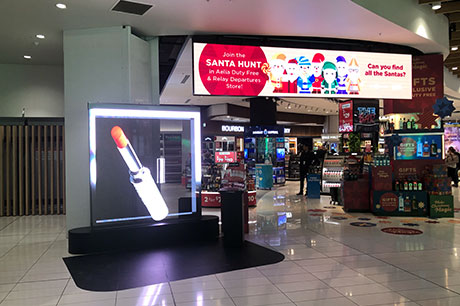
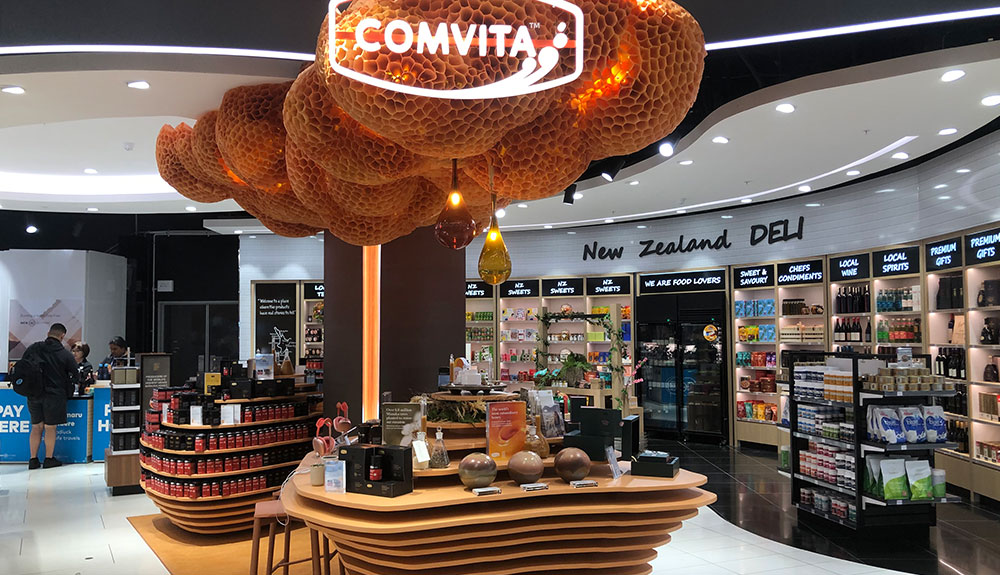
Bryant Park Market at JFK T5, where Avolta recently won a key concession.
Could opportunity be knocking for Avolta in the Americas? It’s a tale of two halves where both are making some constructive progress, though challenges persist. Kevin Rozario reports.
Avolta is investing in different ways in North and South America, a combined region that accounts for about 45% of the global travel retailer’s total revenue. The company has seen some key concession wins in the north of the continent, among them are contracts at America’s busiest international airport, New York’s John F. Kennedy, which could drive up Avolta’s market share in the coming years.
In the second half of last year, JFK Millennium Partners (JMP), the consortium that is building and will operate JFK T6, selected Avolta to open. multiple duty free, travel convenience and speciality retail stores under the Hudson and Dufry banners.
They will cover more than 2,600 sqm in a terminal in excess of 111,000 sqm. The first gates will open in early 2026. The more immediate high-profile prize is an 11-year retail and F&B contract at JFK Terminal 8.
The landlord Port Authority of New York and New Jersey in partnership with commercial operator Unibail-Rodamco-Westfield (URW) Airports and American Airlines have been overseeing a $125 million commercial redevelopment of the terminal.
T8 is expected to top seven million enplanements this year, with a share of international passengers higher than JFK’s average of 55%. The terminal revamp also puts all airlines of the Oneworld alliance, the lead partners being American Airlines and British Airways, under one roof for the first time at JFK.

“Club Avolta transactions are now a big proportion of our sales. We are only scratching the surface
and believe there is a huge potential, especially once we’ve launched all the F&B projects that we have planned in the region.” Enrique Urioste, President and CEO, LatAm and Caribbean, Avolta.
Big contract wins to add 3% to revenue
Together, these JFK T6 and T8 contracts will increase Avolta’s North America revenue by about 3%, to the delight of CEO, Xavier Rossinyol.
In December, at the time of the announcement, he said: “It is an exciting time for Avolta as we cement our future at the new JFK through these contracts, adding around 3% of incremental revenues in our North America region once fully developed.”
He also confirmed the company’s positive outlook for “continued growth” in the region.
A smaller win came as part of Pittsburgh International Airport’s $1.57 billion terminal modernisation through a seven-year contract awarded by Allegheny County Airport Authority.
There, Hudson will open new stores covering about 750 sqm of retail space.
There was also an award at Arizona’s Phoenix Sky Harbor Airport and a key extension at Milwaukee Mitchell Airport.
The extra business comes on the back of a push for hybrid stores, with about a quarter of Avolta’s US tenders including them in bids last year.
North America accounts for 32% of Avolta’s total turnover and the region saw good growth last year.
In the nine months to September 2024, revenue was up by 5.7% (like-for-like) to reach CHF3,242m ($3,580m), though the third quarter saw that growth slip to +4.6%.
Latin America’s rollercoaster

Xavier Rossinyol, CEO, Avolta: “It is an exciting time for Avolta as we cement our future at the new JFK through these contracts, adding around 3% of incremental revenues in our North America region once fully developed.”
In the rest of the Americas, instability still rules. Argentina’s currency devaluation – which has been in overdrive since mid- 2023 – is problematic. While it is of concern, Avolta remains upbeat as volatile currencies are nothing new for the region.
Brazil’s real also experienced downward pressure in 2024 but has rebounded somewhat this year so far.
Given Brazil’s leading position in duty free sales in the region, Avolta has put an action plan in place to mitigate against the weakness of the currency, which is nowhere near that of the Argentinian peso.
Avolta’s sales are still growing, according to Enrique Urioste, who has headed up the Latin America and Caribbean region for Avolta since January 2023.
He told TRBusiness: “We have adapted our promotions and we run a very strong staff training programme. It’s about product, store and service. If you put those three together and execute well, you will have a successful outcome.”
Another factor that is helping to keep the Latin business moving is arrivals duty free and home delivery. Arrivals sales have always been important in the region and they have a big share of the business; up to 60%, depending on exchange rates.
Avolta’s digital strategy encourages online sales, home delivery, and reserve- and-collect (the latter for both departing and arriving passengers) and they are all increasing.
Home delivery was introduced last year in Brazil, Argentina and Uruguay and is growing at “a very good pace”, according to Urioste, with the help of a lot of online advertising to promote the service.
He added: “Home delivery is important because passengers don’t have a lot of time in arrivals, especially if they are connecting in somewhere like São Paulo and changing terminal to get to a domestic destination.
Obtaining a permit from Customs has allowed us to sell to arriving passengers and have their goods delivered direct to their homes in Brazil.”
The upgrade of the ‘Red by Dufry’ loyalty scheme to Club Avolta in October last year is also being well received in Latin America. “Club Avolta transactions are now a big proportion of our sales. We are only scratching the surface and believe there is a huge potential, especially once we’ve launched all the F&B projects that we have planned in the region,” commented Urioste.
In Latin America, passengers perceive Club Avolta as having real value because it represents more than just discounts but a more tailor-made proposal. “We are engaging airports, airlines, hotels, and car rental companies, to name a few, into the programme and if you have a certain status (silver, gold or platinum) you can access lounges or parking perks for example. It’s not even a year since we deployed it.”
Moving north to Mexico, a big market for Avolta, new stores are in the works.
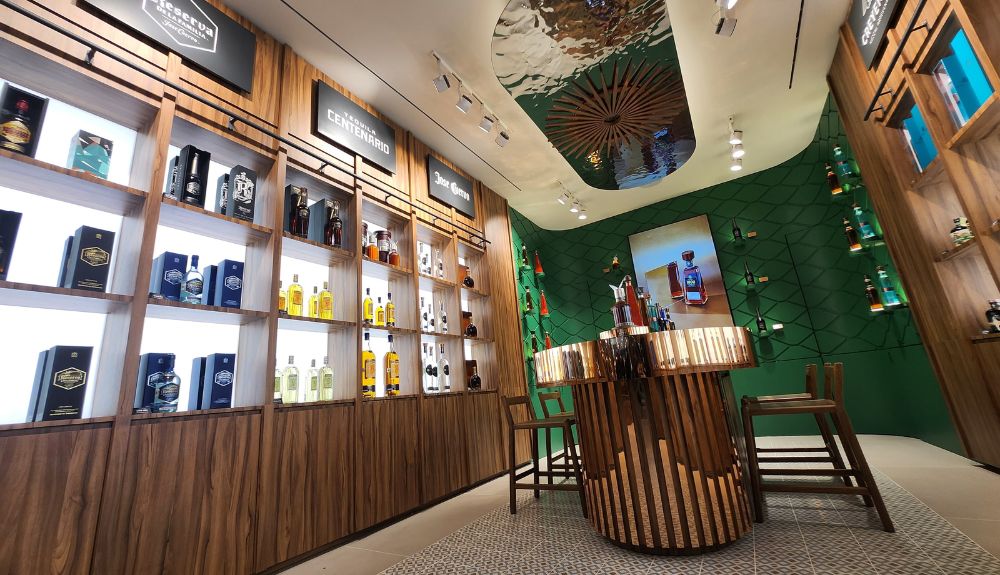
Agave World at Cancún International Airport.
Recently opened were the upscale Agave World and the Hudson partnership with Mexico’s Turin (a Mexican brand focused on coffee and chocolate), both at Mexico City Airport. The latter is a duty paid landside unit and further projects are in the pipeline.
Urioste is pragmatic about duty free: “We’re in the business of selling things that aren’t essential,” he said. “So, it’s not only the pricing that matters, it’s the experience. When you get a ‘wow’ from the passenger, you have a transaction. Whether it’s the Agave World or Hudson’s hybrid concept with Turin, a proposal that is valuable to, and appropriate for, the customer will succeed.”
Brand tie-ups
In April, another partnership, the first airport F&B concept in Brazil with Corona beer (in partnership with AB InBev, the world’s largest brewer), will land at São Paulo’s second gateway of Congonhas.
Tie-ups with major local or regional brands are a path being followed to deliver destination merchandise and a sense of place for passengers.
In the Caribbean, training initiatives have also brought benefits. “In the Dominican Republic, Puerto Rico, Jamaica, Aruba, or wherever we are opening new stores and adding new categories, we offer the right staff training,” said Urioste. “This is paying off because we are seeing growth.
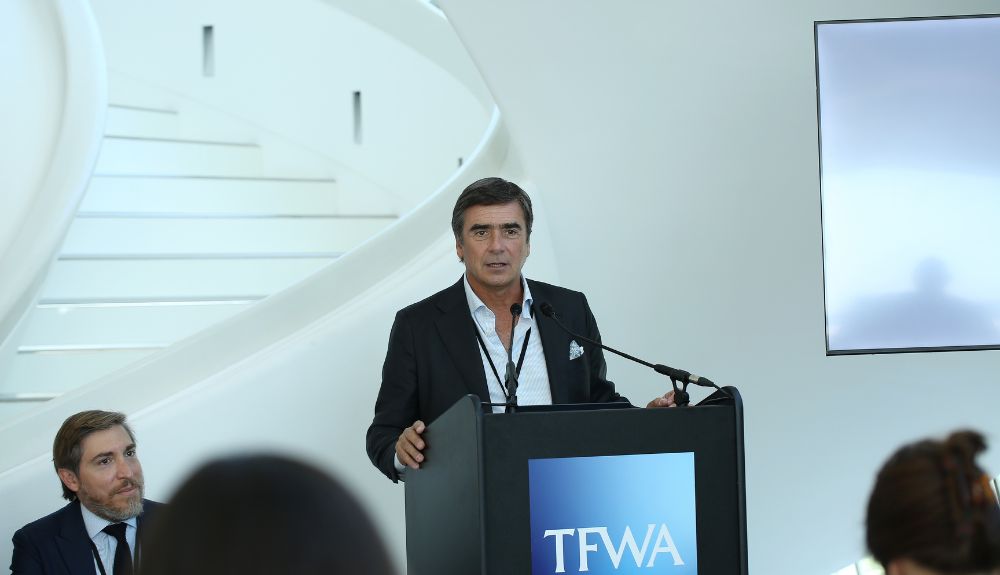
Urioste speaking at the ASUTIL press conference in Cannes 2024. Photo: TFWA Press Office/Nathalie Oundjian.
“For example, in the Caribbean, duty free was not always particularly strong, but since we’ve been intensifying the focus on further training and completed our store refits we’ve achieved double-digit growth. It’s a very solid region and we adapt to each island as they are all very different. Similarly, things we do in Brazil cannot always be replicated in Mexico.”
While growth hotspots exist and measures to contain currency pressures have been implemented, Avolta’s Latin business – which accounts for about 12% of total sales – was depressed last year.
In the nine months to September, like-for-like sales slipped by 2.8% and this widened to 5.8% in the final quarter. Fortunately, North America remains strong and adding new locations.
It is also almost three times as big as Latin America by revenue, so the Americas overall looks like it is on a path to growth – though the ‘Trump effect’ on tourism (a YouGov survey shows 35% of global respondents indicate they are less likely to visit under his leadership, compared to 22% who are attracted by it, and 43% who remain indifferent) remains to be seen.
To access the interview in the TRBusiness March edition, click here.
READ MORE: VIDEO Interview: Camillo Rossotto, Avolta, Pt 1
READ MORE: Avolta takes prime sponsorship of Summit of Americas in Miami
READ MORE: Avolta unveils Presentedby experience at Zayed International Airport

 Trbusiness. The travel retail Trbusiness. The magazine for global retail and duty free professionals.